



Here is the short answer first. You buy Bitcoin in Mexico on a peso exchange such as Bitso, verify your identity with your INE card, and fund the account free by SPEI from your own bank app.
The route matters more than the app in Mexico. The same 10,000 peso buy costs about 50 pesos on the order book and up to 200 pesos on the one tap screen, and the fee table below proves it from live schedules.

This guide belongs to our series on how to buy Bitcoin around the world. It also works a full 300 dollar remittance example, because half of Mexico meets crypto through money that family sends from the United States.
- Is Bitcoin Legal in Mexico?
- Which Exchange Should a Beginner Use?
- What You Need Before You Start
- Step by Step: How to Buy Bitcoin in Mexico
- Step 1: Open and verify your account
- Step 2: Fund your account free by SPEI
- Step 3: Skip Convert and open Bitso Alpha
- Step 4: Place your order and check the math
- Step 5: Move large amounts to your own wallet
- The True Cost of a 10,000 Peso Buy
- The 300 Dollar Remittance Test
- Deposits, Withdrawals and Peso Fees
- How Mexico Taxes Bitcoin
- Common Mistakes and Scam Warnings
- FAQs
- Conclusion: Your First Buy, Done Right
Key takeaways
- Buying and holding Bitcoin is legal in Mexico, but Bitcoin is not legal tender, and Banxico bars banks from selling crypto to customers, so you use a specialist exchange.
- Bitso runs the main local route: verify with an INE card or passport, keep your CURP and RFC handy, and fund free in minutes by SPEI from an 18 digit CLABE account.
- On a 10,000 peso buy, a Bitso Alpha limit order costs 50 pesos and a market order costs 65 pesos. The one tap Convert screen hides a spread of about 1.5 to 2 percent, or 150 to 200 pesos.
- Cash works without a bank account at OXXO, but the deposit fee runs 2.6 percent plus tax, or about 302 pesos on 10,000 pesos.
- Mexico taxes crypto gains as normal income under the ISR at progressive rates up to 35 percent, and you declare them once a year, so keep every SPEI receipt and trade record.
Is Bitcoin Legal in Mexico?
Yes. Mexican law lets you buy, hold and sell Bitcoin, and the 2018 Fintech Law gives crypto its legal name, a virtual asset.
Bitcoin is not legal tender, so no shop or landlord must accept it. The peso stays the only currency that settles a debt by law, and Bitcoin sits beside it as property that you own and trade.
Why your bank app will not sell it to you
Banxico, the central bank, drew a hard line in its Circular 4/2019. The rule bars banks and regulated fintech firms from offering crypto buying, custody or transfers directly to customers.
A bank may use crypto only inside its own back office, and only with Banxico permission that no bank has received in public so far. That one rule explains the whole local market: your bank moves your pesos, and a specialist exchange sells you the Bitcoin.

Who watches the exchanges
Three bodies split the job. The CNBV supervises fintech firms, the finance ministry and its UIF unit run the anti money laundering rules, and the SAT collects the tax.
Bitso, the exchange this guide uses as the main example, started in Mexico City in 2014 and now serves more than 9 million users across Latin America. Bitso describes itself as regulated in Mexico under this framework, and a Bitso group company holds a DLT licence from the Gibraltar Financial Services Commission.
Treat any platform that promises the opposite with care. An app that hides its legal name, its regulator and its fees fails the first test, whatever its ads say.
Which Exchange Should a Beginner Use?
Bitso fits most beginners in Mexico for one simple reason: it speaks pesos natively. You deposit pesos, you trade the BTC/MXN pair, and you withdraw pesos, all inside one account.
Global apps such as Binance also serve Mexican users, but they add friction at the edges. You may fund through peer to peer sellers or a card, convert currencies more often, and face support in another language and time zone.
Volabit runs a smaller local service, and some readers hold accounts at two platforms. Start with one regulated peso route, learn it well, and add a second account only when you know why you need it.
Bitso also runs the peso route next door, and our guide on how to buy Bitcoin in Argentina shows the same company working under very different money rules. The contrast teaches you fast: the exchange stays similar, but the local rails and taxes change everything.
The two screens inside Bitso
Bitso gives you two doors to the same Bitcoin. The basic app shows a Convert screen that swaps pesos for Bitcoin in one tap, and Bitso Alpha shows a real order book with charts, limit orders and stated fees.
Convert feels easier, and the ease carries a price that the fee section below counts in pesos. Alpha asks you to learn two new words, maker and taker, and then charges you far less for every buy.
What You Need Before You Start
You need Mexican residency, an official ID, and a way to move pesos. Bitso runs a full identity check under the anti money laundering rules, and anonymous peso accounts do not exist on the legal route.
Gather your documents before you open the app. A ready folder turns a stop and start signup into a ten minute job.
Your INE, CURP and RFC checklist
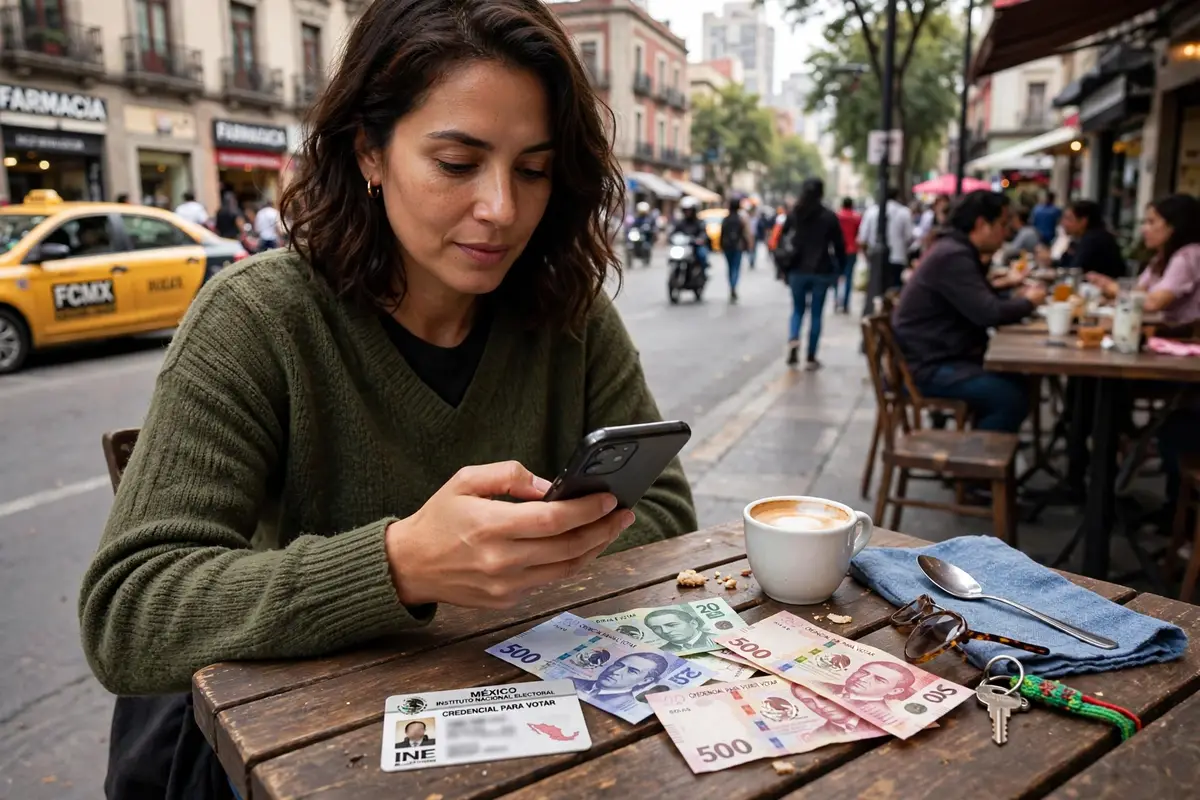
Mexican citizens verify with their INE voter credential, and residents can use a passport that Bitso accepts. The app asks for a live selfie and matches it against the photo on your document.
Keep your CURP and your RFC close as well, because platforms now ask for one or both during signup or at the first deposit. Add a bank account in your own name with its 18 digit CLABE, because SPEI funding only works smoothly when the names match.
Step by Step: How to Buy Bitcoin in Mexico
The steps below follow the Bitso route, and rival peso platforms copy the same shape. Read all five steps once before you move any money.
Start with a small amount that you can afford to lose. A 500 peso test run teaches you every screen with almost no risk.
Step 1: Open and verify your account
Download the official Bitso app or open its official site, then create your account with your email and a strong password. Turn on two factor authentication before you deposit a single peso.
Finish the identity check with your INE card or passport and the live selfie. Clean photos in good light pass fast, and a blurry document sends you back to the start.
Step 2: Fund your account free by SPEI
Open the deposit screen and copy the CLABE that Bitso shows for your account. Send pesos from your own bank app by SPEI, and the money lands in minutes, free, at any hour of the day.
SPEI is the Banxico transfer system that every Mexican bank speaks, and it runs 24 hours a day. The minimum bank deposit sits at 100 pesos, so even your test run clears the floor easily.
Step 3: Skip Convert and open Bitso Alpha
Open Bitso Alpha instead of the Convert screen, and pick the BTC/MXN market. Alpha shows you the live order book, where buyers and sellers post the prices that you see.
A maker posts an order and waits, and a taker takes an order that already sits in the book. Makers pay less, and the next section shows you exactly how much less.
Step 4: Place your order and check the math
Choose a limit order, type your peso amount, and read the Bitcoin amount and the fee on the confirm screen before you tap buy. On 20 October 2026, one Bitcoin traded near 1,500,320 pesos on Bitso, so 10,000 pesos bought about 0.0067 BTC before fees.
Your Bitcoin lands in your Bitso wallet once the order fills. A limit order below the market price may wait or never fill, and that delay is normal, not a fault.
Step 5: Move large amounts to your own wallet
An exchange account suits buying, but it does not suit storing a large amount for years. A platform failure would park your claim in a queue beside every other customer.
Learn the basics from our guide to the best Bitcoin wallets for beginners, then practise with a small withdrawal first. Our walkthrough on how to store Bitcoin safely covers the seed phrase backups that protect you when a phone dies.
The True Cost of a 10,000 Peso Buy
Here is the part that other Mexico guides skip. We rebuilt the cost of the same 10,000 peso buy from the fee schedules and reviews that we checked on 20 October 2026, and the spread between the best and worst route surprised even us.
Bitso Alpha charges a stated maker or taker fee on peso markets, and the fee falls as your 30 day volume grows. A first time buyer sits in the starting tier, so this table uses the starting tier honestly.
| Route for a 10,000 peso buy | Stated cost | Cost in pesos |
|---|---|---|
| SPEI deposit, then Alpha limit order (maker) | 0.50 percent trade fee, SPEI free | 50 pesos |
| SPEI deposit, then Alpha market order (taker) | 0.65 percent trade fee, SPEI free | 65 pesos |
| Convert one tap buy | Spread of about 1.5 to 2 percent inside the price | 150 to 200 pesos |
| Card buy on platforms that offer it | About 1 to 3 percent | 100 to 300 pesos |
| OXXO cash deposit, then Alpha market order | 2.6 percent plus tax to fund, then 0.65 percent to trade | About 367 pesos in total |
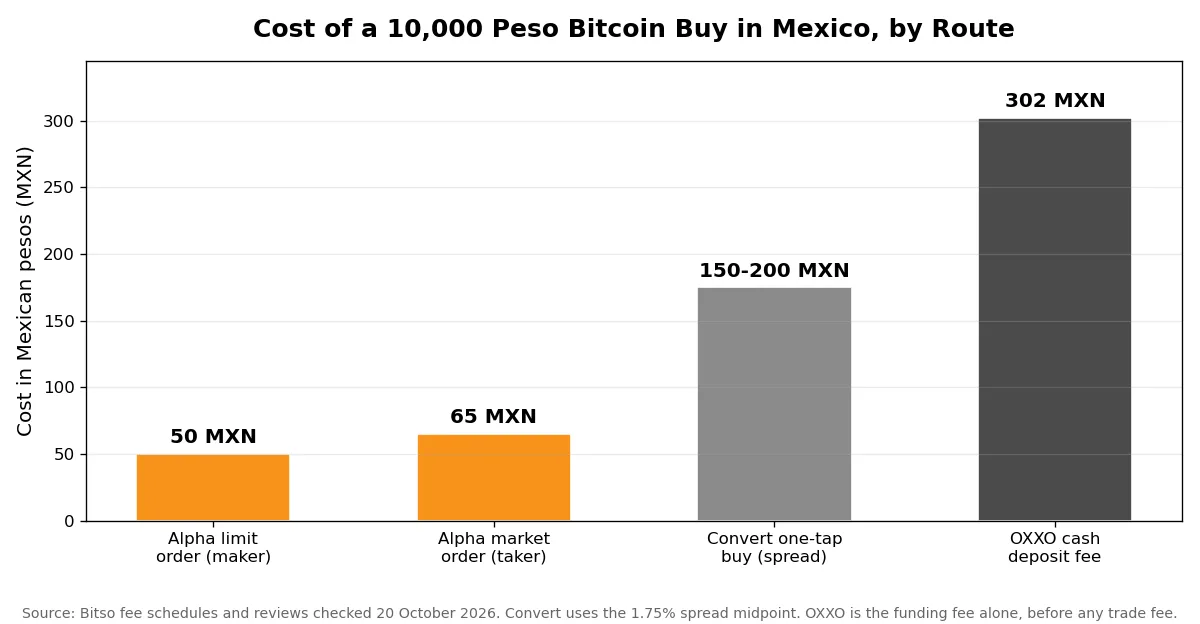
The pattern matches the one in our guide on how to buy Bitcoin in Malaysia, where the instant buy screen also costs about four times the order book fee. The country and the currency change, but the expensive door always wears the friendly one tap label.
My honest advice is simple: pay the Convert spread once if you must, then learn the Alpha screen in your first week. If the basics still feel new, read what Bitcoin is and how it works before you trade often.
The 300 Dollar Remittance Test
Mexico receives more than 60 billion dollars a year in remittances, and most of it comes from family in the United States. So we ran the send that millions of families run, 300 dollars from the US to a bank account in Mexico, down both rails.
The table uses the rates and fees that we checked on 20 October 2026, with the dollar at about 18.39 pesos. Quotes move every day, so treat the table as a dated X ray of the two systems, not a promise.
| Route for a 300 dollar send | Fees and margin | Family receives |
|---|---|---|
| Traditional transfer service, online | 9.99 dollar fee plus a 1.90 percent exchange rate margin, per the World Bank price database | About 5,232 pesos |
| Stablecoin sent to a Bitso account, sold for pesos, withdrawn by SPEI | About 1 dollar in network cost plus about 0.65 percent to convert, SPEI withdrawal free | About 5,463 pesos |
The gap lands near 231 pesos on one small send, and a family that sends monthly keeps about 2,770 pesos a year. The crypto rail wins on cost because SPEI and the peso withdrawal charge nothing at the Mexican end.
The honest limits matter too. Both sides need verified accounts, the sender needs a cheap way to buy the stablecoin in the US, and a volatile coin like Bitcoin can move during the trip, which is why families use a dollar stablecoin for this job.
Deposits, Withdrawals and Peso Fees
SPEI carries pesos in and out for free on Bitso, and a peso withdrawal lands back in your CLABE account in minutes. Bitso Transfer moves money between Bitso users instantly and free, which suits families who both hold accounts.
Cash tells a different story, and Bitcoin withdrawals follow the network. You pay the OXXO funding fee on the way in with cash, and you pay a network based fee when you send Bitcoin to your own wallet, so move larger amounts less often.
Our guide on how to buy Bitcoin in Turkey walks through the same funding choice under different local rules. The habit survives every border: price the full route, from deposit to trade, before you celebrate a cheap headline fee.
How Mexico Taxes Bitcoin
Mexico runs no separate crypto tax, and that surprises many readers. The SAT folds your crypto gain into your normal income under the ISR, the income tax that your salary already knows.
You owe the tax when you sell, swap or spend Bitcoin at a gain, and you owe nothing while you simply hold it. A contador, a licensed Mexican accountant, earns his fee fast once your amounts grow past pocket money.
The rates and the annual declaration
Individuals pay progressive ISR rates that start at 1.92 percent and climb to 35 percent at the top. Your crypto gain stacks on top of your salary and other income, so your job can push your Bitcoin gain into a higher bracket than you expect.
You report the year in your annual declaration, which individuals file by 30 April for the year before. Companies pay a flat 30 percent, and tax guides also report a small general exemption for asset sales that you should confirm with the SAT or your contador before you rely on it.
Records that keep you safe
Keep the SPEI receipt for every deposit, the trade confirmations for every buy and sell, and the peso value of each trade on its date. The SAT gains broader access to digital platform data from April 2026, and Mexico has committed to the OECD CARF data sharing framework, so clean records beat good memory.
Common Mistakes and Scam Warnings
The costliest errors in Mexico are local and boring: the wrong screen, the wrong funding route, and the wrong name on a transfer. Each one is easy to dodge once you have seen it named.
Watch for these traps in your first month.
Mistakes that cost real money
Fake SPEI receipts top the local scam list in peer to peer trades, because a screenshot proves nothing. Release no Bitcoin until the money sits inside your own bank account, and trade only with a seller whose bank account name matches the name on the trade.
The second trap pays a stranger to trade for you, or joins a scheme that promises fixed daily returns. Bitso never asks for your password and never guarantees a profit, so treat any such promise as the scam it is.
The third trap is quiet: a year of Convert buys at a 2 percent spread. Run your own numbers once against the 50 peso maker fee, and you will never unsee the gap.
FAQs
Is it legal to buy Bitcoin in Mexico?
Yes. People in Mexico can buy, hold and sell Bitcoin legally, but Bitcoin is not legal tender, and banks cannot offer crypto services directly to customers under Banxico rules.
What do I need to open a Bitso account?
You need a valid INE credential or passport, a live selfie, and your personal details. Keep your CURP and RFC ready, because the platform can ask for them during signup or at your first deposit.
How much Bitcoin does 10,000 pesos buy?
At a price near 1,500,320 pesos per Bitcoin on Bitso on 20 October 2026, 10,000 pesos buys about 0.0067 BTC before fees.
Why does Convert cost more than Bitso Alpha?
Convert charges a spread of about 1.5 to 2 percent inside the price for one tap ease. Bitso Alpha charges a stated maker or taker fee instead, which starts at 0.50 percent for makers and 0.65 percent for takers on peso markets.
Do I pay tax when I sell Bitcoin in Mexico?
Yes, if you make a gain. Mexico folds crypto gains into your normal income under the ISR, at progressive rates from 1.92 percent up to 35 percent, and you report them in your annual declaration.
Can I deposit cash without a bank account?
Yes. Bitso accepts cash deposits at OXXO stores, but the route charges 2.6 percent plus tax, so a free SPEI transfer from a bank account costs far less when you have one.
Conclusion: Your First Buy, Done Right
You now know how to buy Bitcoin in Mexico the cheap and legal way. Verify with your INE, fund free by SPEI, buy on Bitso Alpha where a 10,000 peso order costs 50 to 65 pesos, and keep your receipts for the SAT.
Start small, learn the screens, and move larger holdings to your own wallet once the amounts matter. When you feel ready, compare the next country in the hub and watch how the same first buy changes across a border.






