

Here is the short answer first. You buy Bitcoin in Malaysia on an exchange that sits on the Securities Commission register, you fund it with a bank transfer or FPX, and you place the order on the exchange order book instead of the instant buy screen.
That register check comes before everything else in Malaysia, and most guides bury it under a list of apps. This guide is part of our series on how to buy Bitcoin around the world, and it shows you how to check the register yourself, what a RM1,000 buy really costs on each route, and how the tax and Shariah rules actually read.

Key takeaways
- Buying and holding Bitcoin is legal in Malaysia, but only Securities Commission registered Digital Asset Exchanges may serve Malaysians, and you should check the register before you send any ringgit.
- Six operators hold DAX registration in 2026: Luno Malaysia, HATA Digital, MX Global, SINEGY DAX, Kinetic DAX and Torum International.
- On a RM1,000 buy, an order book fee runs from RM0 to about RM6 on the routes we checked. Luno Instant Buy charges 2 percent, or RM20 on the same buy.
- Malaysia has no general capital gains tax, so LHDN treats an occasional investor gain as a capital gain. Active traders pay income tax on their gains at normal rates, up to 30 percent.
- The Securities Commission Shariah Advisory Council ruled in 2020 that trading digital assets on registered exchanges is permissible, and it lists Bitcoin as Shariah compliant. That ruling covers registered exchanges only.
Is Bitcoin Legal in Malaysia?
Yes, with a clear boundary. Malaysians may buy, hold and sell Bitcoin, and the Securities Commission Malaysia, which everyone calls the SC, regulates the exchanges that sell it to you.
- Is Bitcoin Legal in Malaysia?
- Which Exchanges Can You Actually Use?
- What You Need Before You Start
- Step by Step: How to Buy Bitcoin in Malaysia
- Step 1: Open and verify your account
- Step 2: Deposit ringgit by FPX or bank transfer
- Step 3: Choose the exchange screen, not instant buy
- Step 4: Place the order and check the total
- Step 5: Move large amounts to your own wallet
- The True Cost of a RM1,000 Buy
- Deposits, Withdrawals, and Ringgit Fees
- How Malaysia Taxes Bitcoin: Investor or Trader?
- The Shariah View, Stated Carefully
- Common Mistakes and Scam Warnings
- FAQs
- Conclusion: Your First Buy, Done Right
Bitcoin is not legal tender in Malaysia, so no shop must accept it. The law treats digital assets as securities under the capital markets rules, and that is why the exchange register matters so much here.
The register check you do before anything else
Every exchange that serves Malaysians must register with the SC as a Recognised Market Operator running a Digital Asset Exchange, or DAX. The SC keeps a public digital assets page where you can verify an operator for free.
Do this check yourself, every time. Find the legal company name on the SC page, match it to the app on your phone, and walk away if the name is missing, because the SC warns that operating a DAX without its authorisation is an offence under securities laws.
The SC tightened the system again in 2026. Its revised Guidelines on Recognized Markets took effect on 20 May 2026 and raised the safeguards around client assets, governance and capital, with older operators getting a transition period to meet the new thresholds.

Which Exchanges Can You Actually Use?
Six operators held DAX registration in our fresh check for this guide: HATA Digital, Luno Malaysia, MX Global, SINEGY DAX, Kinetic DAX and Torum International. Kinetic DAX is the business most older guides still call Tokenize, and Kenanga Investment Bank took a majority stake in it in March 2026.
Luno runs the biggest local market by a wide margin and most beginners start there. HATA competes on fees and also holds a digital broker licence, MX Global counts Binance and Cuscapi among its backers, and SINEGY is a homegrown Penang exchange.
Torum International is the newest name on the register and still builds out its service, so check its live offer before you rely on it. The SC also approves the coins themselves, and its tradeable list covers a small set of about 15 to 22 assets, not the thousands that offshore apps show.
If you are comparing countries while you learn, our guide on how to buy Bitcoin in Indonesia shows a licensing check under a different Asian regulator. The habit is the same in both places: verify the licence first, then look at fees.
What You Need Before You Start
You need to live in Malaysia, meet the exchange age terms, and prove who you are. Registered exchanges run full identity checks under the anti money laundering rules, and anonymous accounts do not exist on the legal route.
Most exchanges run the whole check inside the app with a phone camera. Have these items ready before you start, and the signup takes minutes instead of days.
Your MyKad and bank checklist
Malaysian citizens show their MyKad, and other residents show a passport or resident document the exchange accepts. The app asks you to photograph the document and take a live selfie so it can match your face.
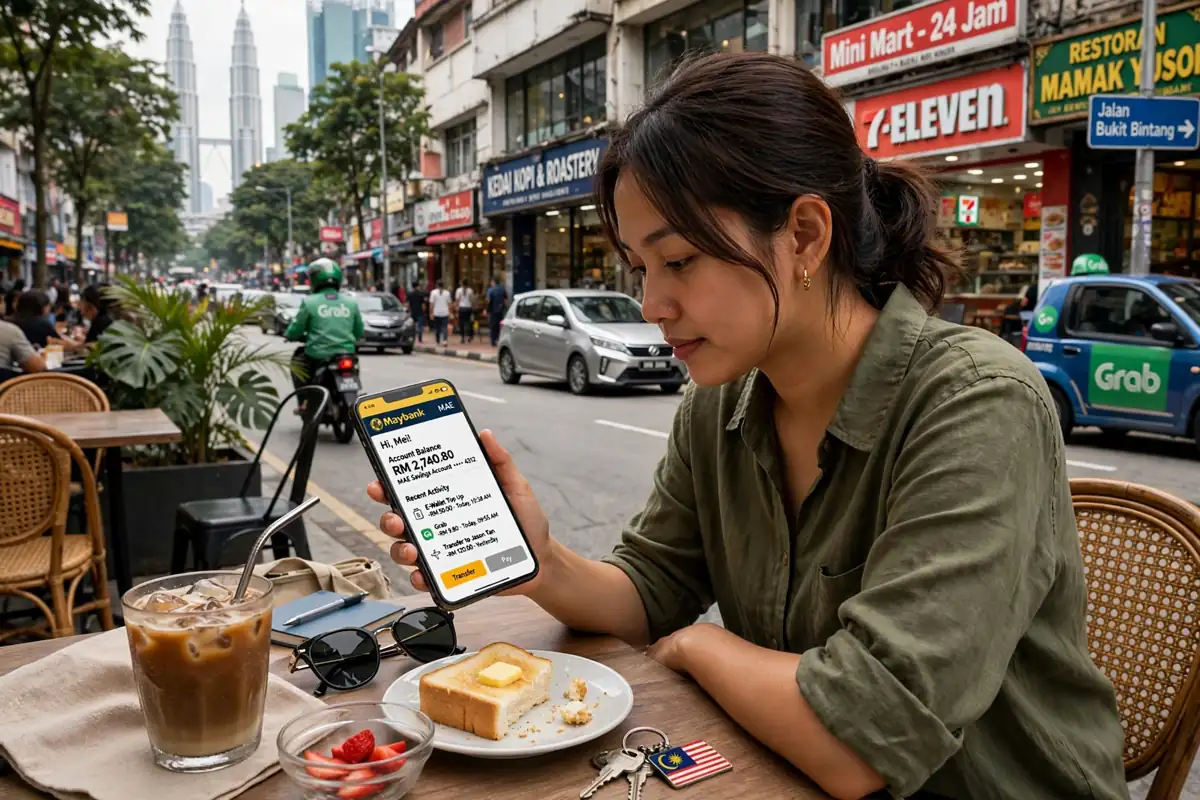
You also give your name, home address, phone number and tax details, and you fund the account from a Malaysian bank account in your own name. Exchanges reject deposits that arrive from another person, so never route your first deposit through a friend or an agent.
Step by Step: How to Buy Bitcoin in Malaysia
The steps below work the same at every big registered exchange, with small name changes. Read them once in full before you move any money.
Go slowly on your first buy. A small test deposit teaches you the screens with almost no risk.
Step 1: Open and verify your account
Download the official app or open the official site you found through the SC register, then create your account with your email and a strong password. Turn on two factor authentication right away, before you deposit anything.
Finish the identity check with the documents from the checklist above. Most apps approve a clean application quickly, though a blurry MyKad photo can send you back to the start.
Step 2: Deposit ringgit by FPX or bank transfer
Send ringgit from a bank account in your own name, because exchanges reject deposits from other people. FPX instant transfer works with all major Malaysian banks, and a normal bank transfer costs the same at most platforms.
Luno charges a RM1 admin fee on deposits below RM100 and charges nothing at RM100 and above, a small detail that punishes tiny test deposits. Deposit RM100 or more and you skip that fee completely.
Step 3: Choose the exchange screen, not instant buy
Every big app gives you two doors. The instant buy screen sells to you in one tap and charges up to 2 percent for that ease, and the next section shows you what that tap costs on a real buy.
The exchange screen is a real order book where you trade with other users and pay a small stated fee. Open that screen, pick the BTC/MYR pair, and choose a limit order if you want to set your own price.
Step 4: Place the order and check the total
Type the ringgit amount, look at the Bitcoin amount and the fee on the confirm screen, and only then place the order. On 20 October 2026, one Bitcoin traded near RM333,800, so RM1,000 bought about 0.0030 BTC before costs.
Your Bitcoin appears in the app once the order fills. A limit order below the market price may wait or never fill, and that is normal, not a fault.
Step 5: Move large amounts to your own wallet
An exchange account is a fine place to buy, but it is not the safest place to store a large amount for years. If the platform fails, your claim sits in a queue with everyone else.
Learn the basics from our guide to the best Bitcoin wallets for beginners, then practise a small withdrawal first. Our walkthrough on how to store Bitcoin safely covers the backup steps that protect you if a phone or laptop dies.
The True Cost of a RM1,000 Buy
Here is the part no other Malaysia guide we found actually works out. The registered exchanges publish fee schedules that disagree with each other in most reviews, so we rebuilt the cost of the same RM1,000 buy from the live schedules we checked on 20 October 2026.
A maker is a person whose limit order waits in the book, and a taker is a person whose order fills at once. One new line matters this year: from 1 October 2026, MX Global adds 8 percent service tax on top of its fee, and the tax hits the fee only, never the full RM1,000.
| Route for a RM1,000 buy | Stated fee | Cost in ringgit |
|---|---|---|
| HATA order book, maker | 0 percent | RM0 |
| MX Global order book, maker | 0 percent | RM0 |
| HATA order book, taker, starting tier | 0.25 percent | RM2.50 |
| MX Global order book, taker | 0.5 percent, plus 8 percent service tax on the fee | RM5.40 in total |
| Luno Exchange, taker, lowest volume tier | 0.60 percent, falling as your volume grows | RM6.00 |
| HATA Instant Buy | 1 percent | RM10.00 |
| Luno Instant Buy | 2 percent | RM20.00 |
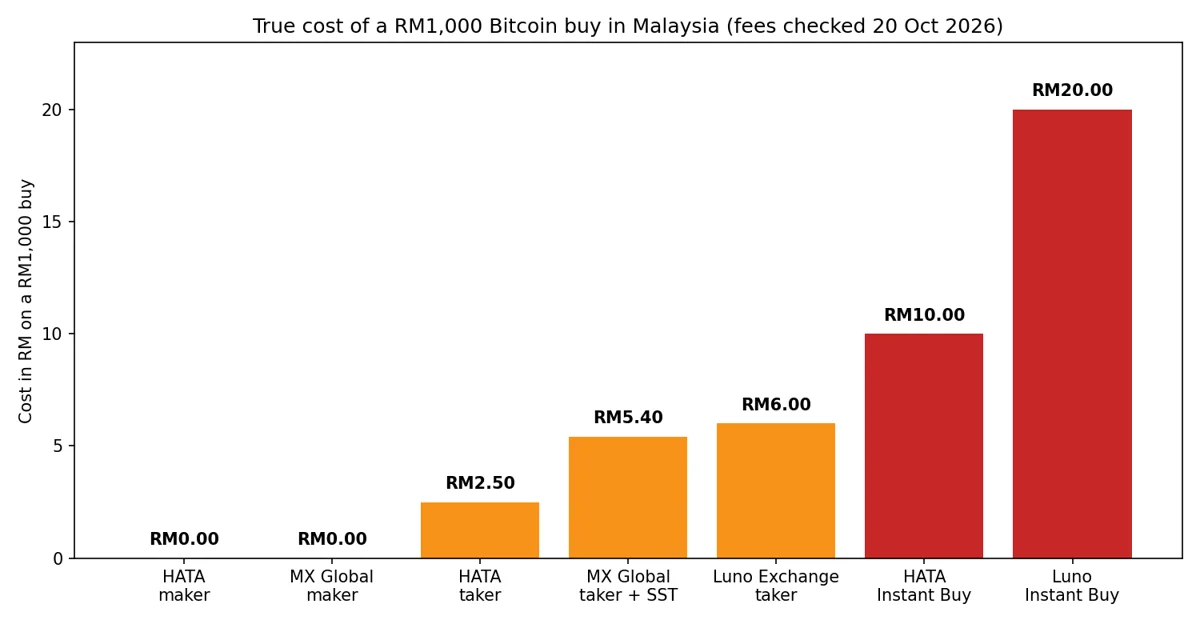
The pattern should look familiar if you have read our Japan guide, and the gap runs even wider here. The exchange logo changes your cost by a few ringgit, but the screen you pick changes it by RM20 on a small RM1,000 buy, and by RM200 on a RM10,000 buy.
My honest view is simple: a beginner pays the instant buy fee once, sees this table, and never pays it again. Learn the order book screen in your first week and the rest of this guide costs you almost nothing to follow.
If you are new to what Bitcoin itself is, start with what Bitcoin is and how it works before you trade often.
Deposits, Withdrawals, and Ringgit Fees
Getting ringgit in costs nothing at RM100 and above on the main platforms, and getting ringgit out carries small fixed fees. Luno charges RM0.10 per ringgit withdrawal and processes weekday withdrawals that beat the cut off time on the same day.
HATA takes bank transfer deposits for free and charges a convenience fee on some FPX and e-wallet routes such as GrabPay and Boost, so read the deposit screen before you confirm. Sending Bitcoin to your own wallet costs a network based fee everywhere, and that fee can dwarf a small withdrawal, so move larger amounts less often.
Compare that with our guide on how to buy Bitcoin in Japan, where the order book can even pay you a small rebate, or the one on how to buy Bitcoin in Italy, where a tax is withheld under a different system. Malaysia charges no tax at the moment you buy, which makes the screen choice your main cost.
How Malaysia Taxes Bitcoin: Investor or Trader?
Malaysia gives long term holders one of the friendliest answers in Asia, and it gives active traders a bill. The Inland Revenue Board, which everyone calls LHDN, sets the line between the two in its digital currency guidelines.
Keep records of every buy and sell from day one. Your exchange history helps, but it may not cover coins you moved to your own wallet and back.
The investor side of the line
Malaysia does not tax capital gains in general, and LHDN states the point plainly for digital currency: only revenue gains from disposing of digital currency face tax. A person who buys occasionally and holds as an investment makes a capital gain, and LHDN does not tax that gain.
Worked example: you buy RM1,000 of Bitcoin, hold it for two years, and sell it for RM1,500 as a one off investment sale. On the LHDN reading, that RM500 gain is a capital gain and you pay no tax on it.
The trader side of the line
LHDN taxes a person who trades digital currencies actively, because that activity generates revenue, not a capital gain. It judges your case on the badges of trade: how often you trade, how long you hold, how you fund the buys, and whether the work looks like a business.
Trading profits then join your other income and face the normal progressive rates, which reach 30 percent at the top. LHDN issued a second edition of its guidelines in December 2025 with more worked examples, and Malaysia has also signed up to share crypto account data internationally in the coming years, so keep clean records even as an investor.
The Shariah View, Stated Carefully
Many Malaysian readers ask a second question before the tax one: does Shariah permit this trade at all? Malaysia is one of the few countries whose regulator answers that question in writing, so we state its answer exactly and we do not stretch it.
The Shariah Advisory Council of the Securities Commission resolved in 2020 that, in principle, investing and trading in digital currencies and tokens on registered digital asset exchanges is permissible. The Council treats a qualifying digital currency as mal, an asset with value that people may trade.
The SC table of Shariah compliant digital currencies lists Bitcoin, with a decision date of 20 July 2020, alongside names such as Ethereum, XRP and Litecoin, and the list has grown to 15 currencies. Two limits matter: the ruling covers trading on SC registered exchanges, not every offshore app or leveraged product, and a Shariah status is not a promise that the price will rise.
Scholars outside this framework reach different views, and readers who need a personal ruling should ask a scholar they trust. Our job here is only to report the Malaysian position accurately, because most guides either skip it or turn it into a sales pitch.
Common Mistakes and Scam Warnings
The costliest errors in Malaysia are boring ones: the wrong screen, the wrong platform, and the wrong tax label. Each one is easy to avoid once you have seen it named.
Watch for these traps in your first month.
Mistakes that cost real money
Buying only on instant buy for a year can quietly cost you more than every other fee in this guide added together. Check the 2 percent figure once against the order book fee, and you will never unsee it.
Sending ringgit to an unregistered offshore platform or a peer to peer seller that a social media post praised is the second trap. If the name is not on the SC register, your money has no local protection, and the SC keeps adding unregistered names to its investor alert list.
The third trap wears a friendly face: an agent who offers to trade on your behalf, or a scheme that promises fixed daily returns. Registered exchanges never ask for your password and never guarantee returns, so treat any such promise as the scam it is.
FAQs
Is it legal to buy Bitcoin in Malaysia?
Yes. Malaysians can buy, hold and sell Bitcoin legally, but only on exchanges registered with the Securities Commission Malaysia as Digital Asset Exchanges, and Bitcoin is not legal tender.
Which exchanges are registered in Malaysia in 2026?
The register lists six DAX operators: Luno Malaysia, HATA Digital, MX Global, SINEGY DAX, Kinetic DAX and Torum International. Check the legal company name on the SC digital assets page before you deposit.
How much Bitcoin does RM1,000 buy?
At a price near RM333,800 per Bitcoin on 20 October 2026, RM1,000 buys about 0.0030 BTC before fees.
Why does instant buy cost more than the exchange screen?
Instant buy charges for one tap ease, up to 2 percent on Luno and 1 percent on HATA. The exchange order book charges a stated maker or taker fee instead, which runs from RM0 to about RM6 on a RM1,000 buy on the routes we checked.
Do I pay tax when I sell Bitcoin in Malaysia?
An occasional investor makes a capital gain, and Malaysia does not tax capital gains, so LHDN does not tax that sale. A person who trades actively pays income tax on the profits at normal rates, up to 30 percent.
Is Bitcoin Shariah compliant in Malaysia?
The Securities Commission Shariah Advisory Council ruled in 2020 that trading digital assets on registered exchanges is permissible, and its table lists Bitcoin as Shariah compliant. That ruling covers registered exchanges and is not an investment recommendation.
Conclusion: Your First Buy, Done Right
You now know how to buy Bitcoin in Malaysia the careful way. Check the SC register, verify your account with your MyKad, fund it with RM100 or more by FPX or bank transfer, and buy on the exchange screen where the fee is a few ringgit, not RM20.
Start small, keep your records for the LHDN line between investor and trader, and move larger holdings to your own wallet. When you feel ready, browse the rest of our country guides from the hub and compare how each country handles the same first buy.
Readers comparing routes across borders can also see how to buy Bitcoin in Mexico, where the same order book habit cuts the cost of a 10,000 peso buy from about 200 pesos to 50.