



Forty million ether now sits locked inside Ethereum’s validator set. That number alone answers how does Ethereum work at the level that matters most. Not through miners burning electricity. Through capital, staked, slashed, and compounded by machines taking turns proposing blocks every twelve seconds.
Most explainers stop there. Validators stake ETH, proof of stake beats proof of work, and the network is greener. True, and incomplete. What actually happened to validator queues this year?

Why have yields collapsed since 2023? What did two major upgrades quietly rewire underneath it all? None of that shows up in the standard explainer. This one goes there.
- The Numbers That Define Ethereum Right Now
- Start With the Question Nobody Answers Precisely
- The Capital Requirement Nobody Explains Well
- Why Staking Yield Fell, and Why That Is Not a Red Flag
- The Three Paths Into Staking, Compared Honestly
- The Centralization Question Nobody Likes Answering
- What a Validator Actually Earns, Broken Down
- Where the Roadmap Goes From Here
- The Security Side Few Buying Guides Mention
- Staking Yield in Historical Context
- FAQs
The Numbers That Define Ethereum Right Now
Before the mechanics, the scale. These figures set the stage for everything explained below.
| Metric | Figure | Source |
| Total ETH supply | 121,817,765 ETH, live as tracked. | Ultrasound Money, June 2026 |
| ETH locked in the beacon chain | 40,315,872 ETH, roughly 33 percent of supply. | Ultrasound Money, June 2026 |
| Minimum stake to run a validator | 32 ETH, unchanged since the Beacon Chain’s 2020 launch. | ethereum.org |
| Maximum effective balance post-Pectra | 2,048 ETH per validator, up from the original 32 ETH ceiling. | ethereum.org |
| Issuance reduction since the Merge | Approximately 88.7 percent lower than the pre-2022 proof-of-work rate. | ethereum.org |
| Validator exit cap | Roughly 0.33 percent of all validators may exit per day, by protocol design. | ethereum.org |
Start With the Question Nobody Answers Precisely

How does Ethereum work without miners? The honest answer requires retiring the word “mining” entirely. Validators replaced miners in September 2022, and the replacement was not cosmetic. Mining rewarded raw electricity. Staking rewards locked capital.
Every twelve seconds, the network needs one validator to propose the next block. Selection is pseudo-random, weighted by how much ETH the validator has staked.
Win the slot, bundle pending transactions, broadcast the result. Other validators check the work and vote on whether the block is valid, a process called attestation.

Lie, go offline too often, or sign two conflicting blocks, and the protocol takes a cut of your stake. That cut is called slashing, and it is the entire reason this system needs no police force.
The Capital Requirement Nobody Explains Well

Becoming a validator is not a technical hurdle. It is a capital one, and the two get conflated constantly.
- 32 ETH activates one validator. That number has never moved, even after Pectra.
- Hardware is almost an afterthought by comparison: roughly 8 to 12 CPU cores, 64GB of RAM, and a few terabytes of fast storage.
- Uptime is the real test. Miss enough attestations and rewards shrink. The protocol’s full penalty schedule rewards consistency over heroics, not aggressive performance.
This is why most individual holders never run a validator directly. The capital bar is high. The operational bar is unforgiving. Pooled or liquid staking exists specifically to route around both.
Pectra: The Upgrade That Let Capital Consolidate
In May 2025, the Pectra upgrade raised the maximum effective balance from 32 ETH to 2,048 ETH per validator. Before Pectra, holding 320 ETH meant running ten separate validator instances, each capped, each managed independently.
After Pectra, that same 320 ETH runs as one validator. Rewards above the old 32 ETH ceiling now auto-compound instead of sitting idle.
For an institution holding tens of thousands of ETH, this collapsed hundreds of separate nodes into a handful. The practical result: large holders consolidate.
Consolidation concentrates influence over block production. That trade-off was an intentional design choice, made for operational simplicity at scale.
Fusaka: The Upgrade That Touched Data, Not Blocks
Pectra changed who could stake how much. Fusaka, activated in December 2025, changed what validators have to download to do their job.
Its core feature, PeerDAS, lets nodes verify Layer 2 rollup data by sampling small portions instead of downloading every blob in full.
This sounds technical because it is. The consequence is plain. Ethereum can support far more Layer 2 throughput without forcing every validator to buy bigger hard drives.
Cheaper, faster verification at the base layer explains why rollup fees kept falling through 2026. They never plateaued after 2024’s Dencun upgrade.
Why Staking Yield Fell, and Why That Is Not a Red Flag
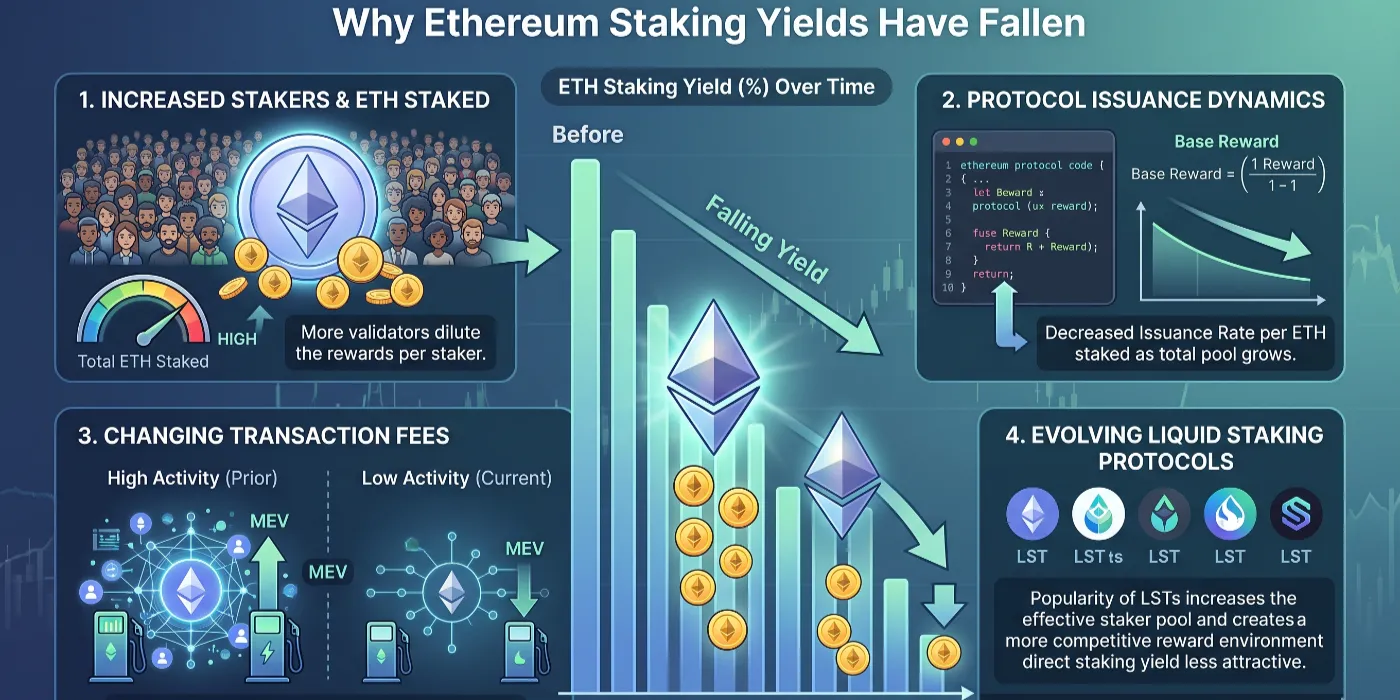
Base staking yield has compressed into the high twos, down from over four percent a few years ago. Every explainer that calls this a warning sign is missing the mechanism.
Ethereum’s issuance scales with the inverse square root of total ETH staked. The more validators join, the reward pool gets divided more ways, and each individual share shrinks. It is arithmetic, not sentiment.
Forty million ETH now staked is not a sign of weakness. It is the direct cause of lower yield. Lower yield at higher participation is exactly what a healthy, maturing security budget looks like.
A network paying high yields to a small validator set is more fragile, not less.
The Three Paths Into Staking, Compared Honestly
Not every staking path suits every holder. The honest trade-offs rarely make it into beginner content.
| Path | Capital Needed | Control | Real Trade-off |
| Solo validator | 32 ETH minimum | Full | Highest yield, but you own every operational failure. |
| Liquid staking pool | Any amount | Partial | Lower yield after protocol fees, but capital stays liquid and usable elsewhere. |
| Staking-as-a-service | 32 ETH typically | Partial | Outsources hardware, but introduces counterparty trust in the provider. |
Liquid staking deserves a specific callout. It issues a token representing your staked position. That token can move through DeFi while still earning.
The flexibility is the entire pitch. It is also the entire risk, since the token’s value depends on the issuing protocol holding up its end.
The Centralization Question Nobody Likes Answering

Pectra’s consolidation benefit comes with a cost the protocol’s own design accepted upfront, and it deserves a straight answer.
Lido alone has, at various points, held close to a third of all staked ETH. No single liquid staking provider controls a strict majority. The protocol also enforces hard caps on how fast any validator set can exit. That limits how quickly concentrated stake could move in a coordinated way.
But the trend line matters. As Pectra makes consolidation cheaper for large holders, the natural pull is toward fewer, bigger validators.
This is the trade-off baked into every proof-of-stake design. Capital efficiency and decentralization pull in opposite directions. Ethereum’s response so far has been social and technical pressure, not a hard protocol rule.
It encourages large operators to spread infrastructure across providers and geographies, rather than capping any one entity by force. Whether that stays sufficient as consolidation continues is an open question, not a settled one.
What a Validator Actually Earns, Broken Down
The 2.78 percent headline yield hides three separate revenue streams. Understanding each one explains why real returns vary so much between validators.
| Reward Source | Typical Share | What Drives It |
| Base consensus reward | Roughly 2 to 2.3 percent APR | Fixed by protocol math, tied to total ETH staked |
| Priority fees (tips) | Variable, often under 0.3 percent | Network congestion and user urgency |
| MEV (maximal extractable value) | 0.5 to 1 percent additional | Validator’s ability to order transactions profitably |
MEV is the least understood piece. It comes from validators reordering or including transactions in ways that extract extra value, often through arbitrage between decentralized exchanges.
Running MEV-Boost software captures this automatically. That’s why two validators with identical stake can still post different real-world returns.
Security in a proof-of-stake system is not abstract. An attacker would need to acquire and risk a majority of staked ETH to meaningfully threaten consensus. That sum is now worth tens of billions of dollars, and rising with Ethereum’s broader network growth.
that to proof-of-work. There, security scaled with electricity prices and hardware availability. Both fluctuate independently of the asset’s own value.
This is the part most explainers gesture at without quantifying. Staked capital and network security are now the same number.
Every ETH that joins the validator set raises the cost of attacking the chain by exactly that much. Mining-based systems have no equivalent direct relationship.
Where the Roadmap Goes From Here

Glamsterdam, expected in the second half of 2026, centers on enshrined proposer-builder separation. That change formalizes how block builders compete for inclusion. It replaces a process once left to a handful of dominant external builders.
It also follows the same twice-yearly upgrade rhythm Ethereum settled into after Fusaka. That cadence marks a sharp departure from the multi-year gaps that defined Ethereum’s earlier history.
That cadence itself is worth noting. A protocol shipping major consensus changes on a predictable schedule behaves less like an experiment.
It behaves more like infrastructure with a maintenance plan. That posture matters when evaluating where Ethereum’s price and adoption head next.
The Security Side Few Buying Guides Mention
Validator mechanics are only half the security picture. The other half lives at the wallet level, where most actual losses happen. Industry-wide, crypto hack losses fell sharply in a recent month, a reminder that the attack surface has shifted from protocol-level exploits toward user-level phishing and key compromise.
Understanding how validators secure the chain means little if the wallet holding your stake gets drained through a fake interface.
Choosing wallet software that supports staking safely, such as the options covered in our self-custodial wallet comparison, matters as much as understanding the consensus layer itself.
Smart Contracts, Briefly, for Context
None of the validator mechanics above explain why Ethereum matters beyond security. That answer sits one layer up, in smart contracts.
They are the self-executing code that runs on top of the consensus layer this article has focused on. Our full breakdown of what Ethereum is covers that layer in depth.
The Ethereum 2.0 transition covers how the network got from mining to staking in the first place, and applications like tokenized digital collectibles are one visible product of what smart contracts make possible once the consensus layer is secure.
None of that works without the validator economics explained above. The smart contracts are the visible layer. Consensus is the foundation underneath, and it is the part almost nothing written for beginners actually explains.
The Answer, In Full
How does Ethereum work? Through validators who stake capital instead of burning electricity. Through a queue and reward system that makes cheating expensive and honesty profitable.
And through two major upgrades in 2025 and 2026. They changed who can consolidate stake, and how cheaply the network verifies its own data.
None of that requires Ethereum’s price to do anything in particular to be true. The mechanics function whether ETH trades at $1,500 or $5,000. That durability, not the price chart, is the actual answer to how Ethereum works.
It’s worth understanding before anyone explains the rest. If you’re ready to put capital behind that understanding, our guide to buying Ethereum picks up exactly where this one ends.
Staking Yield in Historical Context

The 2.78 percent figure means little without a timeline. Here’s what yield actually looked like at each stage of Ethereum’s validator growth.
| Period | Approx. ETH Staked | Approx. Base APR |
| Late 2020, Beacon Chain launch | Under 1 million ETH | Over 15 percent |
| Early 2023, post-Merge | 18 million ETH | Around 5 percent |
| Mid 2025 | 32 to 35 million ETH | Around 3.5 percent |
| Mid 2026 | Roughly 40 million ETH | Around 2.78 percent |
The trend line is consistent and entirely predictable from the issuance formula. Early validators earned extraordinary yields precisely because almost no one else was staking yet. That window is closed permanently.
The protocol didn’t change the rules. The population the rules apply to simply grew roughly forty-fold.
Anyone comparing today’s yield unfavorably against 2021 figures is really just rediscovering this same arithmetic from a different angle.
Entry gets most of the attention. Exit has its own mechanics, and they explain why withdrawing staked ETH was once a genuine bottleneck.
A validator requesting full exit stops earning rewards immediately. Funds don’t arrive instantly, though. The protocol caps exits per epoch, a six-and-a-half-minute window, at roughly four by default.
That cap scales up slightly as the validator count grows. One extra exit slot opens for every 65,536 validators beyond a baseline threshold.
This is deliberate. Letting every validator exit at once could let a sudden ETH withdrawal destabilize network security in one stroke.
The Shanghai and Capella upgrades in April 2023 enabled withdrawals for the first time. Before that, staked ETH was genuinely locked with no exit path. That constraint shaped early staking decisions for years.
Partial withdrawals work differently and skip the queue entirely. Rewards above the 32 ETH baseline sweep out automatically to a validator’s withdrawal address.
This happens on a rolling basis, even above whatever higher balance Pectra allows. No full exit is required. Only closing the validator down entirely triggers the queue.
FAQs
Does Ethereum still use mining?
No. Mining ended in September 2022 with the Merge. Validators, not miners, now produce and confirm every block, using staked ETH as collateral instead of computational power.
Can I lose my staked ETH?
Yes, through slashing, but only for specific violations: signing conflicting blocks, severe or repeated downtime, or other provable misbehavior. Normal participation with reasonable uptime does not put your principal at risk beyond minor reward reductions.
Why did Pectra raise the validator cap to 2,048 ETH?
To let large holders consolidate. Before Pectra, every validator was capped at 32 ETH for reward purposes. That forced institutions to run dozens or hundreds of separate nodes. The new ceiling lets one validator do the work of up to 64 of the old ones.
Is a 2.78 percent staking yield still worth it?
That depends entirely on your alternative. The yield is mechanically lower because more ETH is staked, which is itself a security improvement. Compare it against other low-risk options, not against Ethereum’s own higher yields from years with far less staked capital.
What does Fusaka actually let the network do differently?
It lets validators verify Layer 2 data by sampling instead of downloading every byte. That single change expanded how much rollup activity the base layer can support without raising hardware requirements for every validator.