

There is no legal local way to buy Bitcoin in Morocco, and any guide that tells you otherwise puts your money and your bank account at risk. The Office des Changes declared in November 2017 that transactions in virtual currencies breach Moroccan exchange regulations and carry penalties and fines.
That blunt answer is the whole point of this guide. Most pages that rank for how to buy bitcoin in morocco still push offshore apps and peer to peer offers as if the 2017 ban never happened, so we built this one from the regulators’ own statements instead.

Bitcoin traded near $81,383 on October 20, 2026, which works out to roughly 798,000 Moroccan dirhams per coin. The price is not the hard part in Morocco, though, because the rules are.
- How to Buy Bitcoin in Morocco: The Honest Short Answer
- What the Law in Morocco Actually Says
- What Other Guides Claim vs What the Rules Say
- The Reform Story: A Dated Timeline of Draft Law 42.25
- What the Ban Means for Your Bank Account
- Dirham P2P Offers: A Risk First Checklist
- Why Use Persists Despite the Ban
- How Morocco Compares With Other Countries
- What Would Have to Change in Morocco
- Frequently Asked Questions
- Conclusion: The Safe Move in Morocco Is Patience
Key takeaways
- Morocco has banned crypto transactions since November 2017, because the Office des Changes treats them as a breach of foreign exchange regulations.
- No licensed local exchange exists in Morocco, and no authority has issued a crypto licence to any platform.
- Draft Law 42.25, published for public comment in November 2025, would create a licensing system under the AMMC and Bank Al-Maghrib, but it is not law yet.
- Financial deals with foreign parties must run through authorised intermediaries and use currencies that Bank Al-Maghrib lists, and Bitcoin is not one of them.
- Dirham peer to peer offers carry a double risk: an exchange rules offence on one side and common payment scams on the other.
How to Buy Bitcoin in Morocco: The Honest Short Answer
You cannot buy Bitcoin through a licensed Moroccan route, because the state never created one and then banned the activity in 2017. A resident who searches how to buy bitcoin in morocco today finds offshore marketing pages and informal offers, not a legal local method.
The honest steps in Morocco are therefore protective, not transactional. Check the current rules yourself, keep your bank account clean, and treat any offer that reaches you as unregulated by definition.
Our wider hub on how to buy Bitcoin around the world with country by country rules shows how unusual a full ban like this has become. Most countries in that hub now license exchanges and tax gains, while Morocco still works under the 2017 prohibition.
What the Law in Morocco Actually Says
Morocco never passed a law that names Bitcoin, and that detail confuses many guide writers. The ban instead comes from foreign exchange law, because buying crypto sends value abroad outside the channels the state controls.

Four authorities shape the position, and the table below lists each one with its role. You should know these names, because a seller who cannot explain them cannot explain your legal risk either.
| Authority | Role | What it has said or done |
|---|---|---|
| Office des Changes (Foreign Exchange Office) | Runs the foreign exchange regulations | Declared in November 2017 that virtual currency transactions infringe the exchange regulations and attract penalties and fines |
| Bank Al-Maghrib (central bank) | Issues currency, oversees banks and payments | Joined the 2017 warning, lists the foreign currencies that authorised deals may use, and now leads work on the draft crypto law and the e-dirham pilot |
| AMMC (capital markets authority) | Supervises capital markets | Joined the 2017 warning and would license and supervise crypto service providers under Draft Law 42.25 |
| Ministry of Economy and Finance | Owns financial legislation | Prepared Draft Law 42.25 with Bank Al-Maghrib and the AMMC and published it through the General Secretariat of the Government in November 2025 |
The 2017 Statements, in Plain Words
The trigger was small and specific. A Moroccan digital services firm, MTDS, announced in November 2017 that it would accept Bitcoin as payment, and the regulators answered within days.
The Office des Changes told the public that transactions via virtual currencies constitute an infringement of the exchange regulations, liable to penalties and fines. Bank Al-Maghrib, the AMMC and the insurance supervisor then issued a joint warning about the same risks.
The Office also called virtual currency a hidden payment system that no organisation backs. It reminded residents that financial transactions with foreign countries must pass through authorised intermediaries and use only the foreign currencies that Bank Al-Maghrib lists.
The Penalties Behind the Ban
The 2017 statement ties breaches to the penalties and fines in the existing exchange regulations, and it does not set a separate crypto fine schedule. Any exact fine figure that a blog quotes without naming that underlying exchange law deserves your suspicion.
That legal anchor matters for ordinary residents, not just companies. A rule enforced through foreign exchange law reaches the payment itself, so a buyer can face a penalty even when no Moroccan firm took part in the deal.
What Other Guides Claim vs What the Rules Say
Search results for how to buy bitcoin in morocco contradict each other in ways that should worry a beginner. We checked the highest ranking claims against the regulator statements and the draft law record, and the table below shows the three worst mismatches we found.
| Claim in other guides | What the rules actually say |
|---|---|
| Morocco legalised crypto in 2025 and licensed exchanges now operate | Draft Law 42.25 only reached public comment in November 2025, no parliament has passed it, and no authority has issued any crypto licence |
| Buying Bitcoin in Morocco is easy, just pick an app and pay by card | The Office des Changes treats crypto transactions as an exchange regulations infringement, and Moroccan deals abroad must use authorised intermediaries and listed currencies |
| Peer to peer buying in dirhams is a safe local workaround | A dirham payment does not change the foreign exchange problem, and P2P trades add screenshot, name mismatch and frozen account risks with no regulator to call |
No other top guide we found leads with this correction, and that gap is why this article exists. A beginner who follows the older advice learns about the ban only when a bank questions a transfer or a trade partner vanishes.
The Reform Story: A Dated Timeline of Draft Law 42.25
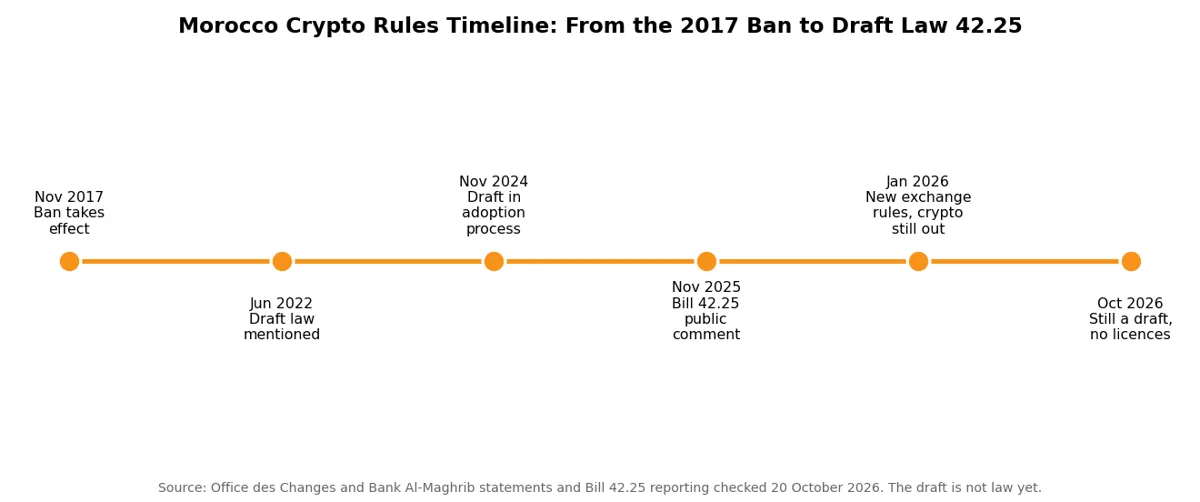
Morocco has worked on a crypto law for years, and the slow public record explains most of the confusion online. Each announcement moved the draft one step forward, and none of those steps made buying legal.
| Date | What happened | What it changed for buyers |
|---|---|---|
| November 2017 | The Office des Changes bans crypto transactions as an exchange regulations infringement, and Bank Al-Maghrib and the AMMC issue a joint warning | Nothing became legal, and the ban still stands today |
| June 2022 | Governor Abdellatif Jouahri tells reporters that Bank Al-Maghrib has a draft crypto law under consideration | Work started in public, but the ban stayed in force |
| November 2024 | Jouahri announces in Rabat that a draft law to regulate crypto assets sits in the adoption process | The direction changed from ban only to ban plus drafting, not to legal buying |
| April to July 2025 | Officials say at GITEX Africa that the bill nears presentation, and Jouahri confirms Bank Al-Maghrib sent the draft to the Ministry of Economy and Finance and urges a fast move to parliament | The draft gained an owner and a route, but no vote took place |
| July 2025 | Bank Al-Maghrib reports a completed retail pilot of its central bank digital currency, the e-dirham, plus a cross border test with the Central Bank of Egypt | The e-dirham is a state digital currency project, not a licence to buy Bitcoin |
| November 2025 | The General Secretariat of the Government publishes Draft Law 42.25 for public comment | The public can finally read the proposal, and it remains a proposal |
| December 2025 | The AMMC runs a training seminar with Chainalysis on tracing crypto transactions and monitoring chains | Supervisors prepare to enforce a future law, which signals intent, not approval |
| January 1, 2026 | A new General Instruction on Exchange Operations takes effect and raises personal travel and online shopping allowances | The update leaves crypto purchases outside every authorised channel |
| October 2026 | Bank Al-Maghrib confirms in its banking supervision reporting that work on finalising the crypto legislation continues | As of this guide, the bill is still a draft and no licensed route exists |
What Draft Law 42.25 Would Change
The draft follows the shape of Europe’s MiCA rules and splits the work between the two regulators. The AMMC would license and supervise crypto asset service providers such as exchanges and custodians, while Bank Al-Maghrib would oversee stablecoin issuers, which the draft limits to licensed banks and payment institutions.
Firms would need prior approval before they operate, plus capital, governance and risk controls. The draft also sets know your customer, anti money laundering and asset tracing duties, and it leaves mining, non fungible tokens, decentralised finance and central bank digital currencies outside its scope.
What the Draft Does Not Change Yet
A published draft changes no one’s legal position until parliament passes it and the state publishes the final law. Until that day, the 2017 exchange regulations position remains the live rule and every licence claim you see is marketing, not fact.
Read any 2026 announcement with that test in mind. Training seminars, pilots and public comment periods all prepare a future market, and none of them authorises a single trade today.
What the Ban Means for Your Bank Account
Exchange rules reach the place residents feel regulation first, which is the payment itself. A Moroccan who pays a foreign platform steps outside the authorised intermediary system that the Office des Changes requires, and the bank transfer or card payment creates the paper trail.
In practice, a bank can question a transfer that it links to crypto, ask about the source and purpose of funds, or refuse the business. None of that requires the bank to prove your intent, because its own compliance duties tell it to control foreign payments.
Morocco also gives Bitcoin no legal tender status, so no shop must accept it and no court treats it as money. Our guide to buying Bitcoin in Egypt under its own strict central bank law and our guide to buying Bitcoin in Kuwait, where a 2023 circular bans crypto dealing outright, show the same regional pattern.
Readers who hold coins from time lived abroad still need safe storage habits. Our ranked list of the best Bitcoin wallets for beginners who want self custody covers the basics without any exchange account.
Dirham P2P Offers: A Risk First Checklist
This guide does not recommend peer to peer or offshore routes, because presenting them as workarounds would mislead you about the ban. What we can do honestly is name the traps that catch residents who run into these offers anyway, in chats, groups and cash transfer adverts.
Start with the legal fact that a dirham payment changes nothing about the exchange problem. The value still ends with a foreign platform or an unknown counterparty outside the authorised system, and the offence sits in that movement, not in the currency on the screen.
Screenshot Proof and Cash Transfer Traps
P2P scammers love screenshot proof, because a chat image proves nothing about a real bank transfer. Offers that name familiar cash services such as Wafacash or CashPlus borrow trust from brands that never approved the trade and cannot reverse it for you.
Funds can appear in a polished screenshot while no money ever moved, and a fake receipt can pressure you to release coins first. Once crypto leaves your wallet, no Moroccan authority can pull it back, and the other side knows that before you do.
Name Mismatch and Frozen Account Risks
Moroccan names pass through Arabic and French spellings, and one person can appear under several forms. Platforms and banks freeze trades when the account name and the identity document differ, and support teams abroad rarely resolve Moroccan naming cases fast.
That freeze risk sits on top of the legal risk, not instead of it. A resident can lose access to funds in a trade that their own regulators never allowed in the first place.

Warning signs that should end any deal
- The seller claims a Moroccan licence that neither the AMMC nor Bank Al-Maghrib can confirm.
- The pitch promises fixed profits, bonus coins or a new local token launch.
- The other side asks you to release coins before real settlement lands in your own account.
- The advert uses a cash transfer brand name to look official, but the trade runs through a private chat.
- Your bank warns you about the transfer and the seller tells you to ignore it.
Storage skill still matters for anyone who already holds coins from earlier years or from life abroad. Our explainer on how to store Bitcoin safely in your own wallet helps you protect what you hold while the law catches up.
Why Use Persists Despite the Ban
Honesty about the ban also means honesty about demand, because Moroccans keep using crypto underground. Industry estimates put the number of Moroccan crypto holders near six million people, about 16 percent of the population, and you should treat that figure as an estimate, not an official count.
Remittances explain much of that demand, since Morocco received about $11.7 billion from its diaspora in 2024 and ranked among Africa’s largest recipients. Stablecoins appeal to families who want faster and cheaper cross border transfers, and that real need is exactly why regulators now draft rules instead of only repeating the ban.
Demand does not soften the legal position today, though. It only explains why Draft Law 42.25 exists and why this guide watches the official record so closely.
How Morocco Compares With Other Countries
North Africa does not speak with one voice on Bitcoin, and Morocco sits near its strict end today. Egypt bans crypto activity without central bank approval under its 2020 banking law, and Kuwait bans dealing, payments and mining under its 2023 circulars.
Contrast helps travellers and new residents set expectations before they move money. Our guide to buying Bitcoin in Malaysia through Securities Commission registered exchanges and our guide to buying Bitcoin in Mexico through local platforms and SPEI transfers show what a licensed route looks like where one exists.
If you are new to the asset itself, step back before you study any country rules. Our plain language explainer on what Bitcoin is and how it works covers the basics in one sitting.
What Would Have to Change in Morocco
A legal route needs the draft to finish its journey first. Parliament must pass Draft Law 42.25 or a successor text, the state must publish the final law, and the AMMC and Bank Al-Maghrib must then open licensing and approve real firms.
Watch the official channels if this topic matters to you, not social media promoters. The General Secretariat publishes draft and final laws, Bank Al-Maghrib publishes its own statements, and the AMMC will publish any future licence register on its own site.
Until a final law changes the position, treat the 2017 ban as the live rule. Hope, rumours and influencer claims do not amend a regulator’s published order.
Frequently Asked Questions
Q: Is it legal to buy Bitcoin in Morocco?
A: No legal local route exists, because the Office des Changes declared in November 2017 that virtual currency transactions infringe Moroccan exchange regulations and carry penalties and fines. No authority has licensed an exchange in Morocco.
Q: Has Draft Law 42.25 legalised Bitcoin in Morocco?
A: No, Draft Law 42.25 is a bill that the General Secretariat of the Government published for public comment in November 2025. As of October 2026 the bill is still a draft, parliament has not passed it, and it grants no one a licence to trade.
Q: Is there a licensed crypto exchange in Morocco?
A: No, no Moroccan authority has licensed a crypto exchange or any other crypto service provider. Any platform that claims a Moroccan licence today makes a claim that neither the AMMC nor Bank Al-Maghrib confirms.
Q: What penalties can apply if I trade crypto in Morocco?
A: The Office des Changes said crypto transactions are liable to the penalties and fines set out in the existing exchange regulations. Financial deals with foreign parties must run through authorised intermediaries and use currencies that Bank Al-Maghrib lists.
Q: Can shops in Morocco accept Bitcoin as payment?
A: No, Bitcoin has no legal tender status in Morocco and crypto payments fall under the 2017 exchange regulations ban. A shop that accepts Bitcoin steps outside the authorised payment system.
Q: How much is one Bitcoin in Moroccan dirhams?
A: At about $81,383 on October 20, 2026, one Bitcoin cost roughly 798,000 Moroccan dirhams. The dirham price moves with both the Bitcoin price and the dollar exchange rate.
Conclusion: The Safe Move in Morocco Is Patience
The search for how to buy bitcoin in morocco deserves a straight answer, and the straight answer in 2026 is that Morocco offers no legal way to do it. The 2017 ban still stands, banks enforce the exchange rules daily, and Draft Law 42.25 promises a future licensing system that does not exist yet.
Your next step is simple and free. Read the regulator statements yourself, keep your bank account away from crypto transfers, and revisit this guide when a final published law changes the rules.