



Learning how to sell bitcoin on P2P platforms takes about fifteen minutes, one verified account, and a clear rule about when to release your coins. You list your bitcoin, a buyer pays you in your local currency, and the platform holds your coins in escrow until the money actually lands in your account.
Most guides stop there, and that is why most sellers get burned. A screenshot is not proof of payment.

Some payment methods can be reversed days after you release your coins. And a buyer who rushes you is usually a buyer who has not paid.
- What Selling Bitcoin on P2P Actually Means
- How Escrow Protects You, and Where It Stops
- Payment Methods Ranked by Reversal Risk
- The 7 Scams That Target Sellers
- 1. The fake payment screenshot
- 2. The chargeback after release
- 3. The third-party payment
- 4. The cancel-after-payment trick
- 5. The off-platform move
- 6. The fake support agent
- 7. The too-good buyer
- How to Sell Bitcoin on Binance P2P, Step by Step
- How to Pick a Buyer You Can Trust
- In-Person Cash Sales: The Rules
- What a $500 Sale Really Costs
- Common Mistakes Sellers Make
- Frequently Asked Questions
- Is selling bitcoin on P2P platforms safe?
- What is the safest payment method for selling bitcoin P2P?
- How do I know the buyer really paid?
- What happens if the buyer never pays?
- Can a buyer reverse the payment after I release the bitcoin?
- Is Binance P2P working after the October 2026 hack?
- Sources
- Conclusion
This guide is written for sellers, not buyers. It ranks payment methods by reversal risk, names the seven scams that target sellers, walks through a real sale on Binance P2P, and uses live 2026 platform fees and status notes, including what happened after the October 29 Binance hack.
Key takeaways
- To sell bitcoin on P2P platforms safely, use a platform with escrow, pick a buyer with hundreds of completed trades, and release your coins only after the money shows in your own bank account, never after a screenshot.
- Bank transfers and cash are the hardest payments to reverse, while PayPal, Venmo, and gift cards carry the highest chargeback risk for sellers.
- The fake payment proof trap is the top seller scam in 2026. Binance and Bybit both warn that edited receipts and fake bank SMS messages prove nothing.
- Binance P2P kept running after the October 29, 2026 hack, which hit about $6.34 billion in assets. Withdrawals resumed in phases from November 1, but check the platform status before you trade.
- Paxful closed in November 2025 and LocalBitcoins closed in 2023, so guides that still recommend them are out of date. Binance, Bybit, OKX, and Hodl Hodl are the live options covered here.
- Platform fees are near zero in 2026. A maker pays at most 0.35% on Binance P2P and 0% on OKX, while Hodl Hodl charges 0.75% per side.
What Selling Bitcoin on P2P Actually Means
Peer-to-peer selling means you trade directly with another person instead of selling to an exchange order book. The platform matches you, holds your bitcoin in escrow, and gives you a dispute path if something goes wrong.
You set your own price and choose which payment methods you accept. That freedom is the point of P2P, and it is also the risk, because the buyer on the other side is a stranger.
How a P2P sale works
You post an ad or answer a buyer’s ad with the amount of bitcoin you want to sell and the price you want. The platform locks your bitcoin in escrow the moment the trade opens, so you cannot spend it and the buyer cannot take it early.

The buyer sends the fiat payment to your bank account or payment app. You open your own banking app, confirm the money arrived, and only then tap release.
The platform sends the bitcoin to the buyer and the trade closes.
Why sellers use P2P instead of an exchange
P2P often pays better than a straight exchange sale, because you set the price and local buyers pay a small premium for convenience. Spreads often run 0.5% to 2% above the market rate, depending on the currency and payment method.
P2P also reaches places where exchanges do not. In countries without a direct bank route to an exchange, a P2P sale can be the only practical way to turn bitcoin into local cash.
If you are weighing speed against safety, our guide to the fastest ways to buy bitcoin shows the same trade-off from the buyer side.
How Escrow Protects You, and Where It Stops
Escrow is the one feature that makes P2P selling safe enough to attempt. Without it, you would be sending bitcoin to a stranger on trust, and trust is exactly what scammers exploit.
Escrow works because the platform, not the buyer, holds your coins during the trade. The buyer cannot receive them until you confirm payment, and you cannot lose them by accident while the trade is open.
What escrow does for a seller
Escrow locks your bitcoin at the start of the trade and releases it only when you confirm the money arrived. If the buyer never pays, the trade times out and your coins return to you.
Escrow also creates a record. Every message, every payment claim, and every timestamp sits inside the platform, so a dispute team can see what actually happened instead of taking sides on words alone.
What escrow cannot do
Escrow cannot undo a release. Once you tap release, the bitcoin is gone, and no support team can pull it back from the buyer’s wallet.
That is why the release tap is the most dangerous button in the whole process.
Escrow also cannot protect a payment that arrives and then gets reversed. A buyer can pay by a reversible method, wait for you to release, then file a chargeback with their bank or payment app.
The platform cannot stop a bank from pulling money back, so your choice of payment method matters as much as escrow itself.
Payment Methods Ranked by Reversal Risk
The payment method you accept decides how much risk you carry after the trade closes. A bank transfer that has cleared is very hard to reverse, while a PayPal payment can be challenged weeks later under buyer protection rules.
The table below ranks the payment methods P2P sellers meet most often, from safest to riskiest, based on how each rail handles reversals and on the warnings Binance and Bybit published in 2026. Use it when you set up your ad, and refuse any method you do not understand.
| Payment method | Reversal risk for sellers | Why |
|---|---|---|
| Cash in person | Very low | Physical cash cannot be charged back, but it carries its own safety risks, covered below. |
| Bank transfer | Low | Cleared domestic transfers are hard to reverse, and the sender name is visible. |
| Wise or Revolut transfer | Low to medium | Fast and traceable, but accounts can be frozen if the sender’s money is flagged. |
| Mobile money (M-Pesa, OPay, PalmPay) | Medium | Fast and common in Africa, but some operators allow reversals on fraud claims. |
| Venmo or Cash App | High | Built for friends, not trades. Payments can be disputed, and accounts get frozen. |
| PayPal (goods and services) | Very high | Buyer protection lets the buyer claim the goods never arrived. Sellers lose these disputes often. |
| Gift cards | Very high | Codes can be drained, faked, or reported stolen after the trade. Avoid them as a seller. |
Two rules follow from this table. First, take bank transfer or cash whenever you can, and treat anything with a dispute button as a risk you price into your rate.
Second, never accept a payment method the buyer suggests at the last minute, because a method switch near the end of a trade is a classic setup for a reversal scam.
If you plan to spend the proceeds rather than hold cash, bitcoin debit cards are one way to use crypto for everyday purchases, but they do not change the rules of a P2P sale itself.
The 7 Scams That Target Sellers
Every scam below follows the same pattern. The buyer creates urgency, shows you something that looks like proof, and pushes you to release before you verify.
If you slow down and check your own account, all seven fail.
1. The fake payment screenshot
The buyer sends a doctored image of a completed bank transfer and says the money is on its way. The image looks real, because it is a real screenshot with the numbers edited.
Binance warned in its April 2026 safety guidance that scammers can manipulate payment receipts and SMS notifications. Open your own banking app and check the balance yourself.
A screenshot proves only that someone showed you an image.
2. The chargeback after release
The buyer pays with PayPal, a credit card, or a reversible app, waits for you to release the bitcoin, then files a fraud claim. The payment provider pulls the money back, and you lose both the coins and the cash.
This is the single most expensive seller scam, because the payment looks genuine at the time. The fix is the ranking table above: do not accept reversible methods from strangers, and never accept PayPal goods and services for a crypto sale.
3. The third-party payment
The buyer says a friend or relative will pay you instead, and the money arrives from an account with a different name. Weeks later, the real account owner reports the payment as fraud and the bank reverses it.
This is also called triangulation. The scammer never uses their own money, so they lose nothing when the chargeback lands.
Refuse any payment that does not come from the verified name on the buyer’s profile.
4. The cancel-after-payment trick
The buyer pays, then asks you to cancel the trade so they can pay again, or claims the payment failed and asks you to release anyway. If you cancel after payment, you lose escrow protection and the dispute team has no trade to review.
Never cancel a trade after the buyer says they paid. If the trade has a problem, open a dispute inside the platform and let support decide.
5. The off-platform move
The buyer offers a better price if you trade on Telegram or WhatsApp instead of the platform. Off the platform there is no escrow, no record, and no dispute path, so the buyer can simply vanish after you send the coins.
Keep every message and every payment inside the platform. A better price is the bait, and the platform fee you save is far smaller than the amount you can lose.
6. The fake support agent
Someone posing as platform support messages you during a trade and asks for your password, one-time code, or a release confirmation. Real support never asks for your password or OTP, and real support never contacts you through a personal chat app.
If a trade feels wrong, use the platform’s own appeal button. Do not follow instructions from any account that messages you outside the official trade window.
7. The too-good buyer
A new account with no trade history offers far above the market rate and wants a large amount right away. The price is the lure, and the payment will be fake, reversible, or from a stolen account.
A rate far above the market is a warning, not a bargain. P2P premiums run 0.5% to 2% above market in normal trading, so an offer 10% above market deserves suspicion, not excitement.
How to Sell Bitcoin on Binance P2P, Step by Step
Binance P2P is the largest P2P market, with about 57,100 live ads across 119 fiat currencies when counted on September 30, 2026, and support for more than 800 payment methods. The steps below work the same way on Bybit and OKX, with different menus.
Before you start, check the platform’s status page. Binance suffered a severe security incident on October 29, 2026, when attackers moved about $6.34 billion in assets from hot wallets, and withdrawals were suspended.
Withdrawals resumed in phases from November 1, and Binance said 98% of the affected assets had been replenished by November 3, with about $2.85 billion frozen or intercepted. P2P trading continued, but a seller should confirm deposits and withdrawals work for their currency before opening a trade.
- Verify your identity and set up two-factor authentication. Binance requires full ID verification for P2P, and 2FA protects your account from takeover. A buyer will also see your verified badge, which builds trust.
- Move the bitcoin you want to sell into your funding wallet. Only the amount in the trade is locked in escrow, so move exactly what you plan to sell and leave the rest in your main wallet.
- Find a buyer or post your own ad. Filter for buyers with hundreds of completed trades and a completion rate above 98%. Compare their price against the market rate before you accept it.
- Open the trade and wait for the escrow lock. Confirm the platform shows your bitcoin locked before the buyer sends anything. Do not accept payment details sent outside the trade window.
- Wait for the payment, then verify it in your own account. Open your banking app or payment app and check the amount, the sender name, and the available balance. Match the sender name to the verified name on the buyer’s profile.
- Release the bitcoin. Tap release only after the money is visible in your account. The platform sends the coins to the buyer and the trade closes.
- Leave feedback and keep the record. Rate the buyer honestly, and keep the trade receipt until the payment has sat in your account for a few days, in case of a late reversal claim.
Binance charges makers 0% to 0.35% depending on the fiat market, and takers pay a flat 0.05 to 0.08 USDT per order on USDT pairs in most markets. Bybit charges 0% in most currencies, with makers paying 0.05% to 0.3% in five currencies, and OKX charges no P2P service fee at all.
Fees are small, so never let a buyer talk you into an off-platform deal to save a few cents.
One warning from recent history: Binance removed Nigerian naira P2P pairs on February 28, 2024, and they had not returned as of August 2026. If a guide or an ad promises naira P2P on Binance, treat it as false and check the live platform yourself.
The same habit applies everywhere, because P2P availability changes by country without warning. Our hub of every way to pay with bitcoin keeps the current picture across methods, and our Lightning payment guide covers the other fast way to move small amounts.
How to Pick a Buyer You Can Trust
Buyer reputation is your best filter, and it costs nothing to use. A buyer with 1,000 completed trades and a 99% completion rate has a history worth more than any promise in chat.
Check three numbers before you accept any trade. First, the completed trade count, which should be in the hundreds at least, and second, the completion rate, which should sit above 98%.
Third, the account age and verification badge, which show the buyer passed the platform’s identity checks.
- Verified badge and matching name. The name on the payment must match the verified name on the profile. A mismatch is a reason to cancel before payment.
- Trade history in your currency. A buyer with 2,000 trades in euros may be new to your local payment method, so prefer buyers active in your currency.
- Reasonable trade limits. Very small first trades are normal for new buyers, but a buyer who insists on a huge first trade with a brand-new account is taking a risk you should not share.
- Clean feedback. Read the last few reviews, not just the star rating. Repeated complaints about slow payment or pressure to release early are warnings.
- Merchant status where offered. Binance Shield Merchants and similar verified merchant programs add a deposit and extra checks, which makes them safer counterparties for larger sales.
Turn down any buyer who rushes you, switches payment methods mid-trade, or asks to move to a private chat. A genuine buyer waits for the escrow timer, because the timer protects them too.
In-Person Cash Sales: The Rules
Cash is the hardest payment to reverse, which makes it attractive, but it is also the only method where your physical safety matters. Treat a cash sale like a meeting with a stranger, because that is what it is.
Meet in a busy public place during daylight, such as a bank lobby or a shopping mall, and bring a friend if you can. Tell someone where you are going and when you expect to be back.
Never meet at your home, and never carry more cash than the trade requires.
How to run a safe cash trade
Agree the amount and the rate inside the platform before you meet, and open the trade so escrow locks your bitcoin. Count the cash together at the meeting, check the notes for fakes, and release the bitcoin only after you hold the full amount.
For larger amounts, meet inside a bank and deposit the cash immediately, so you leave with a receipt instead of a pocket full of notes. If the buyer suggests a quiet location or wants to change the amount at the last minute, walk away and cancel the trade inside the platform.
What a $500 Sale Really Costs
Platform fees are the smallest cost in a P2P sale, and in 2026 most of them are near zero. The real cost sits in the price spread and in any payment method surcharge, not in the platform fee.
The chart below shows the maximum maker fee on a $500 sale at each major platform, using the fee schedules published on September 30, 2026. Binance makers pay 0% in many markets and up to 0.35% in others, Bybit makers pay 0% in most currencies and up to 0.3% in five, OKX charges nothing, and Hodl Hodl charges 0.75% per side.
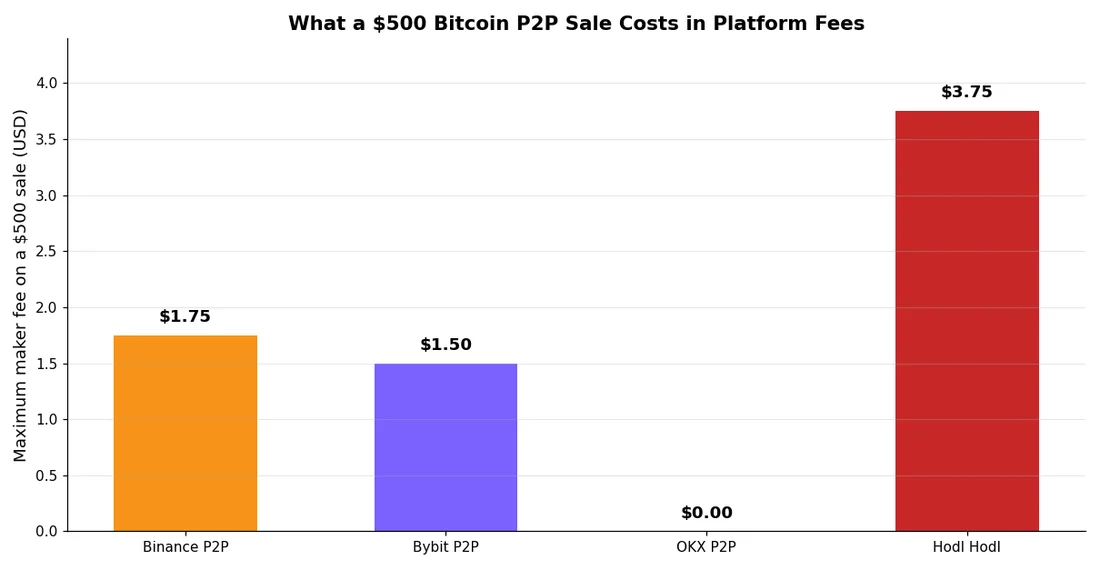
Liquidity matters more than fees. Binance counted about 57,100 live P2P ads and Bybit about 29,400 when checked on September 30, 2026, which is why both markets fill orders fast in most currencies.
A cheaper platform with few ads in your currency can cost you more in waiting time and worse prices than a busier one.
Watch the spread as well as the fee. A buyer offering 2% above market with a 0% fee still costs you less than a buyer at market price on a platform with slow settlement, because your money is at risk until the trade closes.
Speed and safety are part of the price, not extras.
Common Mistakes Sellers Make
Most losses in P2P selling come from small mistakes, not from clever hacks. The list below covers the errors that appear most often in dispute reports and safety guides.
- Releasing on a screenshot. A payment image proves nothing. Check your own account, every time, without exception.
- Accepting PayPal for a first trade. PayPal buyer protection is built for shoppers, not crypto trades, and sellers lose these disputes often.
- Trading off-platform to save a fee. The fee you save is a few cents. The protection you lose is the whole trade.
- Ignoring the sender name. If the payment comes from a different name than the verified profile, stop the trade and open a dispute.
- Using an outdated guide. Paxful closed in November 2025 and LocalBitcoins closed in 2023, yet old guides still list them. Check the platform is live before you follow any guide, including this one.
- Forgetting taxes. A P2P sale is still a sale for tax purposes in most countries, and the platform record is your proof of price and date. Keep it.
- Selling more than you can afford to dispute. Start small with a new buyer or a new platform, and scale up only after a few clean trades.
New sellers sometimes ask whether they can sell without identity checks at all. The honest answer is that the safest platforms all require them now, and the trade-offs are real, as our guide to buying bitcoin without ID explains from the buyer side.
For sellers, a verified buyer is protection, not a burden.
Frequently Asked Questions
These questions come from sellers who are learning how to sell bitcoin on p2p platforms for the first time. Each answer follows the same rules as the guide above.
Is selling bitcoin on P2P platforms safe?
Selling bitcoin on P2P platforms is reasonably safe when you use escrow, accept bank transfer or cash, and release coins only after the money shows in your own account. The main risks are fake payment proof and chargebacks, and both are avoidable if you follow the steps in this guide.
What is the safest payment method for selling bitcoin P2P?
A cleared bank transfer is the safest common method, because it is hard to reverse and the sender name is visible. Cash in person is also hard to reverse, but it carries physical safety risks.
Avoid PayPal, Venmo, and gift cards as a seller.
How do I know the buyer really paid?
Open your own banking app or payment app and check the amount, the sender name, and the available balance. A screenshot, SMS, or PDF from the buyer is not proof, because all three can be faked in minutes.
What happens if the buyer never pays?
The trade times out and your bitcoin returns from escrow to your wallet. If the buyer claims they paid but nothing arrived, open a dispute inside the platform and let the support team review the trade record.
Can a buyer reverse the payment after I release the bitcoin?
Yes, if you accepted a reversible method such as PayPal or a credit card payment. Once you release the bitcoin, the platform cannot recover it, and the payment provider may pull the money back.
This is why the payment method ranking in this guide matters more than the platform fee.
Is Binance P2P working after the October 2026 hack?
Binance P2P kept running after the October 29, 2026 incident, which affected about $6.34 billion in assets. Withdrawals resumed in phases from November 1, 2026, and Binance said 98% of the affected assets had been replenished by November 3.
Check the live platform status for your currency before you open a trade, because availability is still being restored in phases.
Sources
- Binance, October 29 Security Incident: Preliminary Findings and Response Update
- Binance, Lesson 15: Binance P2P Safety Rules, How Beginners Can Avoid Scams
- Bybit, How to Buy Cryptocurrency via P2P
Conclusion
Selling bitcoin on P2P platforms safely comes down to three habits. Use escrow on a live platform, accept payments that cannot be reversed easily, and release your coins only after the money sits in your own account.
The scams in this guide all fail against a seller who slows down. Check the payment yourself, check the buyer before you trade, and keep every step inside the platform.
Do that, and P2P stays what it should be: a fast way to turn bitcoin into cash at a fair price.
If you want to compare the other side of the trade first, our guide to buying bitcoin with a wire transfer shows how bank payments work from the buyer side, and the FinCEN decision to withdraw the $250 crypto rule explains the regulatory backdrop for 2026.






