



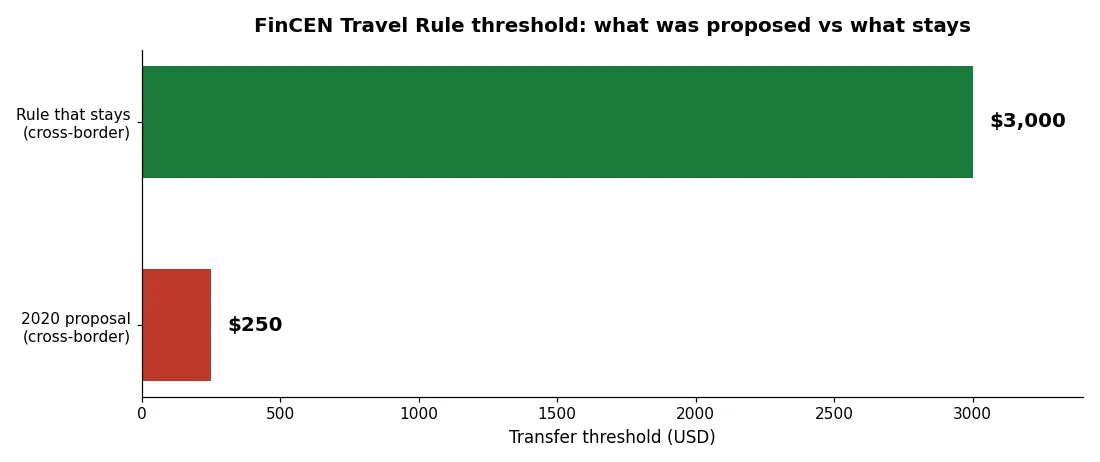
FinCEN and the Federal Reserve just killed the $250 crypto rule. The two agencies filed a joint withdrawal notice on November 6, 2026, and the $3,000 threshold for cross-border transfers stays exactly where it is.
Almost nobody noticed. Bitcoin was sliding toward $76,000 at the same time, and the red charts swallowed the news whole.

Key takeaways
- FinCEN and the Fed withdrew their 2020 plan to cut the cross-border Travel Rule threshold from $3,000 to $250.
- The withdrawal takes effect when the notice is published in the Federal Register on November 9, 2026.
- The $250 plan never took effect, so nothing changes for everyday crypto users today.
- Any future change needs a brand-new proposal and a fresh round of public comment.
- The agencies cited the GENIUS Act and five years of market change as reasons to step back.
What FinCEN and the Fed Actually Did
On November 6, 2026, the Treasury’s Financial Crimes Enforcement Network and the Federal Reserve Board filed a joint withdrawal notice. The document is FR Doc. 2026-22809, and it is scheduled for publication in the Federal Register on November 9, 2026.
- What FinCEN and the Fed Actually Did
- FinCEN Withdraws 250 Crypto Rule: The Plan in Plain English
- What Stays the Same for You
- Why Nobody Noticed: The Crash Swallowed the News
- The GENIUS Act Changed the Math
- What Happens Next
- Frequently Asked Questions
- Did FinCEN cancel the Travel Rule?
- What is the crypto transfer threshold now?
- Does this change what exchanges ask me for?
- When does the withdrawal take effect?
- Can the $250 rule come back?
- The Bottom Line
The notice withdraws a proposal the two agencies published on October 27, 2020. In plain language, the agencies said they “will not take further action” on that proposal.
The withdrawal takes effect on the day the notice is published, November 9, 2026. You can read the notice itself on the Federal Register public inspection page.
FinCEN Withdraws 250 Crypto Rule: The Plan in Plain English
The 2020 proposal targeted two Bank Secrecy Act rules: the Recordkeeping Rule, which makes banks and money transmitters collect and keep details of funds transfers, and the Travel Rule, which makes them pass those details to the next institution in the payment chain.
Both rules use a $3,000 threshold today. The 2020 plan would have cut that line to $250, but only for transfers that begin or end outside the United States.

The proposal also would have spelled out that the rules cover convertible virtual currency. That part mattered because it would have removed any doubt that crypto transfers fall under the same framework as bank wires.
Why $250 Scared Crypto Users
A $250 line would have pulled millions of small transfers into the paperwork net. A $300 payment to family abroad or a $500 exchange withdrawal would have needed full sender and recipient details collected and shared.
Exchanges would have carried the same burden. Every qualifying transfer would have needed identity data attached, stored, and passed along the chain.
What Stays the Same for You
Here is the short version: nothing changes. The $250 plan never took effect, so the rules you live under today are the same rules you lived under last week.
| Rule | 2020 proposal | Rules that stay |
|---|---|---|
| Cross-border threshold | $250 | $3,000 |
| Domestic threshold | $3,000 | $3,000 |
| Crypto coverage | Stated explicitly | Covered under FinCEN’s 2019 guidance |
| Status | Withdrawn Nov 9, 2026 | In force |
FinCEN’s 2019 guidance already treats qualifying crypto transfers as subject to the Travel Rule at $3,000 or more. That guidance stays in force, and exchanges still run their normal anti-money-laundering and customer checks.
If you buy Bitcoin on a regulated exchange, the exchange still verifies your identity. Our guide on how to buy Bitcoin without ID explains the limits of the no-KYC options that exist today.
Why Nobody Noticed: The Crash Swallowed the News
Bitcoin traded near $75,900 on the morning of November 7, 2026. It had fallen from above $80,000 earlier in the week, and US spot Bitcoin ETFs saw $430.2 million in net outflows on November 5 alone.
Traders were watching support levels and liquidation counts, not the Federal Register. A quiet regulatory withdrawal never stood a chance against a red chart.
That is a shame, because the withdrawal is the better story. Price moves fade in a week, but a rule that never takes effect shapes the market for years.
Washington just handed crypto users a real win, and the market yawned because the win arrived on a down day. The agencies did not only drop a bad threshold, they admitted in writing that five years had passed and the world had changed.
The GENIUS Act Changed the Math
The withdrawal notice points to the GENIUS Act, the federal stablecoin law that took effect on July 18, 2025. The agencies said the market and the law have moved so far since 2020 that the old proposal no longer fits.
Trump signed the GENIUS Act into law in July 2025. The law gave stablecoins a federal framework for the first time.
The CLARITY Act died in the Senate, and that failure left regulators to clean up old proposals one at a time. This withdrawal is part of that cleanup.
A Pattern, Not a One-Off
This is not the first dormant crypto proposal to land in the bin. The agencies had already shelved earlier wallet and mixer proposals before this one.
The SEC and CFTC have pushed their own Project Crypto agenda in parallel. The direction of travel in Washington is now toward fresh rules written for today’s market, not patches on 2020 drafts.
What Happens Next
The agencies left the door open, but only just. They said any future change to these rules would come through a new proposal, with a new chance for the public to comment.
The notice puts it plainly: “no final rule will be issued without an additional opportunity for public comment.” That sentence is the real protection for users.
For now, watch two things: whether Congress revives market-structure legislation after the CLARITY Act failed, and whether FinCEN writes a fresh crypto rule that reflects the GENIUS Act era instead of the 2020 one.
Remittance users should also watch the stablecoin space. Western Union is betting on stablecoins to defend its global remittance business, and cheaper cross-border rails make the old threshold debate matter even less.
Frequently Asked Questions
Here are the questions readers keep asking about the withdrawal. The answers come straight from the notice and the rules that stay in force.
Did FinCEN cancel the Travel Rule?
No, FinCEN and the Fed withdrew a 2020 proposal to lower the threshold. The Travel Rule itself stays in force at the $3,000 threshold for qualifying cross-border transfers.
What is the crypto transfer threshold now?
The threshold stays at $3,000 for transfers that begin or end outside the United States. FinCEN’s 2019 guidance treats qualifying crypto transfers the same way.
Does this change what exchanges ask me for?
No, exchanges still run their normal identity and anti-money-laundering checks. The $250 plan never took effect, so nothing about your account changes.
When does the withdrawal take effect?
The withdrawal takes effect on November 9, 2026, when the notice is published in the Federal Register.
Can the $250 rule come back?
Only through a brand-new proposal with a fresh public comment round. The agencies promised that no final rule will be issued without another opportunity for public comment.
The Bottom Line
FinCEN withdraws 250 crypto rule is a headline worth more than the attention it got. The $3,000 threshold stays, your everyday transfers stay untouched, and the government just promised it will not spring a new threshold on you without asking first.
That promise matters more than any single day of price action. Bitcoin will bounce or fall again next week, but a withdrawn rule stays withdrawn, so if you are new to all of this, start with our plain-English guide to what Bitcoin is and our complete guide to Bitcoin payment methods.
This article is for education only, not legal or financial advice. It reflects the FinCEN and Federal Reserve withdrawal notice and market data as of November 7, 2026.






