



Arbitrum price prediction 2026 to 2030 starts with a strange split. ARB trades near $0.166 on November 7, 2026, yet one of the biggest banks on earth says it could reach $10 by 2030.
Our short answer is this. Our base case puts ARB near $0.45 by 2030, with a bull case near $1.20 and a bear case near $0.20.

Nobody knows the real outcome. The gap between the bank target and the model average is about 22 times, and that gap tells you more about this coin than any single forecast does.
- Key Takeaways
- Arbitrum (ARB) Price Today: Where It Stands on November 7, 2026
- What Is Arbitrum, in Plain Words?
- Why ARB Fell 93% From Its Peak
- The $10 Bank Target: What Standard Chartered Actually Said
- What the Models Say: The $0.45 Average
- The 60x Gap: What Each Forecast Really Means
- Our Arbitrum Price Prediction 2026-2030
- 5 Things That Could Push ARB Up
- 5 Risks That Could Hold ARB Back
- Common Mistakes People Make With ARB Predictions
- Frequently Asked Questions
- What is the Arbitrum price prediction for 2030?
- Can ARB reach $10 by 2030?
- Can ARB reach $1?
- What is ARB worth today?
- Why is ARB so far below its all-time high?
- Is Arbitrum a good investment?
- The Bottom Line
ARB trades near $0.166 on November 7, 2026, based on price pages that put it between about $0.1615 and about $0.1717 in the last 24 hours. Its market value sits near $1.14 billion, with about 6.89 billion coins in circulation out of a 10 billion maximum.
That puts Arbitrum around rank 69 among all cryptocurrencies. It sits about 93 percent below its January 2024 peak near $2.39, and it is down about 44 percent from where it traded a year ago.
Key Takeaways
- ARB trades near $0.166 on November 7, 2026, with a market value near $1.14 billion, rank 69, and about 6.89 billion coins in circulation out of a 10 billion maximum.
- ARB is down about 8.5 percent in the last 30 days, even though it closed November 6 at $0.17, up from $0.1557 on November 2.
- Standard Chartered set a $10 ARB target for the end of 2030, with $0.50 by the end of 2026, $1.50 in 2027, $3.50 in 2028 and $6.50 in 2029.
- Algorithmic models are far more modest. CoinStats puts the 2030 average near $0.45, with a low of $0.20 and a high of $1.20.
- This article translates every published 2030 forecast into market value, so you can see what each target would actually require. A $10 ARB needs a $100 billion fully diluted value, about 60 times today’s price.
- Our 2030 scenario bands run from $0.20 in the bear case to $1.20 in the bull case, with $0.45 as the base case. None of this is investment advice.
Arbitrum (ARB) Price Today: Where It Stands on November 7, 2026
ARB woke up to a quiet session on November 7, 2026. It trades near $0.166, down about 1 percent in 24 hours, and it moved with Bitcoin, which sits near $76,000 after the November 5 to 6 selloff.
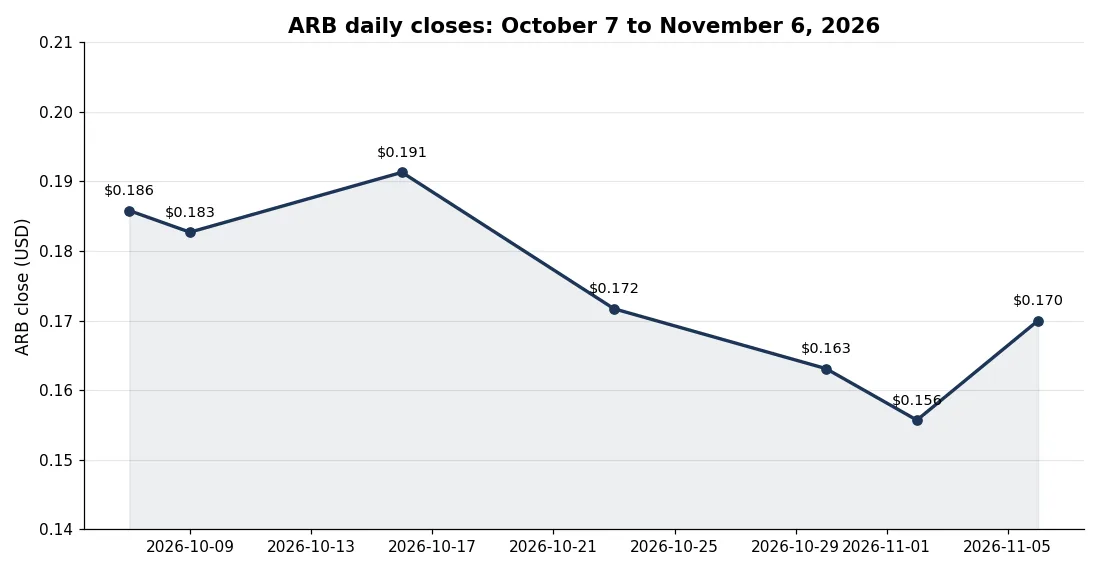
Zoom out a little and the picture looks steadier than the headlines suggest. ARB is up about 2 percent over the last 7 days, and it bounced from $0.1557 on November 2 to a $0.17 close on November 6, so the week ended with buyers stepping back in.

| Metric | Value on November 7, 2026 |
|---|---|
| Price | About $0.166 |
| 24-hour change | About -1% |
| 7-day change | About +2% |
| 30-day change | About -8.5% |
| Market value | About $1.14 billion |
| Market rank | About 69 |
| Circulating supply | About 6.89 billion ARB |
| Maximum supply | 10 billion ARB |
| Fully diluted value | About $1.66 billion |
| 24-hour trading volume | About $130 million to $170 million |
| Total value locked | About $1.4 billion |
| All-time high | $2.39 on January 12, 2024 |
| All-time low | $0.0705 on June 26, 2026 |
| Distance from all-time high | About 93% below |
Two numbers in that table deserve a second look. First, total value locked near $1.4 billion is bigger than the market value near $1.14 billion, which means more money sits inside Arbitrum apps than the whole token is worth on paper.
Second, ARB trades about 135 percent above its all-time low from June 2026. The coin already doubled from its worst point this year, and it still sits 93 percent below its peak, which shows how far it fell and how little of that fall it has recovered.
The last five weeks tell the same story in miniature. ARB closed at $0.1913 on October 16, slipped to $0.1717 on October 23, then to $0.1631 on October 30, and it closed November 6 at $0.17 after dipping to $0.1557 on November 2.
That is a coin drifting sideways in a weak market, not a coin in free fall and not a coin in a rally. Any 2030 forecast has to start from that flat base, not from the old $2.39 peak.
What Is Arbitrum, in Plain Words?
Arbitrum is a layer 2 network built on top of Ethereum. It takes Ethereum transactions, bundles them together, and settles them on Ethereum, which makes them faster and cheaper than using Ethereum directly.
ARB is the token that governs it. Holders vote on upgrades, grants and treasury spending, and the token is the face of the network even though it does not pay gas fees, because users pay fees in ETH.
Think of it this way. Ethereum is a busy highway with expensive tolls, while Arbitrum is an express lane built next to it that still ends at the same destination.
That link is both its biggest strength and its biggest weakness, because Arbitrum needs Ethereum to stay popular and it needs to beat every other express lane that copies the same idea.
What ARB Actually Does
ARB is a governance token first and a store of value second. Holders vote through the Arbitrum DAO, and the DAO controls a large treasury that funds grants, programs and chain growth.
ARB does not give holders a direct claim on network revenue today. The network earns fees, yet no rule sends that money to token holders automatically, and that missing link sits at the center of every honest ARB forecast.
That gap matters for price. A chain can grow fast while its token stays flat, because the token only rises when buyers want the token itself, not just the chain it governs.
Why Ethereum Needs Layer 2s
Ethereum is secure and trusted, yet it handles only a small number of transactions per second. Fees spike when the network gets busy, and ordinary users get priced out of simple trades and transfers.
Layer 2 networks fix that by doing the heavy work off the main chain. Our earlier coverage of Bitcoin versus Ethereum and the 9 key differences every beginner must know explains why Ethereum became the home for apps in the first place, and layer 2s exist to keep those apps usable.
Arbitrum is the biggest of these networks by usage, and it also lets other teams launch their own chains with its technology through Orbit chains. That second business, selling the toolkit to others, is where the newest forecasts find their growth story.
Why ARB Fell 93% From Its Peak
ARB hit about $2.39 in January 2024, in the excitement that followed the first US spot Bitcoin ETFs. The coin then slid for almost two years, and it bottomed near $0.0705 on June 26, 2026.
Three forces drove the fall. First, the whole market cooled after the 2024 peak, and layer 2 tokens fell harder than Bitcoin because traders treat them as riskier bets.
Second, new ARB kept entering the market on a fixed unlock schedule. The schedule runs from March 2023 to March 2027, and it releases the full 10 billion supply across 49 unlock events, so sellers had fresh supply to meet for years.
Third, competition arrived fast. Base, built by Coinbase, grew quickly and took users and attention, while other layer 2s chased the same developers with grants and cheaper fees.
The recovery since June tells a quieter story. ARB closed 2026’s first trading days near $0.21, fell to about $0.0975 by March 23, bottomed in June, and then climbed to a 2026 closing high of $0.2353 on September 22.
That September peak came one week after Standard Chartered started covering the token. The bank note gave ARB a new story to tell, and the market listened for about a week before the wider selloff dragged it back under $0.20.
The lesson is simple. ARB can double from its lows and still sit 93 percent below its peak, because the peak was priced on hope and the lows were priced on unlocks and competition, and neither extreme tells you what the token is worth today.
The $10 Bank Target: What Standard Chartered Actually Said
On September 15, 2026, Standard Chartered started covering ARB and set a $10 target for the end of 2030. Geoff Kendrick, the bank’s global head of digital assets research, led the call, and the report was titled “Arbitrum: The blockchain for TradFi”.
The bank did not pick $10 out of thin air. It published a year by year path, and each step assumes more traditional finance activity moves onto Arbitrum chains.
| Year-end | Standard Chartered ARB target | Multiple from $0.166 today |
|---|---|---|
| 2026 | $0.50 | About 3 times |
| 2027 | $1.50 | About 9 times |
| 2028 | $3.50 | About 21 times |
| 2029 | $6.50 | About 39 times |
| 2030 | $10.00 | About 60 times |
Read that table twice. The bank expects ARB to triple by the end of 2026, then triple again in 2027, and keep climbing every year after that, which is a very specific kind of bet.
It is a bet on adoption, not on a single event. The bank expects ARB to beat both Bitcoin and Ethereum over the same period, which only works if Arbitrum takes a much bigger share of financial activity than it holds today.
The Robinhood Chain Catalyst
The near-term engine in the bank’s thesis is Robinhood Chain. The chain launched its public mainnet in July 2026 using Arbitrum technology, and it is the first big institutional example of the Arbitrum Expansion Program at work.
Under that program, Arbitrum receives 10 percent of net protocol revenue from participating chains. Reports put the September fee flow from Robinhood Chain near $5 million, which is small money today yet real money from a real product.
The logic runs like this. If one big broker chain pays a little, then ten big finance chains could pay a lot, and Arbitrum’s revenue would grow without the main chain doing anything new.
That logic has a hole, and the bank admits it. Revenue flows to the Arbitrum DAO treasury, not to ARB holders, so the token needs a separate step, a vote or a new rule, before chain revenue becomes token demand.
The Tokenization Bet
The long-term engine is tokenized real-world assets. Standard Chartered expects the tokenized asset market to grow from about $340 billion to $4 trillion by 2028, and it expects Arbitrum to host a large share of that activity.
Tokenization means putting stocks, bonds, funds and property onto a blockchain. Banks like the idea because settlement gets faster and cheaper, and Arbitrum wants to be the rails those banks use.
This is a multi-year story, not a 2026 story. A $4 trillion market by 2028 would need banks to move far faster than they have moved so far, and any delay pushes the whole forecast back with it.
What the Models Say: The $0.45 Average
Algorithmic models tell a much quieter story than the bank. CoinStats published a full 2026 to 2030 range for ARB, and its numbers sit far below the bank’s path at every step.
| Year | Low | Average | High |
|---|---|---|---|
| 2026 | $0.14 | $0.20 | $0.30 |
| 2027 | $0.12 | $0.22 | $0.45 |
| 2028-2029 | $0.15 | $0.35 | $0.80 |
| 2030 | $0.20 | $0.45 | $1.20 |
The model assumes the unlock schedule finishes in March 2027 and supply pressure eases after that. It also assumes fee income grows slowly, not in the leaps the bank expects, so the price climbs in small steps.
Notice the 2027 low of $0.12. The model leaves room for one more dip below today’s price, because unlocks run until March 2027 and the market still has to absorb that supply.
Compare the two views side by side and the split is stark. The bank sees $1.50 in 2027, while the model average sees $0.22, and that is nearly a 7 times difference in the same year.
Other forecast sites cluster near the model, not the bank. Most published ARB forecasts for 2030 land between about $0.20 and about $1.20, which makes Standard Chartered the clear outlier in the room.
The 60x Gap: What Each Forecast Really Means
Forecasts sound alike until you turn them into market value. A price target is only a number, while a market value shows how much money the world would need to believe in that number.
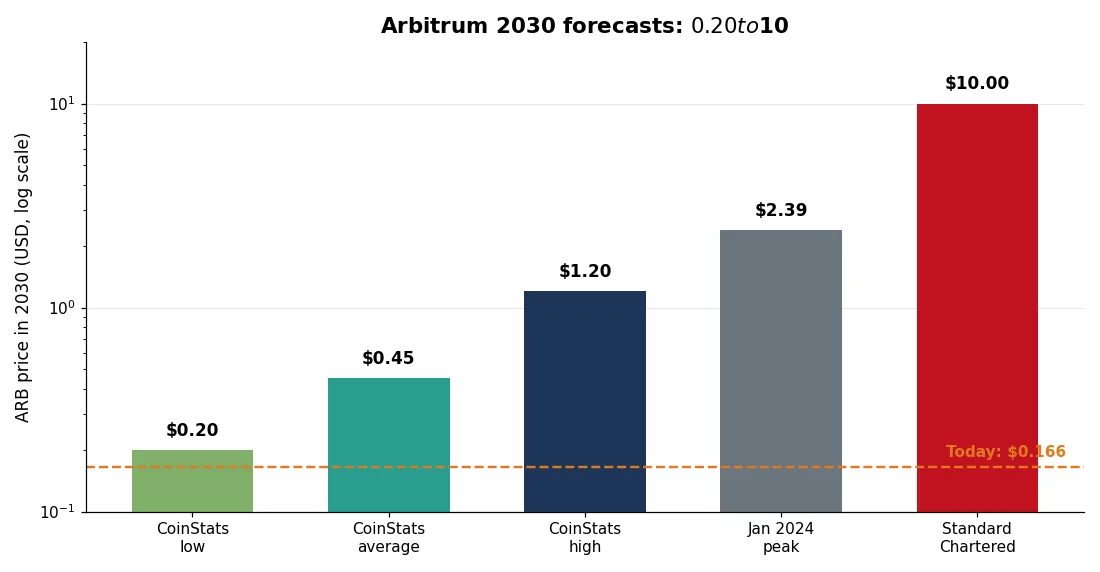
We did that maths for every published 2030 forecast. We multiplied each target by the 6.89 billion coins in circulation today, and by the 10 billion maximum supply, so you can see the full size of each bet.
| 2030 forecast | Source | Price | Multiple from $0.166 | Implied market value | Implied fully diluted value |
|---|---|---|---|---|---|
| Bear case | CoinStats low | $0.20 | About 1.2 times | About $1.38 billion | About $2.0 billion |
| Base case | CoinStats average | $0.45 | About 2.7 times | About $3.10 billion | About $4.5 billion |
| Bull case | CoinStats high | $1.20 | About 7.2 times | About $8.27 billion | About $12.0 billion |
| Old peak | January 2024 high | $2.39 | About 14.4 times | About $16.5 billion | About $23.9 billion |
| Bank target | Standard Chartered | $10.00 | About 60 times | About $68.9 billion | About $100.0 billion |
Now the gap has a shape. The model average needs ARB to grow to a $4.5 billion fully diluted value, which is a big but normal outcome for a working layer 2 network.
The bank target needs a $100 billion fully diluted value. That would put ARB near the size of the largest altcoins today, and it would need tokenized finance to arrive on schedule and Arbitrum to win most of it.
The $1 test sits in between. One dollar per ARB means about $6.89 billion of market value, or about $10 billion fully diluted, which is roughly 6 times today’s price and a fair first milestone for any bull case.
This table is the heart of this article. Every other ARB forecast page lists the targets, yet none of them shows what each target costs in market value, and that missing step is where most readers get misled.
Our Arbitrum Price Prediction 2026-2030
Our scenarios follow the model averages, not the bank outlier, because models price what exists today while the bank prices a future that still needs to happen. We keep the bank target in view as a stretch case, not as the base case.
| Year | Bear case | Base case | Bull case | Standard Chartered |
|---|---|---|---|---|
| 2026 | $0.12 | $0.20 | $0.30 | $0.50 |
| 2027 | $0.12 | $0.22 | $0.45 | $1.50 |
| 2028 | $0.15 | $0.35 | $0.80 | $3.50 |
| 2029 | $0.15 | $0.35 | $0.80 | $6.50 |
| 2030 | $0.20 | $0.45 | $1.20 | $10.00 |
For the rest of 2026, our base case is about $0.20. ARB needs a calm Bitcoin and a steady market to drift up from $0.166, and the bank’s $0.50 year-end target looks like a stretch with less than two months left in the year.
For 2027, our base case is about $0.22. The final unlock lands in March 2027, and the market should feel lighter after that, yet the first half of the year still carries supply pressure.
For 2028 and 2029, our base case is about $0.35. This is the slow grind phase, where Orbit chains and tokenized assets either start paying real fees or they do not, and the price will follow the revenue.
For 2030, our base case is about $0.45, with $1.20 as the bull case and $0.20 as the bear case. A $1 ARB inside this window would already be a strong result, and it would need the bull case to arrive early.
Compare that with our other layer 2 and altcoin calls to keep the scale honest. Our Uniswap price prediction for 2026 to 2030 uses the same scenario method, and our Cronos price prediction for 2026 to 2030 translates every forecast into market value the same way, so you can judge ARB against the same yardstick.
5 Things That Could Push ARB Up
Five forces could lift ARB above our base case. Each one is real, and each one still needs to happen before it counts.
First, Robinhood Chain could grow fast and pay more fees. A $5 million September fee flow is a start, and a tenfold rise would turn the Arbitrum Expansion Program into a real revenue line.
Second, tokenized assets could arrive on schedule. A $4 trillion market by 2028 would need Arbitrum to win only a small share to matter, because the market itself would be so large.
Third, the unlock schedule ends in March 2027. No more scheduled supply means sellers lose their steadiest source of new coins, and buyers face a cleaner market.
Fourth, the DAO could link revenue to the token. A vote to share fees, buy back ARB, or burn supply would change the token’s story overnight, and it is the single most powerful lever nobody has pulled yet.
Fifth, Ethereum itself could rally hard. ARB follows ETH in most market moves, and a strong ETH cycle lifts every layer 2 token with it, so ARB does not need to win alone.
5 Risks That Could Hold ARB Back
Five risks could push ARB toward our bear case. Each one is already visible today, and none of them needs a surprise to hurt.
First, ARB holders still have no direct claim on revenue. A chain can grow while its token stays flat, and that is exactly what happened for much of 2025 and 2026.
Second, Base keeps growing. Coinbase gives Base a built-in user base, and every developer who picks Base is one who did not pick Arbitrum.
Third, tokenization could move slowly. Banks talk about onchain assets for years before they move real money, and a delay of two years would push the bank’s whole forecast back with it.
Fourth, Bitcoin could fall again. ARB trades near $0.166 while Bitcoin sits near $76,000 after a selloff, and another leg down in Bitcoin would drag ARB with it.
Fifth, regulation could bite. Our Pepe price prediction for 2026 to 2030 faces the same market-wide risk, and our Bittensor price prediction for 2026 to 2030 shows how fast sentiment can turn on any single altcoin, so ARB is not special here.
Common Mistakes People Make With ARB Predictions
The first mistake is reading $10 as a promise. Standard Chartered published a target with assumptions attached, and the bank itself listed the risks, so treat it as a scenario, not a guarantee.
The second mistake is anchoring on $2.39. The old peak came from a different market with different supply, and ARB would need a $23.9 billion fully diluted value to return there.
The third mistake is ignoring unlocks. About 3.1 billion ARB still sits outside circulation, and the market has to absorb that supply before March 2027, so price pressure has a calendar, not just a mood.
The fourth mistake is confusing chain growth with token growth. Arbitrum can win users, TVL and fees while ARB stays flat, because the token has no automatic share of that success.
The fifth mistake is forgetting the bear case. Our Shiba Inu price prediction for 2026 to 2030 and our Sui price prediction for 2026 to 2030 both keep a low band for the same reason, because every altcoin forecast needs a floor that assumes things go wrong.
Frequently Asked Questions
Readers ask the same few questions about ARB, so here are the short answers. Each one matches the numbers in the tables above.
What is the Arbitrum price prediction for 2030?
Our base case puts ARB near $0.45 by 2030, with a bull case near $1.20 and a bear case near $0.20. Standard Chartered is far more bullish, with a $10 target for the end of 2030.
Can ARB reach $10 by 2030?
It can only reach $10 if tokenized finance grows to about $4 trillion by 2028 and Arbitrum wins a large share of it. A $10 ARB needs a $100 billion fully diluted value, about 60 times today’s price, so treat it as a stretch case, not a base case.
Can ARB reach $1?
Yes, $1 is a fair bull-case milestone. One dollar per ARB means about $6.89 billion of market value, or about $10 billion fully diluted, which is roughly 6 times today’s price near $0.166.
What is ARB worth today?
ARB trades near $0.166 on November 7, 2026, with a market value near $1.14 billion and a rank near 69. About 6.89 billion coins circulate out of a 10 billion maximum supply.
Why is ARB so far below its all-time high?
ARB peaked near $2.39 in January 2024, then fell on a cooling market, years of scheduled token unlocks, and fast competition from Base and other layer 2 networks. It bottomed near $0.0705 in June 2026 and has climbed about 135 percent since then, yet it still sits about 93 percent below its peak.
Is Arbitrum a good investment?
Nobody can answer that for you, and this article is not investment advice. Arbitrum is the largest Ethereum layer 2 by usage, yet its token has no direct claim on network revenue, so weigh the $0.45 base case against the $0.20 bear case and do your own research before you buy anything.
The Bottom Line
ARB trades near $0.166 after a brutal two years, and the forecasts for 2030 could hardly disagree more. The bank says $10, the models say $0.45 on average, and the truth will depend on whether tokenized finance arrives on schedule.
Our base case is $0.45 by 2030, with $1.20 as the bull case and $0.20 as the bear case. That is a modest gain from here, and it is honest about how much still needs to go right.
Watch three things from here. Watch the March 2027 final unlock, watch the fee flow from Robinhood Chain, and watch whether the DAO ever links revenue to the token.
If all three break in ARB’s favor, the bull case opens up. If none of them do, the bear case is waiting, and the $10 target will stay a headline rather than a price.






