

Yes, you can buy Bitcoin without ID in 2026. Peer-to-peer markets, Bitcoin ATMs, and gift-card vouchers still let you buy Bitcoin without showing a government ID, and this guide shows you how to buy Bitcoin without ID step by step.
But here is the part most guides skip. “No ID” does not mean anonymous, and every route has a hard limit on how much you can buy.

The blockchain records every transaction in public, your bank transfer or phone number can still link a trade to you, and the caps in 2026 are much lower than they were a few years ago.
- What “No ID” Really Means (and What It Does Not)
- The 6 Ways to Buy Bitcoin Without ID at a Glance
- How to Buy Bitcoin Without ID: A Simple Step-by-Step Plan
- 1. Bisq: The Desktop P2P Exchange
- 2. RoboSats: Fast Lightning Trades
- 3. Hodl Hodl: Web-Based Multisig Escrow
- 4. Peach Bitcoin: The Mobile Option
- 5. Bitcoin ATMs: Cash In, Bitcoin Out
- 6. Azteco Vouchers: Gift-Card Simplicity
- What $500 Actually Buys on Each Method
- The 2026 Rules That Shrink No-KYC Buying
- 7 Safety Rules for Buying Without ID
- Common Mistakes to Avoid
- Frequently Asked Questions
- Can you buy Bitcoin without ID in 2026?
- Is it legal to buy Bitcoin without ID?
- What is the cheapest way to buy Bitcoin without ID?
- How much Bitcoin can you buy without ID?
- Do you need ID for a Bitcoin ATM?
- Do you pay tax on Bitcoin bought without ID?
- Sources
This guide puts limits first. You will see how to buy Bitcoin without ID, with the real cap, fee, and cost of each method, a worked example that shows what $500 actually buys on each one at the November 5, 2026 Bitcoin price of about $80,400, and the 2026 rules that are shrinking no-KYC buying in the US and Europe.
Read the limits before you pick a method, and you will avoid the two most common mistakes: paying a 20 percent premium for a $50 buy, and hitting a cap halfway through a larger order.
Key Takeaways
- You can still buy Bitcoin without ID in 2026 through Bisq, RoboSats, Hodl Hodl, Peach, Bitcoin ATMs, and Azteco vouchers.
- Every no-ID route has a hard cap. Bisq Easy stops at $600 per trade, Peach stops at about $1,100 per day, and many US ATMs stop at $900 in total without ID.
- No-KYC costs more. Expect roughly 2 percent extra on a voucher, about 3 percent on RoboSats, and 8 to 20 percent at a Bitcoin ATM.
- No ID does not mean anonymous. The blockchain is public, and your payment method can still identify you.
- In the US, taxes still apply. No-KYC buying changes nothing about reporting a gain when you sell.
What “No ID” Really Means (and What It Does Not)
“No ID” means the platform does not ask you to upload a passport, a driving licence, or a selfie. It does not mean nobody can ever trace the purchase.
Bitcoin runs on a public ledger, and anyone can follow coins from one address to another.

Your payment can also give you away. A bank transfer carries your name, a phone number links to a SIM registration, and a cash deposit at a bank counter sits on camera.
The privacy you gain from skipping ID checks is real, but it is partial, and honest guides say so up front.
Three terms cause most of the confusion, so here they are in plain words. KYC means “know your customer,” the identity checks a regulated exchange must run.
A P2P market matches buyers and sellers directly instead of selling you coins from its own stock. Escrow means a third party, or a piece of code, holds the Bitcoin until both sides confirm the trade, so neither side can run off with the money.
Finally, buying Bitcoin without ID is legal in most countries when you follow the law. It is not a way around sanctions, taxes, or anti-money-laundering rules.
If someone sells you a method as a way to hide income or dodge the tax office, walk away.
The 6 Ways to Buy Bitcoin Without ID at a Glance
Here is the whole field on one screen. Pick your method from this table first, then read the section that covers it in detail, alongside the wider set of ways to pay for Bitcoin covered in our payment methods hub.
| Method | ID needed | Typical cap without ID | Typical extra cost | Best for |
|---|---|---|---|---|
| Bisq Easy | None | $6 to $600 per trade | 10 to 20% premium | First small buy |
| RoboSats | None | About 3 million sats per order (about $2,400) | About 3% over spot | Fast small Lightning buys |
| Hodl Hodl | None | No fixed cap; depends on the offer | Up to 0.6% fee plus seller premium | Web trading without an app |
| Peach Bitcoin | None | About $1,100 per day | About 2% fee plus small premium | Simple mobile buying |
| Bitcoin ATM | Phone number for small buys | About $500 to $900 without ID | 8 to 20% over spot | Cash buyers |
| Azteco voucher | None | $10 to $1,000 per voucher | About 2% online | Cheapest simple buy |
Two patterns jump out of that table. The cheapest routes, Azteco and RoboSats, cap you at small amounts, and the route with the biggest cap, classic Bisq, needs Bitcoin already in hand before you can trade.
That trade-off shapes every decision in this guide.
How to Buy Bitcoin Without ID: A Simple Step-by-Step Plan
Follow these steps in order, no matter which method you pick, because they take about 15 minutes the first time and protect you from the scams that target no-ID buyers. If you want a simpler app-based route and you do not mind showing ID, buying Bitcoin with Cash App is the contrast: fast and cheap, but fully verified.
Step 1: Set up your own Bitcoin wallet first. Download a wallet where you control the keys, write down the recovery phrase on paper, and store it somewhere safe.
Our beginner’s guide to getting a Bitcoin wallet walks through the setup, and our list of the best Bitcoin wallets for beginners compares the safest options. Never leave coins you bought without ID sitting on a platform, because that defeats the purpose.
Step 2: Pick a method from the table above. Match the cap to your amount.
A $100 buy fits Azteco or RoboSats, while a $1,000 buy needs Peach, an ATM with ID, or several smaller trades.
Step 3: Check the live offer before you pay. On P2P markets, each seller sets a different price, so compare two or three offers.
On an ATM, the screen shows the rate before you insert cash, so read it before you commit.
Step 4: Pay only inside escrow. On Bisq, Hodl Hodl, Peach, and RoboSats, the Bitcoin sits locked in escrow until you confirm payment.
Never send money to a seller who asks you to pay outside the platform.
Step 5: Move the coins to your own wallet. Once the trade completes, send the Bitcoin to the wallet you set up in step 1.
Then save a record of the date, amount, and price you paid, because you will need it for tax.
1. Bisq: The Desktop P2P Exchange
Bisq is the oldest no-KYC Bitcoin exchange still running. It is free software, not a company, and it runs as a desktop app on Windows, Mac, and Linux.
There is no account to create and no identity check, and every trade runs over the Tor network.
Bisq locks both sides into a 2-of-2 multisig escrow. That means the Bitcoin and the security deposits sit in an address that needs both traders to agree before the coins move.
Neither Bisq nor a mediator can take the funds on their own, and disputes go to human mediators and arbitrators.
Bisq Easy vs Classic Bisq
Bisq Easy is the simple mode inside Bisq 2, and it is the right start for a first buy. You need no Bitcoin in advance, the seller posts a reputation bond instead of you posting a deposit, and trades run from $6 to $600.
The catch is the price: sellers charge a premium of roughly 10 to 20 percent over the market rate.
Classic Bisq suits larger trades, but it has a cold-start problem. You must already own Bitcoin to post a security deposit, usually 15 percent of the trade amount, with a minimum of 0.001 BTC.
The fee is about 1.3 percent of the trade, split between buyer and seller, and premiums are usually lower than on Bisq Easy.
One warning belongs here. A security review in mid-2026 found serious flaws in the classic Bisq 1 protocol, trading on Bisq 1 was paused while the team fixed them, so check the current status on the official Bisq docs before you use classic Bisq, and start with Bisq Easy if you are unsure.
What Bisq Costs
On Bisq Easy, a $500 buy at a 15 percent premium gives you about $435 worth of Bitcoin. On classic Bisq, the same $500 at a 2 percent premium gives you about $490 worth, but you also lock up a deposit and pay network fees.
New buyers should treat the premium as the price of privacy and compare it with the cheaper options below before they commit.
2. RoboSats: Fast Lightning Trades
RoboSats is a peer-to-peer market that runs on the Lightning Network. You trade through a disposable robot avatar, chat runs over Tor, and the platform charges a total fee of 0.2 percent, split between buyer and seller.
Most offers sit under 3 percent above the market price, which makes RoboSats one of the cheapest no-ID routes.
Trades are small by design. Orders are limited by Lightning capacity to around 3 million satoshis per order, which is about $2,400 at the November 5, 2026 price of $80,400.
That cap suits weekly stacking, not a single large purchase.
You need a Lightning wallet before you trade, and the escrow works through Lightning hold invoices instead of on-chain multisig. The seller locks the Bitcoin in an invoice, you pay with fiat, and the invoice releases when both sides confirm.
It is fast, often done in minutes, but the interface feels technical, so it suits buyers who already use Lightning.
3. Hodl Hodl: Web-Based Multisig Escrow
Hodl Hodl runs in your browser, so you install nothing. You sign up with only an email address and a password, and the platform never holds your funds.
Each trade locks the seller’s Bitcoin in a 2-of-3 multisig escrow, with keys held by the buyer, the seller, and Hodl Hodl, so no single party can move the coins alone.
The fee is at most 0.6 percent per trade, and the seller sets the price, so premiums vary by offer. Some offers sit near the market rate, while others charge several percent extra, so always compare three or four offers before you pick one.
Two limits matter. Hodl Hodl is not available to customers in the United States, so American buyers should skip it.
And because trades settle on-chain, a trade can take longer than a Lightning trade when the network is busy.
4. Peach Bitcoin: The Mobile Option
Peach Bitcoin is a mobile app for iPhone and Android, and it is the easiest no-ID option for a beginner. You create an account with only an email address and a password, and the app stores your data encrypted on your own device.
Trades use 2-of-2 multisig escrow, and Peach steps in to settle disputes.
Swiss rules set the limits. You can buy up to CHF 1,000 per day, about $1,100, and up to CHF 100,000 per year without identity verification.
Your first two trades are capped at CHF 50 each, and the full daily limit opens after those first trades.
The buy fee is about 2 percent, and selling currently costs nothing. Peach also includes a built-in self-custodial wallet with coin control, so you can keep the Bitcoin in the same app or move it to a wallet of your own.
For a simple phone-based buy under $1,100, Peach is hard to beat.
5. Bitcoin ATMs: Cash In, Bitcoin Out
A Bitcoin ATM turns cash into Bitcoin in a few minutes. You tap the screen, type a phone number, scan your wallet QR code, and feed in cash.
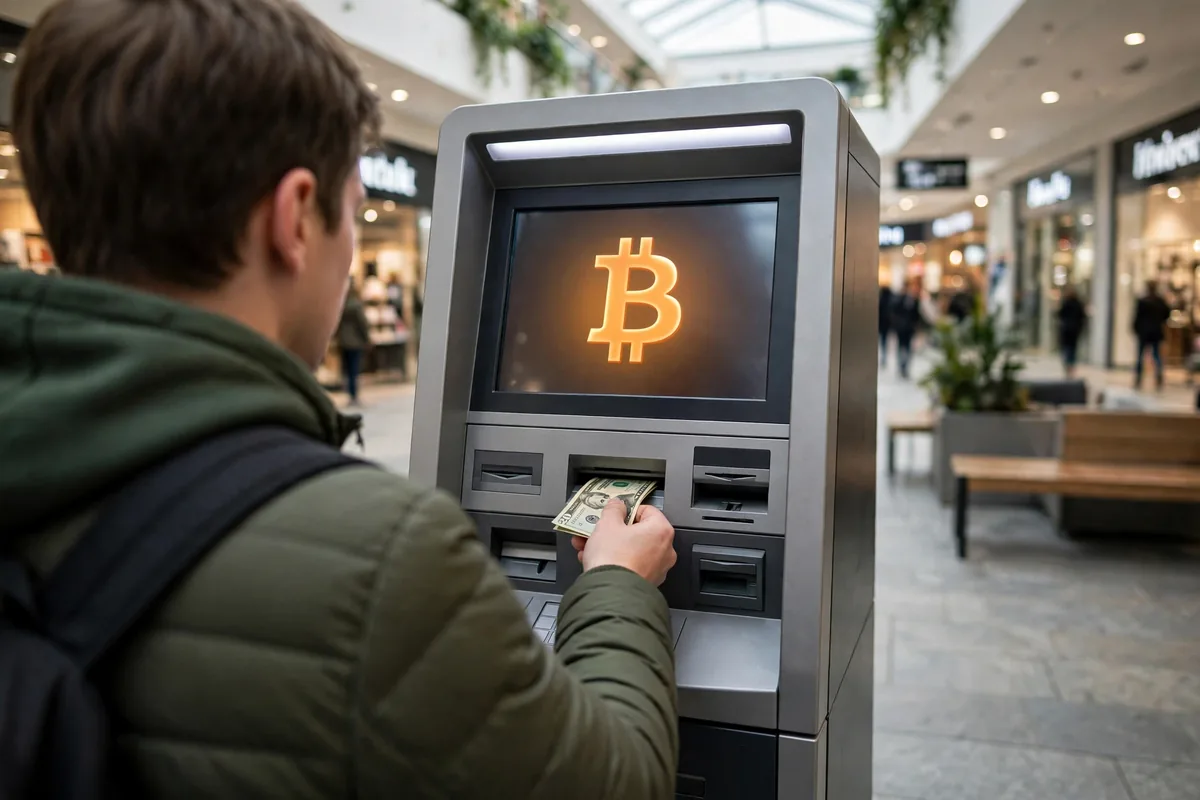
The machine sends the Bitcoin to your wallet, usually within an hour.
The no-ID window is shrinking fast. Most US machines now ask for at least a phone number, and many ask for a government ID once the amount passes $500.
One large operator allows only $900 in total purchases without a verified account, and that is a lifetime figure, not a daily one. Once you pass it, you scan your ID to keep buying.
State laws add more caps on top. California limits every user to $1,000 per day no matter the verification level.
Arizona caps daily buys at $10,500, Colorado at $10,500, and Utah at $5,000. Four states, Indiana, Tennessee, Minnesota, and Hawaii, have banned cash-to-Bitcoin kiosks outright in 2026.
Fees are the real cost of an ATM. Expect 8 to 20 percent above the market price, so a $500 buy can cost you $540 to $600 in effective Bitcoin received.
In February 2026, Bitcoin Depot, one of the largest US operators, started asking for identity verification on every transaction, no matter the size. Check the machine’s rate on screen before you insert cash, and use a locator like Coin ATM Radar to find machines near you.
If you would rather pay cash through a counter than a machine, our guide to buying Bitcoin with Western Union covers another cash-based route.
6. Azteco Vouchers: Gift-Card Simplicity
An Azteco voucher works like a mobile top-up card. You buy a voucher for $10 to $1,000, either online or at a shop, and you get a 16-digit code.
You redeem the code at azte.co/redeem, scan your wallet QR code, and the Bitcoin arrives in under a minute.
You need no account and no ID to buy or redeem a voucher. The online fee is about 2 percent over face value, while buying in person can cost 7 percent or more.
Vouchers come in Lightning and on-chain versions, and they work in more than 190 countries.
Vouchers suit small, simple buys and gifts. You can redeem several vouchers to build a larger amount, but each voucher tops out at $1,000, and some shops set their own lower limits.
Redeem the voucher as soon as you buy it, and never share the code with anyone, because anyone holding the code can redeem it.
What $500 Actually Buys on Each Method
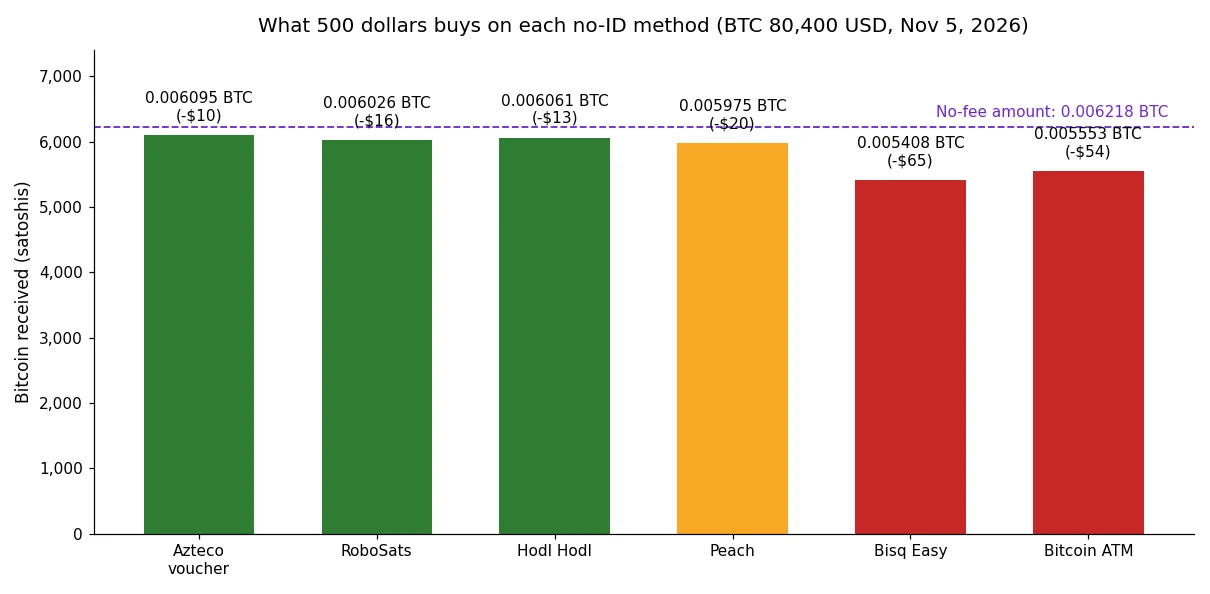
If you are weighing how to buy Bitcoin without ID, the table below works out a $500 buy on each method at the November 5, 2026 Bitcoin price of about $80,400.
At that price, $500 buys 0.006218 BTC with no fees at all, and every row below shows how much of that you actually keep.
| Method | Extra cost used | Bitcoin you receive | Value lost |
|---|---|---|---|
| Azteco voucher | 2% fee | 0.006095 BTC | About $10 |
| RoboSats | About 3% premium plus 0.2% fee | 0.006026 BTC | About $16 |
| Hodl Hodl | About 2% premium plus 0.6% fee | 0.006061 BTC | About $13 |
| Peach Bitcoin | 2% fee plus small premium | 0.005975 BTC | About $20 |
| Bisq Easy | 15% premium (midpoint) | 0.005408 BTC | About $65 |
| Bitcoin ATM | 12% markup (midpoint) | 0.005553 BTC | About $54 |
These numbers are estimates, not quotes. Each seller sets a different premium, and ATM markups move from machine to machine, so your exact result will differ by a few dollars.
The ranking holds up, though: Azteco and RoboSats keep the most Bitcoin, while Bisq Easy and ATMs cost the most.
The lesson is simple. For a $500 buy, the gap between the cheapest and the most expensive method is about $55, which is 11 percent of your money.
Check the premium before you pay, and the method you pick matters more than the method you skip.
The 2026 Rules That Shrink No-KYC Buying
No-KYC buying is getting harder, not easier, and three rule changes explain why. Know them before you plan a large purchase, because they set the real ceiling on every method above.
In the European Union, the MiCA regulation now forces every licensed crypto provider to run full identity checks. The Transfer of Funds Regulation adds a sharper edge: when a transaction touches a regulated provider, there is no small-amount exception at all.
A private trade between two people using their own wallets is still outside these rules, but the moment a licensed exchange, ATM, or payment firm sits in the middle, ID checks apply.
In the United States, the tax rules changed first. Brokers must now report gross proceeds from crypto sales on Form 1099-DA, and from January 1, 2026 they must also report cost basis for covered assets, meaning coins bought and held in the same broker account.
Peer-to-peer trades and self-custody wallets are not brokers, so no form arrives for them, but the tax itself still applies. You report the gain on your return whether or not anyone sends you a form, and you need your own records of what you paid.
Bitcoin ATMs face their own wave of state laws. California caps all users at $1,000 a day, several states cap new customers at $2,000 a day for their first days, and the FBI reported more than $333 million in losses tied to crypto kiosks in 2025.
Operators answer with tighter checks, and the trend points one way.
7 Safety Rules for Buying Without ID
No-ID buying removes the safety net of a regulated exchange, so your own habits carry the risk. These seven rules cover the scams that actually happen.
1. Never pay outside escrow. If a seller asks you to pay by gift card, wire, or direct transfer outside the platform, stop the trade, because escrow is the only thing that stops a seller from taking your money and vanishing.
2. Never write “Bitcoin” in a payment reference. Banks flag crypto-related transfers, and some freeze accounts over them, so use a neutral reference or none at all, and the same rule applies to a bank wire transfer for Bitcoin, where the sender name must match the account holder.
3. Check the seller’s history. On every P2P market, sellers carry a trade count and a rating, so pick sellers with dozens of completed trades, not a brand-new account with a too-good price.
4. Meet in public for cash trades. If you pay cash in person, meet in a busy public place in daylight, bring a friend, and confirm the Bitcoin in your wallet before you hand over the cash.
5. Start small. Run a $50 test trade with a new seller or a new method before you send $500, because a small test costs little and exposes a scammer fast.
6. Keep your own records. Save the date, amount, price, method, and seller name for every buy, because without a broker statement, your own notes are the only proof of your cost basis when you sell.
7. Move coins to your own wallet. Coins left on a P2P platform or in an app wallet are not fully yours, so send them to a wallet where you hold the keys and back up the recovery phrase on paper.
Common Mistakes to Avoid
The most expensive mistake is buying more than the cap allows. A buyer who plans a $2,000 ATM purchase without ID will hit the wall at $500 or $900, and a buyer who plans a $2,000 Bisq Easy trade will find the limit is $600.
Check the cap before you start, and split large buys across methods or days.
The second mistake is mixing no-KYC coins with KYC coins. If you send coins bought without ID into the same wallet as coins from a regulated exchange, you link the two histories forever.
Keep them in separate wallets if privacy matters to you.
The third mistake is forgetting tax. No-KYC means no form from a broker, not no tax.
Track every buy, because the tax office can still ask how you got the coins and what you paid for them.
The fourth mistake is trusting a “no verification” ad. Scam sites copy the look of real P2P markets and promise unlimited no-ID buying.
Real platforms have caps, fees, and escrow. If an offer has none of those, it is a scam.
You now know how to buy Bitcoin without ID, what each method costs, and where the caps sit.
Start with a small test trade, move the coins to your own wallet, and keep your records.
Frequently Asked Questions
These are the questions readers ask most about buying Bitcoin without ID.
Can you buy Bitcoin without ID in 2026?
Yes. This guide explains how to buy Bitcoin without ID through six methods: Bisq, RoboSats, Hodl Hodl, Peach, Bitcoin ATMs, and Azteco vouchers, and each method has a hard cap, though the cheapest routes cap you at small amounts.
Is it legal to buy Bitcoin without ID?
Yes, in most countries, buying Bitcoin without ID is legal when you follow the law. It does not exempt you from taxes, sanctions, or anti-money-laundering rules, and using it to hide income or evade tax is illegal.
What is the cheapest way to buy Bitcoin without ID?
Azteco vouchers are the cheapest simple route at about 2 percent over face value, and RoboSats is close at about 3 percent over the market price plus a 0.2 percent fee. Both cap you at small amounts, so they suit buys under $1,000.
How much Bitcoin can you buy without ID?
It depends on the method. Bisq Easy allows $6 to $600 per trade, Peach allows about $1,100 per day, RoboSats allows about $2,400 per order, and many US ATMs allow about $500 to $900 in total without ID.
Classic Bisq allows larger trades, but you need Bitcoin in hand first for the security deposit.
Do you need ID for a Bitcoin ATM?
Most US machines ask for at least a phone number, and many ask for a government ID once the amount passes $500. One large operator allows only $900 in total without a verified account, and California caps all users at $1,000 per day.
Bitcoin Depot asks for ID on every transaction since February 2026.
Do you pay tax on Bitcoin bought without ID?
Yes. Buying Bitcoin without ID changes nothing about tax.
You owe tax on any gain when you sell, swap, or spend the coins, and you must track your own cost basis because no broker sends you a form for a peer-to-peer buy.