



You can convert Bitcoin to gift cards in about five minutes. Pick a platform, choose the brand and the amount, pay from your wallet, and the code lands in your inbox.
That is the easy part. The hard part is knowing what your Bitcoin is actually worth once the platform takes its cut and adds its reward, because the four big platforms do not charge the same way.

This guide explains how to convert bitcoin to gift cards and compares Bitrefill, Coinsbee, CoinGate, and Fold on one question: what does $100 of Bitcoin actually buy on each one? It also walks through a real first purchase and names the lock-in trap that catches first-time buyers.
- What Converting Bitcoin to Gift Cards Actually Means
- What $100 of Bitcoin Actually Buys
- The Four Platforms, Up Close
- Bitrefill: the biggest catalogue
- Coinsbee: the widest reach
- CoinGate: the no-fee European
- Fold: the rewards machine for Americans
- How to Convert Bitcoin to a Gift Card, Step by Step
- The Lock-In Trap Nobody Mentions
- 5 Mistakes That Waste Your Bitcoin
- Frequently Asked Questions
- Can I convert Bitcoin to gift cards without ID?
- Which platform gives the most back on gift cards?
- How long does it take to get a gift card after paying with Bitcoin?
- Can I turn a gift card back into Bitcoin?
- Is it safe to buy gift cards with Bitcoin?
- Do I pay tax when I convert Bitcoin to a gift card?
- Sources
- Conclusion
Key takeaways
- To convert Bitcoin to gift cards, pick a platform, choose the brand and amount, pay from your wallet, and receive the code by email, usually within minutes.
- On a typical $100 card, Bitrefill returns about $101 of value with 1% sats-back, Coinsbee and CoinGate return about $100 at face value, and Fold returns about $106 with a mid-range 6% sats-back rate.
- Lightning payments deliver gift cards in seconds, while on-chain Bitcoin payments take 10 to 30 minutes to confirm.
- Fold pays the highest rewards at 1% to 20% sats-back, but it is US only and requires identity verification, while Bitrefill, Coinsbee, and CoinGate need no ID for standard purchases.
- A gift card is a one-way trip. Once you convert Bitcoin into a gift card, you cannot turn it back into Bitcoin or cash, so only convert what you plan to spend.
- Bitrefill suffered a data breach in March 2026 that exposed about 18,500 purchase records, so use a fresh email address and never reuse a password on a gift card platform.
What Converting Bitcoin to Gift Cards Actually Means
Converting Bitcoin to gift cards means swapping your coins for store credit at a retailer you already use. The platform takes your Bitcoin, buys the gift card at a wholesale price, and sends you the code.
You never touch cash. The retailer never sees your Bitcoin.
The platform sits in the middle and keeps the difference between the wholesale price and the price you pay, then shares some of it back as rewards.
Why people do it
Most people convert Bitcoin to gift cards because they want to spend crypto without a bank account in the middle. An Amazon or Uber gift card turns coins into groceries or a ride in minutes, with no exchange withdrawal and no waiting for a bank transfer.

Others use gift cards to gift Bitcoin without teaching the recipient how a wallet works. A $50 Steam or Netflix card is easier to hand to a teenager than a seed phrase, and the recipient spends it the same day.
What you actually receive
You receive a code, not a physical card, in most cases. The code arrives by email or shows on screen right after payment, and you redeem it in the retailer’s app or website.
The code has a fixed face value, such as $25, $50, or $100. It spends like cash at that retailer, but only at that retailer, and that limit is the most important fact in this whole guide.
What $100 of Bitcoin Actually Buys
Every platform claims it sells gift cards at face value, and that claim is mostly true. The real differences hide in three places: the small premium some brands carry, the exchange rate spread baked into the checkout price, and the rewards paid back after the purchase.
The table below puts all four platforms side by side on a typical $100 card, using the figures each platform and independent comparison pages published in 2026. The chart shows the same numbers as the value you walk away with.
| Platform | What a $100 card costs | Rewards back | Value you end up with | ID check | Best for |
|---|---|---|---|---|---|
| Bitrefill | $100 on most brands, up to $102 on Amazon and prepaid cards | 1% to 10% sats-back, 1% baseline | About $101 | No, for standard purchases | Biggest catalogue and fastest Lightning delivery |
| Coinsbee | $100 to $105 depending on brand and region | None standing | About $100 | Email only for most orders | Altcoins and countries other platforms skip |
| CoinGate | $100, no fee for paying in crypto | Promo deals only | About $100 | Light touch, verification possible above 700 euros | Paying with coins other than Bitcoin |
| Fold | $100 | 1% to 20% sats-back, 4% to 8% on popular brands | About $106 | Yes, identity verification required | US shoppers who want maximum Bitcoin back |
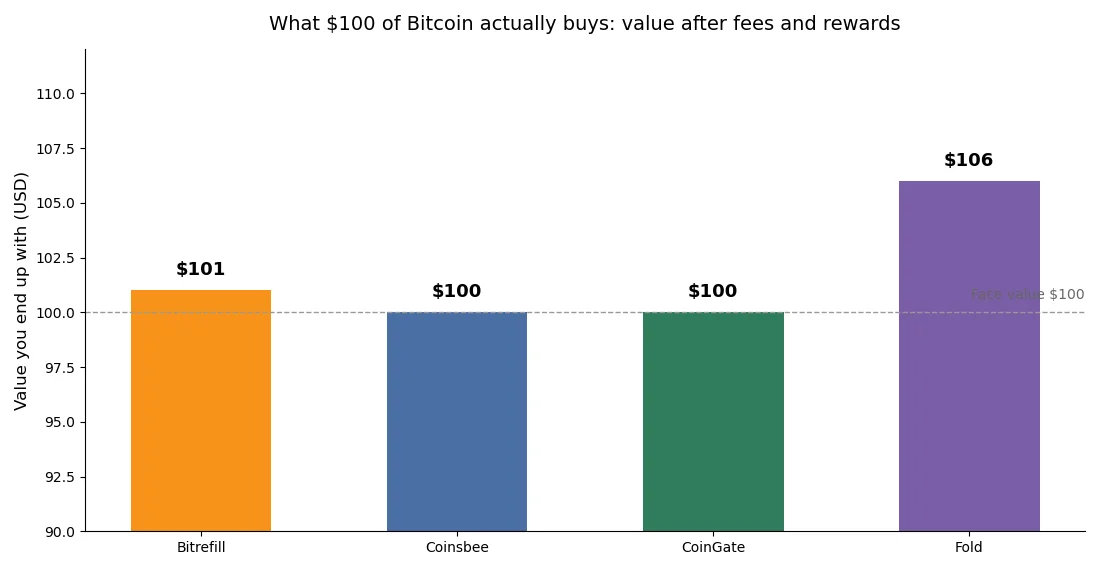
The chart uses a typical brand at face value and mid-range rewards: 1% sats-back on Bitrefill and 6% on Fold, the middle of its 4% to 8% range for popular merchants. Your own result moves with the brand you pick, because a card with a 2% premium and a 10% reward behaves very differently from a plain card with no reward.
One cost sits outside this table and hits every platform the same way. Paying on-chain carries a network fee of about $1 to $5 in normal conditions, and platforms embed a 1% to 2% spread in the Bitcoin-to-dollar rate at checkout.
Paying over Lightning removes almost all of that. Lightning fees run to fractions of a cent, and the code arrives in seconds instead of the 10 to 30 minutes an on-chain payment needs to confirm.
If a platform supports Lightning, use it for every gift card under $100.
The full picture of ways to spend Bitcoin sits in our hub of every way to pay with bitcoin, and our Lightning payment guide explains the fast payment rail in plain language.
The Four Platforms, Up Close
All four platforms sell the same basic product, but they serve different people. The right one depends on where you live, which coins you hold, and whether you care more about privacy or rewards.
Bitrefill: the biggest catalogue
Bitrefill is the oldest and largest platform in this category, with more than 5,000 brands across 170-plus countries. It accepts Bitcoin on-chain and over Lightning, plus Ethereum, Litecoin, Dogecoin, USDT, USDC, and a handful of other major coins.
Most cards sell at face value, but Amazon and prepaid debit cards carry a premium of up to about 2%. The sats-back program pays 1% on every purchase and up to 10% on selected brands, credited instantly to your Bitrefill balance for the next order.
No account or ID is required for standard gift card purchases, which makes Bitrefill the simplest option for a first purchase. One warning belongs here: in March 2026, Bitrefill disclosed a data breach attributed to the Lazarus Group that exposed roughly 18,500 purchase records.
The breach did not expose wallet keys or funds, but it is a reminder to use a unique email address and a unique password on any platform that holds your purchase history.
Coinsbee: the widest reach
Coinsbee covers about 185 countries and accepts more than 200 cryptocurrencies, including Solana, Toncoin, Monero, and Dogecoin, plus Binance Pay. If you hold coins outside the major ones, Coinsbee probably takes them directly, while Bitrefill asks you to convert first.
Prices run from face value to about 5% above it, depending on the brand and region. There is no standing cashback program, so you pay the listed price and earn nothing back, but you also face no reward tiers to track.
Most orders need only an email address. Verification can be requested on larger or flagged orders, so very large purchases may take longer than the instant delivery smaller ones get.
CoinGate: the no-fee European
CoinGate is a licensed European payment processor with a gift card shop built on top of a real payments business. It accepts more than 70 cryptocurrencies for gift card purchases and charges no fee for paying in crypto.
The cost sits in the exchange rate spread instead of a line-item fee. That makes CoinGate cheap for holders of less common coins, because you skip the exchange, the spread, and the withdrawal fee of converting to Bitcoin first.
Gift card purchases need only a light-touch check in most cases. The terms state verification may be required on purchases above 700 euros, depending on the payment method and processor, so large orders are not anonymous here.
Fold: the rewards machine for Americans
Fold is the only platform on this list built around rewards first. Its sats-back rates run from 1% to 20% depending on the brand, with popular merchants typically paying 4% to 8%, and Amazon paying about 2.25%.
Fold is US only and Bitcoin only, and it requires full identity verification because it also offers banking products. It became the first Bitcoin financial services company to list on Nasdaq in February 2025, under the ticker FLD, and it dropped its paid Fold+ subscription tier in early 2026, so the rewards are now open to all users at no cost.
If you live in the US and shop at the same stores every week, Fold returns the most Bitcoin per dollar spent. If you live anywhere else, Fold is not an option at all, and Bitrefill or Coinsbee is the practical choice.
How to Convert Bitcoin to a Gift Card, Step by Step
The steps below show how to convert bitcoin to gift cards using a $50 Amazon gift card on Bitrefill, paid over Lightning, because it is the most common first purchase. The same steps work on the other platforms, with different menus and delivery times.
Bitcoin traded near $76,000 in early November 2026, so $50 of Bitcoin is a small fraction of a coin. Your wallet shows the exact amount in sats at checkout, and you should check it before you confirm.
- Pick the platform for your country and coin. Bitrefill covers the most countries, Coinsbee takes the most coins, CoinGate suits European buyers, and Fold suits US shoppers who want rewards. Check the brand you want is listed before you create anything.
- Choose the brand and the amount. Pick the exact retailer, such as Amazon, and the exact face value, such as $50. Check the region on the card, because a US Amazon card does not work on Amazon UK, and some cards only work in the country printed on them.
- Enter your email address. The code arrives here, so use an address you actually check. A fresh email address used only for crypto purchases keeps a breach like the March 2026 Bitrefill incident from linking your shopping to your main inbox.
- Choose Lightning if the platform offers it. Lightning pays in seconds and costs fractions of a cent, while an on-chain payment needs 10 to 30 minutes and a network fee of about $1 to $5. Your wallet needs a Lightning balance or a channel with enough room, so check that before checkout.
- Pay the exact invoice before it expires. A Lightning invoice usually expires in minutes, so scan the QR code and confirm right away. Never pay an invoice twice, and never send a different amount than the invoice shows, because the platform cannot match a wrong payment automatically.
- Redeem the code the same day. Open the email, copy the code, and add it to your retailer account while the details are fresh. A code sitting in an inbox is easy to lose and easy to steal if your email is ever breached.
On the worked example, the $50 Amazon card can cost about $51 in Bitcoin, because Amazon carries a premium of up to about 2% on Bitrefill. The 1% sats-back returns about $0.50 in Bitcoin to your Bitrefill balance, so the net cost lands near $50.50.
On a brand with no premium, the same $50 card costs $50 in Bitcoin and returns the same $0.50, so the net cost is $49.50. That small gap is why the brand you pick matters more than the platform fee on most purchases.
If you are still deciding how to move Bitcoin around before you spend it, our guide to selling Bitcoin on P2P platforms covers the other direction, turning coins into cash through a person instead of a store.
The Lock-In Trap Nobody Mentions
A gift card is a one-way trip. Once you convert Bitcoin into a gift card, you cannot turn it back into Bitcoin, and you usually cannot turn it back into cash either.
That sounds obvious, but it catches people who convert a large amount at once. Bitcoin can double in a year, and a gift card cannot, so every dollar locked into a card is a dollar that stops moving with the market.
Three things you lose the moment you buy
First, you lose the upside. If Bitcoin rises 20% next month, your $100 gift card is still worth $100 at the store, and the gain belongs to the past.
Second, you lose flexibility. A $100 Amazon card cannot buy groceries at a store that does not take Amazon credit, and a card for the wrong region cannot be spent at all.
Third, you lose the refund path. Most platforms state clearly that gift card codes cannot be returned once delivered, because the code is a bearer token and anyone holding it can spend it.
When a gift card still makes sense
A gift card makes sense when you already plan to spend the money at that store this week. If you buy groceries at the same supermarket every week, converting $100 of Bitcoin into that store’s card costs you nothing in real terms.
It also makes sense as a gift. A card bought with Bitcoin and handed to a friend spends exactly like cash at that store, and the friend never needs to learn anything about crypto.
The rule is simple: only convert what you plan to spend soon, at a store you already use. Never convert your whole stack into cards, and never buy a card as a way to hold value.
5 Mistakes That Waste Your Bitcoin
Most losses in gift card conversions come from small mistakes, not from hacks. The list below covers the errors that show up most often in buyer reports and support threads.
- Buying the wrong region. A US card does not work on a UK store, and the platform will not refund it. Check the country printed on the card before you pay.
- Paying on-chain for a small card. A $5 network fee on a $25 card is a 20% surcharge. Use Lightning for anything under $100, or pay with a stablecoin on a cheap network if the platform supports it.
- Ignoring the premium on popular brands. Amazon and prepaid debit cards carry up to about 2% extra on Bitrefill, and Coinsbee runs up to 5% on some brands. Check the total against the face value before you confirm.
- Leaving the code in your inbox. Redeem the code the same day. An unredeemed code in an old email is easy to forget and easy to lose if the account is ever breached.
- Converting more than you will spend. A gift card cannot go back to Bitcoin. Convert a week of shopping, not a month of savings, and keep the rest in your wallet.
One more caution applies if you ever go the other way and sell the card. Our guide to buying Bitcoin with a gift card explains the reverse trade, where gift cards are one of the riskiest payment methods a seller can accept.
Frequently Asked Questions
These questions come from readers who are learning how to convert bitcoin to gift cards for the first time. Each answer follows the same rules as the guide above.
Can I convert Bitcoin to gift cards without ID?
Yes, on Bitrefill, Coinsbee, and CoinGate, standard gift card purchases need no identity verification.
Bitrefill asks for no account at all, Coinsbee asks for an email address, and CoinGate may ask for verification only on purchases above 700 euros. Fold is the exception, because it requires full identity verification.
Which platform gives the most back on gift cards?
Fold gives the most back, with sats-back rates from 1% to 20% and popular merchants typically paying 4% to 8%.
Bitrefill pays 1% to 10%, with a 1% baseline on every purchase. Coinsbee and CoinGate pay no standing cashback, so they return nothing beyond the face value of the card.
How long does it take to get a gift card after paying with Bitcoin?
A Lightning payment delivers the code in seconds, while an on-chain Bitcoin payment takes 10 to 30 minutes for the network to confirm it. Larger or flagged orders on Coinsbee can take longer if the platform asks for verification, so small first orders are the fastest way to test a new platform.
Can I turn a gift card back into Bitcoin?
No, not through the platforms in this guide.
Once a gift card code is delivered, it cannot be returned or converted back to Bitcoin or cash, because the code is a bearer token and anyone holding it can spend it. Only convert amounts you plan to spend at that store.
Is it safe to buy gift cards with Bitcoin?
Buying from Bitrefill, Coinsbee, CoinGate, or Fold is safe in the normal sense, because the platforms are established and the code arrives after payment. The real risks are buying the wrong region, paying on-chain fees on a small card, and leaving an unredeemed code in your inbox, so check the region, use Lightning, and redeem the code the same day.
Do I pay tax when I convert Bitcoin to a gift card?
In most countries, spending Bitcoin counts as disposing of it, which can create a taxable gain, so keep the receipt with the price and date. The rules differ by country, and a local tax adviser can confirm how your country treats a crypto-to-gift-card purchase, including gift tax if you give the card to someone else.
Sources
- Bitrefill, Gift Cards, Mobile Top-Ups and Bill Payments with Bitcoin
- CoinGate, CoinGate Gift Cards vs Bitrefill
- Spark Money, Bitcoin Gift Card Platforms Compared
- Coinsbee, Buy Gift Cards with Crypto
Conclusion
Learning how to convert bitcoin to gift cards is one of the simplest ways to spend crypto, and the four platforms in this guide all do it well. Bitrefill wins on catalogue and speed, Coinsbee wins on coins and countries, CoinGate wins for European buyers with altcoins, and Fold wins on rewards for Americans.
The number that matters is the value you walk away with, not the headline fee. On a typical $100 card, Bitrefill returns about $101, Coinsbee and CoinGate return about $100, and Fold returns about $106, so the gap between the best and worst option is about six dollars per hundred.
Buy small, pay over Lightning, redeem the code the same day, and only convert what you plan to spend soon. Do that, and a gift card stays what it should be: a fast way to turn a little Bitcoin into something you actually need.
If you would rather spend your Bitcoin directly instead of converting it first, bitcoin debit cards let you tap to pay at any store, and our guide to the fastest ways to buy bitcoin covers topping up your balance when it runs low. If privacy matters more than speed, our guide to buying bitcoin without ID explains the no-KYC options and their limits.