


The headline is true, and it is also a trap. An individual in the UAE pays 0% tax on personal Bitcoin gains, and that single fact has pulled thousands of traders to Dubai.
But the 0% rate is not a blanket. It only covers genuine tax residents, and only on personal investment income.

Run the same trading as a business, and the bill changes fast. Crypto business income faces 9% corporate tax above AED 375,000, and individuals cross into that system once business turnover passes AED 1 million a year.
- Key Takeaways
- Bitcoin Tax in the UAE Explained: The Two Catches
- The Worked Comparison: The Same $100,000 Gain in Three Countries
- The Residency Test: A Visa Is Not Tax Residency
- When 0% Stops: The 9% Corporate Tax Trap
- Investor or Business? Three Personas, Three Tax Bills
- VAT, Staking, Mining and Airdrops: The Smaller Taxes
- VARA and the Regulators: Who Watches Crypto in the UAE
- CARF: The 0% Rate Does Not Mean Invisible
- How to Report and Record Your Bitcoin in the UAE
- Five Mistakes That Cost UAE Bitcoin Holders Money
- Frequently Asked Questions
- Is Bitcoin taxed in the UAE?
- Do I need to live in the UAE for 183 days to pay 0% tax?
- When does crypto trading become a business in the UAE?
- What is the UAE corporate tax rate on crypto profits?
- Does VAT apply to Bitcoin in the UAE?
- Will CARF report my crypto to my home country?
- Sources
This guide gives you bitcoin tax in the uae explained in plain language, with the 2026 rules, worked examples in dollars and dirhams, the residency test, and the two catches most guides skip.
This guide is general information only, not tax advice, and tax rules depend on your own situation, so talk to a qualified tax adviser in the UAE before you act.
Key Takeaways
- Individuals in the UAE pay 0% personal income tax and 0% capital gains tax on Bitcoin held as a personal investment.
- The same $100,000 Bitcoin gain costs $0 in the UAE, about $15,000 in the US at the 15% long-term rate, and about $23,040 in the UK at 24% above the 3,000 pound allowance.
- The 0% rate only helps if you are genuinely a UAE tax resident, which usually means 183 days or more in the country, or 90 days with a residence permit and a permanent home or local work.
- Crypto business income faces 9% corporate tax on taxable income above AED 375,000, and an individual becomes subject to corporate tax registration once business turnover exceeds AED 1 million in a calendar year.
- A company with AED 1,000,000 of taxable profit pays AED 56,250 in corporate tax, because only the AED 625,000 above the threshold is taxed at 9%.
- Transfers and conversions of virtual assets are exempt from the 5% VAT, backdated to 1 January 2018, while mining services and explicit fees can still attract VAT.
- The UAE signed the CARF agreement in September 2025, with data collection from 2027 and the first exchanges of information expected in 2028, so the 0% rate does not mean invisible.
Bitcoin Tax in the UAE Explained: The Two Catches
Start with the good news, because it is real. The UAE charges no personal income tax and no capital gains tax on individuals, so a resident who buys Bitcoin with personal money and sells it later keeps the whole gain.
That covers spot trading, holding, and personal staking in most readings of the rules. It does not cover everything, and the two catches decide whether you pay nothing or 9%.

Catch one is residency. You must actually be a UAE tax resident, not just a person with a visa and a flat you rarely visit.
Catch two is activity. Personal investment income sits outside corporate tax, but business income does not, and the line between the two is where traders get caught.
Our full Bitcoin tax guide puts the UAE in context, and it sits at the friendly end of the list. The rest of this article explains how to stay on the friendly side of that line.
The Worked Comparison: The Same $100,000 Gain in Three Countries
Most guides quote the 0% rate and stop. A worked example shows what it is actually worth, so here is the same gain taxed three ways.
Take an investor who bought Bitcoin for $50,000 and sold it for $150,000, a gain of $100,000. She held the coins for more than a year, and she is a genuine tax resident of each country in turn.
| Country | Tax on a $100,000 long-term gain | What you keep |
|---|---|---|
| UAE, individual resident | $0 | $100,000 |
| USA, long-term rate | $15,000 at 15% | $85,000 |
| UK, higher-rate taxpayer | About $23,040 at 24% above the allowance | About $76,960 |
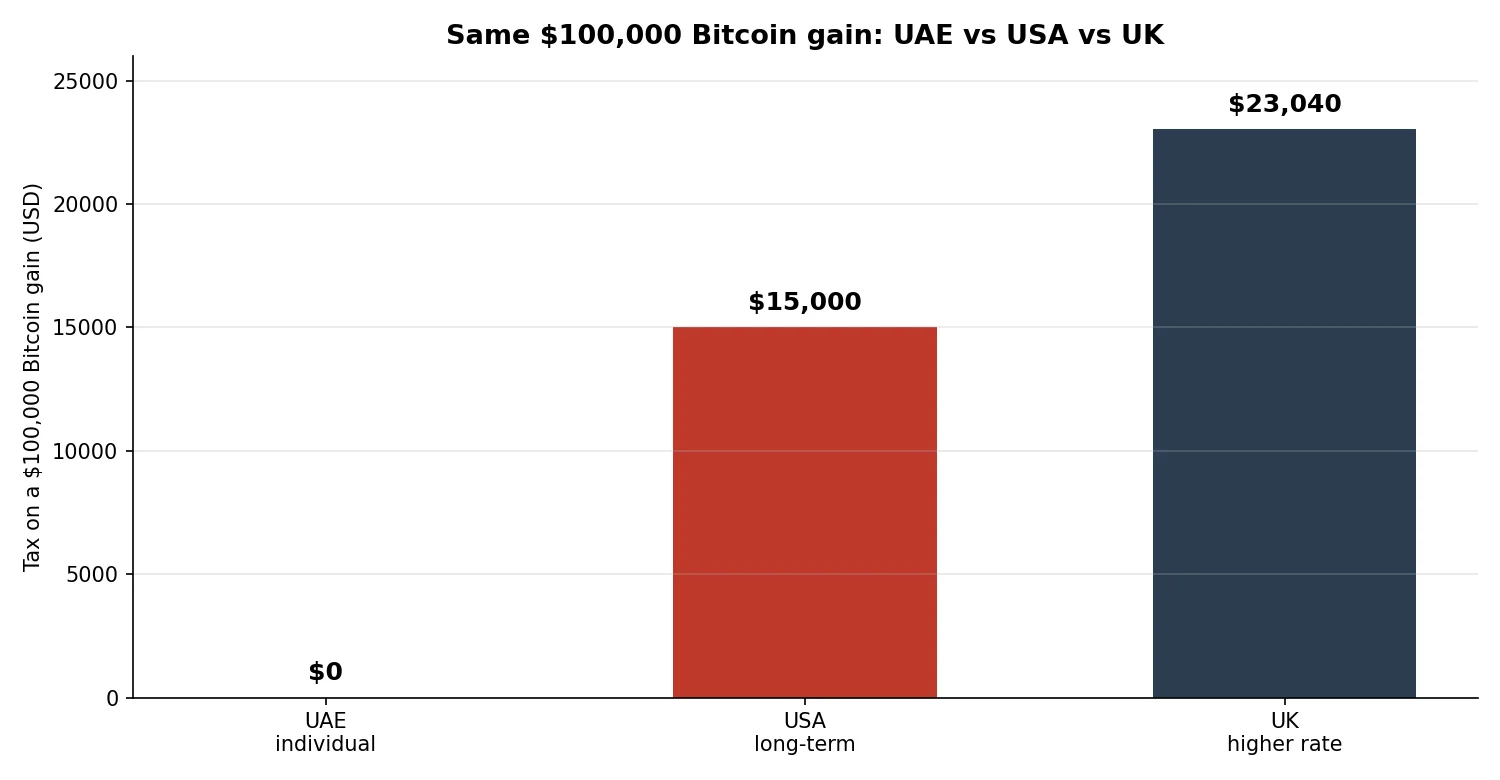
The US figure uses the 15% long-term capital gains rate, which applies to gains on assets held for more than a year. Short-term US gains are taxed as ordinary income at rates up to 37%, and high earners can add the 3.8% net investment income tax on top.
The UK figure uses the 24% higher rate on gains above the 3,000 pound annual exempt amount, which is roughly $4,000. A basic-rate UK taxpayer pays 18% instead, which still leaves a bill of about $17,280 on the same gain.
Our Bitcoin tax in the UK guide explains the UK rules in full, including the pooling rules that make UK calculations harder than they look.
The UAE saves this investor $15,000 against the US and about $23,040 against the UK on one sale. That is the honest size of the prize, and it is large enough to explain the queues at Dubai property viewings.
That comparison is bitcoin tax in the uae explained in numbers, not slogans.
But the saving only exists if the investor is genuinely a UAE tax resident when she sells. A person who still pays tax at home gets the worst of both worlds, which brings us to the residency test.
The Residency Test: A Visa Is Not Tax Residency
This is the catch that ruins the plan for most people. Holding a UAE residence visa does not make you a UAE tax resident, and a Tax Residency Certificate does not automatically end your tax liability back home.
UAE tax residency is set by Cabinet Decision No. 85 of 2022, which took effect on 1 March 2023. A natural person counts as a UAE tax resident if any one of three tests is met in a rolling 12-month period.
The first test is the 183-day rule. Spend 183 days or more in the UAE in 12 consecutive months, and you qualify, with no other condition attached.
The second test is the 90-day rule. Spend 90 days or more in the UAE, and you also qualify if you are a UAE or GCC national, or you hold a valid UAE residence permit, and you have a permanently available place of residence in the UAE or employment or a business activity there.
The third test covers people whose usual place of residence and centre of financial and personal interests is in the UAE. This is the test for people who live in Dubai in every practical sense but travel a lot.
Most crypto movers rely on the 183-day rule, because it is the cleanest to prove. Keep your passport stamps, flight records, and tenancy contract, because the Federal Tax Authority can ask for them.
A Tax Residency Certificate is the document that proves the position to a foreign tax authority. You apply through the EmaraTax portal, and the certificate is usually issued within a few working days once you meet the test.
Here is the part people miss. Your home country has its own exit rules, and some of them are harsh.
The US taxes its citizens on worldwide income wherever they live, so a US citizen moving to Dubai still files a US return and still owes US tax on crypto gains, subject to credits and exclusions. The UK has a statutory residence test with its own day counts and ties, and leaving for a year does not always break UK residence.
Germany has no double tax treaty with the UAE since the old treaty lapsed at the end of 2021, so German movers face extra care. Other countries impose exit tax, which treats you as if you sold your crypto on the day you left, and charges tax on the paper gain before you ever reach Dubai.
Do not sell the day after you land and assume the gain is tax-free. Check the exit rules of the country you left, and get that advice before you move, not after.
For a sense of how different the answers get elsewhere, Spain taxes Bitcoin gains at 19% to 30% and still demands its own foreign-holdings form, while the Philippines has no crypto tax law at all, yet still taxes the gains. Every country has its own trap, and the UAE trap is residency.
When 0% Stops: The 9% Corporate Tax Trap
The UAE introduced federal corporate tax in June 2023, under Federal Decree-Law No. 47 of 2022. It applies to business profits, not to personal investment income, and that distinction is the whole game.
The headline rates are simple. Taxable income up to AED 375,000, about $102,000, is taxed at 0%, and taxable income above that is taxed at 9%.
The 9% rate applies to taxable income, not to gross trading revenue. A business that turns over AED 2 million but spends AED 1.9 million on costs has taxable income of AED 100,000, and pays no corporate tax.
Now work a real company example. A Dubai crypto trading company earns AED 1,000,000 of taxable profit in a year.
The first AED 375,000 pays 0%, which is AED 0. The remaining AED 625,000 pays 9%, which is AED 56,250, about $15,320.
Its effective rate is 5.6% on the full AED 1,000,000, not 9%, because the first slice is free. A smaller company with AED 375,000 or less of taxable profit pays nothing at all.
Individuals are not automatically safe. A natural person who conducts a business or business activity generally becomes subject to corporate tax registration when total turnover from that activity exceeds AED 1 million in a calendar year.
Personal investment income is excluded from that calculation. The Federal Tax Authority has said that personal investment income is not a business activity for natural persons, so a private holder who buys and sells her own coins does not count that turnover toward the AED 1 million line.
The risk sits with the full-time trader. If you trade at high frequency, use leverage, run a paid signal group, manage other people’s money, or operate through a licensed entity, the tax authority can treat the activity as a business.
Once it does, the 0% personal rate is gone for that income, and the 9% corporate rate applies above the threshold. You also pick up registration, record keeping, and filing duties.
Free zones add a second layer. A Qualifying Free Zone Person can pay 0% on qualifying income, but only with real substance, meaning staff, premises, and spending in the free zone, and only on qualifying activities.
The 0% free zone rate is conditional, not automatic, and it does not cover non-qualifying income. A free zone company that trades crypto for its own account without meeting the conditions pays the standard 9% rate above AED 375,000.
Large groups face a third layer. The Domestic Minimum Top-up Tax lifts the effective rate to 15% for UAE entities of multinational groups with global revenue of EUR 750 million or more in at least two of the four preceding financial years.
That rule took effect for financial years starting on or after 1 January 2025, under Cabinet Decision No. 142 of 2024. It does not touch a solo trader or a small Dubai company, but a crypto exchange inside a large group must plan for it.
Investor or Business? Three Personas, Three Tax Bills
The rules above are easier to use when you see them applied to real people. Here are three personas, each with the same AED 500,000 gain, and three different outcomes.
| Persona | What they do | UAE tax on the gain |
|---|---|---|
| Amira, the casual holder | Buys Bitcoin with savings, holds for two years, sells once | AED 0, personal investment income |
| Dan, the full-time trader | Trades daily with leverage, runs a paid trading group, turnover above AED 1 million | Business income, 9% on taxable income above AED 375,000 after costs |
| Orbit Trading LLC | A Dubai company trading crypto as its business, AED 500,000 taxable profit | AED 11,250, which is 9% of the AED 125,000 above the threshold |
Amira is the person the 0% headline was written for. She invests her own money, she holds, and she sells as a private individual.
Dan is the person the headline misleads. His activity looks like a business, because it is one, and the tax authority can treat it as one even without a company.
Orbit Trading is the honest middle case. A company with AED 500,000 of taxable profit pays AED 11,250, which is a 2.25% effective rate, because the first AED 375,000 is free.
This table is the exclusive core of this guide. Most UAE tax guides quote the 0% and 9% rates and leave you to guess which one applies to you, while this one shows the answer for three recognisable situations side by side.
If you sit between Amira and Dan, ask a UAE tax adviser before the year ends. The classification is decided by facts, not by what you call yourself, and it is far cheaper to fix before you file than after an audit.
Residency plus activity is bitcoin tax in the uae explained in one line.
VAT, Staking, Mining and Airdrops: The Smaller Taxes
Corporate tax is not the only tax in the UAE. VAT, staking, mining, and airdrops each have their own treatment, and the answers are kinder than most people expect.
Start with VAT. The UAE charges 5% VAT on most goods and services, but the transfer of ownership of virtual assets, including Bitcoin, and the conversion of virtual assets are exempt from VAT.
That exemption was set out in Cabinet Decision No. 100 of 2024, and it applies to supplies made on or after 1 January 2018. Buying Bitcoin with dirhams, or swapping Bitcoin for another coin, does not add 5% VAT to the trade.
The exemption has limits. Mining does not qualify for it, and the Federal Tax Authority clarified in January 2025 that mining can attract 5% VAT and is taxed as business income.
Explicit fees are a second limit. If a service charges an explicit fee, commission, or discount for a crypto service, that fee can be subject to VAT even when the underlying transfer is exempt.
Staking is simpler for individuals. Personal staking rewards sit inside the 0% personal treatment for most private holders, because there is no personal income tax to apply.
The picture changes if staking is run as a business, for example a validator service with paying customers. That income is business income, and the 9% corporate rate applies above the threshold.
Airdrops follow the same split. A private holder who receives an airdrop pays no UAE personal tax on it, while a business that earns tokens as part of its activity counts them as business income.
Our guide on how Bitcoin miners are taxed explains the hobby versus business line in detail, and the UAE applies the same logic with its own rates.
One practical point follows from all of this. Keep business crypto and personal crypto in separate wallets and separate records, because mixing them is the fastest way to turn a personal gain into a business one.
VARA and the Regulators: Who Watches Crypto in the UAE
Tax is only half the story in the UAE. The other half is regulation, and Dubai built the world’s first dedicated crypto regulator before most countries had any rules at all.
The Virtual Assets Regulatory Authority, known as VARA, was set up in Dubai in March 2022. It licenses and supervises virtual asset service providers in Dubai, including exchanges, brokers, custodians, and token issuers.
VARA does not tax you, and it does not regulate you as a private holder. If you self-custody your own Bitcoin and trade on an exchange, you sit outside VARA’s direct scope as an individual.
Businesses are different. A company that offers crypto services to UAE customers needs the right licence, and the licensing regime tightened further under Federal Decree-Law No. 6 of 2025.
That law gave firms serving UAE users a transition period running to September 2026, after which they must be licensed or stop serving residents. If your exchange tells you it is leaving the UAE, that law is usually the reason.
Abu Dhabi has its own regulator, the Financial Services Regulatory Authority of the Abu Dhabi Global Market, known as the FSRA. The Securities and Commodities Authority covers the rest of the UAE outside the two financial free zones.
Each free zone has its own rules too. The Dubai Multi Commodities Centre, the DIFC, and ADGM each run crypto licensing schemes, and the right licence depends on where your customers are and what service you offer.
For a private holder, the practical lesson is simple. Use a licensed exchange, keep your own records, and do not assume that a slick website means a licensed business.
Our guide to the most crypto-friendly countries ranks the UAE near the top, and the VARA framework is a large part of the reason why.
CARF: The 0% Rate Does Not Mean Invisible
The biggest misunderstanding about UAE crypto tax is that 0% means nobody is watching. That was never true, and from 2027 it becomes clearly false.
The UAE signed the Multilateral Competent Authority Agreement for the Crypto-Asset Reporting Framework, known as CARF, in September 2025. CARF is the OECD system that forces crypto exchanges and custodians to collect user data and share it with tax authorities.
Implementation is scheduled to go live in 2027, with the first exchanges of information expected in 2028. Service providers, not private holders, do the reporting, and the data flows from the exchange to the tax authority.
CARF does not introduce a new UAE capital gains tax for individual investors. Your personal gain stays at 0%, but the tax authority in your home country may now learn about it automatically.
That matters because most home countries tax crypto gains. If you are still a tax resident at home, CARF data can reach your home tax authority in 2028 and trigger questions about gains you never reported.
The UAE already shares financial account data under the Common Reporting Standard, known as CRS, and under FATCA with the US. CARF closes the crypto gap in that system, rather than creating a new one.
The honest summary is short. The UAE gives you a 0% rate, not a hiding place, and the reporting net tightens every year.
Keep records as if every trade will be reported, because from 2027 it probably will be. That habit also protects you if a home tax authority asks questions years later.
That reporting shift is the last piece of bitcoin tax in the uae explained for 2026.
How to Report and Record Your Bitcoin in the UAE
Individuals in the UAE do not file an annual crypto tax return, because there is no personal income tax to file. That does not mean you file nothing, and it does not mean you keep no records.
Start with the basics. Keep a record of every buy, sell, swap, and transfer, with the date, the amount, the price in dirhams or dollars, the fees, and the wallet or exchange involved.
Most exchanges give you a transaction history download. Pull it every year, and keep it somewhere safe, because exchanges close, change hands, and delete old history.
If you run a business, the duties are heavier. Register for corporate tax through the EmaraTax portal, keep proper accounts, and file a corporate tax return within nine months of the end of your financial year.
A free zone company must also check whether it qualifies as a Qualifying Free Zone Person, and keep the substance records that prove it. The 0% free zone rate is lost if the substance test fails.
If you need a Tax Residency Certificate, apply through EmaraTax after you meet the 183-day or 90-day test. The certificate is the document a foreign tax authority will ask for, so keep the approval and the evidence behind it.
One more habit pays for itself. Keep a simple spreadsheet that separates personal trades from business trades, with a note on why each trade sits in its column.
That spreadsheet is your defence if the tax authority ever asks whether your trading was personal or business. A clean record beats a good argument every time.
Five Mistakes That Cost UAE Bitcoin Holders Money
Most UAE Bitcoin tax problems come from the same few errors. Here they are, so you can avoid them.
First, people move to Dubai but stay tax resident at home. They sell, pay nothing in the UAE, and then get a bill from their home country, sometimes with penalties and interest.
Check your exit rules before you move.
Second, people trade like a business and report like a holder. They run a high-frequency operation, take paying clients, and then claim the 0% personal rate on all of it.
The tax authority looks at facts, not labels.
Third, people mix personal and business crypto in one wallet. Once the coins are mixed, it is hard to prove which gains were personal, and the whole pot can be treated as business income.
Separate wallets cost nothing and save everything.
Fourth, people assume a free zone company means 0% tax. They set up the company, do no qualifying activity, keep no staff or premises, and then claim the Qualifying Free Zone Person rate.
The 0% rate needs substance, and the tax authority checks.
Fifth, people keep no records. They rely on the exchange to remember everything, then the exchange closes or only keeps two years of history.
Your records are your defence, so keep them.
If you want the wider picture, our Ireland guide shows a country that cut its crypto CGT rate to 31% in 2026, which is still a long way from the UAE’s 0% for genuine residents. The UAE wins on rates, and it loses on nothing else if you follow the rules above.
Frequently Asked Questions
Here are the questions readers ask most about bitcoin tax in the uae explained.
Is Bitcoin taxed in the UAE?
No, not for individuals. The UAE charges no personal income tax and no capital gains tax on Bitcoin held as a personal investment, so a genuine UAE tax resident pays 0% on personal gains, while crypto business income faces 9% corporate tax above AED 375,000.
Do I need to live in the UAE for 183 days to pay 0% tax?
Usually yes, but not always. You qualify as a UAE tax resident with 183 days or more in the country in 12 consecutive months, or with 90 days or more if you hold a valid residence permit and have a permanent home or local employment or business in the UAE.
When does crypto trading become a business in the UAE?
Trading becomes a business when it is organised, frequent, and run for profit, especially with leverage, paying clients, or a licensed entity. An individual becomes subject to corporate tax registration once business turnover exceeds AED 1 million in a calendar year, and personal investment income does not count toward that threshold.
What is the UAE corporate tax rate on crypto profits?
The rate is 0% on taxable income up to AED 375,000 and 9% on taxable income above that amount. A company with AED 1,000,000 of taxable profit pays AED 56,250, and a Qualifying Free Zone Person can pay 0% on qualifying income with real substance.
Does VAT apply to Bitcoin in the UAE?
No, not on the transfer itself. Transfers and conversions of virtual assets are exempt from the 5% VAT, backdated to 1 January 2018, but mining services and explicit fees for crypto services can still attract VAT.
Will CARF report my crypto to my home country?
Yes, in most cases. The UAE signed the CARF agreement in September 2025, with data collection from 2027 and the first exchanges of information expected in 2028, so exchanges will share your transaction data with tax authorities, even though the UAE itself charges no personal tax on the gains.