



Here is how to calculate Bitcoin mining profitability in one line. Multiply your machine’s hashrate by today’s hashprice, then subtract your power bill.
That is the whole formula, and the rest of this guide runs it with real numbers from November 28, 2026.

Bitcoin traded near $59,700 this morning. Mining difficulty jumped 7.61% yesterday to 145.09 trillion, and hashprice now sits near $26.08 per petahash per day.
- The formula in plain English
- Step 1: Find today’s hashprice
- Step 2: Work out what your machine earns
- Step 3: Subtract the power bill
- How to calculate Bitcoin mining profitability for your own machine
- Antminer S21, worked start to finish
- Antminer S19 Pro, the old workhorse
- FutureBit Apollo III, the quiet home box
- The break-even electricity rate
- Five mistakes that wreck the math
- Mistake 1: Using last month’s hashprice
- Mistake 2: Forgetting the pool fee and downtime
- Mistake 3: Ignoring the hardware cost
- Mistake 4: Using the wrong electricity rate
- Mistake 5: Assuming difficulty stays flat
- Who should skip mining right now
- Frequently asked questions
- What is the formula to calculate Bitcoin mining profitability?
- What is hashprice and where do I find it today?
- How much does an Antminer S21 earn per day right now?
- What electricity price makes Bitcoin mining profitable in 2026?
- Is Bitcoin mining profitable at home with average US electricity?
- How long does it take for a miner to pay for itself?
- The bottom line
- Sources
Those three numbers decide whether any machine earns money today, and they changed fast enough that a calculator page from last week already gives you the wrong answer.
This guide shows the formula, works it out for three real machines, and ends with the one number that matters most: the highest electricity price each machine can survive. If you run the math yourself, you will know in five minutes whether mining pays for you or not.
Key takeaways
- Daily profit equals hashrate times hashprice minus power cost. Hashprice on November 28, 2026 is about $26.08 per petahash per day, or $0.0261 per terahash per day.
- An Antminer S21 earns about $5.22 a day before power and breaks even at 6.2 cents per kWh. An Antminer S19 Pro earns about $2.87 a day and breaks even at 3.7 cents.
- The average American home pays 18.17 cents per kWh, so every machine in this guide loses money on a normal home power bill.
- Yesterday’s difficulty jump cut every miner’s earnings by about 7% overnight. Always run the math with today’s difficulty, never with a number from last month.
- A FutureBit Apollo III earns about $0.31 a day in Eco mode. Buy it for the full node and the quiet box, not for income.
The formula in plain English
Profitability has only three moving parts. Your machine earns money by hashing, it spends money on electricity, and the network sets the rate for hashing through difficulty and the Bitcoin price.
Here is the formula. Daily revenue equals your hashrate in terahashes per second, multiplied by hashprice, the dollars one terahash earns per day.

Daily profit equals daily revenue minus your power cost, and your power cost equals your machine’s watts times 24 hours times your electricity price.
Hashprice does the heavy lifting. It rolls the Bitcoin price, the block reward, the transaction fees and the network difficulty into one number.
When Bitcoin falls or difficulty rises, hashprice falls, and every machine on earth earns less the same day.
That is why this guide starts with hashprice instead of a machine. If you get hashprice right, the rest is simple multiplication.
If you get it wrong, nothing else in your math matters.
Step 1: Find today’s hashprice
Hashprice on November 28, 2026 is about $26.08 per petahash per day. That equals $0.0261 per terahash per day, the unit you need for the formula.
We worked it out from the live network numbers instead of copying a calculator page. The network mines about 453.7 Bitcoin per day, which is 144 blocks times an average reward of 3.1509 Bitcoin per block, including fees.
At a Bitcoin price of $59,707, that daily haul is worth about $27.09 million.
Then we divided that $27.09 million by the network hashrate of about 1,038.6 exahashes per second. The result is $26.08 per petahash per day.
You can check the inputs yourself: difficulty is 145.09 trillion after the November 27 adjustment, and the price comes from the Binance BTC/USDT market on the morning of November 28.
If you learn how to calculate Bitcoin mining profitability from hashprice instead of a calculator, you can redo the math any day in two minutes.
Hashprice has fallen hard in five days. It stood at $29.36 per petahash on November 23, and the November 27 difficulty jump alone cut it by about 7%.
A machine that earned $5.79 a day on November 23 earns $5.22 today, with nothing about the machine changing at all. That is the first lesson of mining math: your hardware stays the same, but your income moves every two weeks when difficulty resets.
Step 2: Work out what your machine earns
Multiply your machine’s hashrate by $0.0261. That gives you gross daily revenue before power, pool fees and anything else.
Here are three real machines at today’s hashprice. The Antminer S21 is the current mid-range workhorse, the Antminer S19 Pro is the cheap used machine everyone asks about, and the FutureBit Apollo III is the quiet home box.
Our Futurebit Apollo Miner Guide runs the Apollo through all four of its power modes in detail.
| Machine | Hashrate | Power | Gross revenue per day |
|---|---|---|---|
| Antminer S21 | 200 TH/s | 3,500 W | $5.22 |
| Antminer S19 Pro | 110 TH/s | 3,250 W | $2.87 |
| Apollo III Eco | 12 TH/s | 150 W | $0.31 |
| Apollo III Turbo | 18 TH/s | 325 W | $0.47 |
These numbers are gross, not profit. Nobody keeps the full $5.22 from an S21.
Power takes most of it, and a mining pool takes about 1% on top. Our guide to Bitcoin mining pool payout methods explains how that fee works and what you get back for it.
If you are new to mining itself, read our beginner’s guide to how Bitcoin mining works first. It explains blocks, difficulty and pools without assuming you already know the terms.
Step 3: Subtract the power bill
Power is where most mining plans die. A machine runs 24 hours a day, so its daily power use is simple: watts times 24, divided by 1,000, gives kilowatt-hours per day.
Multiply that by your electricity price and you have your daily power cost.
An S21 burns 84 kilowatt-hours a day. An S19 Pro burns 78.
An Apollo III in Eco mode burns only 3.6, which is why it stays cheap to run even though it earns almost nothing. The table below shows what each machine nets per day at five electricity prices, and the chart after it shows the same numbers as a picture.
| Electricity price | S21 net per day | S19 Pro net per day | Apollo III Eco net per day |
|---|---|---|---|
| 3 cents/kWh | +$2.70 | +$0.53 | +$0.21 |
| 5 cents/kWh | +$1.02 | -$1.03 | +$0.13 |
| 8 cents/kWh | -$1.50 | -$3.37 | +$0.03 |
| 10 cents/kWh | -$3.18 | -$4.93 | -$0.05 |
| 18.17 cents/kWh (US average home) | -$10.05 | -$11.30 | -$0.34 |
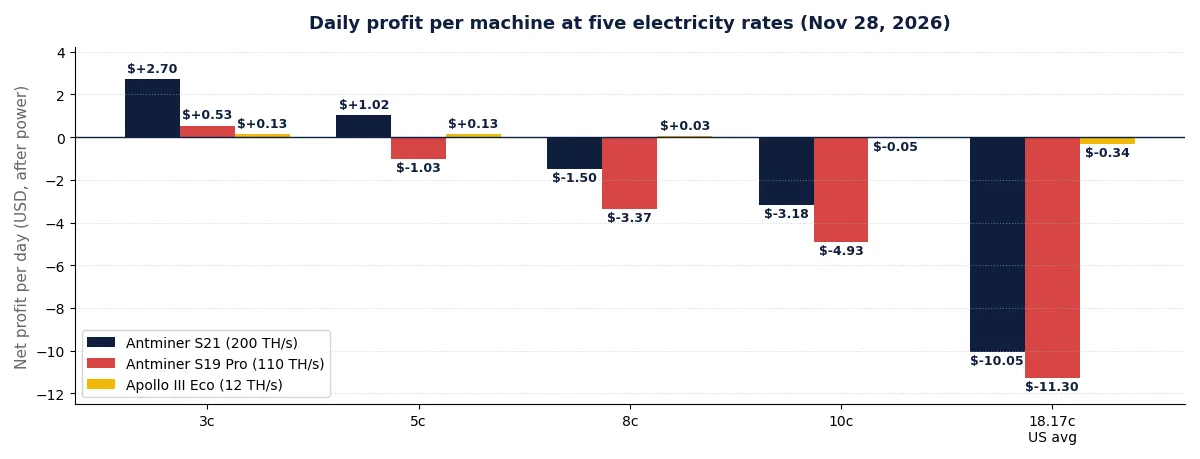
Read the table from left to right and the story is obvious. Cheap power is the whole business.
At 3 cents per kilowatt-hour, all three machines make money. At 5 cents, only the S21 and the Apollo survive.
At the average American home rate of 18.17 cents, the S21 loses $10.05 every single day.
Your own rate is the only one that counts. The US average residential price was 18.17 cents per kilowatt-hour in September 2026, according to the Energy Information Administration, but Texas averaged 15.91 cents and California averaged 29.75 cents.
Check the rate line on your own bill before you trust any national number, and use the total rate including delivery charges, not just the supply rate.
How to calculate Bitcoin mining profitability for your own machine
You now have every piece of the formula. This section runs the full calculation for each of the three machines, step by step, so you can copy the method with your own numbers.
Each example uses today’s hashprice of $0.0261 per terahash per day, today’s Bitcoin price of $59,707, and today’s difficulty of 145.09 trillion. Swap in your own machine’s hashrate and watts, your own electricity price, and the hashprice on the day you run the math.
Antminer S21, worked start to finish
The S21 hashes at 200 terahashes per second and draws 3,500 watts. Gross revenue is 200 times $0.0261, which is $5.22 a day.
Power use is 3.5 kilowatts times 24 hours, which is 84 kilowatt-hours a day.
At 5 cents per kilowatt-hour, power costs $4.20 a day. Profit is $5.22 minus $4.20, which is $1.02 a day.
A new S21 sells for about $949 at the best current price, so payback takes about 933 days at that rate, more than two and a half years of running nonstop.
At 3 cents, the same machine nets $2.70 a day and pays for itself in about 352 days. At 8 cents it loses $1.50 a day and never pays for itself at all.
The machine did not change between those three answers. Only the power price changed, and it flipped the verdict completely.
Antminer S19 Pro, the old workhorse
The S19 Pro hashes at 110 terahashes per second and draws 3,250 watts. Gross revenue is 110 times $0.0261, which is $2.87 a day.
Power use is 78 kilowatt-hours a day, almost as much as the S21, for barely half the earnings.
At 3 cents per kilowatt-hour, power costs $2.34 a day and the machine nets $0.53 a day. A used S19 Pro sells for about $159 on the secondhand market, so payback takes about 300 days at that cheap rate.
At 5 cents it loses $1.03 a day, so it never pays for itself.
The S19 Pro only works with very cheap power or free power, such as surplus solar or a hosting deal under 3.7 cents. If you pay a normal home rate, this machine is a space heater that happens to mine Bitcoin.
Our guide to Bitcoin mining electricity costs breaks down the full running cost of one miner, including the cooling and extras people forget.
FutureBit Apollo III, the quiet home box
The Apollo III in Eco mode hashes at 12 terahashes per second and draws 150 watts. Gross revenue is 12 times $0.0261, which is $0.31 a day.
Power use is 3.6 kilowatt-hours a day, so at 5 cents the power costs $0.18 and the machine nets $0.13 a day.
That sounds profitable until you look at the price. The Apollo III Standard costs $899.99, and at $0.13 a day it would take about 6,766 days to pay for itself, more than 18 years.
Turbo mode earns more, about $0.47 a day gross, but it draws 325 watts and breaks even at 6 cents, so it loses money at most home rates too.
Nobody should buy an Apollo to earn income. People buy it because it runs a full Bitcoin node, sits quietly on a desk at under 35 decibels in Eco mode, and gives them a tiny lottery ticket on finding a block solo.
If that sounds like you, our Bitaxe guide covers an even cheaper home option, and our Avalon Nano 3 guide covers another quiet desktop miner.
The break-even electricity rate
Every machine has one number that decides everything: the highest electricity price it can survive. Divide gross daily revenue by daily power use and you have it.
Above that rate the machine loses money every day it runs, and below it the machine earns.
Here are the break-even rates at today’s hashprice. Compare them with your own rate and you have your answer in one glance.
This is the payoff of learning how to calculate Bitcoin mining profitability yourself.
The chart below adds the US average home rate as a red line, and every machine sits far below it.
| Machine | Break-even electricity rate |
|---|---|
| Apollo III Eco | 8.7 cents/kWh |
| Antminer S21 | 6.2 cents/kWh |
| Apollo III Turbo | 6.0 cents/kWh |
| Antminer S19 Pro | 3.7 cents/kWh |
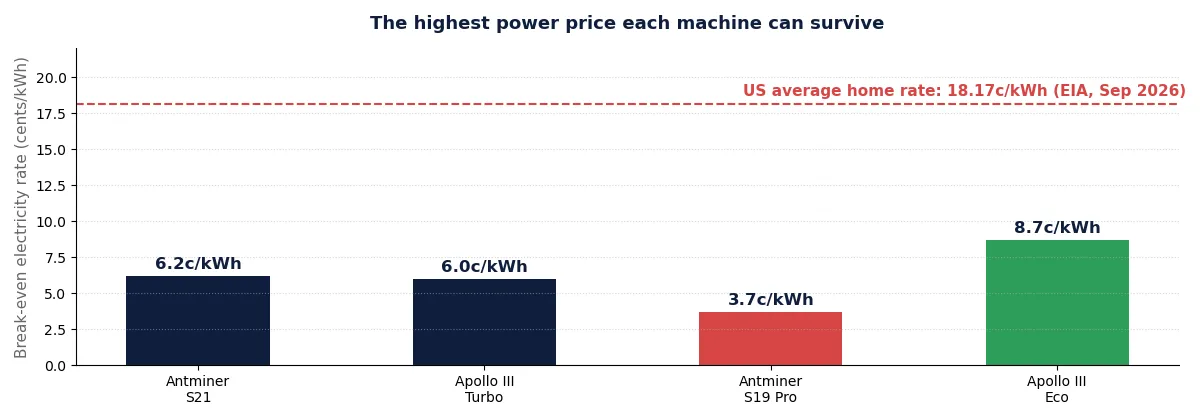
The Apollo Eco mode has the highest break-even rate at 8.7 cents, but that flatters it. It earns only $0.31 a day gross, so even a tiny rise in difficulty wipes out its margin.
The S21 at 6.2 cents is the realistic pick for anyone with cheap power, because it earns enough per day for the profit to mean something.
Notice what is missing from this table: any machine that survives the average American home rate of 18.17 cents. None does.
That is the honest state of home mining in late November 2026, and it is why our honest math on whether Bitcoin mining is still profitable in 2026 reaches a cautious verdict for most readers.
Five mistakes that wreck the math
Most bad mining decisions come from the same five errors. Each one is easy to make and each one flips a losing machine into looking like a winner.
Mistake 1: Using last month’s hashprice
Hashprice fell from $29.36 to $26.08 in five days. A calculator page that still shows October numbers will tell you an S21 earns about $5.90 a day, when it really earns $5.22.
Always check the difficulty date on any number you use.
Mistake 2: Forgetting the pool fee and downtime
Pools take about 1% of your revenue, and machines go offline for updates, heat and repairs. A machine that runs 95% of the time earns 5% less than the perfect math says.
Knock a few percent off your gross revenue before you celebrate it.
Mistake 3: Ignoring the hardware cost
A machine that nets $1.02 a day is not a good buy if it costs $949. That is 933 days to break even, and difficulty will rise several times before then.
Payback time matters as much as daily profit, because the network never stands still.
Mistake 4: Using the wrong electricity rate
Many people use the supply rate on their bill and forget delivery charges, taxes and fees. Use the total rate: your full bill divided by your total kilowatt-hours.
In most US states that number is several cents higher than the headline rate.
Mistake 5: Assuming difficulty stays flat
Difficulty adjusts every 2,016 blocks, about every two weeks. The next adjustment lands around December 10 to 12 and early estimates point down about 6 to 7%, which would lift earnings a little.
But the long trend points up, and the next halving in about April 2028 will cut the block reward from 3.125 to 1.5625 Bitcoin. A machine that barely breaks even today will not break even after that.
Who should skip mining right now
Skip mining if you pay a normal home electricity rate. At 18.17 cents per kilowatt-hour, an S21 loses $10.05 a day and an S19 Pro loses $11.30 a day.
No machine in this guide survives that rate, and hoping Bitcoin doubles is gambling, not mining.
Skip it too if you need the money back quickly. Even at a cheap 5 cents, an S21 needs about 933 days to pay for itself, and that assumes difficulty and price stay exactly where they are today.
They will not. If you cannot wait two to three years, keep your cash.
Consider mining only if you have power under 6 cents, you already own the hardware, or you value the learning and the full node more than the profit. Cheap power lives in a few places: surplus solar, stranded energy, some industrial tariffs, and a few low-cost states.
Our Texas mining guide shows what cheap-power mining looks like in practice, and our complete beginner’s guide to mining Bitcoin walks through the full setup if you decide to go ahead.
Frequently asked questions
These are the questions readers ask most about mining math. Each answer uses the same November 28 numbers as the rest of this guide.
What is the formula to calculate Bitcoin mining profitability?
Daily profit equals your hashrate in terahashes per second times hashprice in dollars per terahash per day, minus your power cost. Power cost equals your machine’s watts times 24 hours divided by 1,000, times your electricity price per kilowatt-hour.
On November 28, 2026, hashprice is about $0.0261 per terahash per day.
What is hashprice and where do I find it today?
Hashprice is the daily revenue one unit of computing power earns, and it rolls the Bitcoin price, block reward, fees and difficulty into one number. On November 28, 2026 it is about $26.08 per petahash per day, down from $29.36 on November 23 after difficulty jumped 7.61%.
You can track it on mining data sites or work it out yourself from the live difficulty and Bitcoin price, as this guide does in step 1.
How much does an Antminer S21 earn per day right now?
An Antminer S21 earns about $5.22 a day before power at today’s hashprice of $0.0261 per terahash per day. After power, it nets about $1.02 a day at 5 cents per kilowatt-hour, about $2.70 a day at 3 cents, and it loses $3.18 a day at 10 cents.
Its break-even electricity rate is 6.2 cents per kilowatt-hour.
What electricity price makes Bitcoin mining profitable in 2026?
It depends on the machine, but the limits are tight in late November 2026. An Antminer S21 needs power under 6.2 cents per kilowatt-hour, an Antminer S19 Pro needs under 3.7 cents, and an Apollo III in Eco mode needs under 8.7 cents.
The average American home pays 18.17 cents, so no machine in this guide profits on a normal home bill.
Is Bitcoin mining profitable at home with average US electricity?
No, not with the machines in this guide. At the average US home rate of 18.17 cents per kilowatt-hour, an Antminer S21 loses $10.05 a day and an Antminer S19 Pro loses $11.30 a day.
Home mining only works with power well under 10 cents, or with a small quiet machine like the Apollo III run as a hobby rather than an income source.
How long does it take for a miner to pay for itself?
Divide the machine’s price by its daily net profit after power. A new Antminer S21 at about $949 takes about 933 days at 5 cents per kilowatt-hour, or about 352 days at 3 cents.
A used Antminer S19 Pro at about $159 takes about 300 days at 3 cents, and it never pays for itself at 5 cents because it loses money every day. A FutureBit Apollo III at $899.99 never realistically pays for itself from mining alone.
The bottom line
Calculating Bitcoin mining profitability takes three numbers: your hashrate, today’s hashprice, and your electricity price. On November 28, 2026, hashprice is $0.0261 per terahash per day, and that single number makes the S21 the only machine here that earns real money, and only on cheap power under 6.2 cents.
That is how to calculate Bitcoin mining profitability without trusting a calculator page.
Run the math with today’s numbers before you spend anything, and run it again before you buy. Difficulty moves every two weeks, the price moves every day, and a machine that looked profitable last month can lose money this month.
If the numbers say no, believe them. The network will still be there when your power price or your budget makes sense.
Sources
- mempool.space, live Bitcoin network difficulty, hashrate and block data used for the November 28, 2026 hashprice calculation.
- U.S. Energy Information Administration, Electric Power Monthly, average US residential electricity price of 18.17 cents per kilowatt-hour, September 2026 data.
- FutureBit Apollo III Standard product page, official hashrate, power and price figures for the Apollo III.