



This futurebit apollo miner guide answers the only question that matters before you spend $900 or more. The Apollo III is the quietest, most polished home Bitcoin miner you can buy today, and at November 2026 prices it will almost certainly never pay for itself through mining alone.
Bitcoin traded near $61,000 on the morning of November 24, 2026. Hashprice, the daily revenue one unit of computing power earns, stood at $29.36 per petahash per day on November 23, down from $31.26 a week earlier and near its lowest level of the year.

That number decides everything in this guide. We ran the Apollo III through all four of its power modes at that hashprice, priced the electricity, and worked out the solo mining odds.
- What the Futurebit Apollo III Actually Is
- Futurebit Apollo Miner Guide: Apollo III Specs and Prices
- Apollo II vs Apollo III: What Changed
- The Honest Earnings Math at November 2026 Hashprice
- Solo Mining: The Block 973,262 Story and Your Real Odds
- The Node in a Box: What the Full Node Actually Gives You
- How to Set Up an Apollo III in an Afternoon
- Apollo III vs the Alternatives
- Common Mistakes Apollo Buyers Make
- Frequently Asked Questions
- Sources
- Conclusion
The short answer is simple. Buy the Apollo III for the full node, the quiet box and the lottery ticket.
Do not buy it as an income machine.
Key takeaways
- Apollo III Standard costs $899.99. The Full Node starts at $1,099.99 without storage, $1,299.99 with 1 TB and $1,399.99 with 2 TB.
- Turbo mode reaches 18.4 TH/s at 315 W, but at November 23 hashprice it earns about $0.54 a day before power and loses money at any normal home electricity rate.
- Super Eco is the only mode that breaks even, and only if you pay 10 cents per kWh or less. It earns about $0.24 a day.
- A solo block win is real but rare. An Apollo Solo setup found block 973,262 on October 26, 2026 and collected 3.154 BTC, yet one Apollo III at Turbo would wait about 1,090 years on average for a block.
- The Apollo III went on sale at four Micro Center stores on November 13, 2026, the first time FutureBit has sold through a physical shop.
What the Futurebit Apollo III Actually Is
The Apollo III is a small desktop Bitcoin miner that also runs a full Bitcoin node. FutureBit announced it on February 24, 2026, and it is the company’s current model, replacing the Apollo II.
It is a 6.5 by 6.5 by 6 inch cube that weighs 6.5 pounds. It sits on a desk, runs quietly in Eco mode, and you control it through a web browser.

FutureBit assembles it in the United States and covers it with a one year limited warranty.
Two versions exist. The Standard is a miner only, with its own controller and a built in power supply.
The Full Node adds a full Bitcoin node, a built in solo mining pool, and a complete Ubuntu desktop computer with 8 GB of memory.
That second part matters more than the hashrate. A full node checks every Bitcoin transaction and block against the rules itself, so you trust nobody else’s copy of the network.
Our complete beginner’s guide to how mining works explains what a node does and why miners run one.
Futurebit Apollo Miner Guide: Apollo III Specs and Prices
FutureBit builds the Apollo III around new 3 nanometer American designed ASIC chips. The table below uses the company’s own production readings from June 2026, taken at 72 degrees Fahrenheit, plus its current shop prices.
| Mode | Hashrate | Power | Efficiency | Noise |
|---|---|---|---|---|
| Super Eco | 8.1 TH/s | 85 W | 10.5 J/TH | Under 35 dB |
| Eco | 12.2 TH/s | 155 W | 12.7 J/TH | Under 35 dB |
| Balanced | 15.3 TH/s | 225 W | 14.7 J/TH | Audible fan |
| Turbo | 18.4 TH/s | 315 W | 17.1 J/TH | About 55 dB |
Power adjusts from 50 to 400 watts, so you pick your point on the curve instead of running flat out. Eco mode stays under 35 decibels, which is quieter than a normal conversation.
Turbo mode hits about 55 decibels, roughly the sound of a running dishwasher.
Prices come from FutureBit’s own shop, checked November 24, 2026. The Standard costs $899.99.
The Full Node costs $1,099.99 without a storage drive, $1,299.99 with 1 TB of SSD storage, and $1,399.99 with 2 TB.
The node and solo mining features need an SSD, so the $1,099.99 box cannot run a node until you add one.
Micro Center sells the 1 TB Full Node at $1,399.99. The Apollo III went on sale at four Micro Center stores on November 13, 2026, in Brooklyn, Miami, Tustin in California, and Austin in Texas.
That was FutureBit’s first brick and mortar sale after years of selling online only.
What You Get in the Box
The Standard ships as a miner with a built in controller, Wi-Fi, Ethernet, and Apollo OS 2.1. You plug it in, connect it to your network, pick a pool, and start hashing.
The Full Node adds an 8 core ARM processor, 8 GB of memory, two SSD bays, 2.5G Ethernet and Wi-Fi 6. It runs Bitcoin Core, serves as your own solo mining pool, and doubles as a Linux desktop you can use for other work.
Apollo II vs Apollo III: What Changed
Most guides online still describe the Apollo II, so buyers mix the two up. The differences are real, and they decide which one you should buy.
The Apollo II uses 5 nanometer chips and reaches 6 to 10 TH/s at 175 to 375 watts. Its Eco mode runs about 29 joules per terahash.
FutureBit has sold out of new Apollo II units, and its page now points buyers to the Apollo III.
The Apollo III jumps to 3 nanometer chips and reaches 18.4 TH/s at 315 watts in Turbo. Its most efficient mode, Super Eco, runs at 10.5 joules per terahash, nearly three times more efficient than the Apollo II in Eco.
The controller also grows from 6 cores and 4 GB of memory to 8 cores and 8 GB.
| Feature | Apollo II | Apollo III |
|---|---|---|
| Chip | 5 nm ASICs | 3 nm American designed ASICs |
| Max hashrate | About 10 TH/s | 18.4 TH/s |
| Power range | 175 to 375 W | 50 to 400 W |
| Best efficiency | About 29 J/TH | 10.5 J/TH |
| Controller | 6 core ARM, 4 GB RAM | 8 core ARM, 8 GB RAM |
| Noise in Eco | Under 40 dB | Under 35 dB |
| Price from | $799 Standard, $1,099 Full Node (sold out) | $899.99 Standard, $1,099.99 Full Node |
If you already own an Apollo II, the upgrade buys you roughly double the hashrate and much better efficiency, but not a profit. If you are choosing between a used Apollo II and a new Apollo III, the III wins on efficiency, noise, and support, while the II only wins if you find one far below its old price.
The Honest Earnings Math at November 2026 Hashprice
This is the section most sellers skip, so we did the math in full. Hashprice stood at $29.36 per petahash per day on November 23, 2026, according to the Luxor Hashrate Index.
That is $0.0294 per terahash per day.
Multiply the Apollo III’s hashrate by that number and you get daily revenue before power. Then subtract the electricity.
The table below shows all four modes at two common power rates, 10 cents and 15 cents per kWh.
| Mode | Revenue per day | Power cost at 10c | Profit at 10c | Profit at 15c | Break-even power price |
|---|---|---|---|---|---|
| Super Eco (8.1 TH/s) | $0.24 | $0.20 | +$0.03 | -$0.07 | 11.8 cents |
| Eco (12.2 TH/s) | $0.36 | $0.37 | -$0.01 | -$0.20 | 9.7 cents |
| Balanced (15.3 TH/s) | $0.45 | $0.54 | -$0.09 | -$0.36 | 8.3 cents |
| Turbo (18.4 TH/s) | $0.54 | $0.76 | -$0.22 | -$0.59 | 7.1 cents |
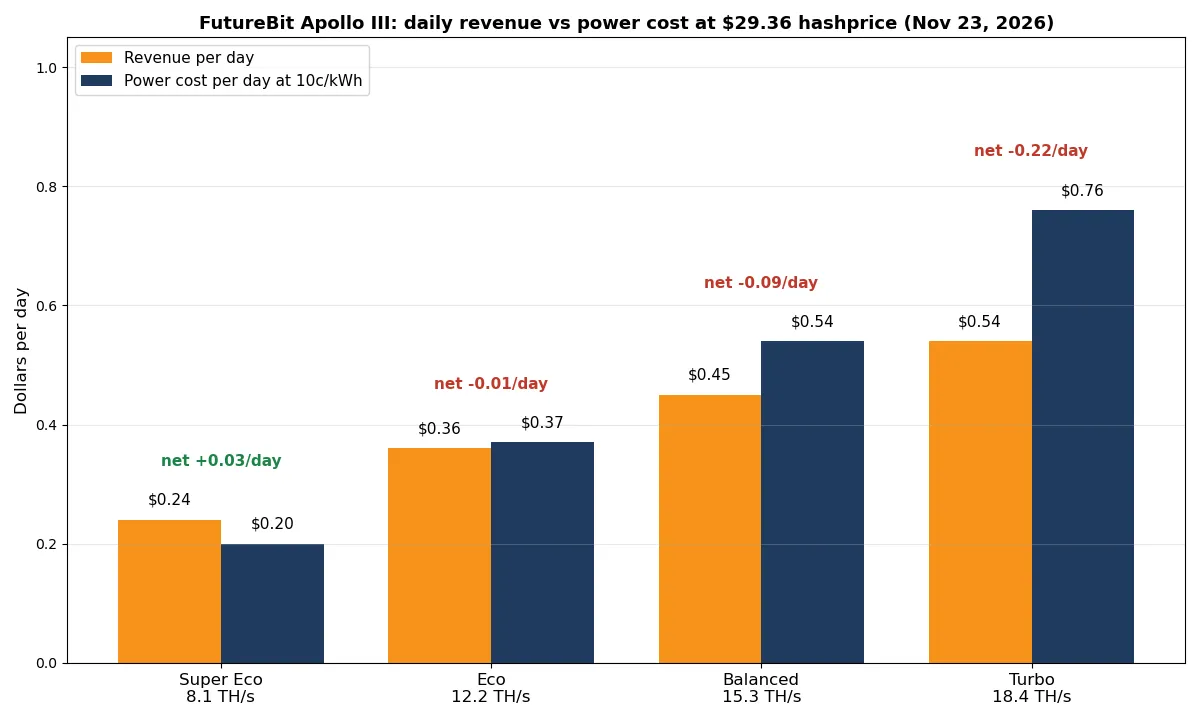
Read that table twice, because it flips the usual advice upside down. Turbo earns the most revenue but loses the most money, since its efficiency drops to 17.1 joules per terahash.
Super Eco earns the least but is the only mode that breaks even, and only at 10 cents per kWh.
At 15 cents per kWh, every mode loses money every day. A Texas home pays about 15.9 cents on average, so the Apollo III loses money there in every mode.
Our guide to what one miner really costs to run in 2026 shows the same pattern for bigger machines, and our bitcoin mining in texas guide works through the state numbers in full.
Monthly numbers make it plainer. Turbo earns about $16.20 a month before power, then costs $22.68 in electricity at 10 cents, a loss of about $6.47 a month.
Super Eco earns about $7.15 a month and costs $6.12, a profit of about $1.03 a month.
At that rate, the $899.99 Standard would need roughly 870 months to pay for itself, and that ignores pool fees, difficulty rises, and the fact that hashprice keeps falling.
The honest conclusion is blunt. If you buy an Apollo III to earn money from pool mining, you will lose money at November 2026 prices.
The machine only makes sense if you value the node, the learning, and the solo lottery ticket more than the cash.
Solo Mining: The Block 973,262 Story and Your Real Odds
On October 26, 2026, a miner running FutureBit’s Apollo Solo setup found Bitcoin block 973,262 and collected the full reward of 3.15418892 BTC, worth about $252,700 at the price that day. It was the fourth block ever credited to FutureBit Apollo Solo, and the first since March 2025.
That story sells a lot of miners, so here is the part the headlines leave out. FutureBit itself says the public record does not show which hardware found the block.
It could have been an Apollo BTC, an Apollo II, an Apollo III, or a whole mining farm pointed at a Solo Node.
The block proves the software works, not that one small box beat the network.
Your own odds are easy to calculate. The network runs at about 1,055 exahashes per second, and an Apollo III at Turbo gives 18.4 terahashes.
That is about 0.0000017 percent of the network. At 144 blocks a day, the average wait for one block is about 1,090 years.
That does not make solo mining pointless. A lottery ticket costs nothing extra once the machine runs, and the built in solo pool means you keep the whole reward if lightning strikes.
But treat it as a lottery ticket, not a plan. Pool mining pays small steady amounts instead, and our guide to pool payout methods explains how FPPS and PPS payouts work in plain English.
The Node in a Box: What the Full Node Actually Gives You
The Full Node is the real reason to buy an Apollo III, so judge it on its own terms. It runs a full copy of the Bitcoin blockchain and checks every transaction itself.
You verify your own payments, you enforce the rules you believe in, and you stop trusting anyone else’s node.
It also runs your own solo mining pool. Other miners in your home can point at it, and any block they find pays straight to your address with no pool fee in between.
That is the setup that found block 973,262.
The same box works as a Linux desktop. You get a full Ubuntu system with 8 GB of memory, so you can browse, run apps, and manage your Bitcoin stack from one quiet cube.
No other home miner bundles all three jobs into one device.
Ask yourself one question before you pay the extra $200. Do you actually want to run a node?
If the answer is yes, the Full Node is good value, since a standalone node computer plus a miner would cost more.
If the answer is no, the Standard saves you money and does the same mining.
How to Set Up an Apollo III in an Afternoon
Setup takes about an hour, plus the time Bitcoin Core needs to sync the blockchain. The node sync is the slow part, so start it first and do the rest while it runs.
- Pick your spot. Put the cube on a hard surface with clear air around it, away from bedrooms if you plan to run Turbo, and near your router for a wired connection.
- Plug in power and Ethernet. Wi-Fi works, but a cable gives a steadier connection for a node that must stay online around the clock.
- Open the Apollo OS dashboard in your browser. The setup wizard walks you through the network, the time zone, and a password.
- Choose your mining mode. Start in Eco or Super Eco, since those are the only modes near break-even at home power rates.
- Pick a pool or go solo. A pool pays small steady amounts, while solo pays nothing until you find a whole block. Beginners should start with a pool.
- Start the node sync. A full sync takes a day or more on a fresh drive, and the machine stays usable while it runs.
- Check your power bill after a week. Multiply the watts by 24 hours and your rate, and confirm the cost matches the math in this guide.
If you want a broader home setup before you buy, our guide to mining Bitcoin at home in 2026 covers panels, ventilation, and realistic beginner expectations.
Apollo III vs the Alternatives
The Apollo III is not the only way to mine at home, and the alternatives suit different buyers. A Bitaxe costs far less and runs even quieter, but it hashes at about 1 to 2 TH/s, so it is purely a lottery ticket with no node.
Our explainer on what a Bitaxe miner is covers that option.
The Avalon Nano 3 is the closest rival, a small quiet miner aimed at beginners. It costs less than the Apollo III Standard, but it has no full node and no solo pool built in.
Our Avalon Nano 3 miner guide works through its numbers the same honest way.
Industrial ASICs earn far more per day, but they cost thousands, sound like a jet engine, and need industrial power. They do not belong in a living room.
The Apollo III wins the home category on quiet operation and the node, not on earnings.
Common Mistakes Apollo Buyers Make
These errors cost real money, and each one is easy to avoid.
- Buying Turbo numbers and running Eco. The 18 TH/s headline only applies in Turbo, which loses the most money. Plan around the mode you will actually run.
- Buying the Full Node without an SSD. The $1,099.99 box has no drive, so the node features do not work until you add one. Budget $1,299.99 for the 1 TB version.
- Expecting pool income to cover the cost. At November 2026 hashprice, no mode pays back a $900 machine. Buy it for the node and the hobby, not the income.
- Mining solo with no patience. A solo block is a once in a thousand year event for one machine, so do not count on it to pay the bills.
- Ignoring the power bill. A Turbo mode machine uses 7.56 kWh a day, so check your rate first and measure the real cost after a week.
- Forgetting taxes. Pool payouts count as income in most countries, so track every satoshi from day one. Our guide to how Bitcoin miners are taxed explains the hobby versus business split.
Frequently Asked Questions
Is the FutureBit Apollo III profitable in 2026?
No, not from pool mining at November 2026 prices. At a hashprice of $29.36 per petahash per day, Turbo mode earns about $0.54 a day before power and loses $0.22 a day at 10 cents per kWh.
Only Super Eco breaks even, with about $0.03 a day of profit at 10 cents, and every mode loses money at 15 cents.
How much does the FutureBit Apollo III cost?
The Standard costs $899.99. The Full Node costs $1,099.99 without a storage drive, $1,299.99 with 1 TB of SSD storage, and $1,399.99 with 2 TB.
Micro Center sells the 1 TB Full Node at $1,399.99.
What is the difference between the Apollo III Standard and Full Node?
The Standard is a miner only, with its own controller and power supply. The Full Node adds a full Bitcoin node, a built in solo mining pool, and a complete Ubuntu desktop computer with 8 GB of memory.
The node features need an SSD, which the $1,099.99 version does not include.
How loud is the Apollo III?
Eco mode runs under 35 decibels, which is quieter than a normal conversation and easy to live with in a room. Turbo mode runs about 55 decibels, roughly the sound of a running dishwasher, so most owners keep it in Eco or Super Eco at home.
Can the Apollo III really find a Bitcoin block solo?
Yes, and it has happened. An Apollo Solo setup found block 973,262 on October 26, 2026 and collected 3.154 BTC, but the exact hardware behind that block is not public.
One Apollo III at Turbo would wait about 1,090 years on average for a block, so treat solo mining as a lottery ticket, not income.
Should I buy the Apollo III or the Apollo II?
Buy the Apollo III. The Apollo II is sold out new, and the III doubles the hashrate to 18.4 TH/s, improves best efficiency from about 29 to 10.5 joules per terahash, and runs quieter.
Only buy a used Apollo II if you find one far below its old $799 to $1,099 price.
Sources
- FutureBit Shop, Apollo III Standard product page
- FutureBit, Best Home Bitcoin Miner in 2026
- FutureBit, FutureBit Solo Miner Finds Bitcoin Block 973262
- Bitcoin Magazine, FutureBit Apollo III Miner Hits Micro Center Shelves
- Luxor Hashrate Index, Bitcoin Hashprice Index
- Hashrate Index, Weekly Mining Roundup November 23, 2026
Conclusion
The Apollo III is the best home Bitcoin miner you can buy in November 2026, and it still loses money. Both facts are true at the same time, and this futurebit apollo miner guide would be dishonest if it hid either one.
Buy it if you want a quiet box that runs your own Bitcoin node, teaches you how mining works, and gives you a lottery ticket on every block. Skip it if you want income, because no mode pays back $900 at a $29 hashprice, and Turbo loses the most.
If you buy one, run Super Eco or Eco, start with a pool, and enjoy the node. If you skip it, put the money into Bitcoin itself or into learning first with our honest look at whether mining is still profitable in 2026.
Either way, you will have made the choice with real numbers, not a sales pitch.