



Here is bitcoin mining electricity costs explained in one line: your power price decides everything, and right now almost nobody with household electricity can win. A miner is just a machine that turns electricity into tiny slices of bitcoin, and the exchange rate between those two things is brutal in late 2026.
Bitcoin trades near $60,000 today, Nov 22, 2026. That sounds like plenty of room to profit, until you see what miners actually earn per unit of computing power.

The number is called hashprice, and it fell to $27.67 per petahash per day. At that level, even the newest machine on the market needs electricity under 13 cents a kilowatt-hour just to break even.
- Key takeaways
- Bitcoin Mining Electricity Costs Explained: The One Number That Decides Everything
- What Is Hashprice, and Why It Sets Your Power Budget
- The Break-Even Power Price for 5 Real Machines
- What One Miner Adds to Your Monthly Bill
- Household Power vs Industrial Power: Why the Same Miner Wins or Loses
- The Hidden Electricity Costs Nobody Puts in the Calculator
- 5 Ways to Cut Your Mining Power Bill
- Common Mistakes That Blow Up the Power Bill
- Is Mining at Home Still Worth It in Late 2026?
- Bitcoin Mining Electricity Costs Explained: Frequently Asked Questions
- How much electricity does a Bitcoin miner use per day?
- How much does it cost in electricity to mine one Bitcoin?
- What is a good electricity rate for Bitcoin mining?
- Can you mine Bitcoin profitably with household electricity?
- Why does electricity cost matter more than the miner’s price?
- Does Bitcoin mining use more electricity than a house?
- Sources
The average American home pays 18.16 cents. Do the math and the story writes itself.
Key takeaways
- Hashprice is $27.67 per PH/s per day on Nov 22, 2026, down from an October average of $37.97. That is the revenue side of the whole equation.
- Break-even power prices today: S19j Pro 3.9 cents, S21 6.6 cents, S21 XP 8.5 cents, S23 Hyd 12.1 cents, S23 XP Hyd 13.0 cents per kWh.
- The average US household pays 18.16 cents per kWh, which is above every machine’s break-even price. Home mining at that rate loses money on electricity alone.
- One Antminer S21 XP uses about 2,624 kWh a month, more than double the average US home’s monthly use of 1,152 kWh.
- At a 4-cent industrial rate, the same S21 XP nets about $119 a month after power. The machine is the same, only the power price changed.
- Electricity is usually 70 to 90 percent of a miner’s running cost, so it beats hardware choice, pool choice, and every other factor.
Bitcoin Mining Electricity Costs Explained: The One Number That Decides Everything
Every mining guide talks about hashrate, difficulty, and hardware. Those matter, but they are supporting actors.
The star of the show is the price you pay for a kilowatt-hour, because electricity is the one cost that never stops.
Think of it this way. A miner runs 24 hours a day, 7 days a week, at full power.

It never sleeps, never idles, and never takes a day off. So your power rate multiplies across every single hour of the month, and small differences explode into big money.
Here is my honest take after watching this market for years: most people who lose money mining did not buy the wrong machine. They bought power at the wrong price.
The machine is a one-time purchase. The power bill arrives every month, forever, and it quietly decides the outcome.
Why electricity beats every other cost
A miner has three real costs: the machine itself, the pool fee, and the power. The pool fee runs about 1 to 2 percent of earnings, which is small.
The machine is a fixed cost you pay once.
Power is different. It is 70 to 90 percent of the running cost for most miners, and it scales with every hour the machine runs.
A machine that costs $3,000 to buy can easily burn $400 a month in power at household rates, so the electricity overtakes the hardware cost in under a year.
That is why professional miners hunt for cheap power the way gold miners hunted for rivers. The location of the plug matters more than the brand on the box.
What Is Hashprice, and Why It Sets Your Power Budget
Hashprice is the simplest number in mining, and most beginners never hear about it. It tells you what one unit of computing power earns in a day.
On Nov 22, 2026, hashprice is $27.67 per petahash per second per day, according to the Luxor Hashrate Index.
One petahash equals 1,000 terahash. So each terahash of your machine earns about 2.77 cents a day.
Multiply that by your machine’s hashrate and you get your daily revenue before any costs.
An Antminer S21 XP runs at 270 terahash, so it earns about $7.47 a day right now. That is the gross number, before power, before pool fees, before anything.
If you want the full beginner version of how this all fits together, read our guide on how Bitcoin mining works.
Why hashprice fell so far in November
Hashprice was $37.97 per petahash per day on average in October. In November it has averaged $31.20 so far, and it dropped to $26.16 on Nov 21, the day Bitcoin crashed to $55,130, its lowest price since September 2024.
Two forces squeeze hashprice at once. When Bitcoin’s price falls, each coin miners earn is worth less.
When more machines join the network, each machine’s share of the reward shrinks. In November 2026 both happened together, and miners felt it immediately.
The network now runs at about 1,029 exahash per second. That is an enormous amount of competition, and every new machine that plugs in takes a slice from everyone else.
The next difficulty adjustment lands around Nov 27, and it decides whether the squeeze tightens or loosens.
The break-even formula anyone can use
You do not need a calculator website to find your break-even power price. The formula is simple, and it is worth learning because it lets you test any machine at any power rate in seconds.
First, find your daily revenue: hashprice times your hashrate in petahash. Then find your daily power use: your machine’s watts times 24 hours, divided by 1,000.
Divide revenue by power use and you get the highest price per kilowatt-hour you can pay before you start losing money.
Try it with the S21 XP. Revenue is $27.67 times 0.27 petahash, which is $7.47 a day.
Power use is 3,645 watts times 24 hours, which is 87.48 kilowatt-hours a day. Divide $7.47 by 87.48 and you get about 8.5 cents.
Pay more than that and the machine loses money on electricity alone.
The Break-Even Power Price for 5 Real Machines
This is the table I wish someone had shown me before I first looked at mining. Every number below comes from today’s hashprice of $27.67 per petahash per day, Nov 22, 2026, and the manufacturers’ own specifications.
Nothing here is a guess.
Read it as a test. Find your power price, then find the machines that survive it.
If your rate sits above a machine’s break-even line, that machine loses money every single day it runs.
| Machine | Hashrate | Power | Efficiency | Revenue per day | Break-even power price |
|---|---|---|---|---|---|
| Antminer S19j Pro | 100 TH/s | 2,950 W | 29.5 J/TH | $2.77 | 3.9 cents/kWh |
| Antminer S21 | 200 TH/s | 3,500 W | 17.5 J/TH | $5.53 | 6.6 cents/kWh |
| Antminer S21 XP | 270 TH/s | 3,645 W | 13.5 J/TH | $7.47 | 8.5 cents/kWh |
| Antminer S23 Hyd | 580 TH/s | 5,510 W | 9.5 J/TH | $16.05 | 12.1 cents/kWh |
| Antminer S23 XP Hyd | 600 TH/s | 5,340 W | 8.9 J/TH | $16.60 | 13.0 cents/kWh |
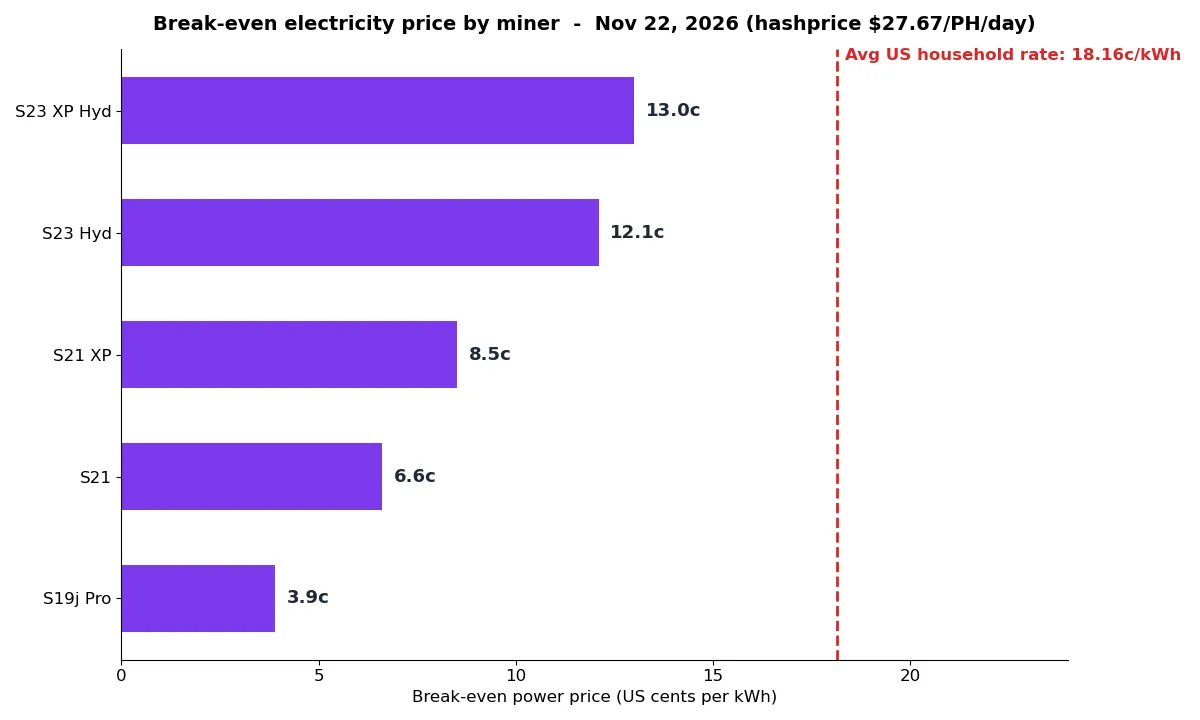
The pattern is obvious once you see it. Newer machines survive higher power prices because they squeeze more hashes out of each watt.
The S19j Pro, a workhorse from 2021, needs power under 4 cents to break even, which almost nobody has at home.
The S23 XP Hyd, the most efficient machine Bitmain sells, survives up to 13 cents. That sounds good until you remember the average US home pays 18.16 cents.
Even the best machine on the market loses money on a normal household tariff right now. If you want the wider picture on whether mining pays at all in this market, read our honest take on whether Bitcoin mining is still profitable in 2026.
What the efficiency number really means
The column to watch is joules per terahash, or J/TH. It tells you how much energy a machine burns for each unit of work, and lower is better.
The S19j Pro needs 29.5 joules per terahash, while the S23 XP Hyd needs only 8.9.
That gap is the whole story of mining hardware in one number. Each new generation does the same work with less power, which pushes the break-even price higher.
But efficiency has limits, and no machine yet beats the gap between a 13-cent break-even and an 18-cent household rate.
One warning about these numbers: they use the wall power from the spec sheet, which is the power the machine draws from the socket. Real machines run a little hotter and draw a little more, so treat the break-even prices as best-case numbers.
Your real break-even sits a touch lower.
What One Miner Adds to Your Monthly Bill
Daily numbers feel small, so let me show you the monthly bill, because that is what actually hits your bank account. A miner runs all month, so multiply the daily power use by 30 and you see the real scale of it.
Here is the same S21 XP at three different power prices. The machine never changes.
Only the rate changes, and the outcome flips completely.
| Power price | Monthly power used | Monthly power bill | Monthly revenue | Net after power |
|---|---|---|---|---|
| 18.16 cents (avg US home) | 2,624 kWh | $476.59 | $224.13 | -$252.46 |
| 10 cents | 2,624 kWh | $262.44 | $224.13 | -$38.31 |
| 4 cents (industrial) | 2,624 kWh | $104.98 | $224.13 | +$119.15 |
Look at that first row again. At the average household rate, one S21 XP costs $476.59 a month in power and earns $224.13.
You lose $252.46 every month, before pool fees, before the cost of the machine, before anything else. That is not a bad month.
That is the normal month at that rate.
Now compare the same machine on the newest hardware. An S23 Hyd uses 3,967 kWh a month, costs $720.44 at the household rate, earns $481.46, and loses $238.99.
At 4 cents it costs $158.69 and nets $322.77. The hardware helps, but the rate still decides the sign of the number.
Your miner uses more power than your house
Here is the part that surprises most beginners. One S21 XP uses about 2,624 kWh a month.
The average US home used about 1,152 kWh a month in August 2026, according to the EIA. So a single miner more than doubles the household’s total power use, and that is before you count the extra cooling.
That matters for two practical reasons. First, your bill does not just grow, it jumps into a different league, and many utilities charge higher rates once you cross into heavy usage tiers.
Second, a normal home circuit cannot feed a big ASIC safely. A 3,645-watt machine needs a dedicated 240-volt circuit, and most living rooms do not have one.
If you are thinking about a small home setup instead, read our guide on how to mine Bitcoin at home in 2026. It covers the realistic setups, including the small low-power miners that actually fit in a home.
Household Power vs Industrial Power: Why the Same Miner Wins or Loses
The gap between household and industrial power is the biggest open secret in mining. Households in the US pay about 18.16 cents per kWh on average.
Commercial customers pay about 14.47 cents. Industrial buyers, the big operations that buy power in bulk, often pay 3 to 5 cents.
Wholesale power at the ERCOT Houston hub in Texas averaged about 4.0 cents per kWh in the week of Nov 2 to 8, 2026. That is the world professional miners live in, and it is a different universe from a household bill.
The same S21 XP that loses $252 a month at home nets $119 a month there.
In my opinion, this is the real divide in Bitcoin mining today. It is not big miners versus small miners, or new machines versus old ones.
It is cheap-power miners versus expensive-power miners, and the cheap-power side wins almost every time.
Where cheap power actually lives
Cheap power comes from a few places. Hydroelectric regions like parts of Washington State, Quebec, and Sichuan have historically offered rates under 5 cents.
Texas offers cheap wind power at night and a deregulated grid where big buyers negotiate directly. Some miners set up next to stranded gas or curtailed renewables, buying power nobody else wants.
But none of these are options you can copy by moving a miner into your garage. They need scale, contracts, and infrastructure.
A home miner cannot call up a utility and negotiate a 4-cent industrial rate, and that gap is exactly why home mining keeps shrinking as a share of the network.
Geography matters inside the US too. Nevada averaged 12.72 cents per kWh for households in August 2026, the cheapest state, while Hawaii averaged 47.18 cents.
Even the cheapest US household rate sits above the S21 XP’s 8.5-cent break-even, so moving states does not fix the problem on its own.
The Hidden Electricity Costs Nobody Puts in the Calculator
Profitability calculators show you the headline number: watts times hours times your rate. Real life adds costs the calculator never mentions, and they all run on electricity too.
Here are the ones that catch beginners.
Cooling is the biggest hidden cost. Nearly all the power a miner draws leaves as heat, and 1,000 watts of mining puts out about 3,412 BTU of heat per hour.
An S21 XP throws off about 12,440 BTU per hour, which is roughly the output of a small space heater running nonstop. In summer you pay again to remove that heat, either with fans, air conditioning, or ventilation.
Power supply losses come next. The spec sheet lists wall power, which already includes the power supply, but cheap or aging power supplies waste more energy as heat.
A miner rated at 3,645 watts can draw more from the wall as its power supply ages, and that extra draw shows up on your bill without earning you a single extra hash.
Demand charges and tiered rates
Many utilities charge more than a flat per-kWh rate. Some add a demand charge based on your highest 15 minutes of usage in the month, which a miner running at full power 24 hours a day will max out every month.
Others use tiered pricing, where the rate climbs once you pass a usage threshold, and a miner blows through the cheap tier in the first few days.
Check your actual bill, not the advertised rate. The EIA average of 18.16 cents already includes taxes and fees, but your bill may also carry a fixed monthly charge and a demand component.
The rate that matters is your total bill divided by your total kilowatt-hours, and for heavy users that number often runs higher than the headline rate.
Downtime still costs you
A miner that stops earning still costs money. If your internet drops, your pool goes down, or your machine overheats and shuts off, the revenue stops but the fixed charges on your bill do not.
A machine that runs 95 percent of the month instead of 100 percent loses 5 percent of its revenue while keeping almost all of its power cost.
This is why uptime matters as much as efficiency. A slightly less efficient machine that runs all month can beat a faster machine that keeps tripping breakers or overheating.
Reliability is a power cost too, just a hidden one.
5 Ways to Cut Your Mining Power Bill
None of these tips turn an 18-cent rate into a 4-cent rate. Be honest with yourself about that.
But each one moves the number in the right direction, and together they can decide whether a borderline setup survives.
Start with the rate itself. Call your utility and ask about time-of-use plans, which charge less at night when demand is low.
Some miners run only during off-peak hours, though that cuts revenue too, so run the numbers before you commit to it.
Second, pick efficiency over raw hashrate. A used S19j Pro looks cheap at second-hand prices, but it needs 29.5 joules per terahash against the S21 XP’s 13.5.
At today’s hashprice the old machine needs power under 4 cents to survive, while the newer one survives at 8.5. The cheaper machine is often the more expensive miner.
Use the heat, and underclock when it pays
Third, use the heat instead of fighting it. Miners heat homes in winter, dry laundry rooms, and warm greenhouses.
Every unit of heat you actually use is a unit of heating you did not buy separately, and that is real money back in cold climates.
Fourth, consider underclocking, which means running the machine below its rated power. It cuts hashrate, but it cuts power use faster, so efficiency improves.
On some machines the break-even power price rises a little, which can save a borderline setup. Test it on your own hardware and measure the wall power, because the gain varies by model.
Fifth, host the machine instead of running it at home. Hosting services place your miner in a facility with industrial power rates, usually 6 to 9 cents per kWh, and charge a fee on top.
That still beats most household rates, but read the contract carefully. Some hosts add setup fees, maintenance fees, and minimum terms that eat the savings.
Common Mistakes That Blow Up the Power Bill
The most expensive mistake is the simplest one: buying the machine before checking the power rate. People order a miner, wait weeks for delivery, plug it in, and only then discover their rate makes profit impossible.
Check the rate first, then decide. Our full beginner walkthrough in how to mine Bitcoin puts the power check before the purchase for exactly this reason.
The second mistake is trusting the sticker rate. Your bill’s headline rate is not your real cost per kilowatt-hour.
Add the fixed charges, the taxes, and the delivery fees, then divide the total bill by the total kilowatt-hours. That is the number your miner actually pays.
The third mistake is ignoring the circuit. A big ASIC needs a dedicated 240-volt circuit with the right breaker, and running it on a shared household circuit is a fire risk.
An electrician visit costs money, but it is cheaper than the alternative, and it is a real part of the setup cost that belongs in your math.
The fourth mistake is forgetting the tax bill. Mined bitcoin counts as income in most countries, and the power you burn to earn it is a cost, but the two do not cancel out on their own.
If mining earns you coins, you owe tax on them, and the power bill does not reduce that tax by itself. Our guide on how Bitcoin miners are taxed explains the hobby-versus-business split.
Is Mining at Home Still Worth It in Late 2026?
Here is my honest verdict, and it is not the answer most people want. At today’s hashprice of $27.67 and today’s household power rates, running a full-size ASIC at home loses money.
The numbers are not close, and no amount of optimism changes them. An S21 XP loses about $252 a month at the average US household rate, and the newest machine on the market still loses about $239.
That does not mean mining is dead. It means home mining at household rates is dead, for now.
The miners who profit today have industrial power, efficient hardware, and scale. The gap between their 4-cent power and your 18-cent power is worth more than any machine upgrade.
But the picture can change. If Bitcoin’s price recovers, hashprice rises with it, and the break-even lines move up.
If you have access to power under 8 cents, through solar, a rural co-op, or a cheap-rate region, an S21 XP works today. And small miners like the Bitaxe or the Avalon Nano 3 play a different game entirely: they cost little, sip power, and teach you mining without a $400 monthly bill.
Our guide to the Bitaxe home miner and the Avalon Nano 3 guide cover those honestly.
If you still want to mine, treat it as a decision about power, not about hardware. Find your real rate, run the break-even formula, and let the number decide.
If the number says no, the smartest mining move is to wait, or to buy bitcoin directly instead of manufacturing it at a loss. That is not defeat.
That is arithmetic.
Bitcoin Mining Electricity Costs Explained: Frequently Asked Questions
These are the questions I hear most about mining power costs, answered with the numbers from this guide.
How much electricity does a Bitcoin miner use per day?
An Antminer S21 XP uses about 87.5 kilowatt-hours a day, because it draws 3,645 watts around the clock. An S19j Pro uses about 70.8 kWh a day, and an S23 Hyd uses about 132.2 kWh a day.
Multiply watts by 24 hours and divide by 1,000 to get any machine’s daily use.
How much does it cost in electricity to mine one Bitcoin?
At today’s hashprice of $27.67 per PH/s per day, the electricity cost of one bitcoin depends on the machine and the power rate. An S23 Hyd at 4 cents per kWh spends about $19,800 in electricity per bitcoin, while the same machine at the 18.16-cent household rate spends about $89,800.
These are electricity-only figures, before pool fees and hardware costs.
What is a good electricity rate for Bitcoin mining?
A good rate sits below your machine’s break-even price. At today’s hashprice, that means under 8.5 cents per kWh for an S21 XP and under 13 cents for an S23 XP Hyd.
Industrial rates of 3 to 5 cents work well, while the average US household rate of 18.16 cents does not work for any current machine.
Can you mine Bitcoin profitably with household electricity?
Not with a full-size ASIC at today’s prices. The average US household rate of 18.16 cents per kWh sits above the break-even price of every current machine, including the S23 XP Hyd at 13 cents.
Small low-power miners can still make sense as a hobby or learning setup, but they earn very little.
Why does electricity cost matter more than the miner’s price?
Electricity is a cost you pay every month for as long as the machine runs, and it makes up 70 to 90 percent of the running cost. A $3,000 machine can burn $400 a month in power at household rates, so the power bill passes the hardware cost in under a year.
The machine is a one-time purchase, while the power bill never stops.
Does Bitcoin mining use more electricity than a house?
Yes, one big miner uses more than a whole house. An S21 XP uses about 2,624 kWh a month, while the average US home used about 1,152 kWh a month in August 2026.
A single miner more than doubles a household’s total power use.
Sources
- U.S. Energy Information Administration, Electric Power Monthly (average residential electricity prices by state)
- Luxor Hashrate Index, Bitcoin network data (hashprice, network hashrate, difficulty)
- Bitmain, Antminer S19j Pro, S21, S21 XP, S23 and S23 XP Hyd specifications
Bitcoin mining electricity costs explained in one sentence: your power rate against your machine’s break-even price decides whether you profit or lose. Find your real rate from your bill, run the formula, and trust the answer.
In late 2026 that answer says household power loses money and industrial power wins, and the smartest miners are the ones who accept the math instead of fighting it.