



Texas is still the first place most people think of when they talk about mining Bitcoin in America. This bitcoin mining in texas guide gives you the honest November 2026 numbers, not the sales pitch.
Bitcoin traded around $61,000 on the morning of November 23, 2026. Two days earlier it touched $55,130, its lowest price since September 2024.

That swing changed the math for every miner in the state. Hashprice, the daily revenue each unit of computing power earns, fell to $26.16 per petahash per day on November 21, then recovered to $28.53 by November 22.
- Why Texas Became America’s Bitcoin Mining Capital
- Bitcoin Mining in Texas Guide: What It Costs in November 2026
- What the November Crash Did to Texas Miners
- ERCOT Demand Response: Getting Paid to Switch Off
- Texas Power Rates: What You Will Actually Pay
- The Rules: Registration, Permits and Taxes
- How to Start Mining Bitcoin in Texas in 6 Steps
- Home Mining vs Hosting in Texas
- Common Mistakes Texas Miners Make
- Frequently Asked Questions
- Sources
- Conclusion
The short answer is simple. Texas can still pay, but only if your power is cheap enough, and most home miners will not clear that bar.
Key takeaways
- Bitcoin traded near $61,000 on November 23, 2026, after a $55,130 low on November 21.
- Hashprice stood at $28.53 per PH/s per day on November 22, down from $31.26 a week earlier.
- Break-even power prices: 4.0 cents for the S19j Pro, 6.8 cents for the S21, 8.8 cents for the S21 XP.
- A Texas home pays about 15.9 cents per kWh, so home mining on a residential plan loses money on all three machines.
- ERCOT pays miners to switch off. On July 22, 2026, miners cut up to 3,299 MW during the grid’s record demand day.
Why Texas Became America’s Bitcoin Mining Capital
Texas did not become the mining capital by accident. It has its own power grid, huge amounts of wind and solar power, cheap land, and a state government that welcomed miners when other states pushed them away.
The big names all landed here. Riot Platforms runs its Rockdale site on a former Alcoa aluminium plant and a second giant site in Corsicana, while Hut 8 runs 280 MW of mining and hosting at King Mountain near McCamey.
The ERCOT Difference
ERCOT, the Electric Reliability Council of Texas, runs a grid that covers about 90 percent of the state and answers to no other state. It is the only grid in the continental United States that stands alone like this.

Most of Texas is deregulated, so you can shop for a retail electricity provider. That choice is the whole game for a miner, because your power contract decides whether you profit or bleed.
Wind, Sun and Cheap Land
West Texas has some of the best wind and solar resources in the country, and the land is cheap and empty. Miners built where the power is made, often next to wind farms that would otherwise waste energy at night.
That is why the mining map of Texas clusters in the west and around old industrial sites. Cheap power and space matter more than being close to a city.
Bitcoin Mining in Texas Guide: What It Costs in November 2026
Every mining decision starts with one number. Hashprice tells you what one unit of computing power earns per day, and on November 22, 2026, it stood at $28.53 per petahash per day, or $0.0285 per terahash per day.
The network pays 3.125 bitcoin per block plus fees, about 451 bitcoin a day in total, and it splits that reward across roughly 1,030 exahashes of computing power. Difficulty sits at 134.82 trillion after a 9.13 percent cut on November 14.
Multiply your machine’s hashrate by the hashprice and you get its daily revenue. Subtract the power bill and you get the truth.
| Miner | Hashrate | Power | Efficiency | Revenue per day | Break-even power price |
|---|---|---|---|---|---|
| Antminer S19j Pro | 104 TH/s | 3,068 W | 29.5 J/TH | $2.96 | 4.0 cents/kWh |
| Antminer S21 | 200 TH/s | 3,500 W | 17.5 J/TH | $5.70 | 6.8 cents/kWh |
| Antminer S21 XP | 270 TH/s | 3,645 W | 13.5 J/TH | $7.70 | 8.8 cents/kWh |
Figures use a hashprice of $0.0285 per TH/s per day on November 22, 2026, and manufacturer specs from Bitmain. Break-even equals daily revenue divided by daily power use.
What Three Popular Miners Earn Each Month
Revenue is only half the story. The table below shows monthly profit at four power prices, after a 30-day month, and it shows why your rate matters more than your machine.
| Miner | At 3 cents/kWh | At 5 cents/kWh | At 8.26 cents/kWh | At 15.88 cents/kWh |
|---|---|---|---|---|
| S19j Pro | +$22.65 | -$21.53 | -$93.54 | -$261.86 |
| S21 | +$95.40 | +$45.00 | -$37.15 | -$229.18 |
| S21 XP | +$152.12 | +$99.63 | +$14.07 | -$185.90 |
Read that last column twice. At the average Texas home rate of 15.88 cents, even the best machine loses about $186 a month.
The 8.26 cent column is the average Texas commercial rate. Only the S21 XP stays green there, and barely, at $14.07 a month.
That is the honest picture for November 2026.
The One Number That Decides Everything
New miners obsess over hashrate. Experienced miners obsess over their power contract, because a two-cent difference in your rate is worth more than a newer machine.
If you cannot get power below your break-even price, no machine saves you. If you can, even an older machine can pay.
Our guide to whether mining still pays in 2026 runs the same math for the whole market.
What the November Crash Did to Texas Miners
November 2026 was brutal for miners. Bitcoin fell from above $76,000 in early November to $55,130 on November 21, its lowest price since September 2024.
Hashprice fell with it, from $31.26 per PH/s per day on November 15 to $26.16 on November 21. That is a 16 percent drop in a week, and it hit every miner in Texas the same way.
| Miner | Break-even at $61,000 BTC (Nov 23) | Break-even at $55,130 BTC (Nov 21 low) |
|---|---|---|
| S19j Pro | 4.0 cents/kWh | 3.7 cents/kWh |
| S21 | 6.8 cents/kWh | 6.2 cents/kWh |
| S21 XP | 8.8 cents/kWh | 8.1 cents/kWh |
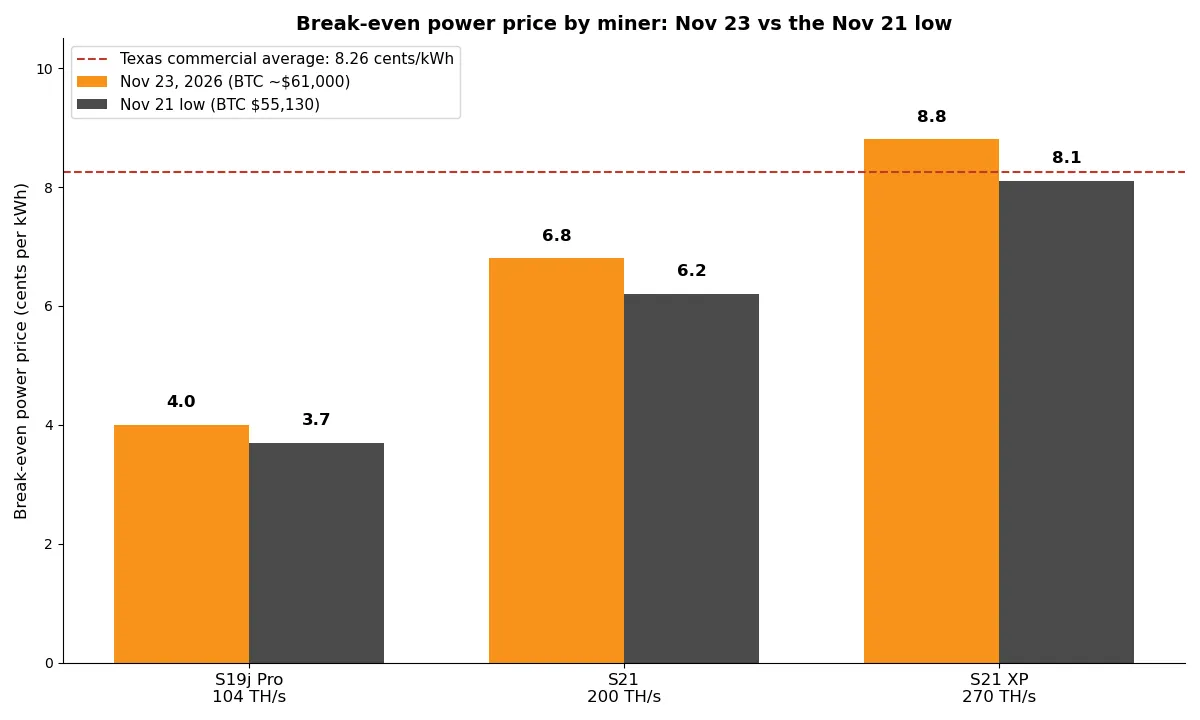
The S19j Pro tells the story. At the November 21 low, it needed power under 3.7 cents just to cover electricity, a price almost no home miner can get.
The crash also explains why miners with fixed-price power contracts survived better than miners on variable rates. When the price fell, their power cost stayed put, while their revenue dropped.
Our story on how far Bitcoin fell below the average cost to mine one coin explains the gap in full.
ERCOT Demand Response: Getting Paid to Switch Off
Here is the part of Texas mining that surprises most people. Some miners earn serious money by turning their machines off.
ERCOT runs demand response programs that pay large power users to cut load when the grid is stressed. A miner can switch off in minutes, which makes it one of the most flexible loads on the grid.
Riot Platforms turned this into a business line. In August 2023 alone, it collected about $31.7 million in power credits, and it has booked tens of millions more across recent quarters.
The summer of 2026 proved the scale. On July 22, ERCOT set an all-time demand record of 91,134 MW, and miners cut up to 3,299 MW during the peak hours.
TeraWulf reported $16.9 million in demand response earnings in the first half of 2026.
3,299 MW
Miners cut this much load on July 22, 2026, during ERCOT’s record demand day.
$31.7 million
Riot’s power credits in August 2023 alone.
91,134 MW
ERCOT’s all-time demand record, set July 22, 2026.
Can a Small Miner Use Demand Response?
Honestly, not directly. ERCOT’s programs are built for large loads, and a home miner with one or two machines is too small to join.
The way in is hosting. Big hosting sites in Texas pass some of their curtailment earnings to customers, or they charge lower rates because their power contracts include demand response.
Ask any host how it handles curtailment before you sign.
There is also a hidden saving. ERCOT sets part of your transmission bill from your load during four 15-minute peak windows each year, called 4CP.
A site that switches off during those windows can cut its bill for the next 12 months.
Texas Power Rates: What You Will Actually Pay
Texas power is cheap by American standards, but cheap is relative. The average Texas home paid 15.88 cents per kWh in July 2026, according to the US Energy Information Administration.
Businesses paid less. The commercial average was 8.26 cents, and industrial users paid 7.07 cents.
Large miners negotiate fixed-price contracts that can run well below those averages, which is the whole point of mining at scale.
| Customer type | Average rate (EIA, mid-2026) |
|---|---|
| Residential | 15.88 cents/kWh |
| Commercial | 8.26 cents/kWh |
| Industrial | 7.07 cents/kWh |
Rates also change by city. Oncor serves Dallas-Fort Worth at about 15 cents, CenterPoint serves Houston at about 16 cents, while Austin Energy and CPS Energy in San Antonio charge about 12 cents.
The other risk is spikes. During Winter Storm Uri in February 2021, wholesale prices hit the $9,000 per MWh cap for days.
The cap is now $5,000, but a variable-rate plan can still hurt you in a heatwave or a freeze.
How to Get a Miner-Friendly Rate
First, pick a fixed-rate plan, never a variable one, if you run machines at home. A fixed rate turns a price spike into your provider’s problem.
Second, compare retail providers on the state’s official Power to Choose site before you sign anything. Third, if you plan to run more than a couple of machines, get quotes from hosting sites in West Texas, where wind power is cheapest.
Our electricity cost guide breaks down what one miner really costs to run at different rates.
The Rules: Registration, Permits and Taxes
Texas welcomes miners, but it also watches them. Senate Bill 1929, in force since September 1, 2023, requires any virtual currency mining facility in the ERCOT region with more than 75 MW of interruptible load to register with the Public Utility Commission of Texas.
Registration is due within one business day of starting retail electric service, and facilities must report their location and five-year demand outlook each year. The PUC adopted the registration rule on November 21, 2024, and fines can reach $25,000 per violation per day.
A 2025 law, Senate Bill 6, also keeps large flexible loads out of a separate 24-hour notice program. The rules keep changing, so check the PUC site before you build anything big.
What Home Miners Need to Know
A home setup under 75 MW does not register with the PUC. That does not mean no rules apply, so check your city permits, your HOA rules, and your electrical panel before you buy a machine.
Noise is the most common complaint. An S21 runs at about 76 decibels, roughly as loud as a vacuum cleaner that never stops, so plan for soundproofing or a garage setup.
Mining income is also taxable, and our guide to how miners are taxed explains the hobby versus business split.
How to Start Mining Bitcoin in Texas in 6 Steps
If the numbers above still work for you, here is the order that saves beginners the most money.
- Sort out power before you buy hardware. Get your rate in writing, fixed, and compare it with the break-even table above.
- Pick home mining or hosting. Home suits one or two quiet machines, while hosting suits anything bigger and anyone who cannot handle the heat and noise.
- Choose a machine that fits your rate. An S21 XP earns at up to 8.8 cents, while an S19j Pro needs under 4 cents, so match the miner to your power.
- Join a mining pool. Solo mining a block with one machine would take decades, so a pool pays you small steady amounts instead. Our beginner’s guide to how mining works explains pools in plain English.
- Set up cooling, ventilation and soundproofing. A single ASIC throws out as much heat as a space heater running all day, and Texas summers make that worse.
- Track every cost from day one. Power, pool fees, repairs and taxes all eat into profit, so keep a simple spreadsheet and check it monthly.
Home Mining vs Hosting in Texas
Most beginners face this choice, and the right answer depends on your power rate and your tolerance for noise. The table below lays out the trade-off.
| Factor | Home mining | Hosting in Texas |
|---|---|---|
| Power rate | Your residential rate, about 15.9 cents | 3 to 8 cents at a good site |
| Noise and heat | In your house, all day | Not your problem |
| Control | Full control of your machine | You trust the host |
| Demand response | Not available to you | The host may share the earnings |
| Upfront cost | Machine plus electrical work | Machine plus setup and monthly fees |
For most Texans, hosting wins on the math. Home mining only works if you have cheap power, a tolerant household, and a machine efficient enough to survive a 16-cent rate, which none of the three machines above can do.
Common Mistakes Texas Miners Make
These are the errors we see again and again, and each one costs real money.
- Buying the machine before the power contract. The rate decides everything, so lock it in first.
- Mining on a variable-rate plan. One heatwave can turn a profitable month into a loss.
- Ignoring the noise. Neighbours complain, HOAs fine, and a machine in a spare bedroom is louder than most people expect.
- Forgetting the summer. Texas heat kills hashboards faster, so budget for cooling and expect more downtime in August.
- Skipping the tax records. Pool payouts are income, and the IRS wants its share, so track every satoshi from the start.
Frequently Asked Questions
Is Bitcoin mining legal in Texas?
Yes. Texas allows Bitcoin mining.
State law treats large mining facilities as flexible loads that must register with the Public Utility Commission if they use more than 75 MW of interruptible power. Home miners face no registration rule, but city permits and HOA rules still apply.
How much does it cost to mine Bitcoin in Texas?
It depends on your power rate and your machine. At November 2026 hashprice, an S21 XP earns about $7.70 a day before power, while an S19j Pro earns about $2.96, and at the average home rate of 15.88 cents per kWh, all three machines lose money.
Can I mine Bitcoin at home in Texas on residential power?
You can, but the math says you should not expect a profit. The average Texas home rate of 15.88 cents per kWh sits far above the break-even price of every common ASIC we tested.
A small, quiet miner like the Avalon Nano 3 suits learning and fun, not income.
What is ERCOT demand response, and how do miners earn from it?
Demand response pays large power users to switch off when the grid is stressed. Riot Platforms collected about $31.7 million in power credits in August 2023 alone.
Home miners cannot join directly, but hosting sites can pass on some of those earnings.
How much power does a Bitcoin miner use in Texas?
A single modern ASIC uses 3,000 to 3,650 watts running around the clock, or about 74 to 87 kWh per day. That is roughly twice what an average Texas home uses in a day, so check your panel capacity before you plug one in.
Is Texas still the best state for Bitcoin mining in 2026?
For large operations, yes. No other state combines cheap wind power, a deregulated market and demand response payments the way Texas does.
For a home miner on a residential rate, the answer is no, and hosting or a cheaper-power state makes more sense.
Sources
- ERCOT, Summer 2026 Operational and Market Review
- Texas Legislature, Senate Bill 1929 bill analysis
- Public Utility Commission of Texas, virtual currency mining facility registration
- US Energy Information Administration, Texas electricity rates
- Bitmain, Antminer S19j Pro, S21 and S21 XP specifications
- Luxor Hashrate Index, Bitcoin hashprice
Conclusion
Texas still offers the best mining setup in America, but only for miners who respect the math. Cheap power, a fixed-rate contract and the right machine are the whole game.
Run your own numbers with the break-even table in this bitcoin mining in texas guide before you spend a dollar. If your rate clears the bar, Texas is waiting, and our guide to mining Bitcoin at home walks you through a small setup step by step.
If it does not, hosting or waiting for a better price beats burning cash on a home rig. The grid will still be there when you are ready.