



Here is the short answer on how to mine bitcoin: buy an ASIC miner, plug it into cheap electricity, join a mining pool, and point it at your Bitcoin wallet. That is the whole job, and it takes about an hour to set up.
The hard part is not the setup. The hard part is the math.

At today’s hashprice, a top machine earns about $7.72 a day before power costs, so your electricity rate decides whether you profit or bleed money. This guide walks you through every step, then shows you the real numbers so you can decide with your eyes open.
- Key takeaways
- What Bitcoin Mining Actually Is
- How to Mine Bitcoin in 5 Steps
- Step 1: Check your electricity price first
- Step 2: Pick your hardware
- Step 3: Get a Bitcoin wallet
- Step 4: Join a mining pool
- Step 5: Connect the miner and start hashing
- The Hardware: What to Buy in 2026
- The Math That Decides Everything
- Solo Mining vs Pool Mining vs Cloud Mining
- Mining Bitcoin at Home: The Parts Nobody Mentions
- 5 Mistakes Beginners Make
- Is Mining Bitcoin Worth It in 2026?
- Where to Go Next in This Mining Guide
- Frequently Asked Questions
- Can I mine Bitcoin on my laptop or phone?
- How much does it cost to start mining Bitcoin?
- How much can a beginner earn mining Bitcoin?
- Is Bitcoin mining legal?
- Do I need to join a mining pool?
- What happens when all 21 million Bitcoin are mined?
- Sources
Key takeaways
- Bitcoin mining in 2026 needs an ASIC miner. A laptop, a phone, or a gaming GPU cannot compete.
- The block reward is 3.125 BTC plus fees, and the network pays out about 450 new BTC a day.
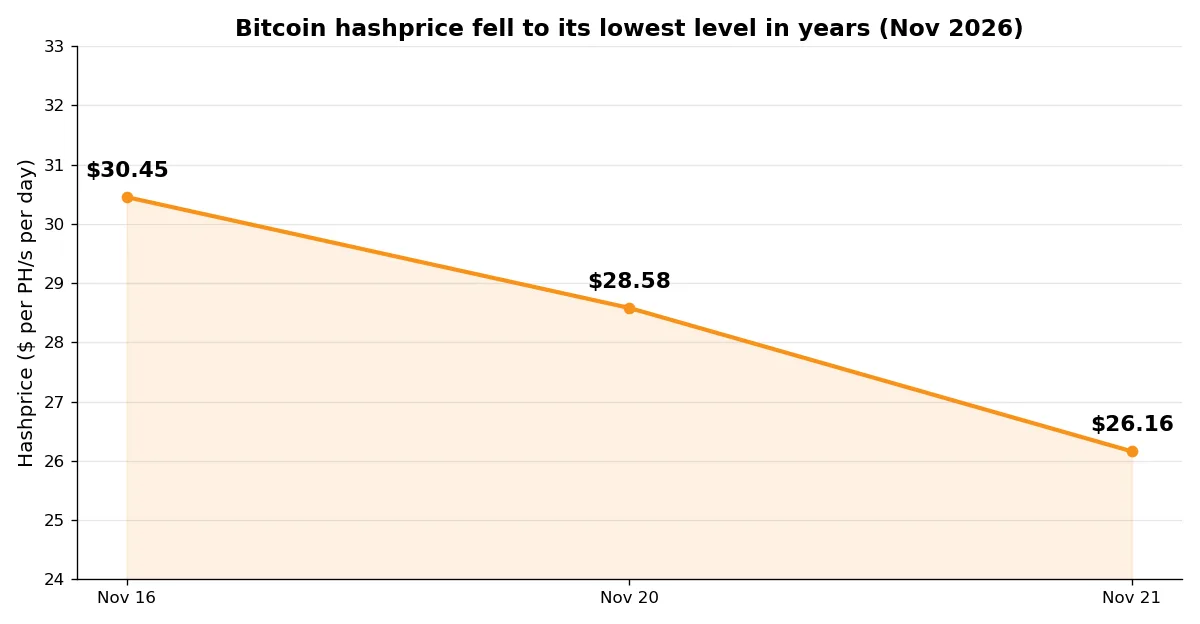
- Hashprice fell to $26.16 per PH/s per day on Nov 21, 2026, the lowest level in years, after Bitcoin dropped to $55,130.
- An Antminer S21 XP earns about $7.72 a day before power at the Nov 20 hashprice. It only covers its electricity below about $0.09 per kWh.
- Join a pool. Solo mining with one machine would take about 75 years on average to find a block.
- Electricity is the whole game. If you pay the average US household rate of about $0.18 per kWh, a big ASIC loses roughly $8 a day.
What Bitcoin Mining Actually Is
Bitcoin mining does two jobs at once. It confirms transactions, and it creates new bitcoin.
Miners collect pending transactions into a block, then race to solve a puzzle. The first miner to solve it adds the block to the chain and collects the reward.
If you want the deeper version first, read our guide on how Bitcoin mining works. This guide stays practical: what to buy, what to pay, and what to expect.
The puzzle, in plain words
Think of the puzzle as a giant guessing game. Miners feed a block of transactions into Bitcoin’s SHA-256 algorithm, over and over, changing one small number each time.

They need a result below a target the network sets. Nobody can predict the answer, so the only way to win is to guess trillions of times per second.
The network adjusts the difficulty every 2,016 blocks, about every two weeks, so blocks keep arriving every ten minutes. When more machines join, the puzzle gets harder.
When machines switch off, it gets easier. On Nov 14, 2026, difficulty dropped 9.13% to 134.82 trillion after miners went offline.
The next adjustment, due around Nov 27, is estimated to rise about 9% again.
What miners actually earn
Each block pays 3.125 BTC in new coins plus the fees users attached to their transactions. That adds up to roughly 450 new BTC a day, split across the whole network.
Your share depends on how much of the network’s computing power you control.
Here is the honest scale of it. The whole network runs at about 1,058 EH/s right now.
One Antminer S21 XP runs at 270 TH/s. That is roughly 0.000026% of the network, which is why pools matter so much.
We get to pools in a minute.
How to Mine Bitcoin in 5 Steps
You do not need a degree for this. You need a power socket, an internet cable, and about an hour.
Here are the five steps in order, and the order matters: check your power price before you spend a cent on hardware.
Each step below has its own detail. Skip none of them, because the expensive mistakes all happen in steps one and two.
Step 1: Check your electricity price first
Find your rate per kilowatt-hour on your power bill or your supplier’s website. This single number decides everything else.
Below $0.06 per kWh, a modern ASIC can make real money. Between $0.06 and $0.09, margins get thin.
Above $0.10, even the best machine on the market loses money right now.
The average US household pays about $0.18 per kWh. At that rate, do not buy a big ASIC to run at home.
The math section below shows the exact break-even price for four popular machines, so run your own number before you buy.
Step 2: Pick your hardware
Buy an ASIC, a machine built for one job: running SHA-256 hashes as fast as possible. The number that matters most is efficiency, measured in joules per terahash (J/TH).
Lower is better. A machine at 13.5 J/TH uses less than half the power per hash of an old machine at 30 J/TH.
For a first machine in 2026, the sensible picks are the Antminer S21 XP (270 TH/s, 13.5 J/TH, about $1,916 to $2,835 new) or, if your budget is smaller, a used S19j Pro. The hardware section below compares the current shortlist in full.
Step 3: Get a Bitcoin wallet
Your pool pays you in bitcoin, so you need somewhere to receive it. Set up a wallet you control before you start mining, not after your first payout arrives.
A mobile wallet works for small amounts, and a hardware wallet is the safer home for anything you plan to keep.
Write your seed phrase on paper and store it offline. Never photograph it, and never type it into a website.
If you are new to wallets, read our guide on how to store your Bitcoin safely before you go further.
Step 4: Join a mining pool
A pool combines the power of thousands of miners and splits the rewards. You get small, steady payouts instead of waiting decades for one lucky block.
Foundry USA, AntPool, and F2Pool mined about 62.3% of blocks in the past month, so any of the big three is a safe start.
Pick a pool with a fee around 1% to 2%, a payout method you understand (FPPS is the common one), and servers near you. Sign up, create a worker name, and copy the pool’s stratum address.
You will paste it into the miner in the next step.
Step 5: Connect the miner and start hashing
Plug the miner into a 220-240V circuit, connect it to your router with an ethernet cable, and open its web page in your browser. Enter the pool address, your worker name, and your wallet address.
Save, and the machine starts hashing within a minute.
Watch the pool dashboard for ten minutes. If your hashrate shows up and shares start counting, you are mining.
Expect your first payout within a day or two, depending on the pool’s minimum payout.
The Hardware: What to Buy in 2026
Hardware is where beginners waste the most money. They buy the cheapest machine, or the one with the biggest hashrate number, and they ignore efficiency.
Efficiency is the number that decides your profit, because electricity is your biggest cost.
Here is the 2026 shortlist, with live prices checked on Nov 22, 2026. Prices move fast, so treat these as a snapshot, not a quote.
Why ASICs won, and why nothing else works
Bitcoin mining used to run on CPUs, then GPUs, then FPGAs. Each step made the last one useless.
ASICs are chips designed for one algorithm only, and they are millions of times faster than a CPU at it. A gaming GPU earns nothing on Bitcoin today, and a phone earns less than nothing once you count the power.
Small open-source miners like the Bitaxe still have a place, but it is a hobby place. Our guide to the Bitaxe home miner explains why it is a great learning tool and a terrible income plan.
The 2026 shortlist
| Machine | Hashrate | Power | Efficiency | Price, Nov 22, 2026 |
|---|---|---|---|---|
| Antminer S23 | 305 TH/s | 3,355 W | 11 J/TH | ~$3,899 |
| Antminer S21 XP | 270 TH/s | 3,645 W | 13.5 J/TH | ~$1,916 to $2,835 |
| Antminer S21 Pro | 234 TH/s | 3,510 W | 15 J/TH | ~$3,500 to $4,500 |
| Antminer S19j Pro (used) | 100 TH/s | 3,050 W | 30.5 J/TH | A few hundred dollars |
The S21 XP is the sweet spot for most beginners. It costs less than half the S23, it runs on normal single-phase 220-240V power, and at 13.5 J/TH it stays efficient enough to survive a bad market.
The S19j Pro looks cheap, but at 30.5 J/TH it burns twice the power per hash, and the next section shows why that kills it.
Buy from a seller with a real return policy and a warranty you can use. Avoid deals that look too cheap, and never pay a seller who only takes crypto and has no reviews.
Second-hand machines can be fine, but ask for a photo of the machine running and a screenshot of its hashrate first.
The Math That Decides Everything
Here is the part most guides skip: the actual numbers. Mining income comes down to one figure called hashprice.
It is the dollars a miner earns per petahash per second, per day. On Nov 20, 2026, hashprice was $28.58.
On Nov 21, it fell to $26.16, the lowest in years, after Bitcoin dropped to $55,130.
Multiply your machine’s hashrate by hashprice and you get your daily revenue before power. Subtract your power cost and you get your profit.
That is the whole business, and the table below works it out for four machines at the Nov 20 hashprice of $28.58 per PH/s per day.
| Machine | Daily revenue | Power per day | Break-even power price |
|---|---|---|---|
| Antminer S23 | $8.72 | 80.5 kWh | $0.108/kWh |
| Antminer S21 XP | $7.72 | 87.5 kWh | $0.088/kWh |
| Antminer S21 Pro | $6.69 | 84.2 kWh | $0.079/kWh |
| Antminer S19j Pro | $2.86 | 73.2 kWh | $0.039/kWh |
Read the last column as your personal test. If your power costs more than the break-even price, the machine loses money every day it runs.
The S19j Pro needs power under $0.04 per kWh, which almost nobody has at home. That is why a cheap old miner is usually the most expensive mistake a beginner can make.
Now the worked example. Take the S21 XP at a power price of $0.05 per kWh.
It earns $7.72 a day, burns 87.5 kWh, so power costs $4.37. After a 1% pool fee of about $0.08, you keep about $3.27 a day, or about $98 a month.
At a $2,835 purchase price, the machine pays for itself in about 867 days, and that assumes hashprice and difficulty never change. They always change.
At $0.10 per kWh, the same machine loses about $1.11 a day. At the average US household rate of $0.18, it loses about $8.11 a day.
This is why whether Bitcoin mining is still profitable depends on your power bill, not on the machine. And it is why Bitcoin now trades below what it costs to mine one for many operators: at current prices, the average miner’s production cost sits above the market price.
Solo Mining vs Pool Mining vs Cloud Mining
You have three ways to mine, and only one of them makes sense for almost every beginner. Solo mining keeps 100% of any block you find, but you will wait a very long time.
Pool mining shares the rewards, and cloud mining rents you someone else’s machines.
The odds explain why pools win. A single S21 XP holds about 0.000026% of the network hashrate, so it would take about 75 years on average to find one block alone.
A Bitaxe at 1.2 TH/s would take about 17,000 years. Pools turn that lottery ticket into a small daily paycheck.
| Method | Best for | Payouts | Watch out for |
|---|---|---|---|
| Pool mining | Almost everyone | Small and steady, daily | 1-2% pool fee |
| Solo mining | Large farms, hobby lottery players | Full block reward, rarely | Years between payouts |
| Cloud mining | People with no space for hardware | Contract-based, often small | Scams are common, contracts often lose money |
Cloud mining deserves a warning. You pay upfront for a contract, and many contracts never return the money you put in.
If you go this route, use a provider with a long public track record, read the fee terms line by line, and never invest more than you can afford to lose outright. For most people, buying bitcoin directly beats a cloud contract.
Mining Bitcoin at Home: The Parts Nobody Mentions
A big ASIC is not a quiet appliance. It is a loud, hot box that runs 24 hours a day, and your home has to cope with that.
The noise is the first surprise: an air-cooled S21 XP runs at about 75 dB, roughly as loud as a vacuum cleaner that never switches off.
Heat is the second surprise. A 3,645W miner puts out about as much heat as three space heaters running nonstop.
In winter that can warm a room nicely. In summer it fights your air conditioning, and the extra cooling cost eats your profit.
Vent the hot air outside if you can.
Power is the third surprise. A big ASIC needs a dedicated 220-240V circuit, and it will not run on a standard 120V outlet.
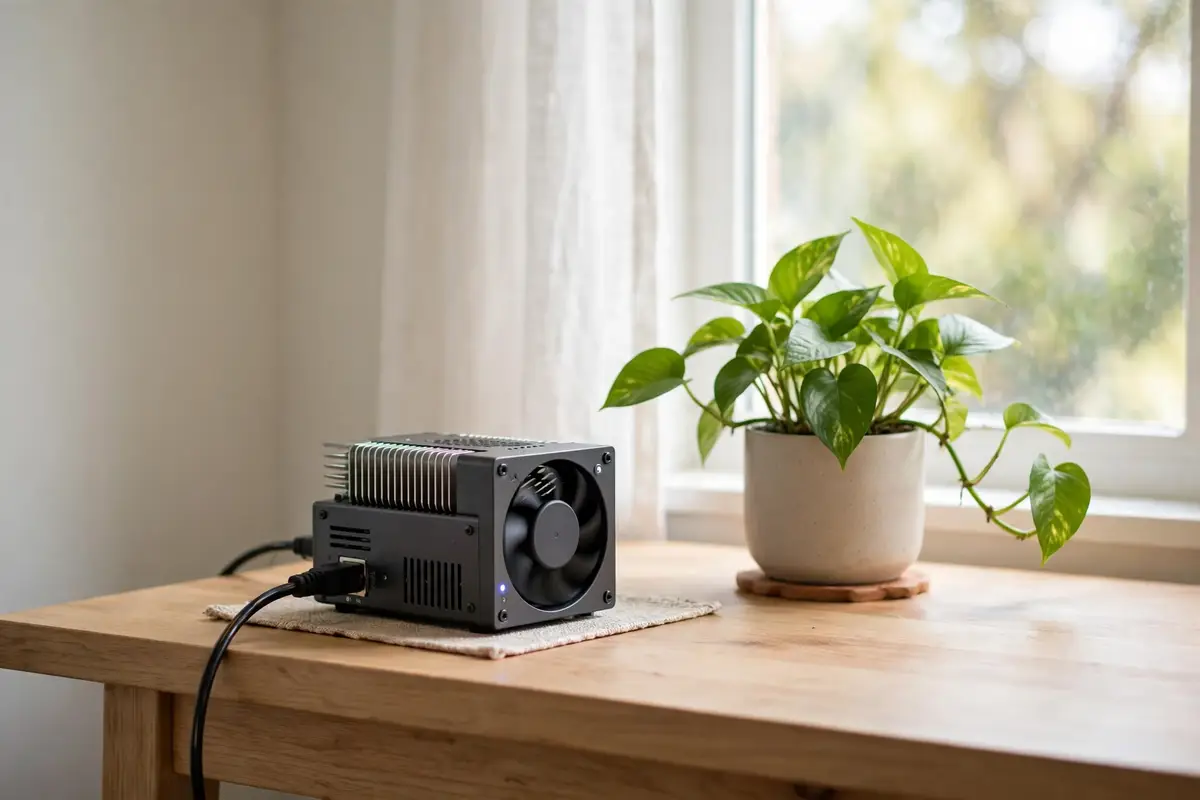
If your home wiring cannot give it a proper circuit, get an electrician before you plug anything in. Our full guide to mine Bitcoin at home covers the room, the wiring, and the noise fixes in detail, including the small quiet miners that actually suit a spare room.
5 Mistakes Beginners Make
Most mining losses come from the same few errors. They are all avoidable, and they all happen before the first satoshi arrives.
Mistake 1: Buying hardware before checking the power price. The machine is the cheap part.
The power bill is the real cost. Work out your break-even price first, using the table above.
Mistake 2: Buying the cheapest old miner. An S19-class machine at 30 J/TH needs power under $0.04 per kWh to break even.
A bargain that loses money every day is not a bargain.
Mistake 3: Mining solo with one machine. You are buying a lottery ticket with a 75-year average wait.
Join a pool and get paid daily.
Mistake 4: Ignoring noise and heat. A miner in a bedroom will keep you awake and cook the room.
Plan the space, the airflow, and the circuit before the box arrives.
Mistake 5: Forgetting tax. Mined bitcoin counts as income in most countries, and selling it later can trigger capital gains tax.
Keep records of every payout from day one. Our guide on how Bitcoin miners are taxed explains the hobby versus business split.
Is Mining Bitcoin Worth It in 2026?
It depends on three things, and you now know all three. Your power price, your hardware efficiency, and the Bitcoin price.
With power under $0.06 per kWh and a modern ASIC, mining still pays. With power at $0.10 or more, the same machine loses money, and no amount of tweaking fixes that.
Timing matters too. Bitcoin fell to $55,130 on Nov 21, 2026, its lowest since September 2024, and hashprice hit its lowest level in years the same day.
That is a brutal time to start, and it is also when the best miners buy hardware cheap. The S21 XP now sells from about $1,916, far below its launch price.
If you believe the price recovers and your power is cheap, a downturn is when the math improves for buyers.
Be honest with yourself about why you are doing it. If you want bitcoin, buying it directly is simpler and usually cheaper.
If you want to learn, support the network, or heat a room with something that pays a little back, mining is a fine hobby with real rewards. Just do it with the real numbers in front of you, not with a YouTube thumbnail’s promises.
Where to Go Next in This Mining Guide
This guide is the hub for our mining cluster. The articles below take each piece deeper, and each one links back here.
Start with the one that matches your next question.
- How Does Bitcoin Mining Work? The full beginner’s explainer, with the puzzle, the blocks, and the halving.
- Is Bitcoin Mining Still Profitable in 2026? The honest math, worked through for several machines and power prices.
- How to Mine Bitcoin at Home in 2026 A realistic setup guide for a spare room, with noise and wiring covered.
- What Is a Bitaxe Bitcoin Miner? The small, quiet, open-source miner that is perfect for learning.
- How Are Bitcoin Miners Taxed? Hobby versus business, and what to record for your tax return.
Coming next in this cluster: a guide to the Avalon Nano 3, a full breakdown of mining electricity costs, and a pool chooser that compares payout methods. If you are still deciding, the profitability guide above is the best next read.
Frequently Asked Questions
Here are the questions beginners ask most, with straight answers.
Can I mine Bitcoin on my laptop or phone?
Technically you can run mining software on either, but you will earn effectively nothing. A laptop hashes millions of times slower than an ASIC, and the power it burns costs more than the bitcoin it finds.
Phones are worse, and mining can overheat them.
How much does it cost to start mining Bitcoin?
A realistic start costs about $2,000 to $3,000 for a modern ASIC like the S21 XP, plus a 220-240V circuit if your home needs one. A learning setup with a Bitaxe costs around $100 to $200, but it earns only a few cents a day in a pool.
How much can a beginner earn mining Bitcoin?
At the Nov 20, 2026 hashprice of $28.58 per PH/s per day, an S21 XP earns about $7.72 a day before power. After power at $0.05 per kWh and a 1% pool fee, that leaves about $3.27 a day.
Your power price changes this more than anything else.
Is Bitcoin mining legal?
Mining is legal in most countries, including the United States, Canada, the UK, and most of Europe. A few countries ban it, including China and Algeria, and some places restrict it.
Check your local rules before you buy hardware, and remember that mined coins are usually taxable income.
Do I need to join a mining pool?
For almost everyone, yes. A single modern ASIC would take about 75 years on average to find a block alone, so solo mining pays nothing for decades.
A pool pays you a small share of every block the pool finds, usually daily.
What happens when all 21 million Bitcoin are mined?
The last bitcoin will be mined around the year 2140. After that, miners will earn only transaction fees, with no new coins.
The block reward halves every four years until then, and the next halving is expected around April 2028.
Sources
- Bitcoin: A Peer-to-Peer Electronic Cash System (Satoshi Nakamoto) The original whitepaper that defines proof of work and the block reward.
- mempool.space Live network data used in this guide: hashrate, difficulty, and the next adjustment estimate.
- Luxor Hashrate Index Source of the hashprice figures quoted in this guide, including the Nov 21, 2026 low of $26.16 per PH/s per day.






