

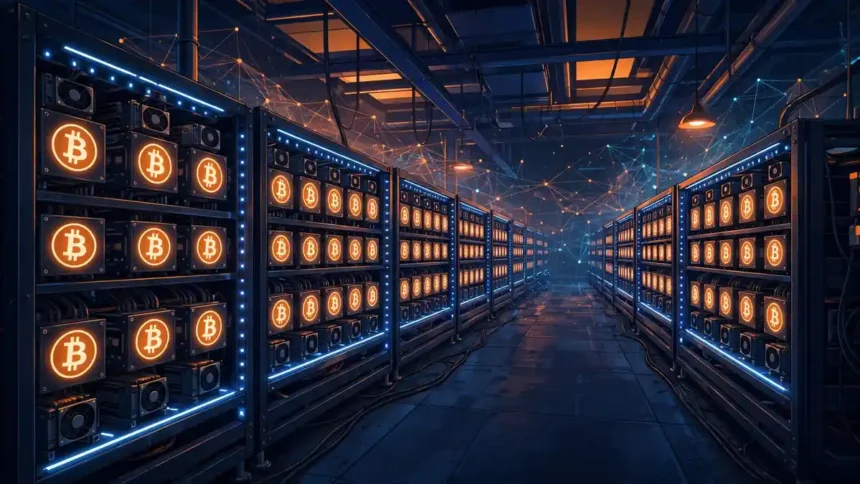
Bitcoin mining is a lottery, not math homework. Miners buy specialized computers, and those machines guess random numbers trillions of times per second. Every ten minutes or so, one lucky guess wins the block.
The winner gets paid in brand-new bitcoin plus transaction fees. That is the whole game. This guide explains bitcoin mining how it works in plain English, with no jargon, no hype, and the real 2026 numbers.

If you are brand new to crypto, start with our beginner’s guide to Bitcoin itself first. It will make everything below click faster.
- The 30-Second Explanation
- What Bitcoin Miners Actually Do (It Is Two Jobs)
- The Lottery Analogy, Step by Step
- What the Winner Gets Paid
- Why Mining Gets Harder Every Two Weeks
- The Halving: Why the Reward Keeps Shrinking
- ASICs: The Only Machines That Count Now
- Mining Pools: Why Solo Miners Team Up
- What Mining Really Costs
- My Honest Take: Is Bitcoin Mining Worth It in 2026?
- 5 Mistakes Beginners Always Make
- See It Explained on Video
- Frequently Asked Questions
- How does Bitcoin mining work in simple terms?
- Can I mine Bitcoin on my laptop or phone in 2026?
- What is the current Bitcoin mining reward?
- Why does mining use so much electricity?
- What is the difference between mining and staking?
- The Bottom Line
Key Takeaways
- Mining is the process that confirms Bitcoin transactions and creates new bitcoin. Miners are record keepers, not gold diggers.
- Miners compete in a guessing game (proof of work). The winner adds the next block and earns the 3.125 BTC block reward plus fees, set after the April 2024 halving.
- Difficulty auto-adjusts every 2,016 blocks (about two weeks) so blocks land roughly every 10 minutes.
- In 2026 only ASIC machines can mine Bitcoin profitably. Laptops and phones cannot compete.
- The reward halves about every four years. The next halving lands around 2028 and will cut it to 1.5625 BTC.
The 30-Second Explanation
Bitcoin has no bank and no boss, so who writes down the transactions? Volunteers with powerful computers, called miners. They bundle recent transactions into a block, then race to guess a winning number for it.
The first to guess right broadcasts the block to the network. Every computer on the network checks the answer in seconds. If it is valid, the block joins the blockchain forever, and the miner collects the reward.
That race is called proof of work. It is very different from how newer coins run their networks, as you can see in how Bitcoin’s proof-of-work differs from Ethereum’s proof-of-stake. The key idea is simple: winning takes real electricity, which makes cheating wildly expensive and honesty the smart play.
What Bitcoin Miners Actually Do (It Is Two Jobs)
Forget the word “mining.” Think “bookkeeping plus lottery.” Every miner does the same two jobs, over and over, every ten minutes.

Job 1: Keep the transaction list honest
When you send bitcoin, your transaction is broadcast to the whole network and waits in a pool of unconfirmed transactions. Miners collect these pending transactions and pack them into a candidate block.
They also check each one: does the sender actually own the coins, and is the signature valid? Bad or fake transactions never make it into a block. This is the security work that makes double-spending impossible.
Job 2: Run the lottery
Here is the clever part. The network will not accept just anyone’s block. The block’s data is run through a formula called SHA-256, which spits out a 64-character code.
Miners change a tiny number in the block, called a nonce, and run the formula again, over and over. Trillions of times per second, across the whole network. They are hunting for a code that falls below a target number set by the network.
The Lottery Analogy, Step by Step
The queue assignment for this article asked for the lottery analogy, because honestly it is the best one ever written about mining. Here is the full version:
- Buy tickets: A miner turns on an ASIC machine. Every hash (guess) it computes is one lottery ticket. Top machines in 2026 make hundreds of trillions of tickets per second.
- One winner every 10 minutes: The network sets the difficulty so that, across ALL miners combined, a winning ticket appears about every 10 minutes. A single drawing happens, and one block wins.
- Everyone can check the ticket instantly: Verifying the winning hash takes a normal computer a fraction of a second. Finding it took the whole network ten minutes of work. Hard to win, easy to check. That asymmetry is the genius of the system.
- Cheaters pay, not profit: If a miner slips a fake transaction into their block, every other node rejects it. The miner burned all that electricity for nothing. Crime does not pay here, by design.
What the Winner Gets Paid
The prize has two parts. The main prize is the block reward: brand-new bitcoin created out of thin air and given to the winning miner. Since the April 2024 halving, that reward is 3.125 BTC per block.
The second part is the transaction fees paid by everyone whose transaction got included in the block.
At current prices, one block is worth a serious amount of money. Roughly 144 blocks are mined every day, which means about 450 new bitcoin enter the world daily. When the next halving arrives around 2028, that number gets cut in half again, so do not miss our guide to the 2028 halving if you want the full timeline.
Notice something important: only 21 million bitcoin will ever exist. The block reward is how new coins are born, and the halvings are how Bitcoin keeps its supply on a fixed, predictable schedule. No central bank can print more, and that is the whole point.
Why Mining Gets Harder Every Two Weeks
Here is a question beginners always ask: if miners keep buying faster machines, would blocks not arrive faster and faster? Yes, and that is exactly why the network fights back.
Every 2,016 blocks, roughly every two weeks, Bitcoin measures how fast blocks have been arriving. If miners got faster and blocks came quicker than 10 minutes, the network raises the difficulty. If miners quit and blocks slowed down, it lowers the difficulty.
The target is always the same: one block about every 10 minutes.
This self-adjusting thermostat has kept Bitcoin running on schedule for over 17 years, through booms, crashes, and a famous mining ban in China. In my opinion, the difficulty adjustment is the single most underrated invention in all of Bitcoin. It is the reason the network cannot be rushed and cannot be stopped.
The Halving: Why the Reward Keeps Shrinking
The block reward started at 50 BTC in 2009. Every 210,000 blocks, about four years, it gets cut in half. The chart below shows the full schedule with real data.

Each halving makes bitcoin scarcer and forces miners to become more efficient. Weak miners with expensive electricity shut down. Strong ones with cheap power survive and grow.
This cycle has repeated four times now. The fifth halving, cutting rewards to 1.5625 BTC, is expected around 2028.
ASICs: The Only Machines That Count Now
In 2009 you could mine bitcoin on a laptop. In 2011, gaming graphics cards took over. By 2014, a new breed of machine arrived: the ASIC (Application-Specific Integrated Circuit), a chip built to do exactly one thing, compute SHA-256 hashes, as fast as possible.

Today, ASICs are the entire game. For reference, Bitmain lists its Antminer S21 at 200 terahashes per second with an efficiency of 17.5 joules per terahash.
Your laptop, for comparison, manages a few dozen megahashes. That is a gap of roughly a million to one. This is not a fair fight, and it never will be again.
So could you mine with your laptop or phone?
Honest answer: no. Not real Bitcoin mining. Your laptop would earn fractions of a cent per day while your electricity bill and fan noise cost far more.
Those phone mining apps you see advertised mine tiny altcoins or simply pay you micro-rewards for watching ads. They are not Bitcoin mining, and anyone promising otherwise is selling you something.
Mining Pools: Why Solo Miners Team Up
Even with an ASIC, mining alone is brutal. You might wait years to win a single block. So most miners join a mining pool: thousands of miners combine their hash power, and when anyone in the pool wins a block, the reward is split among everyone based on how much work each contributed.
A pool does not make winning easier. The network difficulty is the same for everyone. What a pool changes is the variance.
Instead of a tiny chance at a huge payout every few years, you get small, steady payouts every day. For anyone without a warehouse of machines, pools are the only sane way to mine.
One important fact: pools coordinate work, but they do not control the network. The rules stay the same no matter how big a pool gets.
What Mining Really Costs
Mining has three big costs: the machines, the electricity, and the cooling. Of the three, electricity decides everything.
Industry watchers note that in 2026 only operators paying roughly 6 to 8 cents per kilowatt-hour or less, with modern efficient ASICs, can stay profitable. Everyone else is slowly donating money to the power company.
This is also where the famous energy debate lives. Mining uses a lot of electricity, and that is not a bug, it is the security mechanism. But a growing share of miners now chase cheap, stranded, or renewable energy, because cheap power is the whole business model, as our look at sustainable approaches to crypto mining explains.
Location is everything. A miner in a region with 4-cent hydroelectric power and cold air for cooling can print money where a miner paying 15 cents per kilowatt-hour in a hot city loses on every block. Mining is, at its core, a competition to find the world’s cheapest electricity.
My Honest Take: Is Bitcoin Mining Worth It in 2026?
You asked for the opinion style, so here is mine, straight: for almost every beginner reading this, the answer is no. Do not buy a miner for your bedroom. The difficulty is at record highs, the reward just halved in 2024, and professional operations with 4-cent power will outcompete you every single day.
But here is the twist: you do not need to mine to benefit from understanding mining. Understanding mining is what turns Bitcoin from “magic internet money” into something you actually trust.
Once you see that attacking the network would cost more electricity than any attacker could afford, the 21 million supply cap stops being a promise and starts being physics. Learn how mining works, then buy a little bitcoin instead of a machine. That is the rational move for 99% of people, and I will not pretend otherwise to sell you hardware.
The one exception: if you genuinely have access to very cheap or free stranded electricity (a solar setup with excess capacity, for example), small-scale mining can make sense as a hobby with upside. Even then, treat it as an experiment, not an income plan.
Mining: the pros
- You earn bitcoin without buying it on an exchange
- You directly secure the network you believe in
- Rewards are predictable in pools
- Machines can run on cheap or excess energy
Mining: the cons
- Needs cheap electricity (under ~8 cents/kWh) to profit
- ASICs are expensive and become outdated fast
- Difficulty keeps rising, shrinking your share
- Noise, heat, and maintenance are real headaches
- The 2024 halving already cut rewards to 3.125 BTC
5 Mistakes Beginners Always Make
I have watched beginners lose money on mining the same five ways for years. Learn from them for free:
1. Believing “free Bitcoin mining” websites: there is no free lunch in proof of work. Sites promising free mining either pay dust, steal your data, or are outright scams.
We dug into these claims in our guide to free Bitcoin mining claims. Spoiler: the math never works.
2. Buying an old, cheap ASIC: a secondhand miner from 2021 looks like a bargain until you realize the difficulty has doubled since then and it now costs more in electricity than it earns. Always check current profitability calculators before buying any hardware.
3. Ignoring the electricity bill: beginners calculate revenue and forget costs. At 12 cents per kWh, most home setups lose money from day one. Know your exact rate first.
4. Expecting to get rich solo mining: with one machine, your odds of winning a block alone are worse than winning an actual lottery. Join a pool or do not bother.
5. Mining without a plan for the heat and noise: ASICs are as loud as vacuum cleaners and run hot 24/7. Your spare bedroom will become uninhabitable.
Ask me how I know.
See It Explained on Video
If you learn better by watching, this is the single best beginner explanation I have found. Cory Klippsten from Swan Bitcoin walks through exactly what miners do every ten minutes, using the same lottery framing, and it is only a few minutes long:
Frequently Asked Questions
These are the questions beginners ask me most about mining. Short answers, no jargon.
How does Bitcoin mining work in simple terms?
Miners use specialized computers to guess random numbers trillions of times per second. The first to find a winning guess gets to add the next block of transactions to the blockchain and earns 3.125 BTC plus transaction fees. Think of it as a global lottery that runs every ten minutes, where electricity is the ticket price.
Can I mine Bitcoin on my laptop or phone in 2026?
No, real Bitcoin mining requires ASIC hardware built specifically for SHA-256 hashing. A laptop or phone produces a negligible hash rate and would cost more in electricity than it could ever earn. Phone “mining apps” pay tiny rewards for other tasks and are not Bitcoin mining.
What is the current Bitcoin mining reward?
The block reward is 3.125 BTC plus transaction fees, set by the April 2024 halving. The next halving around 2028 will cut it to 1.5625 BTC.
Why does mining use so much electricity?
The electricity IS the security. Because winning a block requires real energy spending, attacking the network would require outspending all honest miners combined, which is economically irrational. Cheap energy wins, which is why miners chase the lowest-cost power on earth.
What is the difference between mining and staking?
Mining is proof of work: miners compete with computing power and electricity to win block rewards, and it is how Bitcoin creates new coins. Staking is proof of stake, used by networks like Ethereum, where validators lock up coins as collateral instead of burning electricity.
The Bottom Line
Bitcoin mining is a brilliantly simple idea wearing complicated clothes. Transactions need recording, nobody is in charge, so the network runs a fair lottery every ten minutes and pays the winner in bitcoin.
Difficulty keeps the schedule honest. Halvings keep the supply scarce. ASICs keep the amateurs out, and electricity keeps everyone honest.
You probably should not mine bitcoin yourself in 2026. But now you understand the machine that has kept Bitcoin alive and unhackable for 17 years, and that understanding is worth more than any miner you could buy. If this clicked for you, the natural next step is learning how to actually get some bitcoin without a mining rig: dollar-cost averaging is the beginner strategy I recommend to friends who ask where to start.
For the complete 2026 math, see whether Bitcoin mining is still profitable in 2026.
Curious about mining at home? See our guide on what a BitAxe home miner is.