

Yes, you can accept Bitcoin payments as a business in 2026, and the setup takes less than a day in most cases. You pick one of three routes, a hosted processor, a self-hosted BTCPay Server, or a plain wallet payment, and you decide up front whether you want dollars in your bank or Bitcoin in your wallet.
I have watched too many merchants overcomplicate this. They read ten guides, compare twelve processors, and never take a single payment.

The honest truth is simpler than the sales pages admit. If you sell online, start with a hosted processor.
- Who Should Accept Bitcoin, and Who Should Not
- The Three Routes to Accept Bitcoin Payments
- Route 1: A hosted payment processor
- Route 2: Self-hosted BTCPay Server
- Route 3: A direct wallet payment
- What It Actually Costs: The 100 Dollar Sale Test
- Volatility: How to Get Paid Without Gambling on Price
- Lightning Network: The Answer for Small Payments
- Bookkeeping, Taxes and the Paper Trail
- Mistakes That Cost Merchants Real Money
- What This Series Covers Next
- Frequently Asked Questions
- Do I need a license to accept Bitcoin payments?
- Can I accept Bitcoin and still get paid in dollars?
- What happens if Bitcoin’s price drops after a customer pays?
- Is BTCPay Server really free?
- Should a small business use the Lightning Network?
- Do I pay tax when a customer pays me in Bitcoin?
- Sources
If you care about control and zero fees, run BTCPay Server. If you sell in person, a wallet and a QR code will do.
This guide shows you each route, what it really costs on a 100 dollar sale, and the mistakes that catch first-time merchants.
Key takeaways
- Three routes exist: hosted processor, self-hosted BTCPay Server, or direct wallet payment. Most stores should start with a hosted processor.
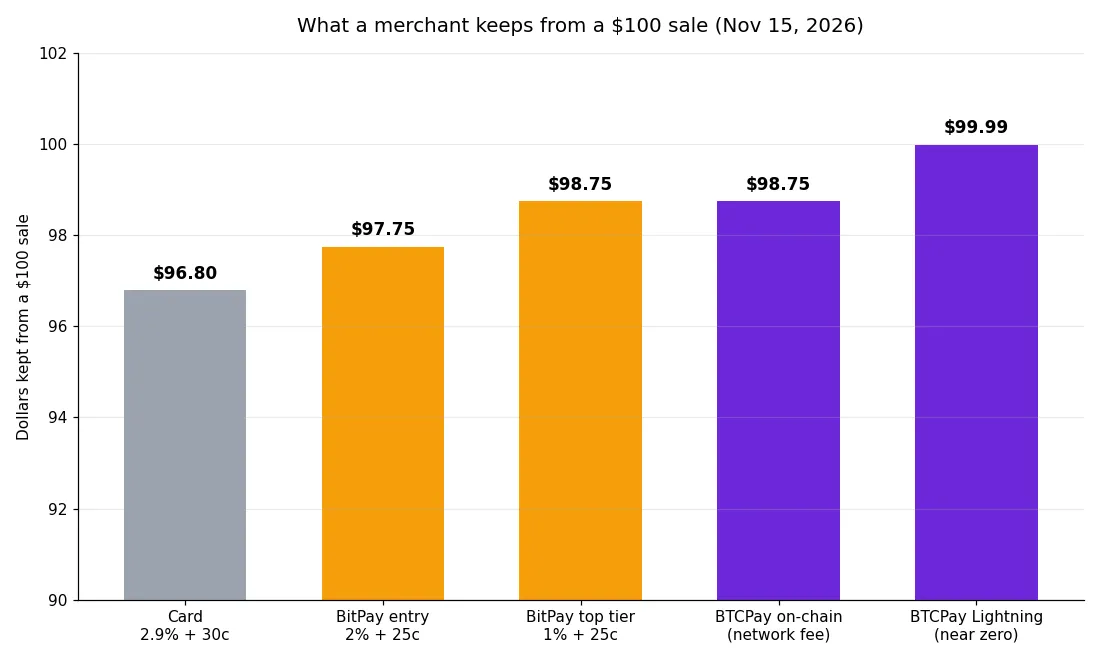
- On a 100 dollar sale, card networks keep about 3.20 dollars, BitPay keeps 2.25 dollars at its entry tier, and BTCPay Server keeps nothing but the network fee.
- Coinbase Commerce shut down for merchants outside the US and Singapore on March 31, 2026. Its replacement, Coinbase Business, only serves those two markets.
- Bitcoin payments cannot be charged back. That saves you fraud losses, but it also means refunds are your job.
- Bitcoin traded near 65,382 dollars on November 15, 2026, so a 100 dollar sale equals about 0.001529 BTC at that price.
Who Should Accept Bitcoin, and Who Should Not
Bitcoin payments fit some businesses far better than others. The deciding factor is not how much you love Bitcoin.
It is who your customers are and how your cash flow works.

Online stores with international customers gain the most. A buyer in another country can pay you without a bank in the middle, without a currency conversion fee, and without a three day wait.
Digital sellers gain too, because there is no shipping address to fake and no card to steal.
Businesses that gain the most
Freelancers and agencies with global clients should look at Bitcoin first. A client in a country with strict capital controls can pay you in minutes, and you skip the wire fee that used to eat 30 or 40 dollars.
High ticket sellers also benefit, because a 2.9 percent card fee on a 5,000 dollar order is 145 dollars, while a processor fee of 1 percent is 50 dollars.
Charities and creators with a global audience are another good fit. A donor anywhere in the world can send you value with no bank account on either side.
Our own series will cover how to accept Bitcoin payments on Shopify and how to accept Bitcoin payments on WooCommerce in detail, so store owners can follow the exact steps for their platform.
Businesses that should wait
Some businesses should hold off, and I say that as someone who wants Bitcoin accepted everywhere. If your margins are razor thin and you need every dollar in the bank tomorrow, the learning curve is not worth it yet.
A corner shop with no online presence and no crypto curious customers will spend more time explaining Bitcoin than it earns from it.
Businesses in countries with unclear crypto rules should also pause. Check your local law before you take a single payment.
If your accountant cannot tell you how a Bitcoin sale is taxed, sort that out first, because the tax record matters more than the checkout button.
The Three Routes to Accept Bitcoin Payments
Every way to accept Bitcoin falls into one of three buckets. The differences come down to control, fees, and who handles the hard parts.
Pick the bucket first, then pick the provider inside it.
There is no wrong choice here, only a wrong fit. A small shop does not need the same setup as a store doing a million dollars a month.
Start simple, and move to a cheaper route once volume justifies it.
Route 1: A hosted payment processor
A hosted processor does the work for you. You sign up, connect it to your store, and it shows your customer a Bitcoin checkout, locks the exchange rate, and sends the money to your bank.
BitPay is the best known name here, and it settles to your bank the next business day in 38 countries. CoinGate and NOWPayments work the same way at around 1 percent and 0.5 percent.
The trade off is custody and identity checks. The processor holds the funds briefly, and it will ask for your business documents before it pays you.
That is normal for any company that touches bank transfers. If you want the fastest setup and you are happy to pay 1 to 2 percent, this route wins.
Route 2: Self-hosted BTCPay Server
BTCPay Server is free, open source software that you run on your own server. Payments go straight to your own wallet, and the software takes a 0 percent processing fee.
There is no company in the middle, so there is no identity check and no one can freeze your account. Our guide on how to set up BTCPay Server walks through the full install.
The trade off is responsibility. You pay for hosting, usually under 10 dollars a month for a small server, and you handle your own security and backups.
If you lose your wallet keys, no support desk can recover them. I recommend this route to any merchant who plans to keep some Bitcoin rather than convert it all to cash.
Route 3: A direct wallet payment
The simplest route needs no processor at all. You show the customer a QR code from your own wallet, they scan it and send the Bitcoin, and you watch it arrive.
This works well at a market stall, a food truck, or any face to face sale. It costs nothing beyond the network fee.
The catch is that you take the price risk yourself, and you must record every payment by hand. There is no automatic invoice, no rate lock, and no tax report.
Use this route for small in person sales, not for a store doing hundreds of orders a day.
What It Actually Costs: The 100 Dollar Sale Test
Fee pages hide the real cost behind percentages, so I ran the same 100 dollar sale through each route. Bitcoin traded near 65,382 dollars on November 15, 2026, which means a 100 dollar sale equals about 0.001529 BTC.
Every number below comes from the providers own published pricing, checked today.
The gap between the cheapest and the most expensive route is real money. On one sale it looks small.
On a thousand sales a month it decides whether Bitcoin pays for itself.
| Route | Fee on a 100 dollar sale | What you keep | Settlement |
|---|---|---|---|
| Card payment (2.9% + 30 cents) | 3.20 dollars | 96.80 dollars | Bank, 1 to 2 days |
| BitPay, entry tier (2% + 25 cents) | 2.25 dollars | 97.75 dollars | Bank, next business day |
| BitPay, top tier (1% + 25 cents) | 1.25 dollars | 98.75 dollars | Bank, next business day |
| BTCPay Server, on-chain | About 0.50 to 2.00 dollars (network fee) | About 98.00 to 99.50 dollars | Your wallet, on confirmation |
| BTCPay Server, Lightning | Fractions of a cent | About 99.99 dollars | Your wallet, instantly |
| Coinbase Business | Fee shown inside your account, not published | Varies | USDC, then bank withdrawal |
Read the table one more time and notice what it does not show. BitPay charges 2 percent plus 25 cents when your monthly volume sits under 500,000 dollars, then 1.5 percent up to 999,999 dollars, and 1 percent above 1 million dollars.
That means a small store pays the highest rate, and the rate only falls when volume grows. BTCPay Server charges nothing at any volume, so the savings grow with every sale.
Now scale the numbers to a real month. A store doing 10,000 dollars a month in Bitcoin sales keeps 9,775 dollars through BitPay at the entry tier, and about 9,990 dollars through BTCPay on Lightning after tiny network fees.
That is a 215 dollar monthly gap, or about 2,580 dollars a year, for the same sales. The gap is the reason I tell merchants to start hosted and graduate to self hosted once the volume is there.
Volatility: How to Get Paid Without Gambling on Price
Volatility is the first worry every merchant names, and it is a fair one. Bitcoin fell from above 126,000 dollars in early October 2026 to near 62,000 dollars in mid November, so a merchant who held every payment would have watched revenue swing hard.
The fix is to decide your policy before your first sale, not after a price drop.
You have two honest choices, and both work. Pick one, write it down, and stick to it when the market moves.
Instant conversion: sell the Bitcoin the moment it arrives
Hosted processors do this for you. BitPay locks the exchange rate at checkout and converts the payment to your local currency, so a 100 dollar sale lands as 100 dollars minus the fee no matter what Bitcoin does next.
Coinbase Business settles in USDC, a dollar pegged stablecoin, and you withdraw to your bank when you choose. This is the right choice if you pay rent, staff, and suppliers in local currency.
Instant conversion has one cost people forget. You give up any upside if Bitcoin rises after the sale.
That is not a loss, it is the price of certainty, and for most businesses certainty is worth more than a gamble.
Keep the Bitcoin: hold some, convert some
The second choice is to keep part of each payment in Bitcoin. A common split is 80 percent converted to cash for bills and 20 percent held as a long term position.
BTCPay Server fits this policy best, because the coins land in your own wallet and no processor decides for you.
Only hold what your business can afford to see fall by half. Bitcoin did exactly that in the six weeks before this guide was written, and merchants who held everything they earned felt it.
Treat held Bitcoin as savings, not as operating cash, and never pay a supplier from coins you may need to sell at a loss.
Lightning Network: The Answer for Small Payments
On-chain Bitcoin payments work well for larger orders, but the network fee makes a 5 dollar coffee sale silly. The Lightning Network fixes that by moving small payments off chain, where fees cost fractions of a cent and settlement is instant.
A customer scans a Lightning invoice, pays in a second, and you keep almost the whole amount.
Both BTCPay Server and most hosted processors support Lightning in 2026. Our guide on how to pay with Bitcoin Lightning explains the failure modes, because Lightning invoices can expire and channels can run dry.
For a merchant, the rule is simple: use Lightning for anything under about 100 dollars, and use on-chain payments for larger orders where a small fee does not matter.
One warning from experience: do not run your only Lightning node on a laptop that sleeps. A node that goes offline cannot receive payments, and a customer standing at your counter will not wait for you to wake it up.
A small always on server or a hosted Lightning service avoids the problem entirely.
Bookkeeping, Taxes and the Paper Trail
Every Bitcoin payment is a sale, and your tax authority will treat it that way. In the US, receiving Bitcoin for goods or services counts as income at the fair market value on the day you receive it.
In the UK, HMRC treats the same receipt as trading income. The exact rules vary by country, but the record keeping does not.
Record four things for every payment: the date, the amount in Bitcoin, the price in your local currency at that moment, and the invoice or order number. Hosted processors export this as a report, and BTCPay Server logs each payment with its rate.
If you take direct wallet payments, keep a simple spreadsheet and update it the same day. Our Bitcoin tax guide covers the full rules for merchants and individuals, and it is worth reading before your first sale.
This guide is not tax advice, and your accountant should confirm the treatment in your country.
One record most merchants forget is the cost basis of the Bitcoin they keep. If you later sell or spend those coins, the gain or loss counts from the day you received them, not the day you sell.
Losing that record turns a simple sale into a guessing game at tax time, so store it with the invoice from the start.
Mistakes That Cost Merchants Real Money
Most merchant losses come from the same few avoidable errors. I have seen all of these happen to real stores, and each one was preventable with ten minutes of preparation.
First, reusing one wallet address for every customer. Anyone can look up that address and see your total revenue.
Use a fresh address for each payment, which BTCPay Server and every processor does automatically. Second, leaving coins on an exchange account instead of moving them to a wallet you control.
Exchanges can freeze accounts, and your operating cash should never depend on someone else’s login page. If you do need to turn Bitcoin into cash later, our guide on how to sell Bitcoin on P2P platforms safely covers the safe routes.
Third, signing up for a processor you have not checked this year. Coinbase Commerce is the cautionary tale here: it shut down for merchants outside the US and Singapore on March 31, 2026, and older guides still recommend it.
If a guide recommends a processor, check the provider’s own site before you sign up. Fourth, ignoring refunds.
Bitcoin payments cannot be charged back, which protects you from fraud, but an angry customer with no refund path becomes a public complaint. Publish a clear refund policy before you take payments, and pay refunds in Bitcoin at the current rate or in cash, whichever your policy states.
Fifth, pricing products in Bitcoin and never updating the price. A product listed at 0.001 BTC cost 126 dollars in early October 2026 and about 65 dollars by mid November.
Price in your local currency and let the processor convert at checkout, or update your Bitcoin prices daily. The complete hub for every way to pay with Bitcoin helps you understand the customer side of the same transaction, which makes your checkout easier to explain.
What This Series Covers Next
This guide is the hub for our Merchants cluster, and it links to the platform guides we already publish. The cluster will now work through the rest of the merchant journey one topic at a time.
Next up are the everyday spending guides, then freelancer payments, donations, and the platform by platform setup guides for BigCommerce, Etsy, Magento, PrestaShop, Squarespace, and Wix.
Each guide in the series links back here, so this page stays the map for the whole cluster. If you run a store and you want a specific platform covered sooner, that is what the comments are for.
The goal is simple: by the end of the cluster, any business owner should be able to pick a route, set it up, and take their first Bitcoin payment without guessing.
Frequently Asked Questions
Here are the questions merchants ask most often about taking Bitcoin payments.
Do I need a license to accept Bitcoin payments?
In most countries you do not need a special license to accept Bitcoin for goods or services, because it is treated like any other payment method. Hosted processors will still ask for your business documents, and some countries restrict crypto use, so check your local rules before you start.
Can I accept Bitcoin and still get paid in dollars?
Yes. Hosted processors such as BitPay convert the payment and settle to your bank in dollars the next business day.
Coinbase Business settles in USDC, which you can withdraw to your bank at any time.
What happens if Bitcoin’s price drops after a customer pays?
With a hosted processor the rate is locked at checkout, so a price drop after payment does not change what you receive. If you take direct wallet payments or hold the Bitcoin yourself, you carry the price risk until you sell or convert it.
Is BTCPay Server really free?
The software is free and charges a 0 percent processing fee, and there is no identity check because no company sits in the middle. You still pay for hosting, usually under 10 dollars a month for a small server, plus the Bitcoin network fee on each payment.
Should a small business use the Lightning Network?
Yes, for small payments. Lightning fees cost fractions of a cent and settlement is instant, which makes it the best option for sales under about 100 dollars.
Use on-chain payments for larger orders, where a small network fee does not matter.
Do I pay tax when a customer pays me in Bitcoin?
Yes, in most countries the payment counts as income at its fair market value on the day you receive it, and you must record the date, the Bitcoin amount, and the local currency value. Our Bitcoin tax guide covers the full rules, but this guide is not tax advice, so confirm the treatment with your accountant.