

You can buy Bitcoin in South Africa in about fifteen minutes. Here is the honest starting point, almost any South African adult with a bank account, an ID, and mobile data can do it today, legally, through a licensed local exchange.
The trick is not finding a way in. The trick is avoiding the expensive way in.

Never use the dodgy doors at all.
- What you need before you start
- How to buy Bitcoin in South Africa: 7 steps
- Step 1: Choose your exchange
- Step 2: Create your account
- Step 3: Complete FICA verification
- Step 4: Deposit rand by EFT
- Step 5: Choose exchange order over instant buy
- Step 6: Confirm and find your Bitcoin
- Step 7: Move larger amounts to your own wallet
- Luno vs VALR vs AltCoinTrader: which one fits you?
- How much does a first buy really cost?
- Common mistakes South African beginners make
- Paying instant fees by default
- Trusting WhatsApp and Telegram tipsters
- Leaving everything on the exchange forever
- Frequently Asked Questions
- Conclusion
I have watched South African friends pay close to 2% on instant buys because the big button looked easiest. I have also seen screenshots of WhatsApp “investment clubs” that vanished with deposits.
This guide walks the regulated route step by step. Choose an exchange, pass FICA verification, deposit rand by EFT, and place your first proper exchange order.
If you are brand new to crypto, our Bitcoin Basics section covers the underlying ideas first.
What you need before you start
South African exchanges must verify you under FICA, the same law banks follow. Gathering the documents first turns sign-up into a straight line instead of a scavenger hunt.

| What you need | Why it matters |
|---|---|
| South African ID or passport | Proves who you are for FICA |
| A selfie | Matches your face to the document |
| Proof of address in some cases | A bank statement or utility bill from the last 3 months |
| A local bank account | Source of your free EFT deposit |
| Mobile number and email | Account security and two-factor codes |
Most approvals land within a few hours on a working day. If you open an account on Friday evening, you often wait until Monday.
This wait catches out more beginners than any fee does. Plan for the delay instead of hunting for a site that skips verification altogether.
No-verification is not a feature in South Africa, it is a warning sign.
How to buy Bitcoin in South Africa: 7 steps
There are three legitimate doors covered below: Luno, VALR, and AltCoinTrader. The FSCA, South Africa’s financial regulator, licences all three.
The steps are almost identical whichever you pick.
Step 1: Choose your exchange
Start with the comparison table later in this guide if you want the numbers first. Short version: Luno is the friendliest for a first buy.
VALR is cheaper and broader once you want lower fees. AltCoinTrader is the local rand specialist with a flat trading fee.
Pick one and stick with it for your first purchase. Opening three accounts on day one only multiplies the FICA paperwork.
Step 2: Create your account
Sign up with an email address and a password you use nowhere else. Turn on two-factor authentication during setup, not later.
Later has a way of never arriving. A unique password plus an authenticator app closes off most of the account-takeover tricks that circulate locally.
Step 3: Complete FICA verification
Upload your ID or passport, take the selfie, and add proof of address if the exchange asks for it.
Keep photos sharp and uncropped. Blurry corners are the commonest reason for a rejection.
Never send documents through WhatsApp or email to anyone claiming to help. Real verification happens inside the app or website only.
Step 4: Deposit rand by EFT
This is where South Africans save real money. A standard EFT from your bank to the exchange is free on Luno and VALR.
It usually reflects within one business day. Instant EFT and card deposits cost extra fees while you learn.
They run around 1.4% and 3.9% respectively on Luno at the time of writing.
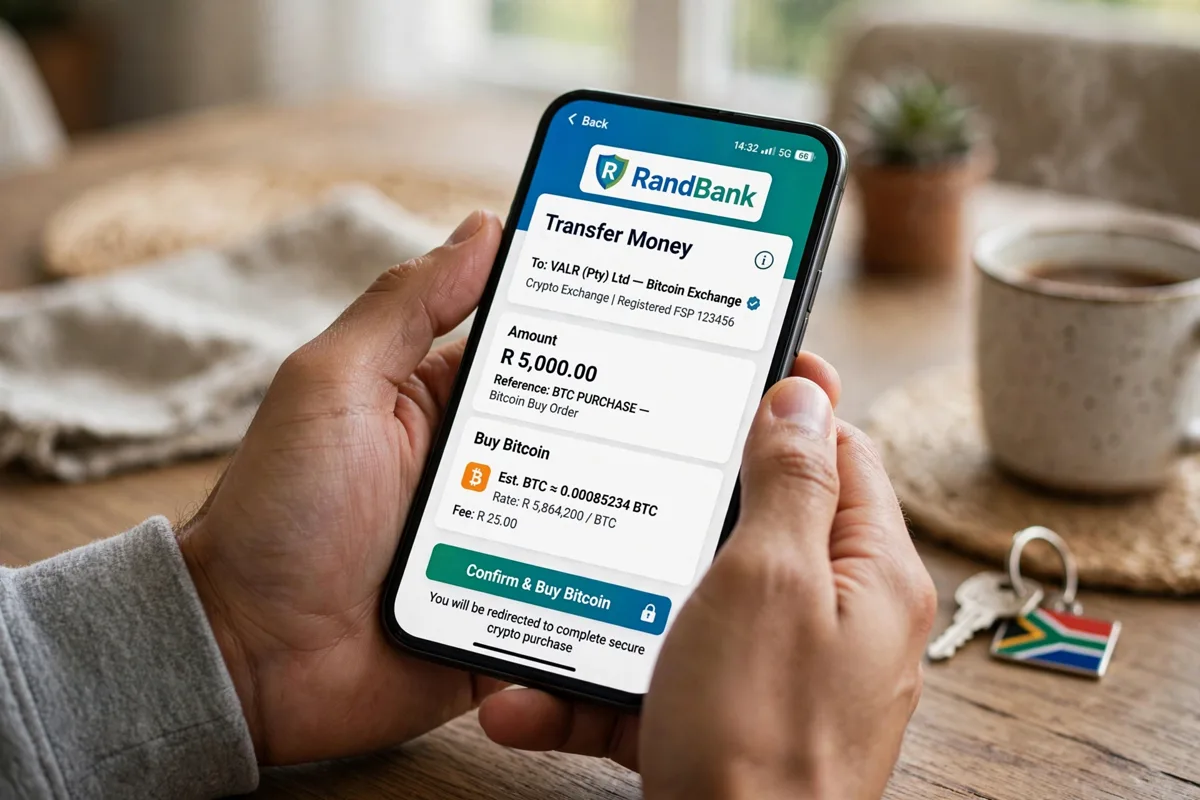
One detail matters more than any other here: use the exact deposit reference the exchange gives you. A wrong reference is the top reason deposits vanish into a support queue.
Support queues move at the speed of paperwork, not the speed of your worry.
Step 5: Choose exchange order over instant buy
Exchanges price instant buy for convenience: about 2% on Luno. A simple exchange order gets you the same coin for a fraction of that.
On the exchange screen, choose the BTC/ZAR pair. Enter how much rand you want to spend, review the fee shown, and confirm.
If order types are new to you, start with a market order in a small amount. Learn limit orders next week.
Step 6: Confirm and find your Bitcoin
Your balance appears in the exchange wallet as soon as the order fills. Save the trade confirmation email.
Note the date and rand amount in a simple spreadsheet. One day, SARS, the South African Revenue Service, may ask how you calculated a gain.
Boring records win that argument every time. Our guide to paying Bitcoin taxes explains the record-keeping habit in more detail.
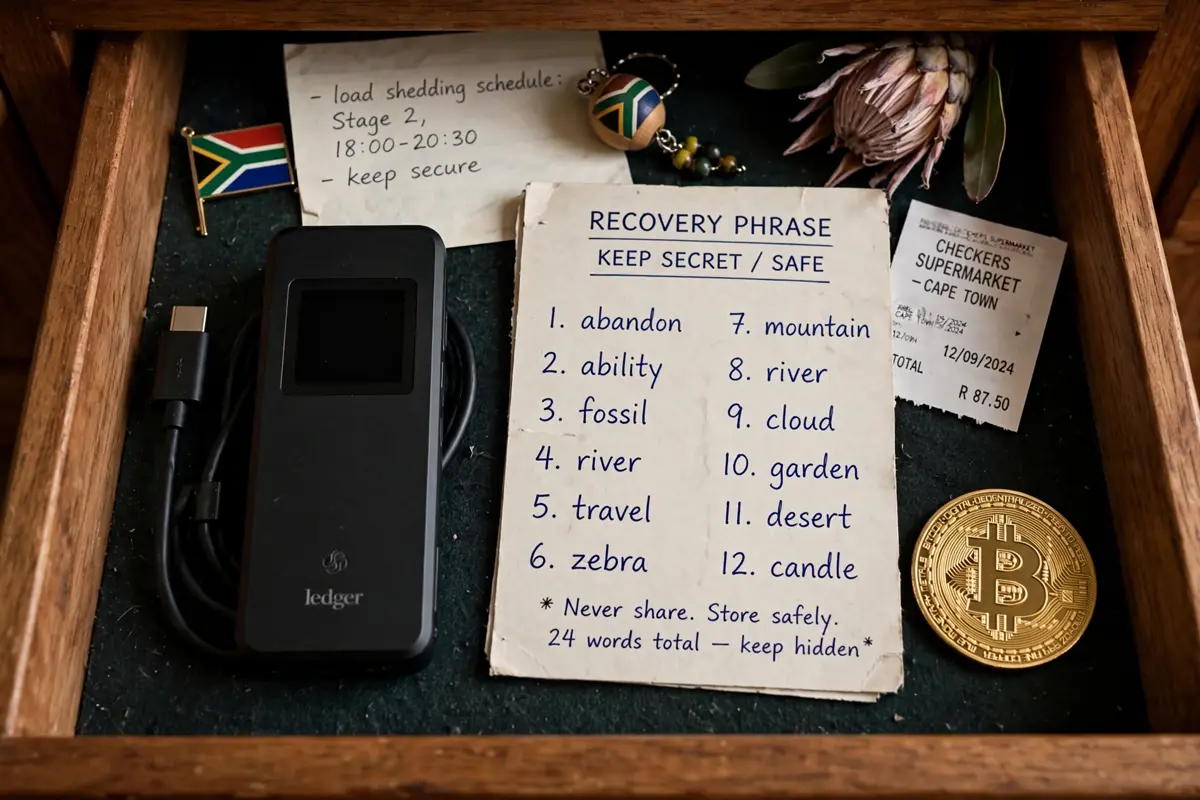
Step 7: Move larger amounts to your own wallet
Small learning amounts can stay on the exchange. Move amounts you would genuinely miss to a wallet you control.
Send a tiny test amount first and wait for it to arrive. Only then send the rest.
Read our plain-language walkthrough on how to store Bitcoin offline for the long term before you move anything.
Luno vs VALR vs AltCoinTrader: which one fits you?
All three are South African, support rand deposits, and hold FSCA licences. They differ in feel and in fees.
Honestly, the best choice depends on how you plan to buy. The table shows fee figures from recent South African fee comparisons in October 2026.
Fees change, so always check the preview screen before you confirm a trade.
| Exchange | Best for | Headline fees | Rand deposit | Watch out for |
|---|---|---|---|---|
| Luno | True beginners and repeat buys | Instant buy about 2%; exchange taker from 0.6% down with volume | Free EFT; instant EFT about 1.4%; card about 3.9% | Instant fees add up on bigger buys |
| VALR | Low fees and wider coin choice | Simple buy about 1.6%; spot fees far lower, some maker rebates | Free EFT; card about 3.9% | More screens and order types to learn |
| AltCoinTrader | Rand-focused local trading | Easy buy 0.75%; exchange trading 0.1% flat | EFT or cash deposit 0.5%, capped at R95 | Smaller coin list, about 35 coins |
My honest take? Start on Luno if the whole idea still feels new.
The app teaches as you go. Move to VALR once fees start to annoy you.
Its exchange pricing and coin range reward that step up. AltCoinTrader is the quiet local option.
Many South Africans like it for simple rand pairs and that flat 0.1% exchange fee.
The new FNB shortcut, and its catch
On 7 October 2026, FNB began letting customers buy Bitcoin, Ether, XRP, Solana and USDT from as little as R10 inside its share trading platform. VALR provides the trading service behind the scenes.
It is the easiest first taste in the country: no new account, no new app. The catch matters though.
Coins bought there stay inside the FNB product. You cannot send them to your own wallet.
If self-custody matters to you, buy on an exchange instead.
How much does a first buy really cost?
Let us run a simple example with the rand price from 12 October 2026, about R1,384,868 per Bitcoin. A R1,000 buy at that price gets about 0.000722 BTC before fees.
Fees then decide how much less you receive.
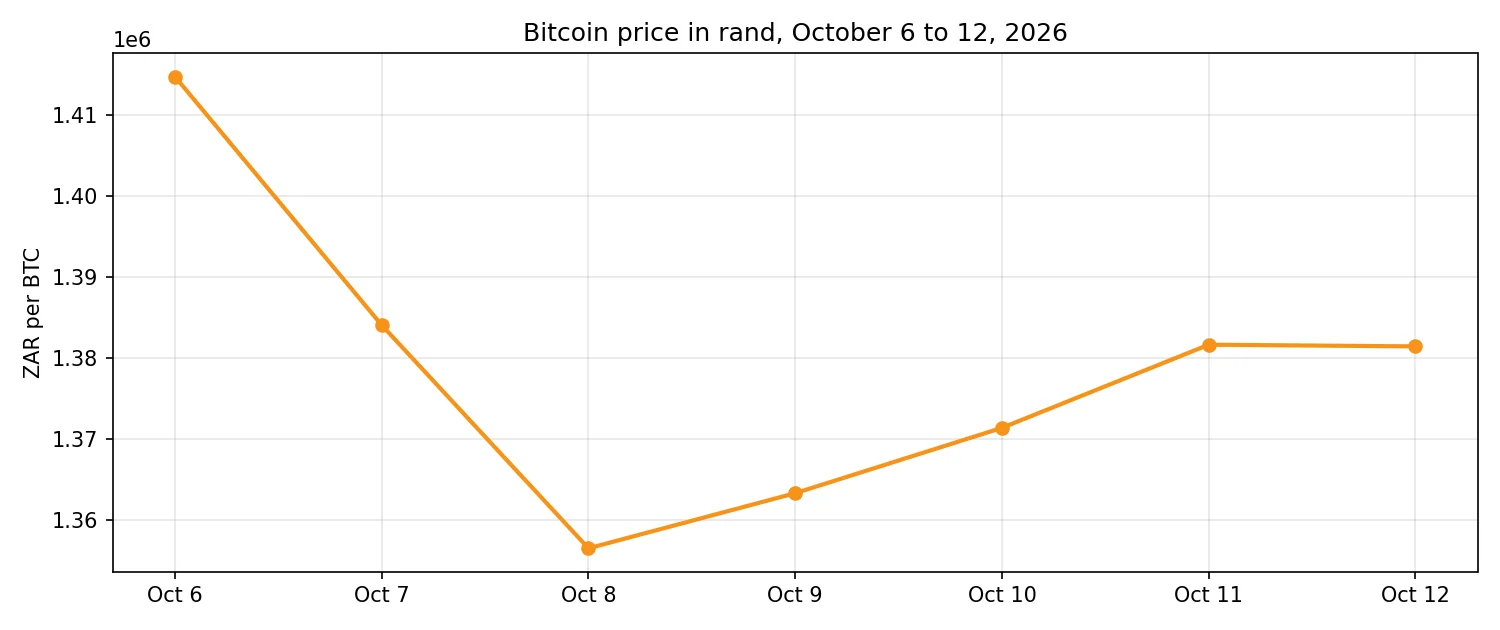
On an instant buy at about 2%, roughly R20 goes to fees on that R1,000. On a 0.1% exchange trade, the trading fee is about R1, before any deposit cost.
Nobody gets rich saving R19. But the habit scales: at R50,000, the same choice is roughly R1,000 versus R50.
Learn the exchange screen early. Your amounts are still small and mistakes are cheap.
After buying, you can check if your Bitcoin transaction is confirmed when you send coins to your own wallet.
Common mistakes South African beginners make
Most losses I see have nothing to do with the Bitcoin price. They come from hurry.
People deposit to the wrong reference. They skip verification until they need to withdraw.
Some buy on the first site a social media ad sends them to.
Paying instant fees by default
The big buy button is not your friend on price. Use free EFT and wait for it to reflect.
Then place an exchange order. Slow really is cheaper here.
Trusting WhatsApp and Telegram tipsters
No licensed exchange recruits through WhatsApp groups. No real trader guarantees monthly profits.
If returns sound fixed and safe, walk away. In South Africa, check for an FSCA licence.
If a crypto firm cannot show one, treat it as a no.
Leaving everything on the exchange forever
An exchange account is a buying tool, not a vault. Turn on two-factor authentication and use a unique password.
Move amounts that matter into your own wallet. Never share your recovery phrase with anyone, including anyone claiming to be support.
Frequently Asked Questions
Is it legal to buy Bitcoin in South Africa?
Yes. Buying, holding and selling Bitcoin is legal in South Africa. Crypto is regulated as a financial product, exchanges need an FSCA licence, and Bitcoin is not legal tender.
What is the minimum amount I need to buy Bitcoin in South Africa?
You can start very small. VALR allows purchases from R10, and FNB customers can buy from R10 inside the bank share platform. On Luno and AltCoinTrader, most beginners start with R100 to R500.
Which exchange is cheapest for buying Bitcoin in South Africa?
For exchange trading, AltCoinTrader charges a flat 0.1% fee and VALR spot fees are also very low. Luno instant buy, at about 2%, is the most expensive of the three main routes, while its exchange fees are much lower.
Do I need FICA verification to buy Bitcoin?
Yes. Licensed South African exchanges must verify your identity under FICA. You will usually need an ID or passport, a selfie, and sometimes proof of address before you can deposit and withdraw freely.
Do I pay tax on Bitcoin in South Africa?
Yes, you may. SARS treats crypto as an asset. Long-term gains can fall under capital gains tax with an annual exclusion of about R50,000, while regular trading profits are taxed as income at rates up to 45%.
Conclusion
Learning how to buy Bitcoin in South Africa is mostly about choosing the regulated door and refusing the expensive one. Open an account at Luno, VALR or AltCoinTrader and finish FICA.
Deposit by free EFT, and use the exchange screen once you feel steady. Start with an amount you can watch fall by half without panic.
Bitcoin can do that, and nobody knows what next month brings.
Your next step is simple. Pick one exchange from the table.
Verify your account today, and make a small test deposit before you buy anything. Small first, safe always.
Buying from Australia instead? Our step-by-step guide explains how to buy Bitcoin in Australia.
Buying from another country follows the same careful pattern, so readers with family or plans abroad can also see how to buy Bitcoin in Argentina for the peso route.