



Bitcoin vs Western Union remittance costs come down to one question. How much of your $500 actually reaches home?
On the busiest Pakistan corridors, the answer surprises most people. Bitcoin barely beats Western Union, and sometimes it loses.

On expensive corridors, Bitcoin wins by a wide margin. This guide shows the real math for $500, corridor by corridor, with the hidden exchange rate margin and the new 2026 US tax included.
- What a remittance really costs
- Bitcoin vs Western Union Remittance Costs: The $500 Test
- The same $500 from the Gulf
- Where Bitcoin clearly wins, and where it does not
- The 2026 US cash tax nobody budgets for
- The last-mile problem
- How to send $500 with Bitcoin, step by step
- Common mistakes
- Frequently Asked Questions
- Is Bitcoin cheaper than Western Union for sending money to Pakistan?
- How much does Western Union charge to send $500 to Pakistan?
- What is the 1% US remittance tax in 2026?
- Should I send Bitcoin or a stablecoin?
- Can the recipient get cash from a Bitcoin transfer in Pakistan?
- The bottom line
- Sources
Key takeaways
- Western Union’s fee is only part of the cost. The exchange rate margin often costs more.
- A $500 transfer from the US to Pakistan costs about $14.71 on average through formal channels. Bitcoin lands in the same range once you count the off-ramp.
- Cash-funded transfers from the US now carry a 1% federal excise tax. Bank or card funding avoids it.
- Bitcoin wins clearly on expensive corridors, where formal costs run 6% to 11%.
- Never send Bitcoin itself as the transfer. Price swings can erase the saving in a day. Use a stablecoin, or accept the risk with open eyes.
What a remittance really costs
Every international transfer has three costs, and most people only see one. The transfer fee is the number on the screen.
The exchange rate margin is the quiet cut taken through a worse rate. The cash-out cost is what the recipient pays to turn the money into spendable cash.
The World Bank tracks the first two together in its Remittance Prices Worldwide survey. Its Q3 2025 data puts the global average cost of sending $200 at 6.36%.
That is $12.72 gone before the money arrives. The United Nations wants every corridor under 3% by 2030, and most corridors still miss that target.

Before you compare routes, it helps to know every way to pay for Bitcoin, because the funding method changes the total too.
The transfer fee
Western Union charges $0 to $10 to send money from the US to Pakistan, depending on how you pay and how the money arrives. Online bank-funded transfers often show a $0 fee.
Cash at an agent location costs more.
Bitcoin has no company fee. You pay a network fee instead, plus whatever your exchange charges to buy and sell.
On-chain Bitcoin fees usually run $1 to $5, and they rise when the network is busy. Lightning Network payments cost under a cent in routing fees in most cases.
The exchange rate margin
This is where Western Union makes most of its money on cheap corridors. The company offers a rate worse than the mid-market rate, and it keeps the difference.
A 2% margin on $500 is $10, and it never appears as a fee line.
Bitcoin has the same problem at both ends. You buy Bitcoin at a spread above the market price, and the recipient sells at a spread below it.
Each spread is usually 0.5% to 2%. Add them together and the round trip costs 1% to 4% before any network fee.
The cash-out cost
Western Union wins here. The recipient walks into one of more than 15,000 agent locations in Pakistan with a CNIC and a control number, and walks out with cash in minutes.
No bank account is needed.
Bitcoin loses here. The recipient needs a way to turn crypto into rupees, usually a peer-to-peer trade or a local exchange.
That step takes time, and it carries its own spread. In places with weak off-ramps, this single step can erase every saving the crypto route offered.
Bitcoin vs Western Union Remittance Costs: The $500 Test
Now the worked example. We send $500 from the United States to Pakistan on November 6, 2026.
Bitcoin trades near $76,000, down about 6% in the last day. The mid-market rate is 276.6 rupees per dollar.
Every number below comes from the World Bank Q3 2025 survey or the live prices quoted.
The table shows the full cost, not the advertised fee. Read the last column first.
That is what your family actually receives.
| Route ($500, US to Pakistan) | Stated fee | FX margin and spreads | Other costs | Total cost | Family receives |
|---|---|---|---|---|---|
| Western Union, corridor average | $6.94 | $7.75 (1.55%) | $0 | $14.71 (2.94%) | PKR 134,231 |
| Western Union, cash-funded (adds 2026 tax) | $6.94 | $7.75 (1.55%) | $5.00 tax | $19.71 (3.94%) | PKR 132,848 |
| Bitcoin route, on-chain | $2.50-5.00 buy spread | $5-10 sell spread | $1-3 network fee | $8.50-18.00 (1.7-3.6%) | PKR 133,321-135,949 |
| Bitcoin route, Lightning | $2.50-5.00 buy spread | $5-10 sell spread | Under $0.10 routing | $7.60-15.10 (1.5-3.0%) | PKR 134,123-136,198 |
Sources: World Bank Remittance Prices Worldwide, Q3 2025 (US to Pakistan $500 average: $6.94 fee plus 1.55% margin). Bitcoin price near $76,000 and USD/PKR mid-market rate 276.6 on November 6, 2026.
Bitcoin buy and sell spreads are typical 0.5% to 2% ranges, not live quotes.
What the table really says
On this corridor, Bitcoin ties Western Union. The ranges overlap almost completely.
Anyone who tells you Bitcoin always wins has never priced the sell side in Pakistan.
Bitcoin does beat cash-funded Western Union, because the 1% tax adds $5 that crypto avoids. It also beats Western Union on speed for bank deposits, since Lightning settles in seconds.
But the cheapest digital services still beat both. One independent test of a $500 transfer to Pakistan found Wise charged $4.82, at the mid-market rate.
The same $500 from the Gulf
The Gulf corridors change the picture. The United Arab Emirates to Pakistan is one of the cheapest corridors in the world.
The World Bank puts its average cost at 2.17% on a $200 transfer, or about $4.34.
Western Union itself is far pricier than the corridor average here. World Bank provider-level data prices Western Union at 5.76% on the UAE to Pakistan route, with an AED 24.26 fee plus a 2.46% exchange rate margin.
That is roughly $11.52 in cost on a $200 transfer, against a corridor average of $4.34.

Bitcoin faces the same off-ramp cost from the Gulf as it does from the US. The buy spread, the network fee, and the sell spread still add up to roughly $8 to $18 on $500.
That beats Western Union’s own 5.76% price, but it only matches the corridor’s cheapest options. The lesson repeats: the corridor matters more than the technology.
Pakistan received a record $41.6 billion in remittances in the 2025-26 fiscal year, up 8.6% on the year before, according to the State Bank of Pakistan. Most of that money comes from the Gulf, the UK, and the US.
Even a 1% saving on that flow is worth more than $400 million a year to Pakistani families.
Where Bitcoin clearly wins, and where it does not
Bitcoin wins where formal channels are expensive. The global average is 6.36% on $200, and several corridors run far above it.
The World Bank prices the US to Lebanon corridor at 11.28%, and parts of Sub-Saharan Africa regularly exceed 8%.
On a $500 transfer at 8%, the formal route costs $40. The Bitcoin route costs $8 to $18.
That gap is real, and it grows with every transfer. Families who send money every month save hundreds of dollars a year.
Cheap corridors: use the cheapest formal option
The US to Pakistan corridor averages 2.94% on $500, and the UAE to Pakistan corridor averages 2.17% on $200. At those levels, Bitcoin has no cost edge once you count the off-ramp.
Use the cheapest regulated service for the corridor, and keep it simple.
Expensive corridors: Bitcoin earns its place
When the formal cost passes 6%, Bitcoin starts to win even after the sell spread. The recipient still needs a reliable off-ramp, so check that first.
A cheap transfer that nobody can cash out is not cheap.
The 2026 US cash tax nobody budgets for
Since January 1, 2026, the United States charges a 1% federal excise tax on remittance transfers paid with cash, a money order, or a cashier’s check. The law is section 4475 of the tax code, added by Public Law 119-21.
The provider collects the tax at the counter and pays it to the IRS.
The tax applies to the amount sent, not the fee. A $500 cash transfer costs $5 in tax.
Twelve monthly transfers cost $60 a year. Transfers funded from a US bank account or a US-issued debit or credit card are exempt, so the tax falls hardest on senders who pay cash at an agent.
Bitcoin transfers dodge this tax because no remittance provider handles the cash leg. That is a genuine $5 saving on a $500 cash transfer.
It is not a reason to choose Bitcoin on its own, but it tips the math on cash-funded routes.
The last-mile problem
Here is the honest catch. Western Union pays out in cash at more than 15,000 locations across Pakistan, including small towns.
The recipient needs only a CNIC and the transfer control number. The money is ready in minutes.
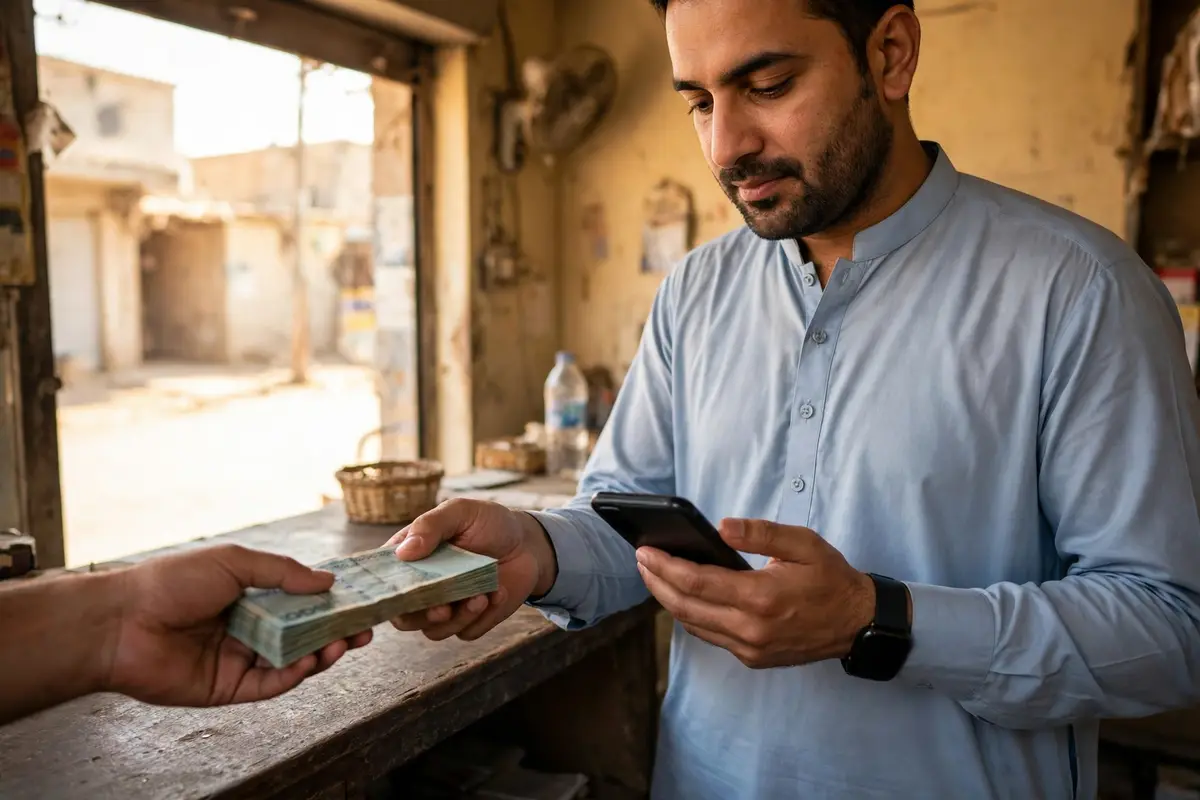
Bitcoin pays out nowhere by itself. The recipient must sell the crypto through a peer-to-peer trade, a local exchange, or a wallet app that supports rupee cash-out.
Each option needs a phone, an account, and some know-how. In cities with active peer-to-peer markets, this works well.
In villages with no crypto buyers, it does not work at all. If your family is in Pakistan, our guide to buying Bitcoin in Pakistan walks through the local options step by step.
Pakistan’s own payment rails help the formal side. The State Bank runs Raast, a free instant payment system, and Pakistani banks must deliver qualifying transfers without charging the sender or the recipient.
That is one reason the Pakistan corridors are so cheap. A Bitcoin transfer still has to land in a bank account or a wallet before Raast can move it.
Some recipients skip cash-out entirely and spend crypto directly with a Bitcoin debit card instead, but every tap sells Bitcoin and can trigger a tax event.
How to send $500 with Bitcoin, step by step
If the corridor and the off-ramp both favor crypto, here is the safe way to do it. The whole process takes under an hour once both sides are set up.
If you need coins in a hurry, the fastest ways to buy Bitcoin compare card, PayPal, and other instant routes. One funding route people forget is that you can buy Bitcoin with Western Union itself, which can make sense when cash is all you have.
- Agree the amount in dollars, not in Bitcoin. Both sides should know the family receives $500 worth of value, whatever the coin price does.
- Buy a dollar stablecoin, not Bitcoin, for the transfer itself. Bitcoin fell about 6% on November 6, 2026 alone. A $500 Bitcoin transfer sent in the morning could be worth $470 by evening.
- Send it on a low-fee network. Lightning costs under a cent in routing fees for Bitcoin, and stablecoin transfers on low-fee networks cost a few cents to a couple of dollars.
- Double-check the address. Send a small test amount first, then the rest once it arrives. A wrong address cannot be reversed.
- Let the recipient sell immediately. The longer crypto sits unsold, the more price risk the family carries.
- Keep the receipts. Note the buy price, the network fee, and the sell price. That record settles arguments and helps with tax reporting.
Common mistakes
The first mistake is comparing the advertised fee only. A $0 fee with a 3% exchange rate margin costs $15 on $500.
Always compare the rupees that arrive, not the fee on the screen.
The second mistake is sending Bitcoin itself instead of a stablecoin. Volatility is not a small risk.
Bitcoin dropped about 6% in a single day on November 6, 2026, and that move alone would have wiped out every fee saving on a $500 transfer.
The third mistake is ignoring the sell side. The transfer is not finished when the crypto arrives.
It is finished when the family holds rupees. Price the cash-out before you send anything.
The fourth mistake is using an unlicensed peer-to-peer trader with no reputation. A bad trade can cost the whole transfer.
Use established platforms, check the trader’s history, and never release crypto before the rupees arrive. Peer-to-peer trades need care, and no-ID options come with their own limits.
Frequently Asked Questions
The questions readers ask most, answered in plain words.
Is Bitcoin cheaper than Western Union for sending money to Pakistan?
On the US to Pakistan corridor, no, not clearly. The formal average is 2.94% on $500, and the Bitcoin route lands in the same range once you count the buy spread, the network fee, and the sell spread.
Bitcoin wins on expensive corridors where formal costs run above 6%.
How much does Western Union charge to send $500 to Pakistan?
The World Bank average for the US to Pakistan corridor is $14.71 on $500, made of a $6.94 fee and a 1.55% exchange rate margin. Cash-funded transfers add a 1% US excise tax, or $5.
The exact cost varies by payment method and payout option.
What is the 1% US remittance tax in 2026?
It is a federal excise tax under section 4475 of the tax code. It applies to remittance transfers paid with cash, a money order, or a cashier’s check after December 31, 2025.
Transfers funded from a US bank account or a US-issued card are exempt.
Should I send Bitcoin or a stablecoin?
Send a stablecoin. Bitcoin’s price can move several percent in a day, and the recipient carries that risk until the coins are sold.
A dollar stablecoin holds its value through the transfer, and the recipient sells it for rupees at once.
Can the recipient get cash from a Bitcoin transfer in Pakistan?
Not directly. The recipient must sell the crypto through a peer-to-peer trade or a local exchange, then withdraw rupees.
That step takes time and carries a spread of roughly 1% to 2%. In areas with no active buyers, Western Union cash pickup is still the better option.
The bottom line
Bitcoin vs Western Union remittance costs is not a contest with one winner. The corridor decides.
On cheap corridors like the US and the Gulf to Pakistan, Western Union and the best digital services match or beat Bitcoin once the off-ramp is counted. On expensive corridors, Bitcoin wins by a wide margin.
Use the test in this guide before every transfer. Add the fee, the exchange rate margin, the tax, and the cash-out cost.
Compare the rupees that arrive. Then pick the route that puts the most money in your family’s hands.