


Key Takeaways
- Western Union does not sell Bitcoin, and you cannot buy Bitcoin at a Western Union counter. The live route is an escrow-protected peer-to-peer trade, where Western Union only moves the cash.
- Bybit P2P is the main venue for this route in 2026, with zero taker fees and escrow that holds the seller’s crypto until you pay. Paxful also lists Western Union offers, and Binance P2P supports it in some countries.
- A collected Western Union transfer is final, with no chargeback. Never send the money before the seller’s Bitcoin sits in escrow, and never write words like “Bitcoin” in the transfer reference.
- On a 500 dollar buy, expect roughly 30 dollars in total cost: the Western Union fee, a 1 to 3 percent exchange rate markup, and a seller premium of about 3 percent over the spot price.
- Western Union now has its own dollar stablecoin, USDPT, launched on Solana in May 2026. It is a separate product from the P2P route, and it does not buy you Bitcoin by itself.
Can you buy Bitcoin with Western Union? Yes, but not in the way the question sounds.
Western Union sells no Bitcoin, runs no exchange, and offers no crypto wallet at its counters. This guide shows how to buy Bitcoin with Western Union step by step.

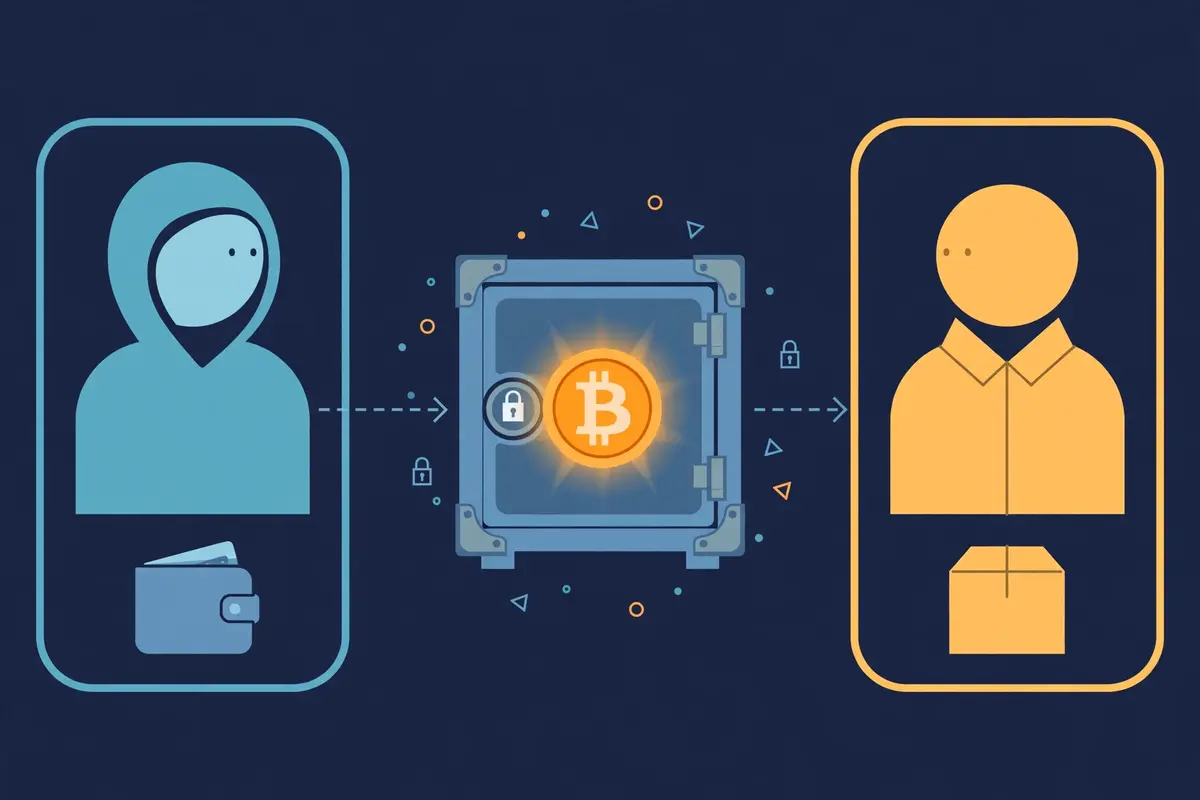
What actually works is a peer-to-peer trade. You find a seller who accepts Western Union, the platform locks their Bitcoin in escrow, you send the transfer, and the escrow releases the coins once the seller confirms receipt.
- Key Takeaways
- Can You Buy Bitcoin Directly With Western Union?
- How to Buy Bitcoin With Western Union in Six Steps
- Step 1: Open an Account on a P2P Platform
- Step 2: Find a Seller Who Accepts Western Union
- Step 3: Open the Trade and Check the Escrow
- Step 4: Send the Western Union Transfer
- Step 5: Share the Tracking Number, Then Wait
- Step 6: Confirm Receipt and Receive Your Bitcoin
- Where to Buy Bitcoin With Western Union
- What It Costs: A Worked 500 Dollar Example
- Western Union Fees and Limits
- Western Union’s Own Crypto Move: The USDPT Stablecoin
- Safety Rules That Protect Your Money
- Western Union vs Other Ways to Buy Bitcoin
- Common Mistakes Beginners Make
- Move Your Bitcoin to a Wallet You Control
- FAQs
- Can I buy Bitcoin directly with Western Union?
- Which platforms accept Western Union for Bitcoin in 2026?
- How much does it cost to buy Bitcoin with Western Union?
- How long does it take to buy Bitcoin with Western Union?
- Is it safe to buy Bitcoin with Western Union?
- What is Western Union USDPT, and can it buy Bitcoin?
- Sources
This guide walks through that route step by step, with real fees, real limits, and the safety rules that matter most, because a Western Union payment cannot be reversed once it is collected.
Can You Buy Bitcoin Directly With Western Union?
No. Western Union is a money transfer company, not a crypto exchange.
Its network covers more than 200 countries and 500,000 agent locations, and it moves cash, not coins.
That distinction shapes everything in this guide. You are not buying Bitcoin from Western Union.

You are paying a private seller with Western Union, inside a trade that a peer-to-peer platform protects with escrow. If a website or a person tells you Western Union itself sells Bitcoin, treat it as a scam.
Bitcoin traded near 80,400 dollars on November 5, 2026. Prices move fast, so check the live price inside the trading app before you place any order, and never let a seller quote you a price from hours ago.
How to Buy Bitcoin With Western Union in Six Steps
The whole trade has six steps, and the order matters more than the speed. Escrow comes first, payment comes second, and the Bitcoin moves last.
Skip the order and you lose your protection. A seller who asks you to pay first, outside a platform, is asking you to trust a stranger with an irreversible payment.
Step 1: Open an Account on a P2P Platform
Create an account on a peer-to-peer marketplace that lists Western Union as a payment method, and complete its identity check. Bybit P2P asks for full identity verification before you can trade, and most platforms now do the same.
Keep your account details in your own name. A seller cannot release Bitcoin to you if the Western Union sender name does not match your trading account.
Step 2: Find a Seller Who Accepts Western Union
Open the P2P desk, pick Bitcoin, enter your amount and currency, and filter the payment methods for Western Union. Offers vary by country, so the sellers you see depend on your corridor.
Compare sellers on three things: their price against the spot price, their completion rate, and their number of completed trades. A seller with hundreds of completed trades and a completion rate above 95 percent is a safer pick than a cheaper seller with ten trades.
Step 3: Open the Trade and Check the Escrow
Enter the amount, confirm the trade, and check that the seller’s Bitcoin is now locked in escrow. The platform holds those coins, so the seller cannot spend them or sell them to someone else while your trade runs.
Read the trade terms before you pay. The seller’s terms state how they want the transfer sent, whether they accept cash pickup or bank deposit, and how fast they confirm.
If the terms ask for anything odd, cancel the trade and pick another seller.
Step 4: Send the Western Union Transfer
Send the transfer exactly as the seller instructed, using the name they gave you. You can pay in cash at an agent location or send online from the Western Union app, depending on what the seller accepts.
Write nothing about crypto in the transfer reference. Bybit’s own help centre warns buyers not to write sensitive words such as “BTC purchase” in the reference, because the transfer can fail.
Use the plain reference the seller gave you, or leave it blank.
Step 5: Share the Tracking Number, Then Wait
Send the seller the money transfer control number, known as the MTCN, through the platform chat only. Never share it by email, WhatsApp, or any channel outside the trade.
Cash pickup transfers usually arrive within minutes, while a bank deposit can take 3 to 5 days. The trade timer keeps running, so watch it, and do not mark the payment as sent until the money has actually left your hands.
Step 6: Confirm Receipt and Receive Your Bitcoin
The seller checks their side, confirms receipt, and the escrow releases the Bitcoin to your platform wallet. Check your wallet balance before you close the trade window.
If the seller goes quiet after you paid, open a dispute inside the platform right away. The escrow still holds your coins, and the platform’s support team reviews the transfer receipt and the chat record.
Where to Buy Bitcoin With Western Union
Three platforms list Western Union offers in 2026, and one famous name from old guides is gone. Check each one live before you sign up, because availability changes by country.
Bybit P2P is the strongest option for most buyers. It charges zero trading fees to buyers, holds the seller’s crypto in custodial escrow, and supports more than 100 payment methods across 180 plus countries.
Its main limit is geography: Bybit P2P is not available to residents of the United States, the United Kingdom, Canada, France, Singapore, or Dubai.
Paxful is the second option, and it works in the United States. It lists more than 300 payment methods, including Western Union, and reports over 14 million registered users.
Paxful paused operations briefly in 2023 before relaunching under new owners, so older guides that call it dead are out of date, but its open marketplace also attracts more scammers, so stick to high-reputation sellers and escrow.
Binance P2P supports Western Union in some countries, though its coverage is thinner than Bybit’s. Check the payment filter inside the app for your own country before you plan around it.
Drop LocalBitcoins from any list you find online. It closed in 2023, and guides that still name it as a live route have not been updated since.
The same goes for any guide that still lists Paxful as closed.
What It Costs: A Worked 500 Dollar Example
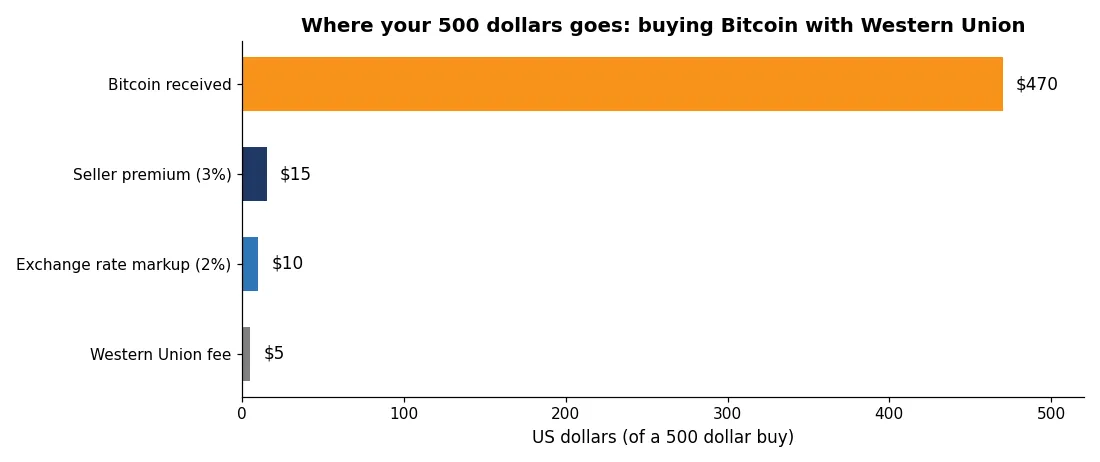
Three separate charges stack up on a Western Union Bitcoin buy, and most guides only mention one of them. Here is what a 500 dollar purchase looks like with realistic numbers, so you can see the full cost before you trade.
The example assumes a bank-funded online transfer in US dollars, a 2 percent exchange rate markup on the corridor, and a seller premium of 3 percent over the spot price. Your numbers will differ by country and corridor, so treat this as a template, not a quote.
| Charge | Rate used | Cost on 500 dollars |
|---|---|---|
| Western Union transfer fee | Flat, varies by corridor | 5.00 dollars |
| Exchange rate markup | 2 percent over mid-market | 10.00 dollars |
| Seller premium over spot price | 3 percent | 15.00 dollars |
| Total cost | About 6 percent | 30.00 dollars |
| Bitcoin received at spot value | 500 minus 30 | About 470 dollars worth |
The seller premium is the charge beginners miss. P2P sellers set their own price, and a seller who accepts an irreversible payment method like Western Union usually prices 2 to 5 percent above the spot price.
That premium is the real cost of the trade, and it is larger than the Western Union fee itself.
Compare that 6 percent with a card buy on a regulated exchange, which often costs 3 to 4 percent in fees, or a bank transfer buy, which can cost under 1 percent. Western Union is not the cheap route.
It is the route for buyers who need cash pickup, have no bank card that works on exchanges, or live where exchanges do not operate.
Western Union Fees and Limits
Western Union fees change with almost every corridor, so the only exact quote is the one the app shows you before you confirm. The ranges below come from Western Union’s own pricing and independent fee guides, and they are current for 2026.
Online transfer fees run from zero to about 25 dollars or more, depending on the corridor, the amount, and whether you pay at an agent or in the app. On top of the fee, Western Union adds a markup of roughly 1 to 3 percent over the mid-market exchange rate, and that markup grows on some corridors.
| Detail | Figure |
|---|---|
| Transfer fee (online) | 0 to about 25 dollars, varies by corridor |
| Exchange rate markup | About 1 to 3 percent over mid-market |
| US unverified account limit | 3,000 dollars per transaction |
| US verified account limit | 50,000 dollars per transaction |
| Cash pickup speed | Usually within minutes |
| Bank deposit speed | 3 to 5 days |
Verify your Western Union account with ID if you plan to send more than 3,000 dollars in the United States, since unverified accounts stop at that limit. Limits differ by country, and the app shows your own maximum when you enter the transfer details.
Western Union’s Own Crypto Move: The USDPT Stablecoin
Western Union launched its own dollar stablecoin, USDPT, on May 4, 2026. It runs on the Solana blockchain and is issued by Anchorage Digital Bank, a federally chartered crypto bank in the United States.
Bybit became the first major exchange to list it on June 4, 2026.
USDPT is a dollar token, not Bitcoin, and it does not buy you Bitcoin by itself. Its purpose is settlement inside Western Union’s network: partners and agents can move digital dollars around the clock, and customers in launch markets can buy it with local currency.
Bitso listed it in Mexico on October 13, 2026, so Mexican users can now buy and sell USDPT directly with pesos.
| Date | USDPT milestone |
|---|---|
| May 4, 2026 | Western Union launches USDPT on Solana, issued by Anchorage Digital Bank |
| June 4, 2026 | Bybit becomes the first major exchange to list USDPT |
| August 2026 | Western Union launches Stablecard, a USDPT wallet with a Visa card |
| October 13, 2026 | Bitso lists USDPT in Mexico with peso trading |
| October 21, 2026 | Western Union picks Noah to power Receiver Redirect, paying transfers out as USDPT; no launch date yet |
Two facts keep this in perspective. First, USDPT is still small, with a supply near 17 to 19 million tokens in October 2026.
Second, it carries no FDIC insurance and no government backing, so the one-to-one dollar peg depends on the issuer’s reserves, not on a federal guarantee.
The P2P route in this guide and the USDPT stablecoin are separate things. Do not confuse them: one buys you Bitcoin through a seller today, and the other is Western Union’s own digital dollar for moving money inside its network.
Safety Rules That Protect Your Money
A Western Union transfer is final once the receiver collects it. There is no chargeback, no recall button, and no bank to call.
That finality is exactly why scammers love this payment method, and why your safety rules matter more than your price.
Western Union itself admitted the problem in 2017, when it paid 586 million dollars to the US Department of Justice and the Federal Trade Commission after admitting it aided and abetted wire fraud. The company has tightened its controls since, but the payment itself is still irreversible.
The Five Rules
First, never pay outside escrow. If a seller asks you to send Western Union money before opening a platform trade, walk away, because no platform can help you once the money leaves escrow’s protection.
Second, never write crypto words in the transfer reference. Words like “Bitcoin” or “BTC purchase” can get the transfer flagged or failed, and they also advertise the purpose of the payment to anyone who sees it.
Third, share the MTCN only inside the platform chat, and only after the escrow holds the coins. The tracking number is the key to the cash, so treat it like a password.
Fourth, check the seller before you check the price. A completion rate above 95 percent and hundreds of finished trades beat a bargain price from a new account every time.
Fifth, keep every receipt and screenshot until the Bitcoin lands in your wallet. If you open a dispute, the platform decides from the transfer receipt, the MTCN, and the chat record.
Red Flags That Mean Stop
Stop the trade if the seller moves the chat to Telegram or WhatsApp, asks you to pay before escrow, offers a price far below the market, or sends you a different receiver name halfway through. Each of these is a known scam pattern, and a real seller has no reason to do any of them.
Western Union vs Other Ways to Buy Bitcoin
Western Union wins on reach and loses on cost. The table below compares it with the routes most beginners use instead, so you can pick the one that fits your situation rather than copying a guide.
| Method | Typical total cost | Speed | Reversible? | Best for |
|---|---|---|---|---|
| Western Union P2P | About 5 to 8 percent | Minutes to days | No | Cash payers, no working bank card |
| Wire transfer | About 1 to 3 percent plus bank fee | Same day to 3 days | Hard to reverse | Large orders |
| Bank transfer (SEPA, ACH) | Under 1 percent | Minutes to 1 day | Yes, in some cases | Regular buys in supported countries |
| Debit or credit card | About 3 to 4 percent | Minutes | Yes, chargeback possible | Fast first buys |
If you can pay by bank transfer, our guide to buying Bitcoin with SEPA shows a cheaper route for European buyers, and our guide to buying Bitcoin with Wise covers another low-cost rail. If you pay with mobile money instead, our guide to buying Bitcoin with UPI covers the Indian route.
For a full comparison of every method, see our payment methods hub.
If you would rather skip ID checks, read our guide to how to buy Bitcoin without ID.
Common Mistakes Beginners Make
The most expensive mistake is paying before escrow. It happens when a seller sounds friendly, offers a good price, and asks you to “send first, I will release fast.” Friendly means nothing here, and escrow is the only guarantee you have.
The second mistake is writing “Bitcoin” in the transfer reference. It can fail the transfer, and it tells Western Union and the receiver exactly what the money is for.
Keep the reference plain.
The third mistake is choosing the cheapest seller instead of the safest one. A seller who prices 2 percent below the market with ten trades is a bigger risk than a seller who prices 3 percent above it with a thousand trades.
The fourth mistake is leaving the Bitcoin on the P2P platform after the trade. Platforms get hacked, freeze accounts, and change rules.
Move your coins to a wallet you control, as our guide to getting a Bitcoin wallet explains.
The fifth mistake is forgetting the price can move during the trade. A cash pickup is fast, but a bank deposit takes days, and Bitcoin can swing several percent in that window.
Check the live price before you confirm, and read our Bitcoin price prediction for 2026 to understand the range analysts expect.
Move Your Bitcoin to a Wallet You Control
Once the escrow releases your Bitcoin, it sits in your platform wallet, and that wallet belongs to the platform, not to you. Withdraw it to a wallet where you hold the keys.
Start with a free software wallet if your amount is small, and move to a hardware wallet once your holdings grow. Write down your recovery phrase on paper, store it offline, and never share it with anyone, including platform support staff.
A real support agent never asks for it.
Test the withdrawal with a small amount first if the platform allows it. A small test costs a little in network fees, and it proves the address works before you move the full balance.
FAQs
These are the questions beginners ask most about this route. Each answer uses the same facts as the guide above, with nothing added.
Can I buy Bitcoin directly with Western Union?
No, since Western Union sells no Bitcoin and runs no exchange. You buy Bitcoin from a private seller on a peer-to-peer platform, and Western Union only moves the payment.
The platform’s escrow holds the seller’s Bitcoin until you pay.
Which platforms accept Western Union for Bitcoin in 2026?
Bybit P2P is the main venue, with zero taker fees and escrow protection, though it is not available in the United States, the United Kingdom, Canada, France, Singapore, or Dubai. Paxful also lists Western Union offers and works in the United States, and Binance P2P supports it in some countries.
How much does it cost to buy Bitcoin with Western Union?
Expect about 5 to 8 percent in total. On a 500 dollar buy, that is roughly 30 dollars: a Western Union fee of about 5 dollars, a 1 to 3 percent exchange rate markup, and a seller premium of about 3 percent over the spot price.
Your corridor and seller set the exact figures.
How long does it take to buy Bitcoin with Western Union?
A cash pickup trade can finish within an hour, since the transfer arrives in minutes and the seller confirms fast. A bank deposit trade takes longer, since the deposit itself can take 3 to 5 days before the seller can confirm receipt.
Is it safe to buy Bitcoin with Western Union?
It is safe only inside an escrow-protected trade with a high-reputation seller. A collected Western Union transfer is final, with no chargeback, so never pay before the seller’s Bitcoin sits in escrow, and never write crypto words in the transfer reference.
Outside escrow, any request to pay for crypto by Western Union is a scam signal.
What is Western Union USDPT, and can it buy Bitcoin?
USDPT is Western Union’s dollar stablecoin, launched on Solana on May 4, 2026 and issued by Anchorage Digital Bank. It is a digital dollar for settlement inside Western Union’s network, not a way to buy Bitcoin.
You can trade USDPT for Bitcoin on exchanges that list it, such as Bybit, but that is a separate trade from the Western Union P2P route.
Sources
- Western Union: official site for transfer fees, limits, and payout options.
- Bybit Help Center: official step-by-step guide to buying coins on Bybit P2P, including escrow and payment reference rules.
- Wise: Western Union transfer limits guide for US senders, covering the 3,000 dollar unverified and 50,000 dollar verified limits.