



Bitcoin and Ethereum are the two biggest cryptocurrencies in the world. Together they make up almost 70% of the entire crypto market. But they are not the same thing, and they are not really competing for the same job.
The short answer: Bitcoin is digital money built to store value, like digital gold. Ethereum is a platform built to run apps, like a global computer that nobody owns. Bitcoin answers the question “how do I protect my money?” Ethereum answers the question “what can we build on top of a blockchain?”

In this guide, you will learn the 9 key differences between Bitcoin vs Ethereum in plain words, see real 2026 numbers, and find out which one fits you as a beginner.
- What Is Bitcoin?
- What Is Ethereum?
- Bitcoin vs Ethereum: 9 Key Differences
- 1. Purpose: Digital Gold vs World Computer
- 2. Supply: Hard Cap vs No Cap
- 3. How They Are Secured: Mining vs Staking
- 4. Speed and Fees
- 5. Smart Contracts
- 6. Energy Use
- 7. Earning Yield: None vs Staking Rewards
- 8. Upgrades and Development
- 9. Market Size and Price Behavior
- Bitcoin vs Ethereum: Side-by-Side Comparison
- Which Should Beginners Choose?
- 5 Beginner Mistakes to Avoid
- Watch: Bitcoin vs Ethereum Explained Simply
- Bitcoin vs Ethereum FAQs
- Is Ethereum better than Bitcoin?
- Can Ethereum overtake Bitcoin in market cap?
- Is Bitcoin or Ethereum better for beginners?
- Which is a better investment in 2026?
- Do I need to buy a whole Bitcoin or a whole Ether?
- Conclusion
Key Takeaways
- Bitcoin (BTC) is digital gold: fixed supply of 21 million, secured by mining, built to store value.
- Ethereum (ETH) is a world computer: it runs smart contracts and apps (DeFi, NFTs), secured by staking.
- Bitcoin confirms transactions in about 10 minutes; Ethereum confirms in about 12 seconds.
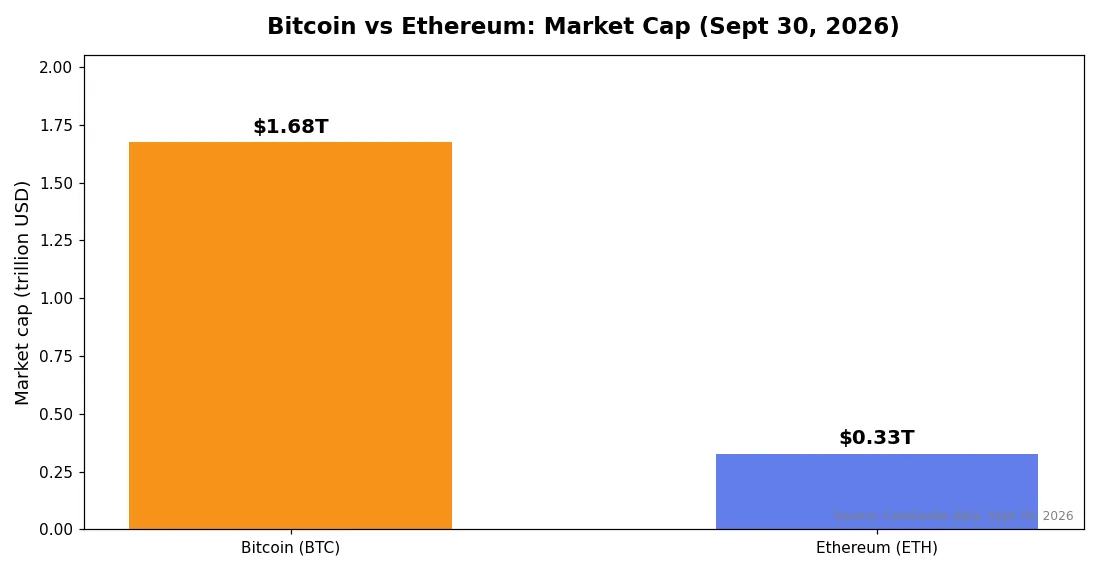
- As of September 2026, Bitcoin’s market cap is about $1.67 trillion vs Ethereum’s $328 billion.
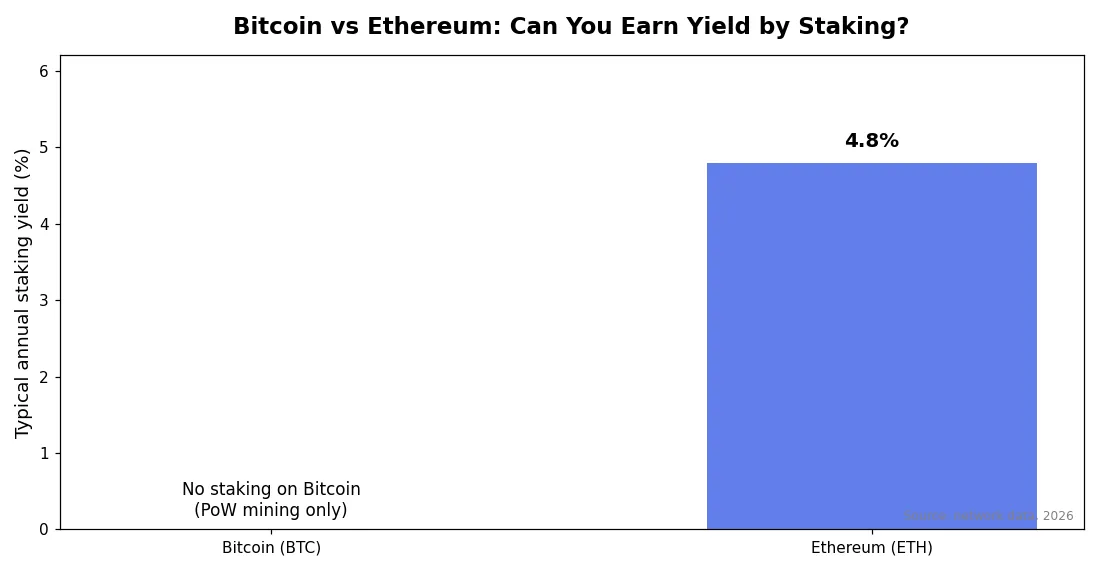
- Ethereum staking pays roughly 4.8% a year; Bitcoin pays nothing for holding.
- Beginners do not have to pick a winner. Most long-term holders own both for different reasons.
What Is Bitcoin?
Bitcoin launched in 2009. It was created by an unknown person (or group) using the name Satoshi Nakamoto. Bitcoin was the first cryptocurrency ever made, and it introduced the blockchain to the world.
Bitcoin has one main job: to be money that no government or bank controls. It has a fixed supply of 21 million coins, and more than 19.9 million are already in circulation. Every four years, the reward paid to miners is cut in half, which slows down new supply even more. The last halving happened in April 2024.
If you are completely new, start with our beginner-friendly guide to how Bitcoin works before you go further.
What Is Ethereum?
Ethereum launched in 2015. It was proposed by Vitalik Buterin and built with several co-founders. Ethereum took the blockchain idea and asked a bigger question: what if a blockchain could run programs, not just payments?

That question created smart contracts: small programs that run automatically on the blockchain and cannot be stopped or changed by anyone. Almost every DeFi app, NFT project, and DAO runs on smart contracts, and most of them run on Ethereum. The currency used to pay for all this computing is called Ether (ETH).
In 2022, Ethereum completed an upgrade called the Merge. It switched from mining to staking, which cut its energy use by about 99.95% overnight. You can read more in our smart contracts explained for beginners.
Bitcoin vs Ethereum: 9 Key Differences
Now the part you came for. Below are the nine differences that actually matter for a beginner. We will keep the tech talk to a minimum and focus on what each difference means for you.
A quick note on prices: both move fast. The numbers below are from late September 2026 and are meant to show scale, not to be trading advice.
1. Purpose: Digital Gold vs World Computer
Bitcoin was built to do one thing extremely well: store and move value without a middleman. Think of it as a digital vault. It does not run apps, and that is by design. Simplicity is its security.
Ethereum was built to be a platform. Think of it as a smartphone while Bitcoin is a calculator. The calculator does math perfectly; the smartphone runs thousands of apps. Ethereum’s apps include lending platforms, exchanges, games, and digital art markets.
2. Supply: Hard Cap vs No Cap
Bitcoin has a hard cap of 21 million coins. This limit is written into the code and cannot be changed without breaking the network’s rules. That is why people call Bitcoin “digital gold”: nobody can print more of it.
Ethereum has no hard cap. New ETH is issued to pay validators, but since 2021 a part of every transaction fee is burned (destroyed). When network usage is high, more ETH is burned than created, and the supply can actually shrink. So Ethereum’s supply is flexible, while Bitcoin’s is fixed.
3. How They Are Secured: Mining vs Staking
Bitcoin uses proof of work. Powerful computers (miners) race to solve puzzles, and the winner adds the next block and earns new BTC. This is very secure but uses a lot of electricity.
Ethereum uses proof of stake. Instead of miners, it has validators who lock up at least 32 ETH as a deposit. If they behave honestly, they earn rewards. If they cheat, they lose part of their deposit. This uses far less energy than mining.
4. Speed and Fees
Bitcoin creates a new block about every 10 minutes and handles around 7 transactions per second. During busy times, fees can rise to $20 or more. For everyday payments, Bitcoin relies on the Lightning Network, a second layer that makes payments instant and nearly free.
Ethereum creates a block every 12 seconds and handles 15 to 30 transactions per second on its main layer. Fees, called gas, change with demand. Most daily activity has moved to Layer 2 networks like Arbitrum, Optimism, and Base, where fees are just cents. That is where most DeFi and NFT activity happens today.
5. Smart Contracts
Bitcoin’s scripting language is intentionally limited. It can do simple things like multi-signature wallets and time-locked payments, but it cannot run complex programs. This limits mistakes and attacks.
Ethereum is fully programmable. Developers can build almost anything: lending markets, stablecoins, NFT collections, prediction markets, and entire financial systems with no bank involved. This flexibility is Ethereum’s biggest strength and its biggest source of risk, because buggy code can be exploited.
6. Energy Use
Bitcoin mining uses a large amount of electricity, roughly comparable to a mid-sized country. Supporters argue much of it comes from renewable or stranded energy, and that the security is worth the cost.
Ethereum’s switch to proof of stake in 2022 cut its energy use by about 99.95%. Running Ethereum today uses less energy than many common web services. If environmental impact matters to you, this is a clear difference.
7. Earning Yield: None vs Staking Rewards
Bitcoin pays you nothing for simply holding it. Your BTC sits in your wallet and its value changes with the market. There is no built-in way to earn more BTC from the network itself.
Ethereum validators earn roughly 4.8% a year in ETH for helping secure the network. Regular holders can stake through exchanges or staking pools to earn a share of that yield. This makes ETH partly an income-producing asset, while BTC is purely a store-of-value asset.
8. Upgrades and Development
Bitcoin changes very slowly and very carefully. Upgrades are rare and need wide agreement from miners, developers, and users. Fans see this as a feature: money should not change its rules often.
Ethereum upgrades several times a year. It has a large developer community and a public roadmap. Ethereum co-founder Vitalik Buterin recently outlined plans to evolve the network into what he calls a “cryptographic world computer” by 2030, with upgrades after next year’s Hegota fork bringing advanced cryptography and privacy features. You can follow the technical progress on Ethereum’s long-term scaling roadmap.
9. Market Size and Price Behavior
Bitcoin is by far the larger asset. At about $83,300 per BTC in late September 2026, its market cap sits near $1.67 trillion, roughly 57% of the whole crypto market. Ethereum trades near $2,670 per ETH with a market cap of about $328 billion, around 11% of the market.
Bitcoin’s size makes it the steadier of the two. Ethereum tends to move more in both directions: bigger rallies, sharper drops. Higher risk, higher potential reward. Neither is “safe” in the way a savings account is safe.
Bitcoin vs Ethereum: Side-by-Side Comparison
Here is everything from above in one quick table. Bookmark this page if you want to come back to it.
| Feature | Bitcoin (BTC) | Ethereum (ETH) |
|---|---|---|
| Launched | 2009 | 2015 |
| Creator | Satoshi Nakamoto (anonymous) | Vitalik Buterin and co-founders |
| Main purpose | Store of value, digital gold | Smart contract platform, apps |
| Max supply | 21 million (hard cap) | No hard cap (fee burning) |
| Secured by | Mining (proof of work) | Staking (proof of stake) |
| Block time | ~10 minutes | ~12 seconds |
| Transactions/sec | ~7 | 15-30 (thousands on Layer 2s) |
| Smart contracts | Very limited | Full support |
| Staking yield | None | ~4.8% per year |
| Market cap (Sept 2026) | ~$1.67 trillion | ~$328 billion |
Which Should Beginners Choose?
Here is the honest answer most guides skip: you do not have to pick one. Bitcoin and Ethereum do different jobs, and many long-term holders own both. Bitcoin protects wealth; Ethereum gives exposure to the app economy built on blockchains.
That said, your goal decides where to start. Read both sides below and see which one sounds like you.
Start With Bitcoin If…
You want the simplest, most battle-tested option. Bitcoin has survived for 17 years, never been hacked at the network level, and is the asset institutions buy first. If your goal is long-term savings outside the banking system, Bitcoin is the calmer starting point. A simple approach is dollar-cost averaging into Bitcoin, buying a fixed amount on a schedule instead of trying to time the market.
Start With Ethereum If…
You want to actually use crypto, not just hold it. Ethereum lets you try DeFi lending, buy NFTs, or earn staking yield. If that sounds fun, start small and learn by doing. Before you buy, check how to buy Ethereum and what it really costs, because fees and exchange spreads surprise many beginners.
5 Beginner Mistakes to Avoid
Most beginners lose money through simple mistakes, not bad coins. Avoid these five.
- Thinking one must “win”. Bitcoin and Ethereum are not in a fight to the death. They serve different purposes and both can grow at the same time.
- Buying ETH on the main network for small amounts. Gas fees can eat a $50 purchase. Use a Layer 2 network or a reputable exchange for small buys.
- Leaving coins on an exchange forever. Exchanges get hacked. Learn the basics of choosing your first Bitcoin wallet (the same ideas apply to Ethereum wallets) and move serious amounts to your own wallet.
- Investing money you need soon. Both BTC and ETH can drop 50% or more in a bad year. Only use money you can leave alone for years.
- Chasing “the next Bitcoin”. Thousands of small coins promise to replace BTC or ETH. Almost all of them fail. Master the top two before touching anything else.
Watch: Bitcoin vs Ethereum Explained Simply
Prefer video? These two short explainers cover the same differences in under a few minutes.
Bitcoin vs Ethereum FAQs
Quick answers to the questions beginners ask most.
Is Ethereum better than Bitcoin?
Neither is better in general. Bitcoin is better at being scarce, simple digital money. Ethereum is better at running apps and smart contracts. Which is “better” depends on what you want to do.
Can Ethereum overtake Bitcoin in market cap?
It is possible but has never happened. Bitcoin’s market cap is about five times larger than Ethereum’s as of September 2026. Ethereum would need a huge rally, or Bitcoin a huge crash, for the “flippening” to happen.
Is Bitcoin or Ethereum better for beginners?
Bitcoin is simpler to understand and less volatile, so most beginners start there. Ethereum is better if you want to learn how crypto apps work. Many beginners end up holding both.
Which is a better investment in 2026?
No one can answer that honestly, and anyone who promises an answer is selling something. Bitcoin has lower volatility and deeper institutional adoption. Ethereum has higher growth potential and staking yield, with higher risk. Consider your risk tolerance and never invest more than you can afford to lose.
Do I need to buy a whole Bitcoin or a whole Ether?
No. Both can be bought in fractions. You can buy $10 worth of Bitcoin (about 0.00012 BTC) or $10 of Ethereum (about 0.0037 ETH). You never need to afford a whole coin.
Conclusion
Bitcoin vs Ethereum is not really a contest. Bitcoin is digital gold: scarce, simple, and built to hold value for decades. Ethereum is a world computer: flexible, fast-moving, and built to power the apps of a decentralized internet.
As a beginner, your next step is simple. Learn the basics of one, buy a small amount you are comfortable losing, and move it to your own wallet. Understanding beats speculating, every time.
Start with our complete beginner’s guide to Bitcoin, then come back here when you are ready to explore Ethereum’s app ecosystem.
To see where ETH could go next, read the Ethereum forecast to 2030 and the levels that decide it.