



Here is the short answer. Our pepe price prediction 2026-2030 puts PEPE near $0.0000038 to $0.0000048 by the end of 2026, and in a base range of $0.0000051 to $0.0000080 by 2030.
That is the middle of the road, built from published forecasts and the market cap math behind them. It is not a promise.

PEPE is a meme coin with no product and no revenue, so its price follows mood, liquidity, and the wider crypto cycle more than anything else.
- Pepe Price Today: Where PEPE Stands on November 6, 2026
- Pepe Price Prediction 2026-2030 at a Glance
- What the Published Forecasts Actually Say
- The Market Cap Test: What Each Target Really Means
- Pepe vs Dogecoin vs Shiba Inu: The Meme Coin Ladder
- What Could Push PEPE Higher
- The Canary Capital ETF filing
- A Bitcoin recovery and the meme rotation
- Whale accumulation and exchange flows
- What Could Push PEPE Lower
- Key Levels to Watch
- Common Mistakes People Make With PEPE Predictions
- Pepe Price Prediction 2026-2030: FAQs
- Can PEPE reach $1?
- What will PEPE be worth in 2030?
- Can PEPE reach $0.01?
- Is PEPE a good investment?
- Where can I buy PEPE?
- The Bottom Line
PEPE trades near $0.00000489 on November 6, 2026. It sits about 83% below its all-time high of $0.00002803 from December 2024.
Yet it still holds a market cap near $2.05 billion and a top 50 ranking. That tension is the whole story of this coin.
It fell hard, but it never left the big leagues.
Key takeaways
- PEPE trades near $0.00000489 on Nov 6, 2026, down about 2% in 24 hours, with a market cap near $2.05 billion.
- Published 2030 forecasts disagree wildly, from $0.0000020 to $0.0000350, a spread of more than 17 times.
- Every price target has a market cap price tag. Even $0.00001 needs a $4.21 billion market cap.
- PEPE can never reach $1. That would need a $420 trillion market cap, more than 150 times the whole crypto market.
- The Canary Capital spot PEPE ETF filing is the one real catalyst left in 2026, but the SEC has not approved it.
Pepe Price Today: Where PEPE Stands on November 6, 2026
PEPE trades near $0.00000489 on November 6, 2026. It fell about 2% in the last 24 hours, while Bitcoin also slid below $76,000.

The drop fits the wider market mood, not a PEPE-specific problem. Fear rules the tape right now.
The numbers tell a steady story. PEPE holds a market cap near $2.05 billion, which keeps it ranked around 45th among all cryptocurrencies.
Traders moved about $434 million of PEPE in the last 24 hours. That is heavy volume for a coin this far below its high, and it shows people still care about this frog.
Short-term traders watch two levels. Support sits near $0.00000474, and resistance sits near $0.00000490 to $0.00000502.
A daily close above $0.00000502 would break the short-term ceiling. A daily close below $0.00000474 would open the door to lower prices.
Neither level guarantees anything, but both mark where buyers and sellers have fought lately.
Zoom out and the picture gets clearer. PEPE peaked at $0.00002803 in December 2024, when its market cap touched roughly $11.8 billion.
Today it trades about 83% below that peak. The August 2026 low near $0.00000254 shows how far it can fall when meme interest cools.
The coin has bounced from that low, but it has not rebuilt the old hype.
Pepe Price Prediction 2026-2030 at a Glance
Before the detail, here is the whole forecast on one table. These are scenarios, not targets.
Each range comes from published forecasts, and the sources sit in the next section.
| Year | Bearish | Base case | Bullish |
|---|---|---|---|
| 2026 (year-end) | $0.0000025 | $0.0000038 – $0.0000048 | $0.0000075 |
| 2027 | $0.0000027 | $0.0000036 | $0.0000090 |
| 2028 | $0.0000035 | $0.0000047 | $0.0000120 |
| 2029 | $0.0000043 | $0.0000055 | $0.0000180 |
| 2030 | $0.0000020 – $0.0000037 | $0.0000051 – $0.0000080 | $0.0000100 – $0.0000350 |
The bearish case assumes meme interest keeps fading and no ETF arrives. The base case assumes PEPE holds its top 50 spot and rides the normal crypto cycle.
The bullish case needs a real catalyst, like an approved ETF or a fresh meme coin mania. Read the rest of this article before you trust any single row.
What the Published Forecasts Actually Say
The honest truth is that the experts disagree with each other. That disagreement is useful, because it tells you how little anyone really knows about a meme coin five years out.
CoinCodex expects PEPE to end 2026 near $0.000003786, below today’s price, and reach $0.000008026 by 2030. Its model leans on past price data and the four-year Bitcoin halving cycle.
CoinLore puts its 2030 base case at $0.0000074, inside a wide range of $0.0000045 to $0.0000337. PrimeXBT is the most cautious of the big model shops, with a 2026 average near $0.00000286 and a 2030 average of $0.00000506.
Changelly sits in the middle. Its 2030 model runs from $0.00000562 to $0.00000974.
CoinPedia is the outlier on the high side, with a 2030 average of $0.0001612 and a high of $0.0003733. That last number would need a market cap near $68 billion, which is more than triple Dogecoin’s current size.
Keep that in mind when a headline quotes it without context.
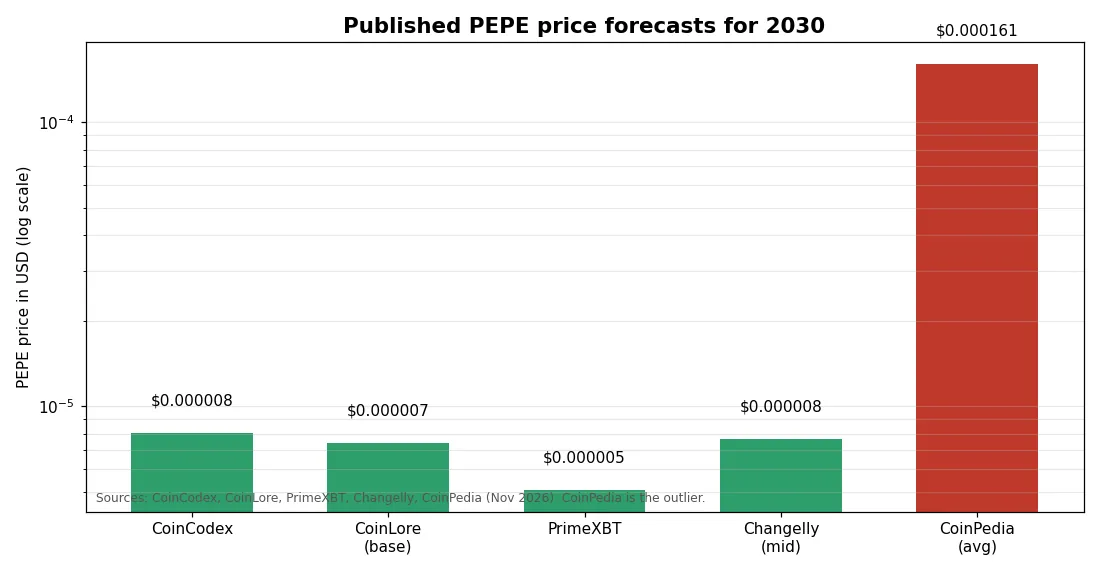
The chart above shows the spread in one picture. Four of the five forecasts cluster between $0.000005 and $0.000008 for 2030.
CoinPedia stands far apart. When four models agree and one does not, the smart move is to ask what the odd one assumes, not to average them all together.
One more pattern matters. CoinCodex and CoinLore both see PEPE ending 2026 below today’s price.
That is not bearish spin. It reflects a simple fact.
PEPE already bounced from its August low, and the rest of the year has no clear driver unless the ETF story moves or Bitcoin turns around.
The Market Cap Test: What Each Target Really Means
This is the part most prediction articles skip, and it is the most useful test in this whole piece. PEPE has a fixed supply of 420.69 trillion tokens.
So every price is just the market cap divided by 420.69 trillion. Flip that around, and every price target carries a market cap price tag.
Here is the table nobody else built for this coin.
| PEPE price | Market cap needed | What it means |
|---|---|---|
| $0.00000254 | $1.07 billion | The August 2026 low |
| $0.000003786 | $1.59 billion | CoinCodex year-end 2026 |
| $0.00000489 | $2.06 billion | Today, Nov 6, 2026 |
| $0.00000506 | $2.13 billion | PrimeXBT 2030 average |
| $0.000008026 | $3.38 billion | CoinCodex 2030 |
| $0.00001 | $4.21 billion | A clean round number, double today |
| $0.00002803 | $11.79 billion | The December 2024 all-time high |
| $0.0001612 | $67.82 billion | CoinPedia 2030 average |
| $0.01 | $4.21 trillion | More than the whole crypto market today |
| $1 | $420.69 trillion | About 160 times the whole crypto market |
Read that table slowly, because it kills two myths at once. First, the base case forecasts are modest in market cap terms.
CoinCodex’s 2030 call needs only a $3.38 billion market cap, barely 60% above today. That is a normal cycle move, not a moonshot.
Second, the wild calls are not wild, they are impossible. PEPE at one cent needs a $4.21 trillion market cap.
That is larger than the entire crypto market right now.
So when someone online says PEPE will hit $1, you now know the answer. It would need $420 trillion.
That is roughly 160 times the size of the whole crypto market. No meme coin has ever done that, and no serious model predicts it.
The question is not whether PEPE can reach $1. It is whether it can double or triple from here, and the table shows exactly what that takes.
This market cap test is also why the December 2024 high matters so much. PEPE already reached $11.79 billion once, so $0.00002803 is not a fantasy number.
It is a level the market already paid. The question for 2030 is whether the meme still has the pull to get back there, not whether the number itself is possible.
Pepe vs Dogecoin vs Shiba Inu: The Meme Coin Ladder
PEPE does not compete in a vacuum. It fights Dogecoin and Shiba Inu for the same pool of meme money, and that fight shapes every forecast.
Our Dogecoin price prediction 2026-2030 asks whether DOGE can reach $1, while our Shiba Inu price prediction 2026-2030 asks whether SHIB can double or drift lower. PEPE sits third in that race, and the gap tells you a lot.

Dogecoin is the original meme coin, with a market cap many times larger than PEPE and a community that survived several cycles. Shiba Inu built an ecosystem around its token, with a swap, a layer 2 chain, and burn mechanics.
PEPE has none of that. Its own website calls it a meme coin with no intrinsic value or expectation of financial return.
That honesty is refreshing, and it is also the whole risk.
But PEPE has one edge the other two lack. It is younger, it launched in April 2023, and it reached the top 50 faster than any meme coin before it.
It also has the most famous meme on the internet behind it. Pepe the Frog has lived online for nearly two decades.
That cultural reach is real, even if it never shows up on a balance sheet. Traders who follow trending meme coins keep finding PEPE near the top of the volume charts for exactly this reason.
The ladder looks like this. Dogecoin is the safe meme bet, Shiba Inu is the ecosystem bet, and PEPE is the pure momentum bet.
If meme coins rally as a group, PEPE usually moves fastest in both directions. It gained the most in the week to October 23, 2026, when it outperformed every other top 50 token.
It also falls hardest when the mood turns, as the 83% drop from its high proves.
What Could Push PEPE Higher
Three forces could lift PEPE from here. None of them is guaranteed, but each one is real and trackable.
The Canary Capital ETF filing
Canary Capital filed an S-1 for a spot PEPE ETF on April 8, 2026, and amended it on October 2. The fund would hold PEPE directly, list on Cboe BZX, and use BitGo as custodian.
The SEC has not declared the filing effective, and no fixed decision deadline exists. So this is a filing, not an approval, and anyone who calls it an approved ETF is wrong.
Still, it is the one catalyst that could bring fresh money. An ETF would let ordinary investors buy PEPE exposure through a brokerage account, without touching a crypto exchange.
That matters because PEPE’s current buyers are almost all crypto natives. New buyers would mean new demand, and new demand is what moves a fixed-supply token.
Watch the warning sign too. Bitwise’s Dogecoin ETF is heading toward liquidation, which shows that meme coin wrappers can struggle to attract real demand even after approval.
An ETF is a door, not a crowd. People still have to walk through it.
A Bitcoin recovery and the meme rotation
PEPE follows Bitcoin, just with more drama. Bitcoin fell below $76,000 on November 6 after a rough week for stocks, and the whole market turned fearful.
When Bitcoin stabilizes and risk appetite returns, traders rotate down the risk curve. They move from Bitcoin to large caps, then to meme coins.
PEPE sits at the far end of that curve, so it usually moves last and moves hardest.
The last cycle proved the pattern. PEPE’s December 2024 high came right as Bitcoin mania peaked.
The same rotation could lift it again in the next risk-on wave. The catch is timing.
Nobody knows when that wave starts, and PEPE can drift sideways for months while traders wait.
Whale accumulation and exchange flows
PEPE recorded its highest weekly trading volume since at least September 20 during the week ending November 1. Heavy volume near a low often means large holders are buying while small holders sell.
That is not proof of a bottom, but it is a sign that somebody with size still wants this coin. Keep an eye on exchange balances too.
Coins leaving exchanges usually mean holders plan to keep them, not sell them.
What Could Push PEPE Lower
The risks are just as real, and honest predictions name them first.
Meme fatigue is real
Memes age. Pepe the Frog is nearly twenty years old, and internet culture moves fast.
Every cycle brings a new set of mascots, and attention is the only thing a meme coin sells. If traders move on to the next joke, PEPE has no product to fall back on.
Dogecoin has its history, Shiba Inu has its ecosystem, and PEPE has a picture. That picture has to stay funny forever, or the price pays for it.
No yield, no revenue, no floor
PEPE pays no staking reward and earns no fees. There is no cash flow to value, so there is no fundamental floor under the price.
When buyers vanish, the price can fall until buyers return, and nobody can say where that level sits. The August 2026 low of $0.00000254 is one marker.
Below that, the chart offers little comfort.
Regulation and the ETF long shot
The SEC has never approved a spot crypto ETF for an asset without a regulated futures market. That is a real procedural hurdle for the Canary filing.
If the SEC stalls or rejects it, the one catalyst in this story disappears. Worse, a rejection could read as a verdict on meme coin ETFs in general, and the price would likely drop on the news.
Anyone buying PEPE for the ETF should know the odds are far from certain.
Key Levels to Watch
Levels do not predict the future, but they show where traders have already made decisions. Here are the ones that matter right now.
Resistance sits at $0.00000490, then $0.00000502, then $0.00001073, the first big chart level above today’s price. A monthly close above the descending trendline would be the first real sign the downtrend is ending.
Support sits at $0.00000474, then $0.00000254, the August low. Below that low, the next floors are thin and untested.
The most important level is not on the chart. It is $0.00002803, the old all-time high.
Reclaiming it would mean a roughly 5.7 times move from today’s price and a return to an $11.79 billion market cap. That is the bull case in one number.
The bear case is simpler. If Bitcoin keeps sliding and meme interest fades, PEPE can revisit its August low without much resistance.
Common Mistakes People Make With PEPE Predictions
Most PEPE predictions fail for the same three reasons, and all three are easy to avoid once you see them.
First, people quote a price without checking the market cap. A $0.01 call sounds small, but it needs $4.21 trillion.
Always run the market cap test before you believe a target. Second, people treat one model’s output as a fact.
CoinPedia’s $0.0001612 average for 2030 is a model output, not a promise, and four other models sit far below it. Third, people buy the ETF headline and skip the fine print.
A filing is not an approval, and an approval is not demand. Bitwise’s Dogecoin ETF is the proof.
One more mistake deserves a line of its own. People size their PEPE position like a blue chip and then panic when it drops 20% in a week.
PEPE is a meme coin. It fell 83% from its high in less than two years.
Anyone who holds it should size the position so a move like that hurts, but does not ruin them. If you want a calmer way to think about sizing any altcoin, our guide on how to buy altcoins the right way covers the basics, and our Litecoin price prediction 2026-2030 shows what a forecast looks like for a coin with real payment use behind it.
Pepe Price Prediction 2026-2030: FAQs
People ask the same five questions about PEPE. Here are straight answers to each one.
Can PEPE reach $1?
No, not in any realistic scenario. PEPE has 420.69 trillion tokens in supply, so $1 would need a market cap of $420.69 trillion.
That is about 160 times the size of the entire crypto market today. No serious forecast predicts it, and the math rules it out.
What will PEPE be worth in 2030?
Published forecasts for 2030 range from $0.0000020 to $0.0000350. Most cluster between $0.0000051 and $0.0000080.
Our base case sits in that cluster at $0.0000051 to $0.0000080, with a bearish case near $0.0000020 to $0.0000037 and a bullish case up to $0.0000350 if a catalyst like an ETF approval lands.
Can PEPE reach $0.01?
Almost certainly not. One cent per PEPE would need a $4.21 trillion market cap, which is larger than the whole crypto market right now.
Even the most optimistic published forecast, CoinPedia’s $0.0003733 high for 2030, sits far below one cent.
Is PEPE a good investment?
That depends on what you want from it. PEPE has no product, no revenue, and no yield, so it is a bet on meme culture and market mood, not on a business.
It can move fast in both directions, as the 83% drop from its high shows. Anyone who buys it should treat it as a small, high-risk position and never as a core holding.
Where can I buy PEPE?
PEPE trades on most major crypto exchanges, including Binance, Coinbase, and Kraken, as well as decentralized exchanges on Ethereum. Check fees and withdrawal options before you buy, and move large holdings to a wallet you control.
If you are new to buying crypto, start with our guide on how to buy Dogecoin, which walks through the same exchange steps that work for PEPE too.
The Bottom Line
Our pepe price prediction 2026-2030 is a story of modest upside and real risk. The base case sees PEPE near $0.0000038 to $0.0000048 by the end of 2026, then drifting toward $0.0000051 to $0.0000080 by 2030.
That is a gain, but not a life-changing one, and it needs the wider market to cooperate. The bull case needs an ETF approval or a fresh meme mania to reach $0.0000350.
The bear case needs only for interest to fade, which would take PEPE back toward $0.0000020.
The market cap table is the takeaway to keep. Every target has a price tag, and most of them are smaller than they sound.
A double from here needs just $4.21 billion, which PEPE has already exceeded by a wide margin. A return to the old high needs $11.79 billion, which it already reached once.
Those are the two numbers that matter. Everything else is noise, and the frog will tell you the rest.
Disclaimer: This article is for information only and is not financial advice. Cryptocurrency prices are volatile, and meme coins can lose most of their value quickly.
Do your own research before you buy anything.