



Render price prediction 2026-2030 starts with a strange split. RENDER trades near $1.53 on November 8, 2026, yet the network behind it just ran out of graphics cards to rent.
Our short answer is this. Our base case puts RENDER near $5.00 by 2030, with a bull case near $8.00 and a bear case near $2.00.

Nobody knows the real outcome. The published forecasts for 2030 run from $2.27 to $100, and that spread tells you more about this coin than any single number does.
- Key Takeaways
- Render (RENDER) Price Today: Where It Stands on November 8, 2026
- What Is Render, in Plain Words?
- The Strange Split: Demand Up, Price Down
- What the Models Say: The $5.00 Average
- The $10 Test: What Each Forecast Really Means
- Render Price Prediction 2026: The Rest of the Year
- Render Price Prediction 2027: The AI Workloads Test
- Render Price Prediction 2028 and 2029: The Scaling Years
- Render Price Prediction 2030: Our Bear, Base and Bull Cases
- 5 Catalysts That Could Push RENDER Higher
- 5 Risks That Could Hold RENDER Back
- Common Mistakes People Make With RENDER Predictions
- Frequently Asked Questions
- What is the Render price prediction for 2030?
- Can RENDER reach $10 by 2030?
- Can RENDER reach its all-time high of $13.53?
- What is RENDER worth today?
- Why is RENDER so far below its all-time high if demand is rising?
- Is Render a good investment?
- The Bottom Line
RENDER trades near $1.53 on November 8, 2026, based on price pages that put it between about $1.53 and about $1.59 in the last 24 hours. Its market value sits near $818 million, with about 533.54 million coins in circulation out of a 561.67 million total supply.
That puts Render around rank 79 among all cryptocurrencies. It sits about 89 percent below its March 2024 peak near $13.53, and it is down about 33 percent from where it traded a year ago.
Key Takeaways
- RENDER trades near $1.53 on November 8, 2026, with a market value near $818 million, rank 79, and about 533.54 million coins in circulation out of a 561.67 million total supply.
- RENDER is down about 15 percent in the last 30 days, even though it closed November 6 at $1.58, up from $1.503 on November 5.
- Render Network ran out of GPUs in the second quarter of 2026, the first shortage since 2018, because AI workloads now make up 35 to 40 percent of all network activity.
- Algorithmic models put the 2030 average near $5.00. CoinStats sees $2.00 to $8.00, CoinCodex sees about $3.89, and DappRadar sees only $2.27.
- This article translates every published 2030 forecast into market value, so you can see what each target would actually require. A $10 RENDER needs a $5.34 billion market value, still below the record market value near $7.22 billion.
- Our 2030 scenario bands run from $2.00 in the bear case to $8.00 in the bull case, with $5.00 as the base case. None of this is investment advice.
Render (RENDER) Price Today: Where It Stands on November 8, 2026
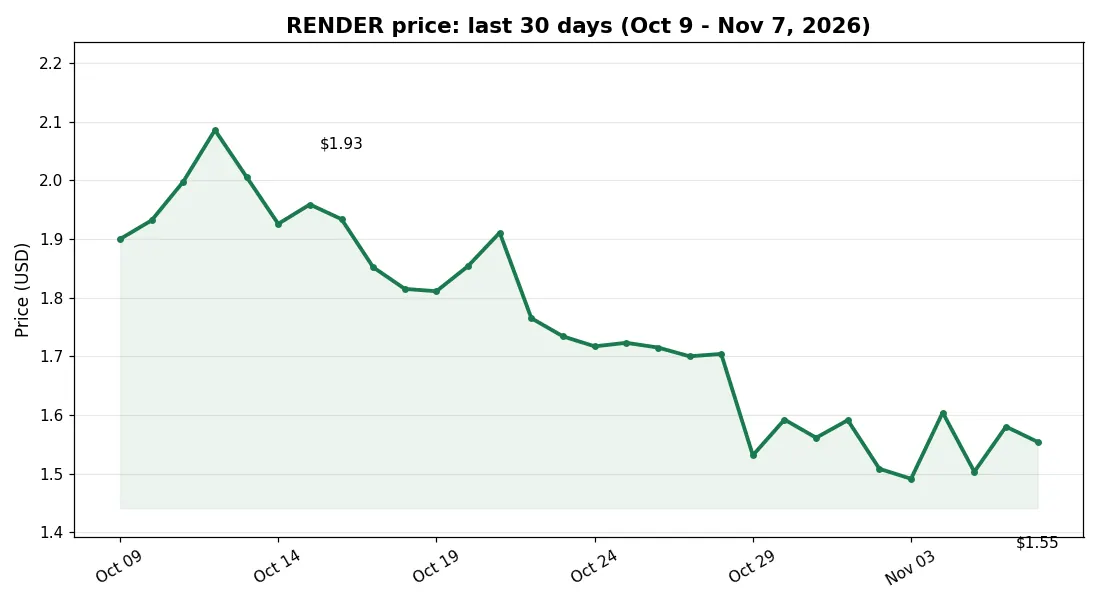
RENDER woke up to a quiet session on November 8, 2026. It trades near $1.53, down about 2 percent in 24 hours, and it moved with Bitcoin, which sits near $75,800 after the November 5 to 6 selloff.
Zoom out a little and the picture looks steadier than the headlines suggest. RENDER is down about 2.4 percent over the last 7 days, and it bounced from $1.503 on November 5 to a $1.58 close on November 6, so buyers stepped back in after the dip.

| Metric | Value on November 8, 2026 |
|---|---|
| Price | About $1.53 |
| 24-hour change | About -2% |
| 7-day change | About -2.4% |
| 30-day change | About -15% |
| Market value | About $818 million |
| Market rank | About 79 |
| Circulating supply | About 533.54 million RENDER |
| Total supply | About 561.67 million RENDER |
| Fully diluted value | About $872 million |
| 24-hour trading volume | About $16.4 million |
| All-time high | $13.53 in March 2024 |
| All-time low | $0.0367 |
| Distance from all-time high | About 89% below |
Two numbers in that table deserve a second look. First, about 95 percent of the total supply already circulates, so RENDER has almost no unlock overhang left, unlike many newer coins that still drip supply into the market.
Second, RENDER trades about 4,000 percent above its all-time low near $0.0367. The coin already survived a full cycle from almost nothing to $13.53 and back, and it still sits 89 percent below its peak, which shows how far it fell and how little of that fall it has recovered.
The last five weeks tell the same story in miniature. RENDER closed at $1.934 on October 16, slipped to $1.734 on October 23, then to $1.592 on October 30, and it closed November 7 at $1.554 after dipping to $1.503 on November 5.
That is a coin drifting down in a weak market, not a coin in free fall and not a coin in a rally. Any 2030 forecast has to start from that flat base, not from the old $13.53 peak.
What Is Render, in Plain Words?
Render is a marketplace for graphics cards. People who need heavy computing power for 3D art or AI work rent it from people whose graphics cards sit idle, and the network matches them up.
Jules Urbach started the project in 2017 through his graphics company OTOY, the team behind the OctaneRender software that film and design studios use. The idea was simple: thousands of powerful graphics cards sit unused around the world, while artists wait hours for a single frame to render.
RENDER is the token that pays for the work. A creator submits a job, node operators run it on their graphics cards, and the network pays them in RENDER after it checks the result.
Think of it this way. A hotel chain owns rooms, while Airbnb rents out spare rooms that already exist, and Render does the Airbnb version for graphics cards.
What RENDER Actually Does
RENDER is a payment and work token first and a store of value second. Creators pay for jobs with it, node operators earn it for finished work, and the network burns a small part of each payment, which removes those coins from circulation.
The token moved chains in 2024, from an Ethereum token called RNDR to a Solana token called RENDER. Solana gives the network faster and cheaper payments, which matters when thousands of small jobs settle every day.
That move also changed the story. Render stopped being only a tool for 3D artists and became part of the AI infrastructure trade, because the same graphics cards that render film frames also train and run AI models.
Why AI Teams Rent GPUs This Way
AI teams need huge amounts of graphics power, yet buying the newest chips costs a fortune and waiting lists stretch for months. Big cloud providers charge high prices and lock buyers into long contracts.
Render offers a cheaper and more flexible route. A team can rent idle consumer graphics cards by the job, pay only for the work it uses, and skip the hardware bill entirely.
Our earlier coverage of the Bittensor price prediction for 2026 to 2030 follows the same AI infrastructure story from the machine learning side, and Render covers the raw computing power underneath it. The two coins bet on the same trend from different angles.
The Strange Split: Demand Up, Price Down
Here is the puzzle at the heart of this render price prediction 2026-2030. The network has never been busier, yet the token has never looked cheaper relative to its peak.
In the second quarter of 2026, demand for graphics power on Render passed available supply for the first time since the network launched in 2018. AI workloads now make up 35 to 40 percent of all activity, up from under 10 percent in 2024.
The network answered by adding about 60,000 consumer graphics cards from Salad, a distributed computing platform, through a community vote known as RNP-023. The vote passed at RenderCon in April 2026, and the new cards joined as a separate subnet.
Token burns tell the same story. The network burned 530,171 RENDER tokens from January to September 2025, a rise of about 279 percent over the same period in 2024, because more paid jobs mean more tokens burned.
The network has now processed more than 68 million rendered frames in total, and about 35 percent of those frames arrived in 2025 alone. Grayscale put about 21.7 percent of its Decentralized AI Fund into RENDER in the second quarter of 2026, which is a serious institutional vote of confidence.
So why does the price sit near $1.53? Three forces explain it.
First, Bitcoin fell to about $75,800 after the November selloff, and altcoins fall harder than Bitcoin in every market dip.
Second, burns sound big until you compare them with supply. A few hundred thousand burned tokens barely dent a supply of 533 million, and node operators still receive new tokens for their work, so emissions have historically outpaced burns.
Third, network growth does not pay token holders directly. Render can run out of graphics cards while RENDER stays flat, because the token only rises when buyers want the token itself, not just the service it powers.
That gap matters for price. A network can grow fast while its token stays flat, and that is exactly what happened through most of 2025 and 2026.
What the Models Say: The $5.00 Average
Algorithmic models tell a modest story for RENDER. CoinStats published a full 2026 to 2030 range in October 2026, and its numbers sit far below the wildest forecasts in the same article.
| Year | Low | Average | High |
|---|---|---|---|
| 2026 | $1.20 | $1.65 | $2.40 |
| 2027 | $1.10 | $2.20 | $3.60 |
| 2028-2029 | $1.50 | $3.80 | $6.50 |
| 2030 | $2.00 | $5.00 | $8.00 |
The model assumes AI-linked usage grows slowly, not in leaps, so the price climbs in small steps. It also assumes the token holds above $1.50 through 2026, which is exactly where it trades today.
Notice the 2027 low of $1.10. The model leaves room for one more dip below today’s price, because the wider market still looks weak and Bitcoin sets the tone for every altcoin.
CoinCodex agrees on the direction but not the speed. Its model, updated November 7, 2026, puts RENDER near $1.52 at the end of 2026, about $3.78 on average in December 2027, and about $3.89 by 2030, a gain of about 144 percent from today.
DappRadar is the most cautious of the three. Its algorithmic forecast, updated November 7, 2026, puts RENDER at $1.60 in 2026, $1.81 in 2027, $2.02 in 2028, $2.15 in 2029, and only $2.27 in 2030.
CoinLore sits between them. Its base case puts RENDER near $0.94 at the end of 2026 and about $2.54 in 2030, with a bull case near $9.59, yet it only reaches $10 in 2039 on its base path.
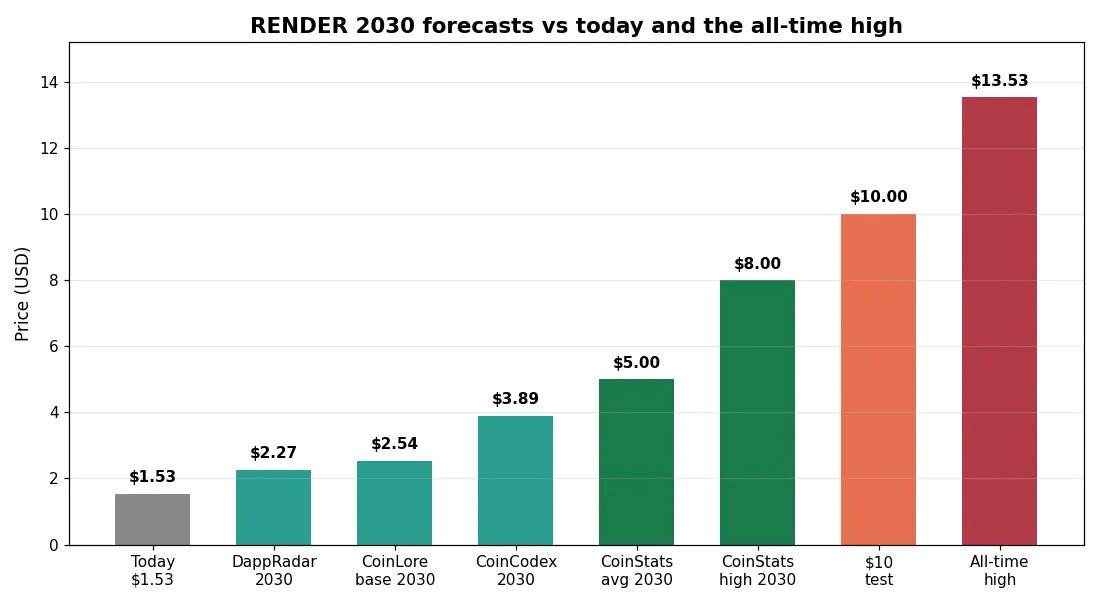
Compare the views side by side and the split is clear. The 2030 central estimates run from $2.27 to $5.00, and every one of them sits far below the old $13.53 peak, which tells you the models expect a slow grind, not a new mania.
The $10 Test: What Each Forecast Really Means
Forecasts sound alike until you turn them into market value. A price target is only a number, while a market value shows how much money the world would need to believe in that number.
We did that maths for every published 2030 forecast. We multiplied each target by the 533.54 million coins in circulation today, and by the 561.67 million total supply, so you can see the full size of each bet.
| 2030 target | Source | Implied market value | Multiple from $1.53 today |
|---|---|---|---|
| $2.00 | CoinStats low, our bear case | About $1.07 billion | About 1.3 times |
| $2.27 | DappRadar | About $1.21 billion | About 1.5 times |
| $2.54 | CoinLore base case | About $1.36 billion | About 1.7 times |
| $3.59 | CoinCodex headline | About $1.92 billion | About 2.3 times |
| $3.89 | CoinCodex average | About $2.08 billion | About 2.5 times |
| $5.00 | CoinStats average, our base case | About $2.67 billion | About 3.3 times |
| $8.00 | CoinStats high, our bull case | About $4.27 billion | About 5.2 times |
| $10.00 | The $10 test | About $5.34 billion | About 6.5 times |
| $13.53 | All-time high, March 2024 | About $7.22 billion | About 8.8 times |
| $62.00 | Coinpedia low for 2030 | About $33.08 billion | About 40.5 times |
| $100.00 | Coinpedia high for 2030 | About $53.35 billion | About 65.4 times |
Read that table twice. Our $5.00 base case needs only about $2.67 billion of market value, which is roughly 3.3 times today’s price, and that is a normal altcoin recovery, not a fantasy.
The $10 test is more interesting. Ten dollars per RENDER means about $5.34 billion of market value, and that is still below the record market value near $7.22 billion from March 2024, so $10 is ambitious but not impossible.
The $100 target is a different story. One hundred dollars per RENDER needs about $53.35 billion of market value, about 65 times today’s price, which would put a GPU rental network above most large crypto projects today.
That is the value of the market value test. It separates forecasts that need a good market from forecasts that need a whole new world, and most RENDER forecasts fall in the first group.
Render Price Prediction 2026: The Rest of the Year
Only a few weeks remain in 2026, so the rest of the year is about holding ground, not chasing a rally. The models agree on that, even though they disagree on the exact number.
CoinStats puts the rest of 2026 between $1.20 and $2.40, with $1.65 as the average. CoinCodex sees about $1.52 at year end, almost exactly where the price sits today, while DappRadar sees $1.60.
That narrow range makes sense. RENDER needs Bitcoin to steady near $75,800 first, and it needs the November selloff to stop dragging every altcoin down with it.
Watch the $1.50 level from here. CoinStats treats it as the floor for the rest of the year, and a clean break below it would open the way toward its $1.20 low.
Watch the $2.00 level too. A push above $2.00 would break the downtrend that started near $1.93 in mid-October, and it would give the bulls their first real win in a month.
Render Price Prediction 2027: The AI Workloads Test
2027 is the year the AI story has to show up in the numbers. The network added 60,000 graphics cards in 2026, and the market will ask whether those cards actually earn their keep.
CoinStats puts 2027 between $1.10 and $3.60, with $2.20 as the average. CoinCodex is more bullish, with a December 2027 average near $3.78, while DappRadar sees only $1.81.
The spread comes from one question. Does AI demand keep growing at the 2026 pace, or does the GPU shortage fade once the new Salad capacity comes fully online?
If AI workloads keep climbing toward half of all network activity, the $3.60 high looks reachable. If the shortage was a one-off spike, the $1.10 low is waiting, and RENDER could retest its late 2026 lows.
Our Arbitrum price prediction for 2026 to 2030 faces the same timing problem, because both coins need their big adoption story to arrive on schedule rather than on a slide deck. The difference is that Render already has the demand, while Arbitrum still waits for banks to move.
Render Price Prediction 2028 and 2029: The Scaling Years
2028 and 2029 are the years Render either becomes real AI infrastructure or stays a niche tool for artists. The forecasts widen here because the outcome is genuinely uncertain.
CoinStats groups the two years together, with a low of $1.50, an average of $3.80, and a high of $6.50. CoinCodex splits them, with a central estimate near $6.75 in 2028 and about $5.35 in 2029.
DappRadar stays cautious through both years, with $2.02 in 2028 and $2.15 in 2029. That is the slow-grind path, where the network grows but the token barely moves.
Three things decide which path wins. First, the Dispersed subnet for AI compute has to win real customers beyond the first wave of crypto-native teams.
Second, OTOY needs to keep expanding RENDER payments across its tools, because its 30-plus AI model integrations are the most direct bridge between the token and real users.
Third, the burn rate has to keep climbing. Burns rose about 279 percent year over year, yet they remain small next to total supply, so the token needs several more years of that growth before scarcity bites.
Render Price Prediction 2030: Our Bear, Base and Bull Cases
By 2030 the picture should be clear. Either decentralized GPU networks won a real share of AI computing, or the big cloud providers kept the market for themselves.
| Scenario | 2030 price | Implied market value | What has to happen |
|---|---|---|---|
| Bear case | $2.00 | About $1.07 billion | AI demand cools, the GPU shortage fades, Bitcoin stays weak |
| Base case | $5.00 | About $2.67 billion | AI workloads keep growing, burns climb, the market recovers |
| Bull case | $8.00 | About $4.27 billion | Render becomes a default AI compute layer, institutions buy in |
Our base case of $5.00 matches the CoinStats average, and it needs only a normal market recovery plus steady network growth. That is the honest middle of the published range.
Our bull case of $8.00 matches the CoinStats high, and it needs Render to win real enterprise AI customers, not just crypto-native teams. Grayscale already holds a large position, so the institutional door stands open.
Our bear case of $2.00 matches the CoinStats low, and it needs only one thing: the AI compute story cools down. If centralized clouds win the price war, Render stays a niche network with a flat token.
None of these cases reaches the old $13.53 peak. Returning there would need about $7.22 billion of market value, and no published model expects that before 2030.
5 Catalysts That Could Push RENDER Higher
Five catalysts could push RENDER toward our bull case. Each one is already visible today, and none of them needs a surprise to help.
First, the GPU shortage could persist. Demand passed supply in the second quarter of 2026, and the network says the imbalance could last until about 2028, which gives Render years of pricing power.
Second, AI workloads could keep growing as a share of the network. They rose from under 10 percent in 2024 to 35 to 40 percent in 2026, and every point of that shift ties the token closer to the AI boom.
Third, burns could finally outpace emissions. Burns rose about 279 percent year over year, and if that growth continues while node rewards stay flat, the supply squeeze would start to bite.
Fourth, institutions could follow Grayscale. The fund put about 21.7 percent of its Decentralized AI Fund into RENDER, and other funds watch that allocation closely.
Fifth, Bitcoin itself could rally hard. RENDER trades near $1.53 while Bitcoin sits near $75,800 after a selloff, and a strong Bitcoin cycle lifts every altcoin with it.
That means RENDER does not need to win alone. Our Bitcoin price prediction for 2026 tracks the five year-end targets that set the tone for the whole market.
5 Risks That Could Hold RENDER Back
Five risks could push RENDER toward our bear case. Each one is already visible today, and none of them needs a surprise to hurt.
First, emissions still outpace burns. Node operators receive new tokens for their work, and monthly emissions have historically run ahead of burns, so the token faces steady sell pressure even when demand grows.
Second, centralized clouds could win the price war. Amazon, Google and Microsoft buy graphics cards by the tens of thousands, and they can undercut a distributed network whenever they choose to.
Third, the AI boom could cool. About $2.87 billion flowed into decentralized AI tokens in mid-2026 after regulators moved against centralized AI models, and a policy reversal could send that money back just as fast.
Fourth, Bitcoin could fall again. RENDER fell about 15 percent in the last 30 days while Bitcoin slid toward $75,800, and another leg down in Bitcoin would drag RENDER with it.
Fifth, competition keeps growing. Our Cronos price prediction for 2026 to 2030 and our Quant price prediction for 2026 to 2030 face the same market-wide risk, and our Hyperliquid price prediction for 2026 to 2030 shows how fast sentiment can turn on any single altcoin, so RENDER is not special here.
Common Mistakes People Make With RENDER Predictions
The first mistake is reading $100 as a real target. Coinpedia published $62 to $100 for 2030, yet $100 needs about $53.35 billion of market value, which is a different universe from today’s $818 million.
The second mistake is anchoring on $13.53. The old peak came from a different market with different hype, and RENDER would need about $7.22 billion of market value to return there.
The third mistake is confusing network growth with token growth. Render can run out of graphics cards while RENDER stays flat, because the token has no automatic share of network revenue.
Fourth, many readers ignore the burn maths. Burns rose about 279 percent year over year, yet 530,171 burned tokens barely dent a supply of 533 million, so scarcity is a slow story, not a sudden one.
The fifth mistake is forgetting the bear case. Our Pepe price prediction for 2026 to 2030 keeps a low band for the same reason, because every altcoin forecast needs a floor that assumes things go wrong.
Frequently Asked Questions
Readers ask the same few questions about RENDER, so here are the short answers. Each one matches the numbers in the tables above.
What is the Render price prediction for 2030?
Our base case puts RENDER near $5.00 by 2030, with a bull case near $8.00 and a bear case near $2.00. CoinStats agrees on the $5.00 average, CoinCodex sees about $3.89, and DappRadar sees only $2.27.
Can RENDER reach $10 by 2030?
It can, but only if AI compute demand keeps growing and institutions buy in at scale. A $10 RENDER needs about $5.34 billion of market value, about 6.5 times today’s price, so treat it as a stretch case, not a base case.
Can RENDER reach its all-time high of $13.53?
Not before 2030 on any published model. Returning to $13.53 needs about $7.22 billion of market value, and CoinLore only reaches $10 in 2039 on its base path, so the old peak stays a long-term dream.
What is RENDER worth today?
RENDER trades near $1.53 on November 8, 2026, with a market value near $818 million and a rank near 79. About 533.54 million coins circulate out of a 561.67 million total supply.
Why is RENDER so far below its all-time high if demand is rising?
RENDER peaked near $13.53 in March 2024, then fell on a cooling market, Bitcoin weakness, and the simple fact that network growth does not pay token holders directly. Burns rose about 279 percent year over year, yet they remain small next to a 533 million supply, so the token has not tightened yet.
Is Render a good investment?
Nobody can answer that for you, and this article is not investment advice. Render is one of the few crypto projects with a real working business and rising demand, yet its token sits about 89 percent below its peak, so weigh the $5.00 base case against the $2.00 bear case and do your own research before you buy anything.
The Bottom Line
RENDER trades near $1.53 after a strange year, and the forecasts for 2030 could hardly disagree more. The cautious models say $2.27, the middle says $5.00, and the wildest says $100.
Our base case is $5.00 by 2030, with $8.00 as the bull case and $2.00 as the bear case. That is a modest gain from here, and it is honest about how much still needs to go right.
Watch three things from here. Watch whether the GPU shortage lasts into 2027, watch whether burns keep growing faster than emissions, and watch whether Bitcoin steadies near $75,800 or slides further.
If all three break in RENDER’s favor, the bull case opens up. If none of them do, the bear case is waiting, and the $10 test will stay a headline rather than a price.