

The altcoin market in 2026 is simultaneously the most exciting and most dangerous place in finance. There are over 23,000 cryptocurrencies listed across global exchanges. Most of them are worthless. Some are outright scams. A handful have become transformative financial infrastructure.
The gap between winning and losing in altcoins is almost always a research problem, not a luck problem.

This guide tells you everything you need to navigate it correctly. What altcoins actually are. How they differ from Bitcoin.
- Key Takeaways
- What Are Altcoins? The Complete Definition
- Altcoins vs Bitcoin: Understanding the Core Difference
- 8 Essential Altcoin Categories You Must Understand Before Buying
- 1. Smart Contract Platforms (Layer 1 Blockchains)
- 2. Stablecoins
- 3. Decentralised Finance (DeFi) Tokens
- 4. Layer 2 Scaling Networks
- 5. Meme Coins
- 6. AI and Infrastructure Tokens
- 7. Real-World Asset (RWA) Tokens
- 8. Gaming and Metaverse Tokens
- What Is Altcoin Season and Is It Happening in 2026?
- Where to Buy Altcoins: Best Exchanges Compared for 2026
- Centralised Exchanges (CEX): The Standard Starting Point
- Decentralised Exchanges (DEX): Access Without Permission
- 5 Critical Steps to Buy Altcoins Safely
- Step 1: Choose Your Exchange Based on Your Specific Needs
- Step 2: Create and Secure Your Account Properly
- Step 3: Complete Verification and Fund Your Account
- Step 4: Research Before You Place Any Order
- Step 5: Buy and Immediately Move to Self-Custody
- How to Evaluate Any Altcoin Before Buying: The Essential Framework
- Tokenomics: The Numbers That Drive Price
- Development Activity and Team Transparency
- Real Adoption Metrics
- Competitive Positioning
- Major Altcoins Worth Understanding in 2026
- Ethereum (ETH): The Smart Contract Foundation
- XRP: Institutional Payment Infrastructure
- Litecoin (LTC): The Proven Payment Alternative
- Dogecoin (DOGE): The Cultural Currency with Institutional Backing
- Altcoin Investment Strategies That Actually Work
- Portfolio Allocation: The Pyramid Model
- Dollar-Cost Averaging on Established Projects
- Sector Rotation Based on Market Cycles
- Approaching Altcoin Presales With Extreme Caution
- Critical Risks of Buying Altcoins That Most Guides Skip
- Extreme Illiquidity for Small-Cap Altcoins
- Smart Contract Exploits
- Regulatory Delisting Risk
- Sophisticated Scams Targeting Altcoin Buyers
- Storing Your Altcoins Safely After You Buy
- Frequently Asked Questions About Buying Altcoins
- What is the best altcoin to buy right now?
- How much money do I need to start buying altcoins?
- Are altcoins more risky than Bitcoin?
- What is the difference between a coin and a token?
- Can I buy altcoins without completing KYC verification?
- What happens to my altcoins if an exchange goes bankrupt?
- How do I know if an altcoin is a scam?
- What is the difference between a CEX and a DEX for buying altcoins?
- Altcoins in 2026: Research First, Buy Second
The eight categories you need to understand before buying anything. Which exchanges to use and which to avoid. The five steps from account creation to secure storage.
And the specific red flags that have cost investors billions over the past three years. Whether you are completely new to crypto or moving beyond Bitcoin for the first time, this is your starting point.
Key Takeaways
| Insight | What It Means for You |
| Altcoin season 2026 is selective and fundamentals-driven | The days of every token rising together are over. Research quality matters more than timing. |
| Over 23,000 altcoins exist. Most are worthless. | Focus on established projects with real utility, active development, and verifiable adoption. |
| Binance lists 350+ altcoins. Gate.io lists 4,600+ | The exchange you choose determines which altcoins you can access. Know the trade-offs. |
| Bitcoin dominance above 60% signals a Bitcoin season | Capital rotation into altcoins typically follows Bitcoin consolidation, not Bitcoin rallies. |
| Ethereum underpins most of the altcoin economy | Most DeFi, NFTs, stablecoins, and token launches live on Ethereum or its Layer 2 networks. |
| Regulatory clarity is reshaping which altcoins survive | The FIT21 Act and SEC commodity classifications are determining which tokens can be listed in the US. |
| Self-custody is non-negotiable for serious holdings | Exchange collapses and hacks have cost altcoin holders billions. Move coins to wallets you control. |
| Altcoin presales carry extreme risk | Most presale tokens never list on major exchanges. Only buy presales with a proven track record. |
What Are Altcoins? The Complete Definition
Altcoin is a portmanteau of ‘alternative’ and ‘coin.’ Every cryptocurrency that is not Bitcoin is technically an altcoin.
That definition covers an extraordinary range of assets: from Ethereum, a trillion-dollar smart contract platform, to a dog-themed meme token launched yesterday with a $10,000 market cap.

Bitcoin launched in 2009 and proved that a decentralised digital currency could work. Developers quickly saw limitations: Bitcoin processes roughly 7 transactions per second, has no native smart contract functionality, and was designed purely as money, not as programmable infrastructure.
Those limitations opened the door for alternative cryptocurrencies that tried to solve specific problems Bitcoin was not designed to solve.
Ethereum, launched in 2015, was the most consequential of those alternatives. It introduced smart contracts, self-executing code stored on a blockchain that runs without human intermediaries.
That single innovation unlocked decentralised finance, NFTs, stablecoins, and the entire token economy that now moves trillions of dollars annually. Every altcoin category that exists today traces its origins to the infrastructure Ethereum built.
In 2026, altcoins span everything from battle-tested Layer 1 blockchains with billions in institutional backing to speculative meme tokens with no utility whatsoever.
The word altcoin does not tell you whether a project is legitimate or not. That determination requires understanding the categories and doing the research.
Altcoins vs Bitcoin: Understanding the Core Difference
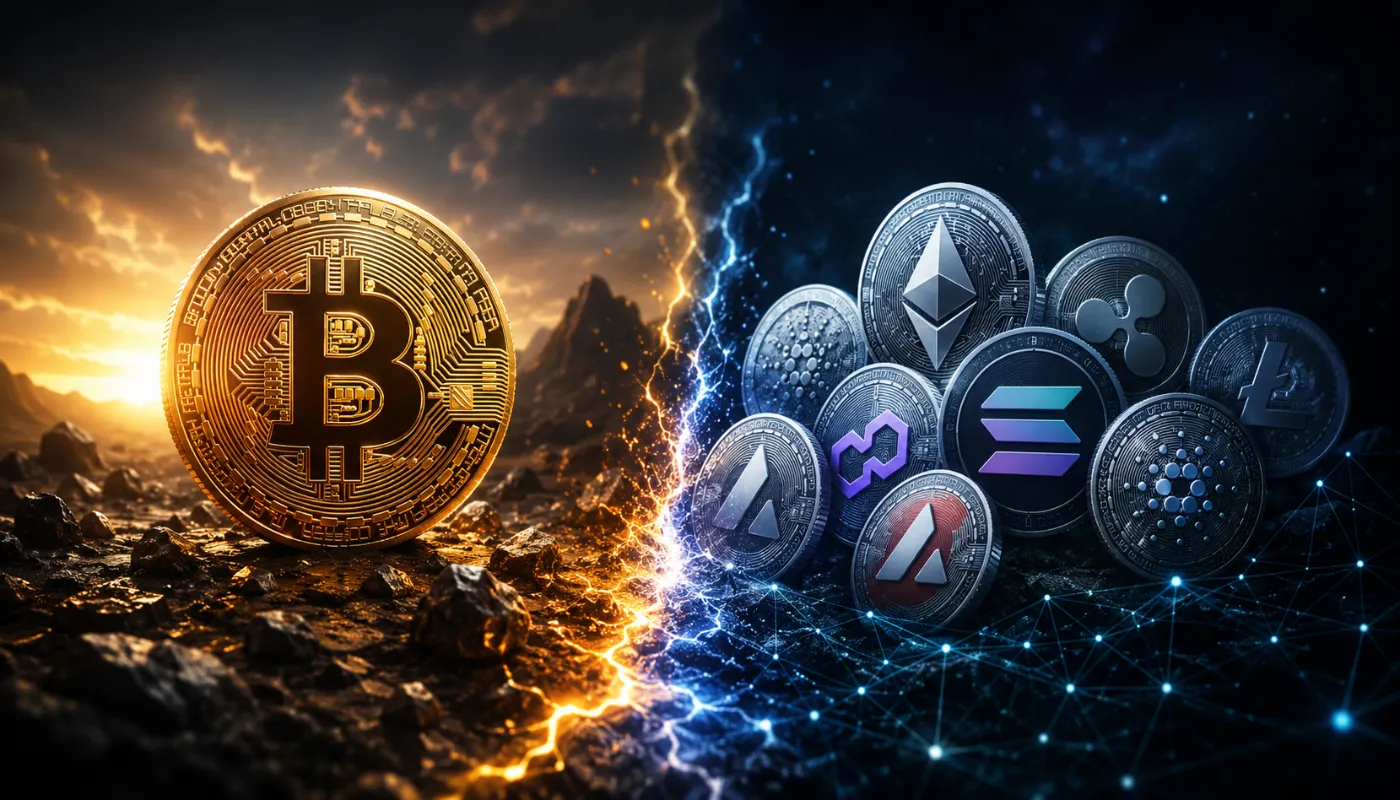
The most common mistake new investors make is treating Bitcoin and altcoins as interchangeable. They are not. They serve different purposes, carry different risk profiles, and behave differently across market cycles.
| Feature | Bitcoin (BTC) | Altcoins (General) |
| Primary purpose | Store of value, sound money, digital gold | Varies: payments, smart contracts, DeFi, gaming, identity, AI, RWAs |
| Market cap | $1.2 trillion+ (June 2026) | From billions (ETH, SOL) to effectively zero (most new tokens) |
| Regulatory status | Commodity classification in US, EU, UK | Varies by project. Some are securities. Most are unclassified. |
| Spot ETF availability | Yes (US, UK, Australia, Canada, EU) | Ethereum only (US). Others pending or unavailable. |
| Volatility | High vs traditional assets, lower vs altcoins | Significantly higher than Bitcoin in both directions |
| Liquidity | Deep liquidity on all major exchanges | Varies dramatically. Low-cap altcoins can have severe slippage. |
| Development risk | Minimal. Protocol is deliberately conservative. | High. Most altcoin projects fail within 2-3 years. |
| Halving cycle | Every 4 years. Predictable supply schedule. | Most altcoins have no fixed supply mechanism or arbitrary tokenomics. |
The practical implication: Bitcoin is where most serious long-term investors keep the majority of their crypto allocation. Altcoins are where investors take calculated, sized bets on specific use cases with higher risk and higher potential return.
If you are new to crypto and have not yet bought Bitcoin as a foundational position, that is the natural starting point before diversifying into altcoins.
8 Essential Altcoin Categories You Must Understand Before Buying
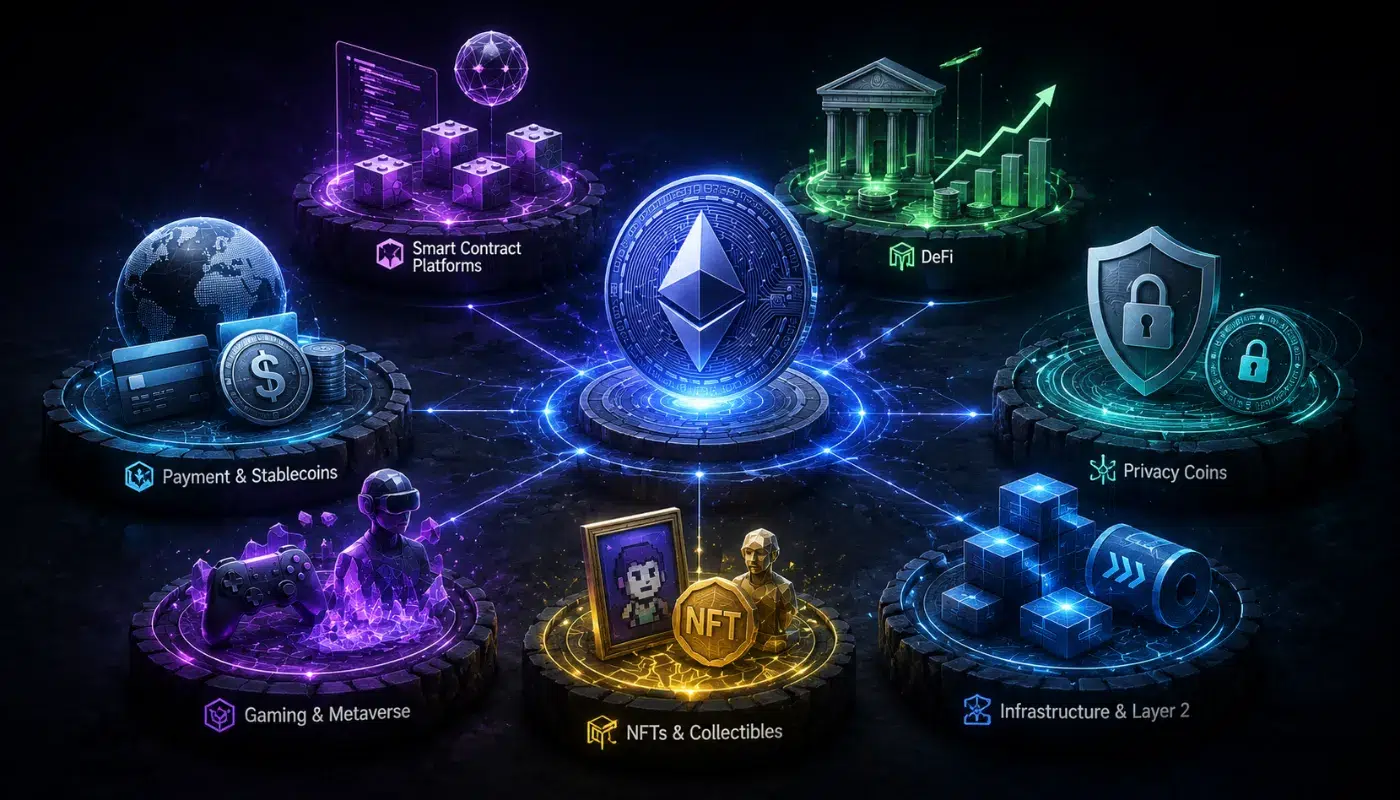
Most guides list a handful of popular altcoins and call it a day. That approach is useless unless you understand what problem each category is trying to solve.
Here are the eight categories that matter in 2026, with honest assessments of where each stands.
1. Smart Contract Platforms (Layer 1 Blockchains)
Smart contract platforms are the foundational infrastructure of the altcoin economy. They are the blockchains that host applications, tokens, NFTs, and financial protocols. Every other category in this list depends on them.
Ethereum (ETH) dominates this category by every meaningful metric: total value locked, developer count, institutional adoption, and regulatory clarity. Its Layer 2 ecosystem, including Arbitrum, Base, and Polygon, now processes more daily transactions than Ethereum mainnet itself.
For a deep technical understanding of how Ethereum powers smart contract infrastructure, our dedicated guide covers the architecture, staking, and 2026 upgrades in full.
Solana (SOL) is the strongest Layer 1 competitor to Ethereum. Its high throughput and sub-second finality have made it the dominant platform for consumer-facing applications and high-frequency trading.
The Firedancer multi-client upgrade completed in 2025 significantly improved reliability. Cardano (ADA) prioritises academic rigour and achieved full decentralised governance under the Voltaire upgrade in late 2025. Avalanche (AVAX) serves enterprises through customisable subnet architecture.
The best blockchain projects of 2026 covers all major Layer 1 platforms in depth with current data on adoption, upgrades, and institutional backing.
2. Stablecoins
Stablecoins are cryptocurrencies pegged to the value of a stable asset, typically the US dollar. They solve crypto’s most fundamental practical problem: volatility.
A stablecoin lets you stay within the crypto ecosystem, transact instantly and cheaply, and avoid the price swings that make using Bitcoin for everyday payments impractical.
Tether (USDT) holds approximately 70% of the stablecoin market as of June 2026 and handles more daily transaction volume than Bitcoin or Ethereum. USD Coin (USDC), issued by Circle and Coinbase, is preferred by regulated institutions for its regulatory compliance and full reserve transparency.
DAI and USDS are decentralised stablecoins maintained through overcollateralised smart contracts on Ethereum rather than through centralised issuers.
Most altcoin buyers use stablecoins as a bridge: buy USDT or USDC on a fiat-to-crypto exchange, then use them to purchase any altcoin they want on any exchange without needing to convert through Bitcoin or Ethereum first.
3. Decentralised Finance (DeFi) Tokens
DeFi tokens are the governance and utility assets of financial protocols that run on blockchains without banks or brokers. Aave (AAVE) governs the largest decentralised lending protocol, where users borrow and lend crypto without a bank.
Uniswap (UNI) governs the largest decentralised exchange. Curve (CRV) governs the dominant stablecoin trading platform. MakerDAO (MKR) oversees the DAI stablecoin system.
According to DeFiLlama, total value locked across DeFi protocols sits above $100 billion in 2026. That represents real economic activity. Lending protocols are processing billions in loans. DEXs are clearing billions in daily volume. These are not theoretical numbers.
However, DeFi token prices are highly sensitive to smart contract exploits, governance disputes, and regulatory developments. Investing in DeFi tokens requires understanding the specific protocol’s mechanics and competitive position.
4. Layer 2 Scaling Networks
Layer 2 networks sit on top of Layer 1 blockchains and process transactions faster and cheaper while inheriting the security of the base layer.
Arbitrum (ARB) and Optimism (OP) use optimistic rollup technology. Polygon (POL) uses zero-knowledge proofs. Base, launched by Coinbase, serves as the primary on-ramp for mainstream users into Ethereum’s ecosystem.
Layer 2 networks now collectively process more daily transactions than Ethereum mainnet. They are where most real user activity happens in 2026.
Their native tokens serve governance and fee payment functions within their ecosystems. Layer 2 tokens carry the risk that Ethereum itself might eventually absorb their functionality through base-layer upgrades. That is a legitimate long-term risk worth understanding before investing.
5. Meme Coins
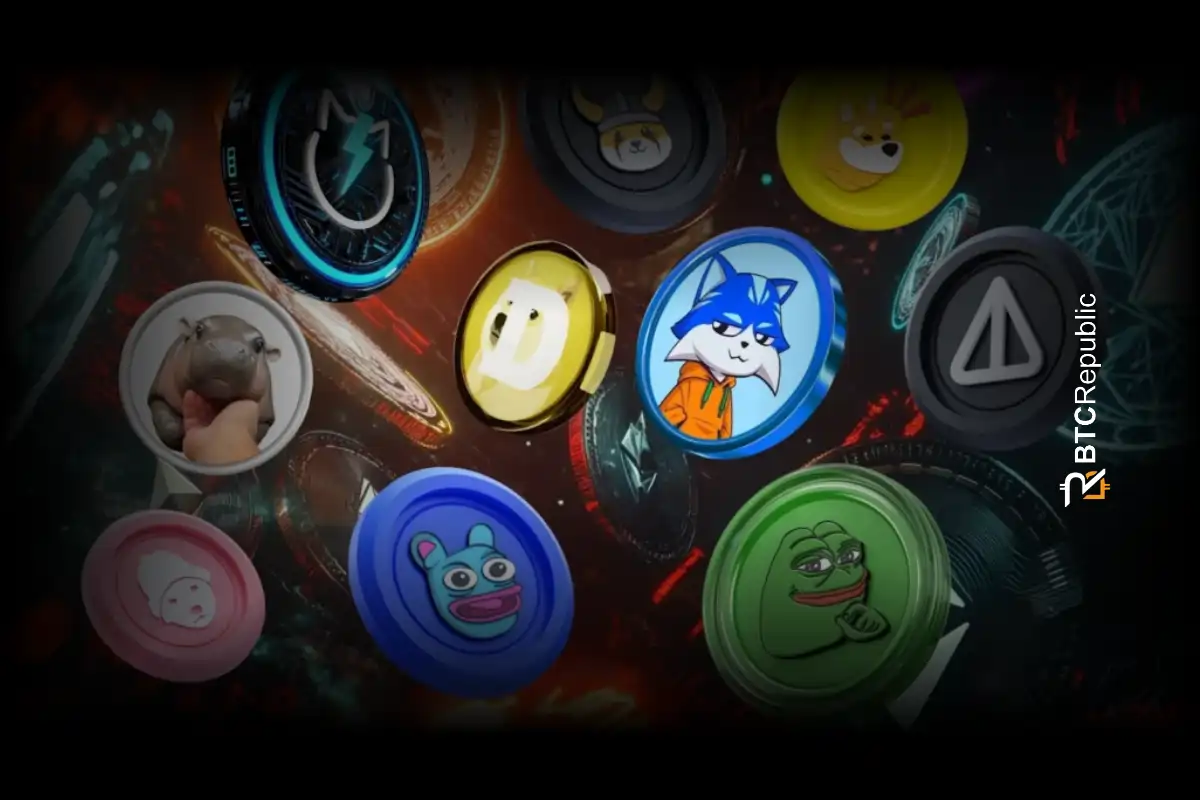
Meme coins are cryptocurrencies whose primary value driver is community enthusiasm, viral culture, and celebrity association rather than technical innovation or protocol utility.
Dogecoin (DOGE) is the original and most legitimate meme coin. It has been running since 2013, has SEC commodity classification, Nasdaq-listed spot ETFs, and active corporate payment integrations through Tesla.
For everything you need to know about the current state of DOGE, our complete guide to buying Dogecoin covers it in full.
Below DOGE sits a long tail of tokens with varying degrees of legitimacy: Shiba Inu (SHIB) with its established community and ecosystem, Pepe (PEPE), Bonk (BONK), and thousands of others launched daily on Solana and Ethereum.
The defining characteristic of this category is that prices are driven almost entirely by sentiment and social media velocity. Returns can be extraordinary. Losses can be total. Position sizing is the only real risk management tool available.
6. AI and Infrastructure Tokens

One of the fastest-growing altcoin categories in 2026 is the intersection of artificial intelligence and blockchain. These tokens power decentralised compute networks, AI model marketplaces, and verifiable on-chain AI inference.
Bittensor (TAO) rewards nodes that contribute useful machine intelligence to a shared network, creating a decentralised market for AI capabilities.
Render (RNDR) enables distributed GPU rendering for AI workloads. Near Protocol is actively positioning itself as AI-friendly infrastructure.
This category reflects a genuine technological convergence. Blockchain provides the verifiable data provenance and decentralised coordination that AI systems need to be trustworthy at scale.
However, it is also one of the most narrative-driven sectors in crypto, where token prices often price in AI hype rather than AI adoption.
Distinguish between projects with real deployed products and those with ambitious roadmaps and minimal traction.
7. Real-World Asset (RWA) Tokens
Real-world asset tokenisation is the process of converting physical or financial assets into blockchain-based digital tokens. In 2026, this is no longer an emerging trend. It is operational infrastructure.
BlackRock manages billions in tokenised treasury assets. JPMorgan processes wholesale payments through on-chain settlement.
Tokenised private credit, real estate, and commodities are accessible to retail investors through platforms that did not exist two years ago.
RWA tokens are among the most institutionally credible assets in the altcoin universe because they are backed by verifiable off-chain assets and governed by legal frameworks.
Their growth is also directly correlated with regulatory clarity. As the FIT21 Act and SEC guidance evolve in the US, more traditional asset classes will move onto blockchain rails.
This is the category with the strongest fundamental growth story of 2026.
8. Gaming and Metaverse Tokens
Gaming tokens are the native currencies of blockchain-based games and virtual worlds where players genuinely own in-game assets as NFTs.
The Sandbox (SAND), Immutable X (IMX), Gala Games (GALA), and Illuvium (ILV) are among the most established projects.
Unlike traditional games where developers own everything, blockchain games allow players to sell, trade, and sometimes use their assets across compatible games.
The play-to-earn model popularised by Axie Infinity in 2021 proved economically unsustainable in its original form. The gaming projects that survived the 2022 crash shifted toward play-and-earn models where earnings are supplementary rather than primary income.
The games that thrive are those with genuine entertainment value independent of token prices. Gaming tokens should be evaluated like gaming companies: does the game have players? Does the player base grow independently of price speculation?
What Is Altcoin Season and Is It Happening in 2026?
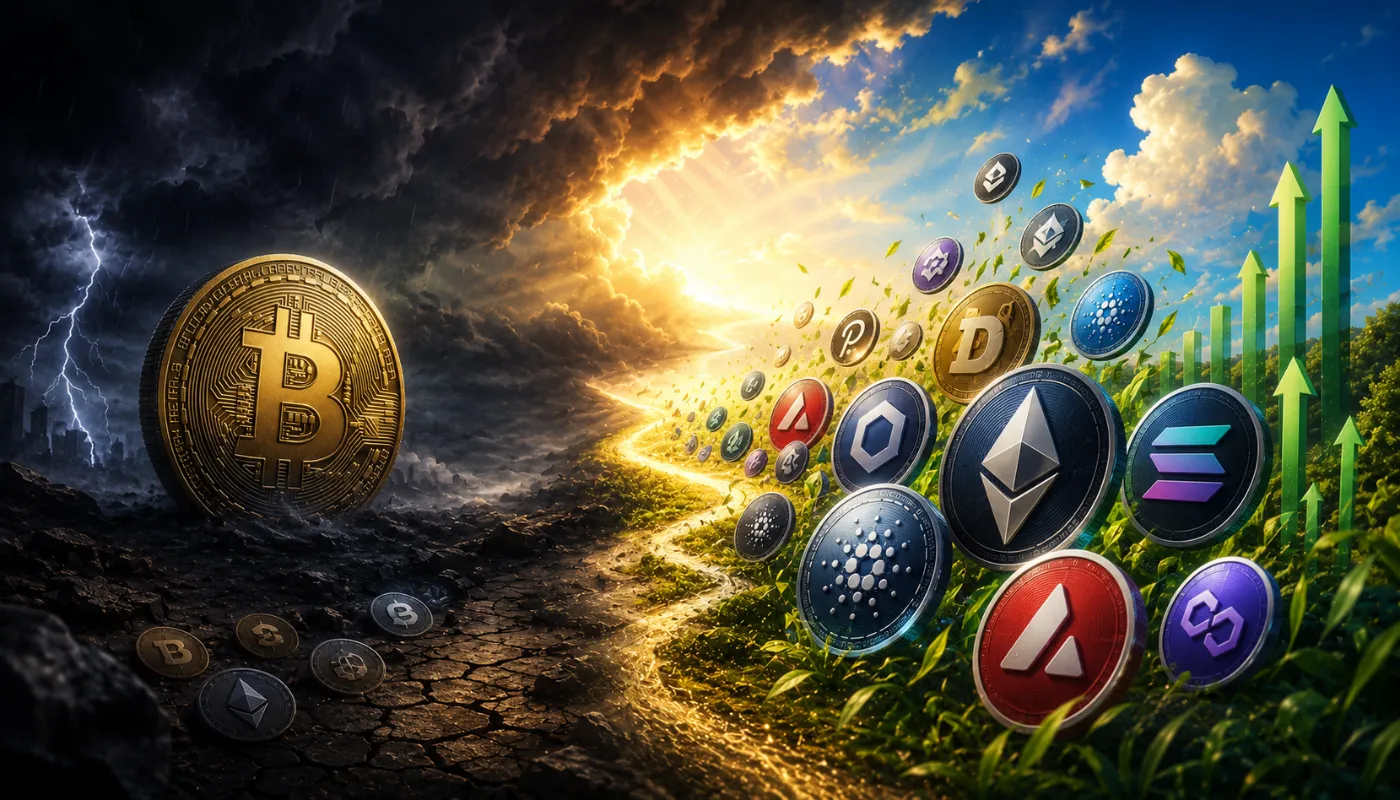
Altcoin season refers to periods when a broad basket of altcoins significantly outperforms Bitcoin on a relative basis over sustained weeks or months.
It is not a single-asset pump. It requires three conditions to align simultaneously: Bitcoin dominance must fall below 50%, ALT/BTC trading pairs must show consistent gains, and liquidity must expand across multiple sectors simultaneously.
As of June 2026, Bitcoin dominance sits above 60%, which classifies the current market as a Bitcoin season by the standard Altcoin Season Index. The index reads 27 out of 100, far below the 75 threshold that signals a confirmed altcoin season. That does not mean individual altcoins cannot rally.
Solana, XRP, and several AI tokens have posted significant gains even during this period of Bitcoin dominance. But broad altcoin season conditions have not materialised.
The historical pattern is consistent: Bitcoin rallies first, pulling up the total crypto market. Bitcoin then consolidates. Capital rotates into Ethereum first, then to large-cap altcoins, then to mid-caps and small-caps. This rotation typically begins 3 to 6 months after a Bitcoin ATH.
Bitcoin hit $126,200 in October 2025. If the historical pattern holds, a selective altcoin rotation could emerge in the second half of 2026.
Where to Buy Altcoins: Best Exchanges Compared for 2026
Your choice of exchange determines which altcoins you can access, how much you pay in fees, and how quickly you can get into new opportunities.
No single exchange is optimal for every buyer. Here is the honest comparison.
Centralised Exchanges (CEX): The Standard Starting Point
Centralised exchanges are the most accessible entry point for most buyers. They accept fiat deposits, handle KYC compliance, provide customer support, and offer deep liquidity on major trading pairs.
Their trade-off is custodial risk: the exchange holds your private keys. Understanding what KYC means in crypto before creating an exchange account helps you understand the verification process and what information exchanges require.
| Exchange | Altcoins Listed | Spot Fee | Best For | US Available? |
| Binance | 350+ | 0.10% | Widest selection, lowest CEX fees, global access | No (Binance.US limited) |
| Coinbase Advanced | 550+ | 0.40% | US residents, regulated access, institutional trust | Yes |
| Kraken | 200+ | 0.26% | Security-conscious buyers, 13-year track record | Yes |
| MEXC | 3,000+ | 0% maker / 0.05% taker | Maximum altcoin selection, new listings fast | Restricted in US |
| KuCoin | 700+ | 0.10% | Early altcoin access, wide mid-cap selection | Restricted in US |
| Gate.io | 4,600+ | 0.20% | Broadest altcoin access on any CEX globally | Restricted in US |
Decentralised Exchanges (DEX): Access Without Permission
Decentralised exchanges allow you to swap altcoins directly from your wallet without creating an account or passing identity verification.
Trades are executed by smart contracts rather than a central operator. Uniswap on Ethereum, Raydium on Solana, and PancakeSwap on BNB Chain handle billions in daily volume between them.
DEXs offer access to thousands of tokens that will never appear on centralised exchanges, including new token launches, small-cap projects, and assets the legal teams at regulated exchanges have declined to list.
However, DEXs require you to hold and manage your own crypto wallet, understand gas fees, verify token contract addresses manually to avoid counterfeits, and accept that there is no customer support if something goes wrong.
For experienced users, DEXs are powerful. For beginners, they are a significant step up in complexity and risk. Our guide to the best decentralised crypto wallets covers the wallet setup required for DEX access.
If your goal is to avoid identity verification entirely, our guide to no-KYC crypto exchanges covers the available options and their specific trade-offs.
5 Critical Steps to Buy Altcoins Safely
The mechanics of buying altcoins are straightforward. The decisions you make at each step determine whether your investment is safe or unnecessarily exposed to risk.
Step 1: Choose Your Exchange Based on Your Specific Needs
Your country of residence, the specific altcoins you want, your fee sensitivity, and your technical comfort level all point toward different exchanges.
US residents start with Coinbase or Kraken for regulatory safety. Global buyers with lower fees as the priority choose Binance. Anyone hunting new or obscure altcoins before they list on major exchanges uses MEXC or KuCoin.
Buyers who want the absolute widest selection use Gate.io. Make this decision before creating an account rather than picking randomly and switching later.
Step 2: Create and Secure Your Account Properly
Register with your email address on the exchange’s official website. Always type the URL manually or use a saved bookmark.
Phishing sites that perfectly mimic real exchanges are among the most common altcoin buyer scams. After creating your account, immediately enable two-factor authentication using an authenticator app, not SMS.
SIM-swap attacks that intercept SMS verification codes are well-documented and specifically target crypto holders. Use a strong, unique password that you do not use anywhere else.
Step 3: Complete Verification and Fund Your Account
Most regulated exchanges require KYC identity verification before you can deposit fiat or withdraw funds above small limits. Upload your government-issued ID and selfie as prompted.
Verification typically takes minutes to hours. Once verified, deposit funds through your preferred method. Bank transfers are cheapest, usually free or under $2, but take one to three days.
Card deposits are instant at 1.5% to 3% fees. For altcoin buying specifically, consider depositing USDT or USDC directly if you already hold stablecoins, as most altcoin pairs trade against stablecoins rather than fiat.
Step 4: Research Before You Place Any Order
This is the step most buyers skip and most losses trace back to. Before buying any altcoin, verify three things.
- First, check the token’s contract address on the blockchain explorer and confirm it matches the official project website. Scammers create tokens with identical names and logos to established projects.
- Second, check the trading volume and liquidity. If an altcoin’s 24-hour volume is under $500,000, selling a meaningful position without severe slippage may be impossible.
- Third, read the project’s documentation and check development activity on its GitHub repository. Active code commits signal genuine ongoing development.
Months of silence signal abandonment. The principles for identifying crypto scams and fraudulent projects apply equally to altcoin research.
Step 5: Buy and Immediately Move to Self-Custody
Execute your purchase using a market order for immediate execution at the current price, or a limit order to specify the price you want and wait for the market to reach it. Once purchased, withdraw your altcoins to a wallet you control.
The importance of this step cannot be overstated. Exchange collapses including FTX in 2022 and Bybit’s $1.5 billion hack in February 2025 demonstrate that exchange custody carries risks no amount of reputation protects against.
For a full guide on self-custody principles, our guide to storing Bitcoin safely covers the mechanics that apply equally to altcoins.
How to Evaluate Any Altcoin Before Buying: The Essential Framework

The crypto market is saturated with projects making ambitious claims and delivering nothing. Here is a practical framework for cutting through the noise.
Tokenomics: The Numbers That Drive Price
Tokenomics describes how a cryptocurrency’s supply is structured and distributed. Before buying any altcoin, answer these questions. What is the total supply and the circulating supply?
A project with 100 billion total tokens but only 5% in circulation has an enormous supply overhang that will dilute price as tokens unlock.
What percentage of supply is held by the team and early investors? Concentration above 30% in insider wallets is a major red flag.
Is there a burning mechanism that reduces supply over time, or is supply inflationary? What is the fully diluted valuation, total supply multiplied by current price, and how does it compare to established projects?
A small altcoin with a $10 billion FDV is not actually small.
Development Activity and Team Transparency
Open-source blockchain projects have public GitHub repositories where you can see every code commit, every contributor, and the frequency of development activity.
A project with daily commits across multiple contributors is actively built. A repository with no updates for six months suggests the team has moved on.
Additionally, check whether the founding team is publicly identified and whether their backgrounds are verifiable. Anonymous teams are a risk factor.
They are not always fraudulent, but if they disappear, there is no legal recourse.
Real Adoption Metrics
Price action tells you what speculators think. On-chain data tells you what users actually do.
For any altcoin claiming utility, find the real numbers: daily active addresses, transaction count, total value locked for DeFi protocols, gross merchandise volume for gaming platforms, and revenue generated by the protocol.
Projects that show growing on-chain activity independently of price appreciation have genuine demand.
Projects with rising prices but flat or declining on-chain activity are driven purely by speculation.
Competitive Positioning
Almost every altcoin competes in a defined market. Ask: who else is solving this problem, and why does this project have an advantage?
A new Layer 1 blockchain competing with Solana and Ethereum needs a compelling technical differentiator, not just a faster consensus algorithm that is already available elsewhere.
A DeFi lending protocol launching in 2026 faces Aave with billions in TVL and years of audited track record. Network effects in blockchain are powerful. Displacing incumbents requires more than marginal improvements.
Major Altcoins Worth Understanding in 2026
The following altcoins represent the most significant positions in the market by market cap, institutional backing, and demonstrated utility.
Each has its own dedicated buying guide for investors who want to go deeper.
Ethereum (ETH): The Smart Contract Foundation
Ethereum is the most important altcoin by every meaningful metric. It powers the majority of DeFi, most stablecoin issuance, the majority of NFT activity, and most tokenised real-world assets.
The Pectra upgrade in May 2025 and Fusaka in December 2025 have made the network dramatically more capable and scalable. Spot ETH ETFs in the US, UK, and Australia brought institutional capital at scale.
Our complete Ethereum price prediction through 2030 covers analyst projections against the backdrop of these developments.
For buying ETH step by step, our complete guide to buying Ethereum covers every exchange option, fee structure, and storage choice.
XRP: Institutional Payment Infrastructure
XRP resolves international payment transfers in 3 to 5 seconds at under $0.01 per transaction.
Over 300 banks and financial institutions use RippleNet. XRP’s protracted legal battle with the SEC concluded with a regulatory framework that affirmed XRP’s commodity status in most transaction contexts.
If you want to invest specifically in XRP, our step-by-step XRP buying guide covers the exchanges, legal context, and storage options in full.
Litecoin (LTC): The Proven Payment Alternative
Litecoin is one of the oldest altcoins, launched in 2011, and one of the most consistently operational.
Its 2.5-minute block times, near-zero fees, and dominant BitPay payment volume make it the most practically used payment cryptocurrency outside of stablecoins.
The fourth halving is expected in July 2027, putting LTC in a historically significant pre-halving accumulation window.
Our complete guide to buying Litecoin covers the full picture including the halving cycle, MWEB privacy upgrade, and current market position.
Dogecoin (DOGE): The Cultural Currency with Institutional Backing
Dogecoin holds SEC commodity classification, two Nasdaq-listed spot ETFs, and a confirmed X Money payment layer integration in development.
Its BitPay payment volume leads all cryptocurrencies.
The Dogecoin price prediction for 2026 and beyond covers analyst projections across bull, base, and bear scenarios.
Altcoin Investment Strategies That Actually Work

Strategy separates informed altcoin investors from people who are effectively gambling. Here are the approaches with the strongest track records.
Portfolio Allocation: The Pyramid Model
Most experienced crypto investors structure their altcoin exposure as a pyramid. Bitcoin forms the base and receives the largest allocation, typically 50% or more of total crypto holdings.
Ethereum and other large-cap altcoins form the middle layer at 20-30%. Mid-cap altcoins with real utility but higher risk take 10-15%. Speculative small-caps and meme coins represent 5-10% at most.
This structure gives you meaningful exposure to upside in all market conditions while ensuring the portion most likely to go to zero is the smallest part of your portfolio.
Dollar-Cost Averaging on Established Projects
Setting up automatic weekly or monthly purchases of a fixed dollar amount removes the pressure of timing the market.
For established altcoins with genuine long-term theses, Ethereum and Solana being the clearest examples, DCA across a full market cycle has historically produced better returns than attempting to time entries.
The psychology of holding through crypto volatility is as relevant to altcoin holders as to Bitcoin holders, and the emotional experience is considerably more intense given altcoins’ amplified volatility.
Sector Rotation Based on Market Cycles
Different altcoin categories outperform at different stages of the market cycle. DeFi tokens tend to lead during bull markets driven by on-chain activity.
Infrastructure tokens like Layer 2s perform well when developer activity peaks. Meme coins spike during late-stage retail euphoria.
Gaming and NFT tokens follow gaming adoption cycles that do not always align with crypto market cycles. Understanding which sector is in its growth phase, versus which is overbought, is a meaningful edge.
Approaching Altcoin Presales With Extreme Caution
Altcoin presales allow investors to buy tokens before they list on exchanges, theoretically at the lowest possible price. The reality is more complicated. Most presale tokens never list on major exchanges.
Many that do list immediately dump as early investors sell. Legitimate presales from projects with real teams and products exist, but they represent a small fraction of what gets marketed to retail investors.
If you decide to explore presales, our guide to joining crypto presales safely with 6 essential rules is essential reading before committing any capital.
Critical Risks of Buying Altcoins That Most Guides Skip

Honest altcoin coverage requires covering the risks as seriously as the opportunities.
These are not hypothetical risks. Each has caused measurable, documented losses at scale.
Extreme Illiquidity for Small-Cap Altcoins
A token with a $5 million market cap and $50,000 in daily volume is effectively impossible to exit quickly if something goes wrong. Your sell order moves the price against you before it fills.
This illiquidity trap catches buyers who focus on potential returns without checking whether they can actually exit the position. Before buying any altcoin, check the 24-hour volume.
If the volume is less than 10 to 20 times your intended position size, liquidity will be a problem.
Smart Contract Exploits
DeFi protocols and new blockchains are software. Software has bugs. Over $3 billion was lost to smart contract exploits and hacks in 2025 alone, according to blockchain security firm data.
Projects with multiple independent audits and extended operating track records are significantly safer than newly launched protocols with limited audit history.
Never put more in a new protocol than you are prepared to lose entirely to a smart contract vulnerability.
Regulatory Delisting Risk
The SEC, FCA, MAS, and other regulators have the authority to pressure exchanges to delist tokens they classify as unregistered securities.
Several altcoins that were listed on US exchanges in 2022 were delisted following regulatory pressure in 2023 and 2024.
A delisting does not necessarily mean the project is fraudulent. But it can lock you out of your primary exit route and crash the token price regardless of fundamentals.
Sophisticated Scams Targeting Altcoin Buyers
The altcoin market attracts sophisticated fraud. Rug pulls where development teams drain project funds after launch and disappear.
Pump-and-dump schemes where coordinated buying inflates a small-cap token before insiders dump onto retail buyers.
Honeypot contracts where buyers can purchase but the smart contract prevents selling. Fake influencer accounts promoting tokens they have already sold.
The framework for identifying legitimate crypto investments versus fraudulent schemes applies to altcoins with even greater force than to Bitcoin, given the lower barriers to creating a new token.
Storing Your Altcoins Safely After You Buy
The principles of self-custody apply as strongly to altcoins as to Bitcoin. In some ways they apply more strongly. Smaller altcoins are not listed on regulated custodians.
If the exchange holding your obscure altcoin fails, there is no institutional backstop.
Multi-Chain Hardware Wallets
Ledger supports over 5,500 cryptocurrencies through its Ledger Live interface, making it the most practical hardware wallet for altcoin holders with diverse portfolios.
Trezor supports several thousand assets but has slightly lower coverage of newer tokens.
For altcoin-specific storage, the critical check is whether your specific altcoin is supported before buying the hardware wallet.
Software Wallets for Active Altcoin Use
For regular altcoin trading and DeFi participation, software wallets are the practical choice. MetaMask is the standard for Ethereum and EVM-compatible altcoins. Phantom is the standard for Solana altcoins.
Trust Wallet supports multiple chains from a single interface and is reviewed in detail in our Trust Wallet comprehensive review.
For active trading positions you access regularly, software wallets are appropriate. For long-term holdings, hardware wallets are the right choice.
Frequently Asked Questions About Buying Altcoins
What is the best altcoin to buy right now?
There is no universal best altcoin because the right choice depends entirely on your goals, risk tolerance, time horizon, and which market conditions prevail. In 2026, Ethereum offers the strongest fundamental case as institutional infrastructure. Solana offers the strongest consumer adoption momentum. XRP offers the strongest institutional payment narrative. For speculative exposure, Dogecoin has regulatory infrastructure that most meme coins lack. Research each specific project rather than taking blanket recommendations.
How much money do I need to start buying altcoins?
Most exchanges allow altcoin purchases starting at $10 or less. There is no minimum that makes sense for everyone. The practical consideration is that very small positions, under $100, are difficult to manage meaningfully because percentage gains that sound impressive on paper translate to small absolute returns. A reasonable starting point for someone new to altcoins is $100 to $500 spread across two or three established projects, enough to learn the process while limiting downside exposure.
Are altcoins more risky than Bitcoin?
Yes, significantly. Bitcoin has the deepest liquidity, the longest operating track record, the most regulatory clarity, and the broadest institutional adoption of any cryptocurrency. Altcoins carry additional risks: project failure, team abandonment, smart contract exploits, regulatory delisting, and severe illiquidity on small-cap tokens. The higher potential returns of altcoins reflect these higher risks. Size your altcoin positions accordingly.
What is the difference between a coin and a token?
A coin is a cryptocurrency that operates on its own dedicated blockchain. Bitcoin, Ethereum, and Solana are coins. A token is built on top of an existing blockchain rather than running its own. Most DeFi tokens, gaming tokens, and meme coins are tokens. ERC-20 is the most common Ethereum token standard. SPL is the Solana equivalent. Tokens inherit the security and infrastructure of their host blockchain but also inherit its limitations and congestion costs.
Can I buy altcoins without completing KYC verification?
Yes, through decentralised exchanges and certain platforms designed for privacy. DEXs like Uniswap allow token swaps directly from your wallet without any account creation or identity verification. However, they require you to already hold crypto to swap, have no customer support, and carry higher risk of interacting with fraudulent tokens. Our guide to no-KYC exchanges covers platforms that offer this option with regulated risk management frameworks for those who specifically need it.
What happens to my altcoins if an exchange goes bankrupt?
If your altcoins are held in a custodial exchange wallet and that exchange files for bankruptcy, your assets become part of the bankruptcy estate. Recovery depends on the jurisdiction, the bankruptcy process, and how much remains after creditors are paid. FTX customers recovered a portion of their funds through bankruptcy proceedings that took years to complete. The only certain protection is withdrawing your altcoins to a non-custodial wallet you control before any problem occurs.
How do I know if an altcoin is a scam?
No checklist eliminates all risk, but consistent red flags are: anonymous team with no verifiable identities, no working product despite years of development, tokenomics that concentrate large percentages in team or early investor wallets, promises of guaranteed returns, social media pressure to buy quickly before a deadline, and no verifiable code repository or audit history. Legitimate projects have public teams, active GitHub repositories, multiple independent audits, and user numbers that grow independently of price.
What is the difference between a CEX and a DEX for buying altcoins?
A centralised exchange (CEX) is a company that manages an order book, holds your assets in custody, requires identity verification, and provides customer support. A decentralised exchange (DEX) is a smart contract that matches trades automatically without any company involved. CEXs are easier to use and offer fiat on-ramps. DEXs offer access to thousands more tokens, require no identity verification, and let you trade directly from your own wallet. Most serious altcoin buyers use both: CEXs for major altcoins and DEXs for newer or smaller projects.
Altcoins in 2026: Research First, Buy Second
The altcoin market rewards preparation and punishes impulse. The investors who consistently make money in this space are not the ones who chase the hottest narrative.
They are the ones who understand what they are buying before they buy it, who know which category each project belongs to, who have checked the tokenomics and development activity and competitive position, and who size their positions according to the actual risk profile of each asset.
The 2026 market is more institutionally sophisticated, more regulatory-aware, and more fundamentals-driven than any previous cycle.
That is genuinely good news. It means the garbage gets filtered out faster. Projects without real utility lose their hype premium more quickly.
The ones that survive and grow are the ones delivering actual value. Finding those projects early, before the institutional money flows in, is exactly what this guide has equipped you to do.
Start with the complete ranking of top cryptocurrencies by market cap to understand the landscape. Then use the research framework in this guide to evaluate any specific altcoin you are considering.
The market rewards the investors who do that work. Everything else is speculation, and in the altcoin market, uninformed speculation has a well-documented outcome.