

Litecoin remains one of the most straightforward cryptocurrencies to buy in 2026. It is listed on virtually every major exchange, trades with deep liquidity, and has been running without a single network interruption since Charlie Lee created it in 2011. If you want to buy Litecoin, you can have LTC in your wallet in under 15 minutes.
But the process is only that simple if you know which exchange to use, how to avoid the fees that quietly eat into your position, and how to store your LTC safely after you buy it.

This guide covers everything. What Litecoin actually is and why people still buy it in 2026. Where to buy it and how each exchange compares. The step-by-step process from account creation to holding LTC in your own wallet.
- Key Takeaways
- What Is Litecoin and Why Do People Still Buy It?
- Litecoin vs Bitcoin: Key Differences Before You Buy LTC
- Where to Buy Litecoin: Best Exchanges in 2026
- How to Buy Litecoin: Step-by-Step
- Step 1: Choose Your Exchange and Create an Account
- Step 2: Complete Identity Verification
- Step 3: Deposit Funds
- Step 4: Find Litecoin and Place Your Order
- Step 5: Withdraw LTC to Your Own Wallet
- Where to Store Litecoin After You Buy It
- Understanding Litecoin Transaction Fees and Exchange Costs
- Litecoin in 2026: Where the Market Stands
- Litecoin vs Other Payment Cryptocurrencies
- Risks of Buying Litecoin You Must Understand
- Competition and Narrative Risk
- Price Volatility
- No ETF, No Institutional Demand Catalyst
- MWEB Regulatory Risk
- Custodial Risk
- Strategies for Buying Litecoin Effectively
- How to Avoid Litecoin Scams
- What to Do With Your Litecoin After You Buy It
- Frequently Asked Questions About Buying Litecoin
- Is Litecoin a good investment in 2026?
- What is the minimum amount of Litecoin I can buy?
- How long does a Litecoin transaction take?
- What is the best wallet to store Litecoin?
- Can I buy Litecoin without ID verification?
- What is the next Litecoin halving?
- What is MimbleWimble and should it affect my decision to buy LTC?
- Is Litecoin the same as Bitcoin?
- Conclusion: Is Buying Litecoin Right for You?
How to read the halving cycle that shapes LTC’s price. And the risks you need to understand before committing a single dollar. By the end, you will have everything you need to buy Litecoin with confidence.
Key Takeaways
| Point | What You Need to Know |
| LTC trades around $44-$55 in June 2026 | Market cap sits near $3.5-$4B, making it a mid-cap altcoin with deep liquidity |
| 91.5% of all LTC has already been mined | Only around 7 million LTC remain to be mined before the 84 million cap is reached |
| Next halving expected July 2027 | Block rewards will drop from 6.25 LTC to 3.125 LTC. Historically, a price catalyst |
| 380 million lifetime transactions processed | The Litecoin Foundation confirmed zero network interruptions across 15+ years of operation |
| MimbleWimble Extension Blocks (MWEB) active since 2022 | Optional privacy transactions are live, expanding use cases beyond basic payments |
| Litecoin is #1 on BitPay by payment volume | LTC holds over 41% of all crypto payments processed by BitPaythe leading payment processor |
| Always withdraw to your own wallet | Never hold LTC on an exchange long-termuse a non-custodial or hardware wallet |
What Is Litecoin and Why Do People Still Buy It?
Litecoin is a peer-to-peer digital currency created by Charlie Lee, a former Google engineer, on October 7, 2011. Lee forked it directly from Bitcoin’s open-source code with three deliberate changes: faster block times, a larger total supply, and a different hashing algorithm called Scrypt.
Those three changes made Litecoin faster and cheaper for everyday transactions while keeping the core architecture that makes Bitcoin trustworthy.
The result is a network that produces a new block every 2.5 minutes, four times faster than Bitcoin’s 10-minute blocks. A standard LTC transaction confirms in seconds to minutes, depending on the fee you pay, compared to Bitcoin’s typical 10-60 minute confirmation window.

Average fees on Litecoin run around 0.00028 LTC per transaction, a fraction of a cent at current prices. For payments, remittances, and everyday transfers, those metrics make Litecoin genuinely practical in a way that Bitcoin’s base layer is not.
According to the Litecoin Foundation, the network has processed over 380 million transactions since launch with zero network interruptions. That track record of reliability across 15 years and multiple market cycles is something very few blockchains can match.
LTC is not the most technically exciting project in crypto. But it is one of the most proven.
What Litecoin Is Used For
The primary use case for Litecoin is payments. According to BitPay, the world’s leading crypto payment processor, Litecoin accounts for over 41% of all crypto payments processed on the platform, making it the most used cryptocurrency for payments by a considerable margin.
Thousands of merchants worldwide accept LTC directly or through payment processors like BitPay and Coingate. Beyond payments, some investors hold LTC as a complement to Bitcoin, with a similar technical DNA, a similar halving cycle, but with more room to grow from a lower price base.
MimbleWimble Extension Blocks (MWEB)
In May 2022, Litecoin activated MimbleWimble Extension Blocks, one of the most significant upgrades in its history. MWEB adds an optional privacy layer that allows users to conduct confidential transactions, hiding amounts and addresses from the public ledger, without affecting the transparency of standard LTC transactions.
Users choose whether to use the privacy layer on a transaction-by-transaction basis. This makes Litecoin one of the few major cryptocurrencies offering genuine optional privacy without requiring users to switch to a dedicated privacy coin.
Some South Korean exchanges delisted LTC in response to regulatory concerns about privacy features, which is worth knowing if you operate in markets with strict exchange regulations.
Litecoin’s Halving Cycle
Like Bitcoin, Litecoin undergoes a halving approximately every four years, cutting the block reward paid to miners in half. Litecoin’s third halving occurred in August 2023, reducing the block reward from 12.5 LTC to 6.25 LTC. The fourth halving is expected in July 2027, when the reward will drop to 3.125 LTC.
Historically, Litecoin’s price has rallied in the months leading up to each halving as traders price in the upcoming supply reduction, only to sell off sharply in the days following the event itself. The 2026-2027 pre-halving window is the current period, and some analysts expect a similar pattern to play out.
Understanding how halving cycles affect crypto prices more broadly is covered in our guide to investing in Bitcoin and crypto, which explains the mechanics in full detail.
Litecoin vs Bitcoin: Key Differences Before You Buy LTC

Many first-time LTC buyers come from a Bitcoin background. Understanding the core differences helps you make a more informed decision about whether Litecoin fits your goals.
| Feature | Bitcoin (BTC) | Litecoin (LTC) |
| Created | 2009 by Satoshi Nakamoto | 2011 by Charlie Lee (forked from Bitcoin) |
| Block time | ~10 minutes | ~2.5 minutes (4x faster) |
| Total supply | 21 million BTC | 84 million LTC |
| % already mined | ~93.5% | ~91.5% (76.8M of 84M LTC) |
| Hashing algorithm | SHA-256 | Scrypt (more ASIC-resistant historically) |
| Transaction fees | Variable; can be high at peak demand | Consistently very low (~$0.001-$0.01) |
| Privacy | None | Optional MWEB privacy layer (since 2022) |
| Next halving | ~2028 | ~July 2027 |
| Institutional ETFs | Yes (US spot ETFs since Jan 2024) | No ETF is currently approved |
| Primary narrative | Digital gold, store of value | Digital silver, payments |
Litecoin is not trying to replace Bitcoin; it never was. Charlie Lee designed it to complement Bitcoin the way silver complements gold.
Faster and cheaper for everyday transactions, while Bitcoin handles large-value transfers and long-term storage. That positioning still holds in 2026, which is why Litecoin’s payment volume on platforms like BitPay consistently outperforms most other cryptocurrencies.
Where to Buy Litecoin: Best Exchanges in 2026
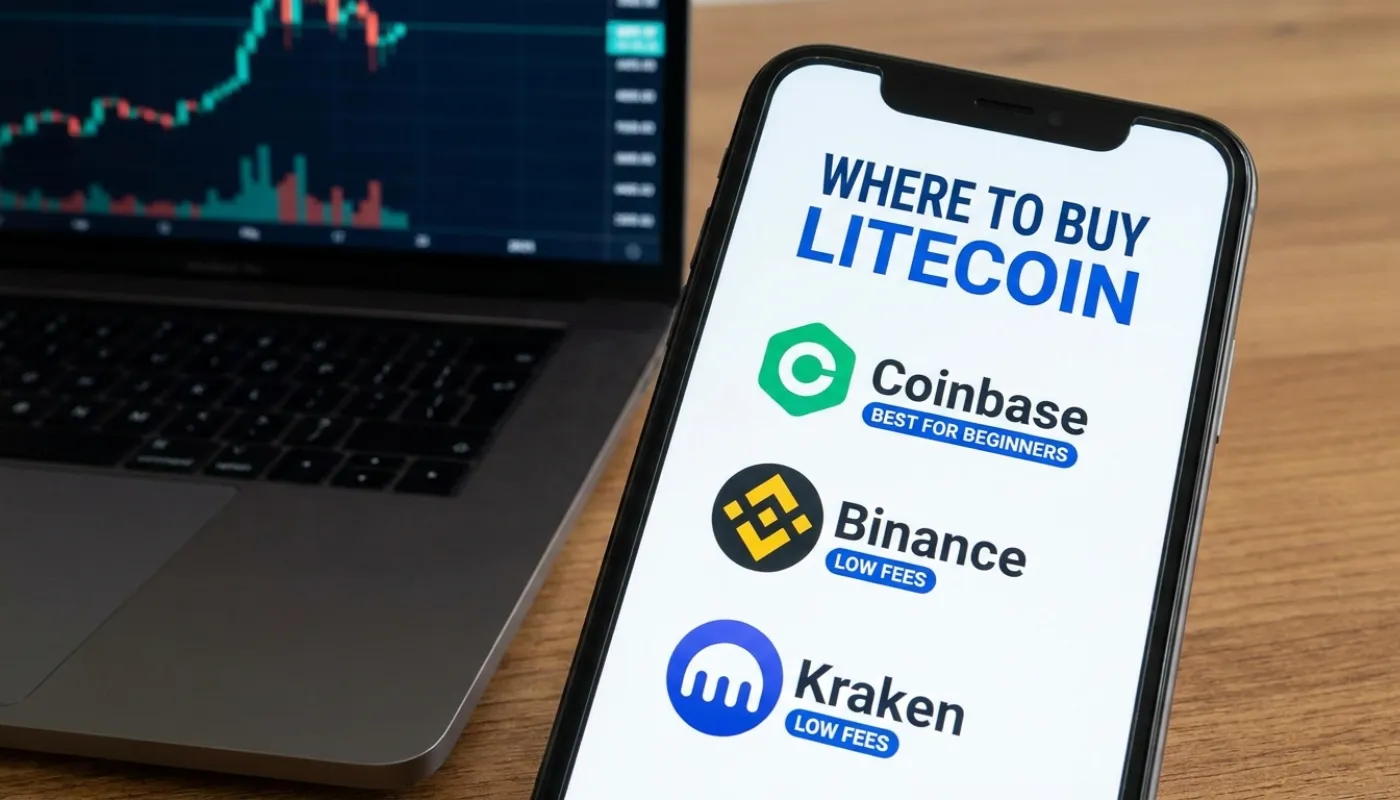
Litecoin is one of the most widely listed cryptocurrencies in the market. You will find it on every major centralised exchange and most decentralised ones.
The exchanges below are the most established, most liquid, and most widely available options for buying LTC in 2026.
Binance
Binance is the world’s largest cryptocurrency exchange by trading volume and offers LTC trading pairs against USD, USDT, BTC, ETH, and BNB. Spot trading fees start at 0.1% and drop further with volume or BNB fee payments.
Binance supports bank transfer, debit card, credit card, and P2P trading for fiat deposits. It is available in most countries outside the United States, where Binance.US operates with a more limited feature set.
Visit Binance to check availability and current LTC pairs in your region.
Coinbase
Coinbase is the best option for US residents and beginners in regulated markets. It is publicly listed on NASDAQ and holds licences in every US state that requires them.
LTC is available through Coinbase’s simple buy interface at approximately 1.49% per transaction, or through Coinbase Advanced Trade at 0.4% or less.
Coinbase supports bank transfer, debit card, PayPal, Apple Pay, and Google Pay deposits.
Kraken
Kraken has operated since 2011, the same year Litecoin launched, and has never suffered a major security breach. It offers LTC/USD and LTC/EUR pairs with spot trading fees starting at 0.26% for takers.
Kraken is available in most countries, including the US, EU, UK, Canada, and Australia.
It is the strongest choice for buyers who prioritise security track record above all else. Kraken also supports wire transfer, debit card, and various local bank payment methods.
OKX
OKX offers some of the lowest spot trading fees in the market, starting at 0.08% for makers. It has a built-in Web3 wallet and strong liquidity across LTC trading pairs.
OKX is particularly strong in Asia and the Middle East and is not available to US residents. Its mobile app is among the most polished available and makes buying LTC on a phone straightforward, even for first-time buyers.
Exchange Comparison
| Exchange | Spot Fee | Best For | US Available? | LTC Pairs |
| Binance | 0.10% | Low fees, global reach | No (Binance.US only) | LTC/USDT, LTC/BTC, LTC/BNB, LTC/ETH |
| Coinbase | 0.40% | US residents, beginners | Yes | LTC/USD, LTC/USDC |
| Kraken | 0.26% | Security-first buyers | Yes | LTC/USD, LTC/EUR, LTC/BTC |
| OKX | 0.08% | Asia/MENA, low-fee traders | No | LTC/USDT, LTC/BTC, LTC/ETH |
How to Buy Litecoin: Step-by-Step
The steps below apply to any centralised exchange. The interface will look slightly different on each platform, but the process is identical across all of them.
Step 1: Choose Your Exchange and Create an Account
Pick an exchange based on your country of residence, preferred payment method, and fee tolerance. Navigate to the exchange’s website directly. Always type the URL yourself or use a bookmark.
Never click exchange links from emails, social media, or messaging apps. Fake exchange sites are one of the most common crypto scams. Create your account using a strong, unique password and enable two-factor authentication immediately.
Use an authenticator app like Google Authenticator rather than SMS-based 2FA. SIM-swap attacks targeting crypto holders are common and SMS codes can be intercepted.
Step 2: Complete Identity Verification
All regulated exchanges require identity verification under Know Your Customer (KYC) regulations. Our guide to what KYC means in crypto explains the process and why it exists.
In practice, you will upload a government-issued photo ID and a selfie. Verification typically takes between a few minutes and 24 hours, depending on the platform.
Complete this step before trying to deposit, as unverified accounts cannot buy or withdraw on most regulated exchanges.
Step 3: Deposit Funds
Once verified, navigate to the deposit section and choose your funding method. Bank transfers are the cheapest option, often free or under $1but take one to three business days to clear.
Debit card deposits are instant but typically charge 1.5% to 3% in fees. Credit card deposits are available on some exchanges but are often treated as cash advances by card issuers, adding fees on top of the exchange’s charge.
For amounts above $500, a bank transfer saves meaningful money. For smaller amounts or urgency, a debit card is a perfectly reasonable choice.
Step 4: Find Litecoin and Place Your Order
Search for LTC or Litecoin in the exchange’s trading interface. For a simple buy, use the market order option: enter the amount you want to spend in your local currency and click buy.
The exchange executes at the current market price instantly. If you want more control over your entry price, use a limit order: set the exact price you are willing to pay and the exchange executes when the market reaches that level.
For a recurring purchase strategy, most major exchanges let you set up automatic weekly or monthly LTC buys at a fixed dollar amount, the most practical way to implement a dollar-cost averaging approach without manual effort.
Step 5: Withdraw LTC to Your Own Wallet
This is the most important step and the one most beginners skip. After buying LTC, withdraw it from the exchange to a personal wallet you control. Exchanges hold your assets in custodial wallets.
If the exchange is hacked, becomes insolvent, or freezes withdrawals, you may lose access. To withdraw, navigate to the withdraw section, enter your personal wallet address, select the Litecoin network (not ERC-20 or any other network; Litecoin has its own native network), and confirm.
Always verify the wallet address character by character before confirming. Litecoin transactions are irreversible.
Where to Store Litecoin After You Buy It
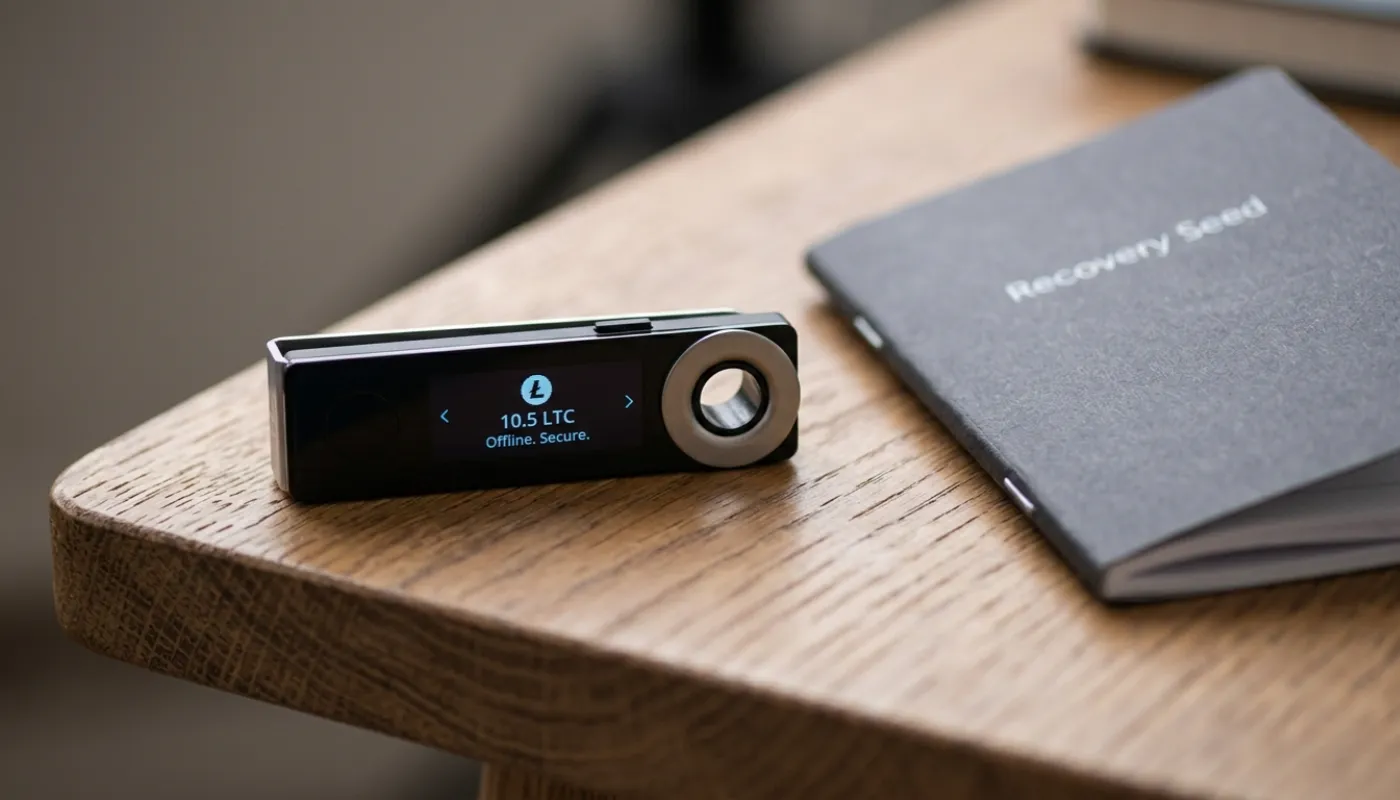
Choosing the right wallet to store your LTC is as important as choosing the right exchange to buy it.
There are two fundamental types: custodial wallets, where a third party holds your keys, and non-custodial wallets, where you hold them yourself.
For any meaningful amount of LTC held longer than a few days, a non-custodial wallet is the right choice.
Hot Wallets (Software)
Hot wallets are software applications that store your private keys on a device connected to the internet. They are free, convenient, and ideal for regular use and smaller balances.
Litecoin Core is the official full-node wallet maintained by the Litecoin Foundation. Electrum-LTC is a lightweight alternative that does not require downloading the full blockchain.
Trust Wallet supports Litecoin and is reviewed in detail in our Trust Wallet review. Hot wallets are appropriate for active users transacting regularly.
For long-term holdings, the constant internet connection represents a security risk that hardware wallets eliminate.
Cold Wallets (Hardware)
Hardware wallets store your private keys on a physical device that never connects to the internet. Transactions are signed inside the device, meaning malware on your computer cannot access your keys.
Ledger and Trezor both support Litecoin natively. A Ledger Nano X costs approximately $149 and a Trezor Safe 3 costs approximately $79.
For anyone holding more than a few hundred dollars in LTC, a hardware wallet is the single best security investment available. The cost of the device is negligible compared to the protection it provides.
Essential Wallet Security Rules
- Write your seed phrase on paper. Never photograph it, type it digitally, or share it with anyone. Your seed phrase is the master key to all funds in the wallet.
- Verify the wallet address on your hardware device screen. Never trust the address shown on your computer screen; malware can silently replace clipboard addresses.
- Test with a small amount first. Send a small LTC transfer to your new wallet and confirm receipt before sending the full amount.
- Store your seed phrase in at least two physical locations. A house fire or flood destroying your only seed phrase backup means permanent loss of funds.
- Never connect your wallet to sites you did not specifically seek out. Unsolicited DeFi links and fake airdrops are among the most common wallet-drainer attack vectors.
Understanding Litecoin Transaction Fees and Exchange Costs
Fees are one of the most underestimated costs when buying Litecoin. There are four types to understand before making your first purchase.
Trading Fees
The percentage of the exchange charges on each trade. On simple buy interfaces, this typically runs 1% to 1.5%. On advanced trading interfaces with maker-taker pricing, it drops to 0.08% to 0.4%.
On a $1,000 LTC purchase, the difference between a 1.5% simple buy fee and a 0.1% advanced fee is $14. At scale, that difference is significant.
Network Gas Fees
When you send LTC from an exchange to your wallet, a small network fee is paid to Litecoin miners who validate the transaction.
Average Litecoin network fees run approximately 0.00028 LTC under $0.02 at current prices.
This is one of Litecoin’s strongest practical advantages over Bitcoin, where base layer transaction fees can spike to $10-$50 during congestion.
On Litecoin, the fee is reliably negligible regardless of network conditions.
Deposit and Withdrawal Fees
Fiat deposit fees vary by method: bank transfers are typically free, card deposits cost 1.5% to 3%. Exchange withdrawal fees for LTC vary by platform.
Some charge a flat fee in LTC regardless of network costs. Check your specific exchange’s withdrawal fee schedule before assuming the transfer is cheap; some platforms charge several times the actual network fee.
The Spread
The spread is the gap between the market price and the price the exchange quotes you on simple buy interfaces. It is not shown as a fee but it is a real cost.
Platforms often build a 0.5% to 2% spread into the quoted price on top of their stated fee. Advanced trading interfaces show the actual order book price with minimal spread.
For larger purchases, using the advanced interface consistently saves money that simple buy interfaces quietly take.
Litecoin in 2026: Where the Market Stands
As of June 2026, Litecoin is trading between $44 and $55, according to CoinMarketCap and CoinGecko data. Market capitalisation sits near $3.5 to $4 billion, placing LTC around the 24th largest cryptocurrency by market cap.
Approximately 76.84 million of the 84 million maximum supply has already been minedmeaning 91.5% of all LTC that will ever exist is already in circulation.
The price action in 2026 has been subdued compared to the broader market. LTC hit $143 in December 2024 during the altcoin rally that followed Bitcoin crossing $100,000.
It has since consolidated significantly, trading in a $44-$80 range through the first half of 2026. The $50-$55 zone has acted as a consistent support level, with buyers stepping in on dips and preventing a deeper breakdown.
The most significant near-term catalyst for Litecoin is the fourth halving expected in July 2027.
Based on Changelly’s LTC historical halving analysis, LTC has rallied sharply in the 3-6 months before each previous halving, peaking shortly before or after the event, then correcting.
The 2026-2027 pre-halving window means buyers entering LTC now are positioned at an historically early point in that cycle.
That does not guarantee a rally, but it is the pattern the market has followed three times in a row.
LTC Price History: The Halving Cycle Pattern
| Year | LTC Price Range | Key Event | Pattern |
| 2019 | $29 to $145 | 2nd halving (Aug 2019)reward cut from 25 to 12.5 LTC | Pre-halving rally to $145, immediate post-halving selloff to $41 |
| 2021 | $100 to $412.96 | All-time high on May 10, 2021 | Rode Bitcoin’s bull cycle; failed to break $413 a second time |
| 2022 | $45 to $110 | MWEB upgrade activated | Crypto winter; MWEB launch saw delistings in South Korea |
| 2023 | $57 to $114 | 3rd halving (Aug 2023)reward cut to 6.25 LTC | Pre-halving rally to $114, post-halving drift to $72 |
| 2024 | $49 to $143 | Bitcoin crosses $100K (Nov 2024) | Altcoin rally in Q4 2024 pushed LTC back above $100 |
| 2026 | $44 to $80 (YTD) | Pre-4th halving accumulation phase | Consolidation; $50-$55 acting as consistent support |
| 2027 (est.) | TBD | 4th halving reward expected to cut to 3.125 LTC | Pre-halving rally pattern expected; timing uncertain |
Litecoin vs Other Payment Cryptocurrencies
Litecoin’s primary competition is not Bitcoin, but the growing range of payment-focused cryptocurrencies and networks competing for the same use case.
Understanding where LTC fits in that landscape helps you make a clearer investment decision.
| Asset | Transaction Speed | Average Fee | Privacy | Market Cap (approx. 2026) | Primary Use Case |
| Litecoin (LTC) | ~2.5 min confirmations | ~$0.001 | Optional (MWEB) | ~$3.5-$4B | Payments, store of value |
| Bitcoin (BTC) | ~10-60 min | $1-$50+ | None | ~$1.2T+ | Store of value, large transfers |
| XRP | 3-5 seconds | ~$0.0002 | None | ~$100B+ | Institutional cross-border payments |
| Dogecoin (DOGE) | ~1 min | ~$0.01 | None | ~$25B+ | Micro-payments, tipping |
| Solana (SOL) | ~0.4 seconds | ~$0.001 | None | ~$80B+ | High-frequency consumer apps |
| Monero (XMR) | ~2 min | ~$0.01 | Full (mandatory) | ~$3B | Privacy-first transactions |
Litecoin’s strongest competitive advantages are its 15-year track record, deep exchange liquidity, MWEB’s optional privacy, and its dominant position on BitPay.
Its weakest points are the lack of smart contract functionality and the growing competition from faster networks like Solana and XRP for high-throughput payment use cases.
For a broader view of where LTC sits within the full crypto market, our guide to the top cryptocurrencies by market cap covers the competitive landscape in full.
Risks of Buying Litecoin You Must Understand
Litecoin’s long operating history and deep liquidity do not make it a safe investment. There are real, specific risks every buyer should understand before committing money.
Competition and Narrative Risk
Litecoin was created when Bitcoin was the only meaningful alternative for fast payments. In 2026, it competes with Solana, XRP, stablecoins, and Lightning Network-enabled Bitcoin payments for the same use case.
Many of these competitors are faster, cheaper, or have stronger developer ecosystems. Litecoin’s primary defences are its track record, its liquidity, and its real payment volume on BitPay.
Whether those defences are sufficient in an increasingly competitive landscape is a genuine open question.
Price Volatility
LTC has lost more than 80% of its value from its all-time high of $412.96 during previous bear markets. The current price of $44-$55 is more than 85% below that peak.
Drawdowns of this magnitude are normal in crypto history, but genuinely painful to live through. Never invest more in Litecoin or any cryptocurrency than you can afford to lose entirely.
The psychology of holding through volatile markets is something every crypto investor benefits from understanding before the first significant drawdown hits.
No ETF, No Institutional Demand Catalyst
Bitcoin’s January 2024 spot ETF launch brought billions in institutional inflows and helped drive BTC to all-time highs.
Ethereum received the same catalyst in mid-2024. Litecoin has no spot ETF currently approved or pending in any major jurisdiction. This means it does not benefit from the same sustained institutional buying pressure that has structurally changed Bitcoin and Ethereum’s market dynamics.
Without a similar catalyst, LTC’s price is primarily driven by retail sentiment and its own halving cycle rather than institutional capital flows.
MWEB Regulatory Risk
The MimbleWimble privacy upgrade that expanded Litecoin’s utility also created a regulatory liability. Several South Korean exchanges delisted LTC after MWEB was activated in 2022 due to concerns about privacy transaction compliance.
As regulators globally tighten rules around privacy-enabling crypto features, the risk of additional delistings in regulated markets exists. This would reduce LTC’s liquidity and accessibility in affected jurisdictions.
Custodial Risk
Leaving LTC on any exchange exposes you to custodial risk. Exchanges can be hacked, freeze withdrawals, or become insolvent.
FTX’s 2022 collapse and the earlier Mt. Gox failure both resulted in permanent customer losses with no insurance or recovery mechanism.
Withdrawing LTC to a wallet you control eliminates this risk entirely. It is the single most important security decision any crypto holder makes.
Strategies for Buying Litecoin Effectively
How you buy Litecoin matters almost as much as whether you buy it. These three approaches cover the main strategies buyers use in practice.
Dollar-Cost Averaging (DCA)
Set up an automatic weekly or monthly LTC purchase for a fixed dollar amount regardless of the current price. When the price is high, your fixed amount buys fewer LTC.
When the price is low, it buys more. Over time, this smooths out your average purchase price and removes the psychological burden of timing the market.
All major exchanges support recurring purchases. For the pre-halving period of 2026-2027, a DCA approach spreads exposure across the price range rather than concentrating risk at one entry point.
Pre-Halving Accumulation
Based on three previous halving cycles, LTC has tended to rally in the 3-6 months before the halving event. Buyers who entered before the pre-halving rally benefited most from the move.
The fourth halving is expected in July 2027, meaning the current 2026 period is the historically early accumulation window.
This is a pattern-based approach, not a guarantee. Past halving cycles have followed similar trajectories but with different magnitudes and timing.
Payment Use Case Buying
If your primary reason for buying Litecoin is to use it for payments, sending money internationally, paying merchants, or making peer-to-peer transfers, buy only what you need for near-term use and keep it in a hot wallet for accessibility.
The payment use case does not require holding a speculative position. Buy LTC, use it, buy more when needed.
This approach eliminates price risk while accessing Litecoin’s genuine practical utility as a payment network.
How to Avoid Litecoin Scams
Scammers target Litecoin buyers with the same tactics they use across all cryptocurrencies.
Our full analysis of how to identify crypto pyramid schemes and fraud covers the most dangerous patterns in detail. For Litecoin specifically, the risks to know are:
- Fake exchange websites: Near-identical copies of real exchange sites steal login credentials. Always type URLs directly or use bookmarks. Never click exchange links from social media or email.
- Guaranteed return schemes: Any platform promising fixed LTC returns daily or weekly is a scam. No legitimate investment guarantees returns. No exceptions.
- Impersonation of Litecoin Foundation: Scammers pose as official Litecoin accounts offering free LTC giveaways or upgrade assistance. The real Litecoin Foundation never asks for your private keys or funds.
- Fake MWEB upgrade notifications: Some scammers target LTC holders with fake messages claiming they need to ‘upgrade’ their wallet for MWEB compatibility. No upgrade requires sending your LTC anywhere.
- Phishing via Litecoin-branded emails: Emails appearing to be from exchanges or wallets asking you to verify your account or ‘claim’ LTC rewards. Legitimate platforms never request credentials or funds via email.
What to Do With Your Litecoin After You Buy It
Buying LTC is step one. Here are the main paths available after your purchase settles.
Hold Long-Term
Move LTC to a hardware wallet and hold it for a defined time horizon, ideally through the next halving cycle.
This strategy requires no active management and benefits from any long-term appreciation without requiring you to monitor prices daily.
Set your position size based on what you can afford to hold through a significant drawdown without selling in panic.
Use It for Payments
Litecoin’s payment infrastructure is live and widely accepted. BitPay, Coingate, and NOWPayments all support LTC. Thousands of merchants accept it directly.
If you travel to regions with expensive international wire transfer costs, LTC is a practical alternative for sending value across borders quickly and cheaply.
Compare how this differs from how Ethereum is used for smart contract interactions. LTC is deliberately simpler and more payment-focused.
Trade It
If you understand technical analysis and want to trade LTC’s price movements rather than hold it, all major exchanges offer LTC spot and derivatives markets.
Trading requires discipline, clear risk management rules, and an acceptance that losses are part of the process.
For beginners, a simple hold strategy in cold storage carries significantly less risk than active trading.
Understanding how the broader blockchain ecosystem shapes crypto prices helps inform better trading decisions if you choose that path.
Frequently Asked Questions About Buying Litecoin
Is Litecoin a good investment in 2026?
Litecoin’s investment case in 2026 rests on three factors: the upcoming July 2027 halving that historically catalyses pre-halving rallies, its dominant position as the most-used crypto on BitPay for payments, and its 15-year track record of reliability. The risks are equally clear: it lacks institutional ETF demand, faces growing competition from faster networks, and its MWEB privacy feature creates regulatory exposure in some jurisdictions. Whether those factors combine to produce appreciation depends on market conditions that no analysis can predict with certainty. Start small, understand the risks, and position accordingly.
What is the minimum amount of Litecoin I can buy?
You can buy fractions of LTC on any major exchange, with practical minimums starting as low as $1-$10, depending on the platform. Litecoin can be divided into litoshis, its smallest unit (0.00000001 LTC), similar to how Bitcoin divides into satoshis. You do not need to buy a whole LTC. At current prices around $44-$55, even a $50 purchase gets you close to one full LTC.
How long does a Litecoin transaction take?
Litecoin produces a new block every 2.5 minutes, meaning most transactions receive their first confirmation within 2-3 minutes. For most exchanges and merchants, one confirmation is sufficient for small transactions. For larger amounts, waiting for 6 confirmations (approximately 15 minutes) is the standard security threshold. This is four times faster than Bitcoin’s typical 10-60 minute confirmation time.
What is the best wallet to store Litecoin?
For long-term storage, a hardware wallet like Ledger or Trezor is the safest option, as your private keys never touch an internet-connected device. For regular use and smaller balances, Electrum-LTC provides a lightweight software option, and Trust Wallet supports LTC with a clean mobile interface. Avoid leaving LTC on any exchange beyond the time needed to complete your purchase and withdrawal.
Can I buy Litecoin without ID verification?
Regulated exchanges require KYC identity verification under anti-money-laundering laws in most countries. Some peer-to-peer platforms and decentralised exchanges allow LTC purchases without account creation, though they typically carry higher risk and require you to already hold crypto. For most buyers, completing KYC on a regulated exchange is the safest and most practical route.
What is the next Litecoin halving?
The fourth Litecoin halving is expected in approximately July 2027. It will reduce the block reward from 6.25 LTC to 3.125 LTC per block. Based on the pattern of the previous three halvings in 2015, 2019, and 2023, LTC’s price has typically rallied in the months before the halving and sold off sharply in the days immediately following it. The 2026 period represents the early accumulation phase of that cycle, though past patterns do not guarantee future results.
What is MimbleWimble and should it affect my decision to buy LTC?
MimbleWimble Extension Blocks (MWEB) is an optional privacy layer activated on Litecoin in May 2022. It allows users to conduct confidential transactions where amounts and addresses are hidden from the public ledger. Standard LTC transactions remain fully transparent. MWEB is relevant to your decision in two ways: it expands Litecoin’s utility for privacy-conscious users, and it has caused regulatory-driven delistings on some South Korean exchanges. If you are in a jurisdiction with strict rules around privacy-enabling crypto features, check whether your preferred exchange still supports LTC before buying.
Is Litecoin the same as Bitcoin?
No. Litecoin was forked from Bitcoin’s code in 2011 but differs in meaningful ways. Litecoin is four times faster, has four times the total supply, uses a different hashing algorithm, and has added optional privacy transactions that Bitcoin lacks. The two are complementary rather than competing. Bitcoin functions as a store of value and settlement layer, while Litecoin targets everyday payments. For a full explanation of how to buy Bitcoin and how the process differs from buying LTC, our Bitcoin buying guide covers both in parallel.
Conclusion: Is Buying Litecoin Right for You?
Litecoin has been doing exactly what it was designed to do for 15 years: processing fast, cheap, reliable transactions on a decentralised network.
The fundamentals that made it relevant in 2011 still hold in 2026: faster confirmations than Bitcoin, near-zero fees, optional privacy through MWEB, and a dominant position as the most-used cryptocurrency on BitPay by payment volume.
None of that has changed.
What has changed is the competitive environment. Litecoin now competes with Solana, XRP, and Lightning Network-enabled Bitcoin payments for the same use case.
It does so without the institutional ETF demand that has structurally changed Bitcoin and Ethereum’s market dynamics. The upcoming July 2027 halving provides a near-term narrative catalyst, and historical patterns suggest the pre-halving period is when LTC tends to attract the most attention.
But narrative and price are different things, and past halving cycles are not a guarantee of future performance.
If you want to buy Litecoin, you now have everything you need: the best exchanges to use, the full step-by-step process, the wallet options to store it safely, the fee structure to navigate, and the risks to hold honestly alongside the opportunity.
Start with an amount you are genuinely comfortable losing. Move your LTC off the exchange the same day you buy it.
And understand that the decision to hold through volatility, which always comes eventually in crypto, is where the real test of any investment thesis begins.
If you are timing a purchase, check our Litecoin price prediction for 2026 to 2030 before you decide how much to buy.