

Dogecoin started as a joke. A literal internet meme turned into a cryptocurrency by two engineers who thought it would be funny. That was 2013. In 2026, DOGE has a market cap above $11 billion.
Two regulated US spot ETFs trading on Nasdaq, SEC commodity classification, and a potential integration into X Money that could put it in front of 500 million users. The joke stopped being funny to anyone who missed it.

This guide covers everything you need to buy Dogecoin confidently. Where to buy it. What fees you will actually pay. Which wallets keep your coins safe.
- What You Need to Know Before Buying Dogecoin
- What Makes Dogecoin Different From Every Other Cryptocurrency
- The X Money and Tesla Catalyst: What Is Actually Confirmed in 2026
- The Spot ETF Milestone Nobody Is Talking About Enough
- Dogecoin vs the Competition: Where DOGE Actually Fits
- Where to Buy Dogecoin: Best Exchanges Ranked Honestly
- Binance: Best for Low Fees and Global Access
- Coinbase: Best for US Residents and First-Time Buyers
- Kraken: Best for Security-First Buyers
- Robinhood: Best for Casual US Investors
- Exchange Comparison at a Glance
- How to Buy Dogecoin Step by Step
- Step 1: Pick Your Exchange and Sign Up
- Step 2: Complete KYC Verification
- Step 3: Fund Your Account
- Step 4: Place Your DOGE Order
- Step 5: Withdraw DOGE to a Wallet You Control
- Storing Your Dogecoin Safely: Wallet Options Explained
- Hardware Wallets: The Gold Standard for Long-Term Holders
- Software Wallets: For Active Users and Daily Transactions
- Five Security Rules Every DOGE Holder Must Follow
- The Real Cost of Buying Dogecoin: Full Fee Breakdown
- Trading Fees
- Network Transaction Fees
- Exchange Withdrawal Fees
- Deposit Fees You Probably Did Not Notice
- The Honest Picture of Dogecoin’s Market Position in 2026
- Dogecoin Risks: Read This Before Buying a Single DOGE
- No Supply Cap Creates Permanent Inflation
- Musk Dependency Is a Two-Edged Sword
- Sentiment-Driven Volatility
- X Money Integration Is Still Unconfirmed
- Scam Exposure for Retail Buyers
- Smart Ways to Buy Dogecoin Without Making Rookie Mistakes
- Dollar-Cost Averaging Removes the Timing Problem
- Size Your Position for What DOGE Actually Is
- Use DOGE as a Payment Currency, Not Just a Trading Asset
- Know the Difference Between DOGE and Other Crypto Experiments
- Using Dogecoin for Real Payments: The Ecosystem in 2026
- Should You Buy Dogecoin, Litecoin, or Another Altcoin?
- Frequently Asked Questions About Buying Dogecoin
- How much does Dogecoin cost right now?
- Is Dogecoin a good investment right now?
- Can DOGE reach $1?
- What wallet should I use for Dogecoin?
- Does Elon Musk own Dogecoin?
- Are there Dogecoin ETFs?
- What is the difference between buying DOGE directly versus a DOGE ETF?
- How do I avoid Dogecoin scams?
- Can I buy less than one full Dogecoin?
- What network should I select when withdrawing DOGE from an exchange?
- The Bottom Line on Buying Dogecoin
What is genuinely happening with X Money and Tesla payments in 2026. And the honest risks you need to understand before committing a single dollar. No hype. No clickbait promises. Just the complete picture.
What You Need to Know Before Buying Dogecoin
Before you touch an exchange, get the key facts straight. Most guides skip the numbers that actually matter.
| Fact | The Reality in June 2026 |
| DOGE price | Trading at approximately $0.074 to $0.087, roughly 88% below its all-time high of $0.7376 |
| Market cap | Approximately $11.5 billion, top 10 by market cap with over 150 billion DOGE in circulation |
| New supply each year | 5.26 billion DOGE with no maximum supply cap, permanent low-level inflation at approximately 3.4% annually |
| Transaction speed | Blocks every 1 minute, significantly faster than Bitcoin’s 10-minute average |
| Average transaction fee | Approximately $0.001, less than a tenth of a cent at current prices |
| SEC classification | Formally classified as a digital commodity on March 20, 2026, same status as Bitcoin and Ethereum |
| Spot ETFs live | REX-Osprey DOJE launched September 2025 and 21Shares TDOG listed on Nasdaq January 22, 2026 |
| X Money integration | Confirmed real product, DOGE as native payment layer not yet officially confirmed but widely anticipated |
| Tesla payments | Dogecoin accepted for Tesla merchandise since January 2022, still active as of 2026 |
| All-time high | $0.7376 on May 8, 2021 during Elon Musk’s Saturday Night Live appearance |
What Makes Dogecoin Different From Every Other Cryptocurrency

Dogecoin was built to be spent, not hoarded. That single design decision separates it from Bitcoin and most other cryptocurrencies that chase scarcity and store-of-value narratives. DOGE has no maximum supply.
Approximately 5.26 billion new coins enter circulation every year through mining rewards, keeping inflation low but permanent. The idea is that a currency you actually spend is more useful than one you lock in a vault forever.

The Dogecoin network runs on a Proof-of-Work blockchain forked from Litecoin, using the Scrypt hashing algorithm. Blocks arrive every minute. Transactions confirm in under two minutes in most conditions. Fees average less than $0.001 per transaction regardless of the amount sent.
Those three characteristics are why DOGE handles more daily transactions than most newer, more technically sophisticated blockchains.
The community aspect is real and not to be dismissed. Dogecoin funded the Jamaican bobsled team’s trip to the 2014 Winter Olympics.
It funded a NASCAR driver. It raised money for clean water wells in Kenya. That culture is also what makes DOGE’s price so sensitive to social media sentiment, which is both its greatest strength and its most dangerous feature.
The X Money and Tesla Catalyst: What Is Actually Confirmed in 2026
Tesla has accepted Dogecoin for merchandise purchases since January 2022, confirmed on Tesla’s official Dogecoin support page. That integration has been continuously operational for over four years.
The Boring Company accepted DOGE for Las Vegas Loop transportation starting in May 2022. These are real, operational payment integrations, not speculation.
X Money launched its public beta in April 2026 with peer-to-peer transfer features and bank-linked financial functionality. Elon Musk has repeatedly hinted at DOGE integration as a native clearing layer for micro-transactions across the platform’s 500 million users.
As of June 2026, that integration is not officially confirmed. However, the infrastructure exists, the regulatory pathway is cleared through the SEC commodity classification, and every credible analyst covering DOGE treats it as the most significant potential near-term catalyst.
The distinction matters enormously for how you size a DOGE position. Confirmed integrations support a floor. Unconfirmed integrations create speculation premiums that can evaporate quickly. Position yourself accordingly.
The Spot ETF Milestone Nobody Is Talking About Enough
Dogecoin is now one of fewer than five cryptocurrencies with a US-listed spot ETF. The REX-Osprey DOJE became the first US regulated DOGE vehicle when it launched in September 2025. 21Shares followed with TDOG on the Nasdaq on January 22, 2026.
If you want to understand how dramatically spot ETFs changed institutional appetite for crypto, our analysis of the Bitcoin ETF approval and its market impact covers the full picture.
Combined AUM for DOGE ETFs remains modest compared to Bitcoin and Ethereum equivalents. But the infrastructure now exists for institutional capital to enter at scale.
That is a structural change that did not exist twelve months ago and that most retail buyers have not fully priced into their thinking about DOGE.
Dogecoin vs the Competition: Where DOGE Actually Fits

Dogecoin does not compete with Bitcoin as a store of value. It does not compete with Ethereum as a smart contract platform. It competes for payments and micro-transactions. In that lane, its combination of brand recognition, fee structure, speed, and SEC commodity status is genuinely hard to match.
| Asset | Block Time | Avg Fee | Max Supply | ETF (US)? | Primary Use Case |
| Dogecoin (DOGE) | ~1 minute | ~$0.001 | None (inflationary) | Yes (TDOG, DOJE) | Payments, tipping, micro-transactions |
| Bitcoin (BTC) | ~10 minutes | $1 to $50+ | 21 million | Yes (IBIT, FBTC) | Store of value, large transfers |
| Litecoin (LTC) | ~2.5 minutes | ~$0.001 | 84 million | No | Payments, store of value |
| XRP | 3 to 5 seconds | ~$0.0002 | 100 billion | Pending | Institutional cross-border payments |
| Solana (SOL) | ~0.4 seconds | ~$0.001 | No hard cap | No | High-frequency apps, DeFi |
| Shiba Inu (SHIB) | Varies (ERC-20) | Gas-dependent | ~589 trillion | No | Speculation, limited utility |
DOGE’s advantage over newer competitors is brand equity and liquidity. No competitor can replicate 13 years of cultural presence, Musk association, and retail familiarity.
Its disadvantage is the same one it has always had: no hard supply cap and price behaviour driven more by sentiment than fundamentals.
Understanding where Dogecoin fits within the broader universe of top cryptocurrencies by market capitalisation helps frame the risk-reward honestly.
Where to Buy Dogecoin: Best Exchanges Ranked Honestly
DOGE is listed on almost every major exchange on earth. That ubiquity is one of its strengths. The question is which exchange gives you the best combination of fees, security, and payment flexibility for your specific situation.
Binance: Best for Low Fees and Global Access
Binance is the world’s largest cryptocurrency exchange by volume and offers DOGE spot trading pairs against USDT, BTC, BNB, ETH, and USD. Spot trading fees start at 0.1% and drop further with volume or BNB fee payments.
It supports bank transfer, debit card, credit card, P2P trading, and Apple Pay in supported regions. Not available in the US. Visit Binance to confirm availability in your country.
Coinbase: Best for US Residents and First-Time Buyers
Coinbase is NASDAQ-listed, regulated in all 50 US states, and the most trusted gateway for American first-time buyers. DOGE is available through the simple buy interface at approximately 1.49% per transaction.
Switching to Coinbase Advanced Trade drops fees to 0.4% or lower. Coinbase supports debit card, bank transfer, PayPal, Apple Pay, and Google Pay.
Kraken: Best for Security-First Buyers
Kraken has been operating since 2011 and has never suffered a major security breach. It offers DOGE/USD and DOGE/EUR pairs with fees starting at 0.26% for takers.
Available in most countries including the US, EU, UK, Canada, and Australia. Kraken supports bank wire, debit card, PayPal, and Apple Pay deposits in supported regions.
Robinhood: Best for Casual US Investors
Robinhood introduced DOGE to millions of retail investors during the 2021 rally and remains the most frictionless option for casual US buyers. Zero commission on DOGE trades with no minimum purchase.
The catch: Robinhood operates a custodial model where you cannot withdraw DOGE to an external wallet. A significant limitation for anyone planning to hold long-term or use DOGE for payments.
Exchange Comparison at a Glance
| Exchange | Spot Fee | Best For | US Available? | DOGE Withdrawal? |
| Binance | 0.10% | Global buyers, lowest fees | No (Binance.US only) | Yes |
| Coinbase | 0.40% | US beginners, regulated access | Yes | Yes |
| Kraken | 0.26% | Security-first buyers | Yes | Yes |
| Robinhood | $0 commission | US casual investors | Yes | No |
| OKX | 0.08% | Asia and MENA, lowest maker fees | No | Yes |
How to Buy Dogecoin Step by Step
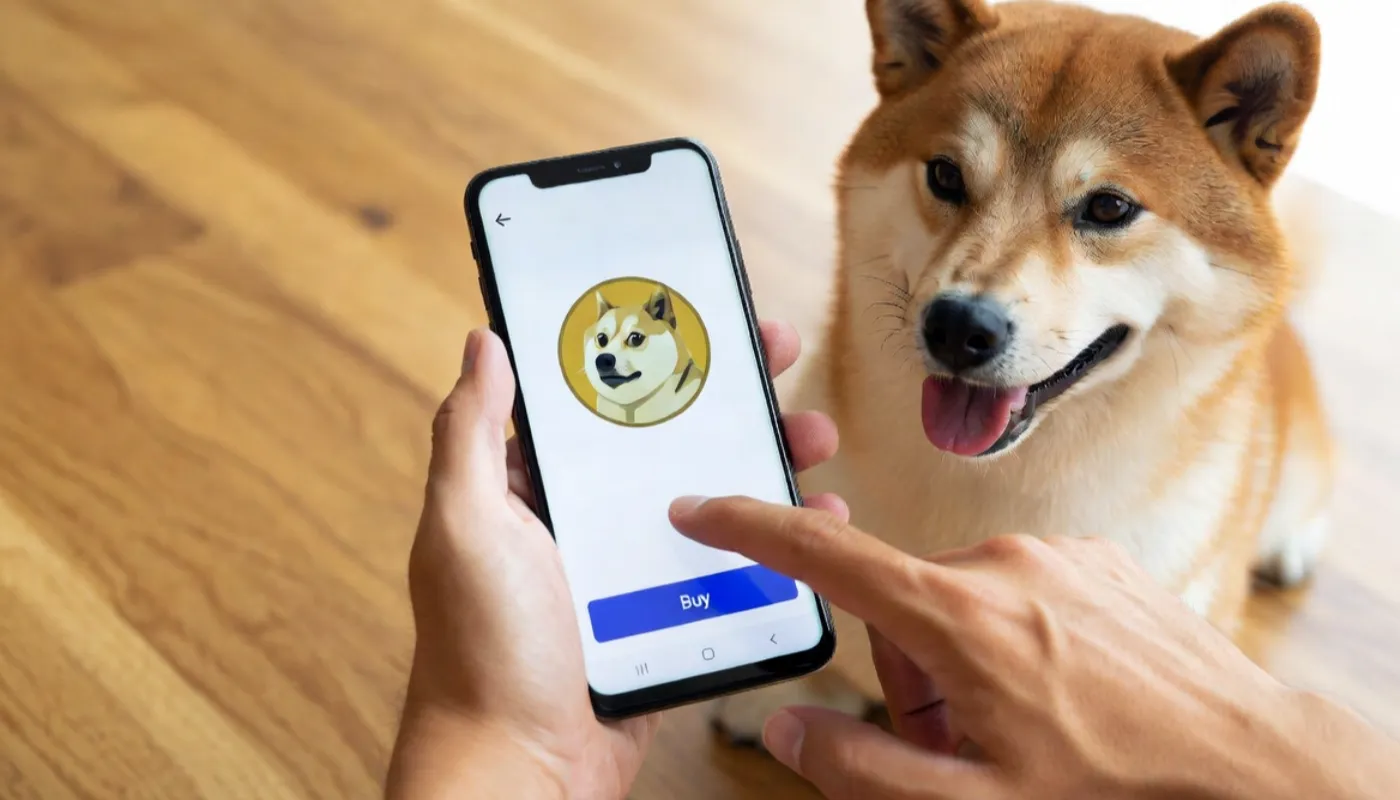
On a regulated exchange, you can go from sign-up to holding DOGE in under 20 minutes. Here is exactly how.
Step 1: Pick Your Exchange and Sign Up
Choose your platform based on your country of residence and fee tolerance. Navigate to the exchange’s official website by typing the URL directly.
Never click exchange links from emails, social media, or messaging apps. Fake exchange sites that steal credentials are among the most common crypto scams.
Create your account with a strong, unique password and enable two-factor authentication immediately using an authenticator app rather than SMS.
Step 2: Complete KYC Verification
Every regulated exchange requires identity verification before you can trade. Our guide to what KYC means in crypto and why it exists explains the process in detail.
In practice, you upload a government-issued photo ID and a selfie. Verification takes between a few minutes and 24 hours.
If you specifically want to avoid this process, we also cover exchanges that operate without KYC requirements, though those come with their own trade-offs.
Step 3: Fund Your Account
Bank transfers are the cheapest method, usually free or under $1, but take one to three business days to clear. Debit card deposits are instant but cost 1.5% to 3%.
Credit card deposits are available on some platforms but are often treated as cash advances by card issuers, adding fees on top of the exchange charge. For amounts above $300, a bank transfer saves meaningful money.
Step 4: Place Your DOGE Order
Search for DOGE or Dogecoin in the trading interface. A market order executes instantly at the current price.
A limit order lets you set the price you want and the exchange fills your order when the market reaches that level.
Use the advanced trading interface rather than the simple buy flow to avoid the spread markup that platforms quietly add to the basic interface.
Step 5: Withdraw DOGE to a Wallet You Control
This step is non-negotiable if you plan to hold DOGE for more than a few days. Exchanges are custodians who hold your private keys, not you.
When FTX collapsed in November 2022, billions in customer assets became inaccessible overnight with no deposit insurance and no legal recovery.
Navigate to the withdraw section, enter your personal wallet address, select the Dogecoin network, and confirm. Always verify the address character by character before confirming. DOGE transactions are irreversible.
Storing Your Dogecoin Safely: Wallet Options Explained
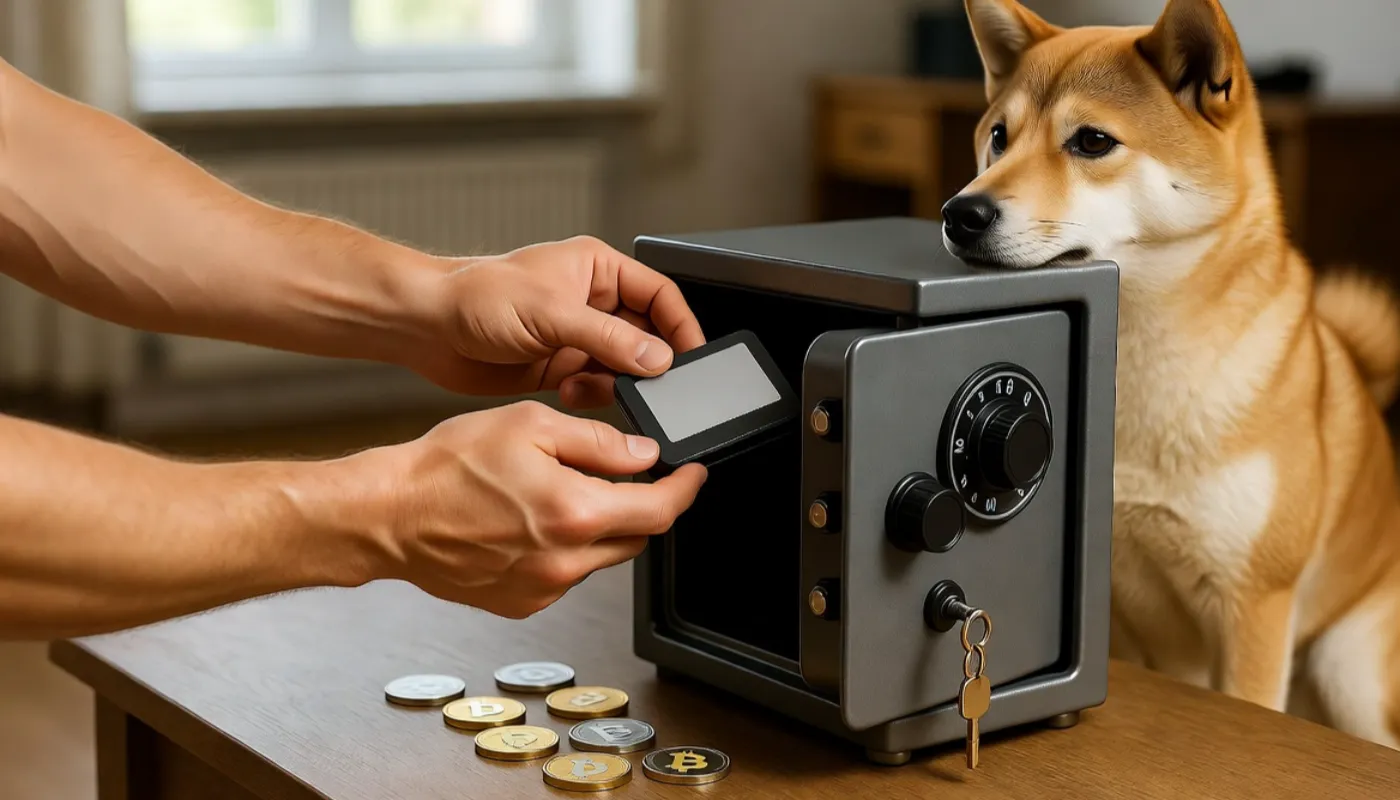
The right wallet depends on how you plan to use your DOGE. Holding for years is different from using it for daily payments.
The core principle: the more you hold, the more security matters.
Hardware Wallets: The Gold Standard for Long-Term Holders
Hardware wallets store your private keys on a physical device that never touches the internet. Transactions are signed inside the device, meaning malware on your computer cannot access your keys even if your system is fully compromised.
Ledger and Trezor both support Dogecoin natively. A Ledger Nano X costs approximately $149 and a Trezor Safe 3 approximately $79.
If you are holding more than a few hundred dollars in DOGE for more than a few weeks, the cost of a hardware wallet is justified.
Software Wallets: For Active Users and Daily Transactions
Software wallets live on your phone or computer and are free to use. The official Dogecoin Core wallet on GitHub is the most complete option but requires downloading the full blockchain.
For mobile use, Trust Wallet is one of the most popular non-custodial options supporting DOGE. We cover it in detail in our Trust Wallet in-depth review.
Exodus is another well-regarded option with a clean interface.
Five Security Rules Every DOGE Holder Must Follow
- Never screenshot your seed phrase. Write it on paper and store copies in two physical locations.
- Verify wallet addresses on the hardware device screen. Clipboard-hijacking malware specifically targets crypto holders.
- Send a small test transfer first. Confirm a small amount arrives before moving your full balance.
- Never connect your wallet to sites you did not specifically seek out. Wallet drainer contracts embedded in fake DeFi sites can empty a wallet in one click.
- Use a dedicated browser or device for crypto transactions. Separate it from daily browsing to reduce exposure to malicious scripts.
The Real Cost of Buying Dogecoin: Full Fee Breakdown
The headline trading fee is rarely the only cost. Understanding all layers prevents unpleasant surprises.
Trading Fees
Simple buy interfaces charge 1% to 1.5%, sometimes more with a spread built in. Advanced trading interfaces using maker-taker models charge 0.08% to 0.4%.
On a $500 DOGE purchase, the difference between a 1.5% simple fee and a 0.1% advanced fee is $7. On $5,000, that difference is $70. The advanced interface takes two minutes to learn.
Network Transaction Fees
When you send DOGE from an exchange to a personal wallet, a small fee goes to Dogecoin miners. Average Dogecoin network fees run approximately $0.001 at current prices.
This is one of DOGE’s genuine practical advantages. Bitcoin base-layer fees can spike to $10 to $50 during congestion. Dogecoin’s fee structure barely moves regardless of network conditions.
Exchange Withdrawal Fees
Separate from the network fee, many exchanges charge a flat DOGE withdrawal fee. These vary significantly. Some exchanges charge 1 DOGE, others charge 5 DOGE, some waive it entirely.
At current prices, a 5 DOGE withdrawal fee costs approximately $0.37. Negligible for a large holding but meaningful if you are withdrawing frequently in small amounts.
Deposit Fees You Probably Did Not Notice
Card deposits usually cost 1.5% to 3% on top of any trading fee. On a $1,000 card deposit, that is $15 to $30 before you have even placed a trade.
Bank transfers are almost always free. The convenience premium of card deposits is rarely worth paying for amounts above $300.
The Honest Picture of Dogecoin’s Market Position in 2026
Dogecoin peaked at $0.7376 on May 8, 2021. It currently trades at approximately $0.074 to $0.087, around 88% below that high.
The 2025 peak of $0.434 in January, driven by Trump election momentum and the Department of Government Efficiency’s DOGE acronym connection, has faded.
The current consolidation zone of $0.074 to $0.112 is where DOGE has spent most of 2026.
| Price Driver | Current Status | Potential Impact |
| X Money DOGE integration | Beta launched April 2026, DOGE as payment layer not officially confirmed | Very high if confirmed, currently speculative |
| 21Shares TDOG spot ETF | Live on Nasdaq since January 22, 2026, AUM growing but modest vs BTC/ETH | Medium, institutional infrastructure exists, scale pending |
| Tesla merchandise payments | Active and confirmed since January 2022 | Low daily volume, price floor support rather than catalyst |
| SEC commodity classification | Confirmed March 20, 2026 | Clears regulatory overhang, enables bank custody and more ETF products |
| Bitcoin price correlation | DOGE is high-beta and amplifies BTC moves in both directions | High, BTC rally to new ATHs historically drives DOGE 2 to 5x the BTC move |
| Elon Musk social media | Single post can move price 10 to 30% within hours | Unpredictable, structural positive until it is not |
| DogeOS Layer-2 development | ZK rollup proposal in early 2026 development | Low near-term, potentially high if implemented 2027 onward |
Analyst base-case forecasts for DOGE through end of 2026 cluster between $0.12 and $0.25. A bull case requires Bitcoin at new all-time highs, confirmed X Money DOGE integration, and ETF flows scaling beyond current levels.
For a detailed year-by-year breakdown of where DOGE could trade through 2030, our Dogecoin price prediction analysis covers the full modelling across multiple scenarios.
Dogecoin Risks: Read This Before Buying a Single DOGE

Some of these risks are specific to DOGE in a way that does not apply to Bitcoin or Ethereum. Understanding them changes how you size your position.
No Supply Cap Creates Permanent Inflation
Bitcoin has 21 million coins. That fixed scarcity is the foundation of its store-of-value narrative. Dogecoin has no cap. 5.26 billion new DOGE enter circulation every year, permanently.
For the price to rise over time, demand must consistently outgrow supply growth.
When retail enthusiasm is high, that happens easily. When it fades, the constant supply expansion applies downward pressure that does not exist for capped assets.
Musk Dependency Is a Two-Edged Sword
No major cryptocurrency is more dependent on a single individual’s public statements than Dogecoin. A single post from Elon Musk can move DOGE 20 to 30% within an hour. That cuts both ways.
His positive commentary has driven the most significant DOGE price events in history. His silence, criticism, or perceived distancing from DOGE would be equally destructive.
You are not just buying a cryptocurrency. You are buying partial exposure to one person’s social media decisions.
Sentiment-Driven Volatility
DOGE has dropped more than 70% in previous bear markets from highs that were themselves sentiment-driven.
The investor psychology behind holding through crypto crashes is something every DOGE buyer should understand before entering a position.
The emotional experience of watching a 70% drawdown in a meme coin is different from watching the same drawdown in Bitcoin.
X Money Integration Is Still Unconfirmed
The market frequently prices in X Money DOGE integration as if it is confirmed. It is not. X Money is real and operational.
DOGE as the native clearing layer for crypto micro-transactions on X remains unconfirmed as of June 2026. Build your position on what is confirmed. Be clear about what is speculative.
Scam Exposure for Retail Buyers
DOGE’s retail-heavy buyer base and meme culture make it one of the most heavily targeted assets in crypto. Our analysis of how crypto fraud targets new buyers covers the most common patterns.
The most dangerous scams: fake giveaways requiring you to send DOGE to receive more back, fake exchange websites built to capture login credentials, and wallet drainer contracts embedded in fake airdrop pages.
Smart Ways to Buy Dogecoin Without Making Rookie Mistakes

Knowing how to buy DOGE is straightforward. Knowing when and how much to buy is where most people go wrong.
Dollar-Cost Averaging Removes the Timing Problem
Set up an automatic recurring DOGE purchase for a fixed dollar amount weekly or monthly. When the price is high, your fixed amount buys fewer DOGE.
When the price is low, it buys more. Over 12 months spanning both peaks and troughs, this approach consistently produces a lower average purchase price than trying to time entry points manually.
Most major exchanges including Binance, Coinbase, and Kraken support automatic recurring purchases at no additional fee.
Size Your Position for What DOGE Actually Is
DOGE is not Bitcoin. It is a high-beta meme coin with sentiment-driven price behaviour, no supply cap, and significant Musk dependency.
The position size appropriate for buying Bitcoin as a long-term store of value is not the position size appropriate for DOGE.
A common framework: limit speculative meme coin exposure to 5 to 10% of your total crypto allocation. This gives you meaningful upside participation if DOGE performs while limiting damage if the inevitable drawdown arrives.
Use DOGE as a Payment Currency, Not Just a Trading Asset
DOGE was designed to be spent. If you buy it specifically to use for payments, you sidestep the price volatility problem entirely. Buy what you need, use it, buy more when needed.
This approach extracts DOGE’s genuine utility without requiring you to hold a speculative position through volatile markets.
Know the Difference Between DOGE and Other Crypto Experiments
DOGE is a relatively simple blockchain. It does not do what Ethereum’s smart contract ecosystem does. It does not compete with the most innovative blockchain projects on technical grounds.
It competes on community, brand recognition, and payment rails. Buying DOGE is a bet on those things specifically. Be clear about what you are actually betting on.
Using Dogecoin for Real Payments: The Ecosystem in 2026
DOGE’s most defensible value proposition is payments. Here is what the real-world acceptance actually looks like.
Where You Can Spend DOGE Right Now
Tesla accepts DOGE for merchandise through its online store. The Boring Company accepts it for Las Vegas Loop transportation.
Thousands of independent merchants accept DOGE through processors including BitPay, Coingate, and NOWPayments.
The Dallas Mavericks completed 20,000 DOGE transactions in their first two days of accepting it in 2021. Online tipping platforms built specifically around DOGE have been active since 2014.
The GigaWallet and Such App
The Dogecoin Foundation’s commercial arm, House of Doge, developed GigaWallet, an open-source backend that allows businesses to accept DOGE without running a full node.
The foundation’s Such App, targeting public release in H1 2026, is a non-custodial application for small businesses and individual creators to accept DOGE directly.
The goal is to anchor DOGE’s value to real transaction volume rather than speculative trading cycles.
Should You Buy Dogecoin, Litecoin, or Another Altcoin?
If you are deciding between DOGE and other accessible altcoins, base the framework on what you want the asset to do.
- If you want payments with a fixed supply: Litecoin has been processing low-fee payments since 2011 with an 84 million coin cap, active BitPay integration, and a pre-halving cycle expected in July 2027. Its risk-reward profile is different from DOGE.
- If you want utility beyond payments: Ethereum gives you exposure to the world’s largest smart contract ecosystem with staking yield, DeFi access, and institutional ETF products. The use cases are fundamentally different.
- If you want the meme coin trade specifically: DOGE is the only meme coin with SEC commodity classification, Nasdaq-listed spot ETFs, and a live corporate payment integration at a major company. Every other meme coin competes with DOGE’s brand from a position of significant disadvantage.
If you are thinking about how to approach crypto investing more broadly, including position sizing and risk management across multiple assets, that guide covers the foundational principles that apply to every crypto purchase including DOGE.
Frequently Asked Questions About Buying Dogecoin
How much does Dogecoin cost right now?
As of June 2026, Dogecoin trades between approximately $0.074 and $0.087. The circulating supply stands at approximately 150 billion DOGE with a total market cap of approximately $11.5 billion. Prices fluctuate significantly based on Bitcoin’s movements, Elon Musk’s social media activity, and macro risk sentiment.
Is Dogecoin a good investment right now?
DOGE has more institutional infrastructure in 2026 than at any previous point: SEC commodity status, two Nasdaq-listed spot ETFs, live Tesla payment integration, and potential X Money integration as a catalyst. However, the price is sentiment-driven and the no-supply-cap structure creates permanent inflationary pressure. Size it as speculation, not as a core holding.
Can DOGE reach $1?
Reaching $1 would require a market capitalisation of approximately $155 billion, roughly 13 times current levels. Most base-case analyst forecasts for 2026 cluster between $0.12 and $0.25. A $1 DOGE requires confirmed X Money integration, Bitcoin at new all-time highs, and sustained institutional ETF inflows at a scale not yet seen.
What wallet should I use for Dogecoin?
For long-term storage, a hardware wallet from Ledger or Trezor is the most secure option. For regular use, Trust Wallet and Exodus are solid non-custodial mobile options. The official Dogecoin Core wallet gives you full-node security but requires downloading the entire blockchain. Avoid leaving DOGE on exchanges for any longer than necessary.
Does Elon Musk own Dogecoin?
Yes. Musk publicly confirmed personal ownership of Bitcoin, Ethereum, and Dogecoin in 2021. Among the three, he has been most vocal about DOGE, describing it as more practical for everyday transactions than Bitcoin due to speed and low fees. Tesla, The Boring Company, and SpaceX have all integrated Dogecoin in various capacities.
Are there Dogecoin ETFs?
Yes. Two US spot Dogecoin ETFs are currently trading. The REX-Osprey DOJE launched in September 2025 and the 21Shares TDOG listed on the Nasdaq on January 22, 2026, following the SEC’s formal commodity classification of DOGE on March 20, 2026. Both hold physical DOGE as the underlying asset.
What is the difference between buying DOGE directly versus a DOGE ETF?
Buying DOGE directly gives you actual Dogecoin you can withdraw to a wallet, use for payments, and send anywhere. A DOGE ETF gives you price exposure through a brokerage account with no wallet required. ETFs suit investors wanting DOGE inside a regulated portfolio or retirement account. Direct ownership suits anyone who wants to actually use the network.
How do I avoid Dogecoin scams?
The universal rule: if any platform requires you to send DOGE to receive DOGE, it is a scam. Legitimate exchanges never contact you through Telegram or DMs requesting funds or seed phrases. Never click exchange links from social media or email. Always type URLs directly or use bookmarks.
Can I buy less than one full Dogecoin?
Yes. You can buy any fraction of DOGE on any major exchange, with practical minimums starting as low as $1 on most platforms. At current prices of $0.074 to $0.087, buying a single full DOGE costs less than $0.09. Most buyers purchase hundreds or thousands of DOGE at once given the low price per coin.
What network should I select when withdrawing DOGE from an exchange?
Always select the Dogecoin native network when withdrawing. Do not select ERC-20, BEP-20, or any other network. Sending DOGE on the wrong network sends it to an incompatible address on a different chain, and it may be permanently unrecoverable. Double-check the network selection before every withdrawal.
The Bottom Line on Buying Dogecoin
Dogecoin is not the joke it was in 2013. It is also not Bitcoin.
It sits in a unique position that no other cryptocurrency occupies: a commodity-classified asset with Nasdaq-listed ETFs, live corporate payment integrations, 13 years of operating history, and the world’s most famous crypto advocate in its corner.
That combination does not guarantee price appreciation. But it means DOGE in 2026 deserves to be evaluated on its actual merits rather than dismissed as a meme or treated as a guaranteed moon mission.
The case for buying Dogecoin comes down to three things: its genuine payment utility at fees that make it practical for real-world transactions, its position as the only meme coin with institutional-grade regulatory infrastructure, and the potential X Money catalyst that would be the most significant adoption event in DOGE’s history if it materialises.
Buy Dogecoin with eyes open. Start small. Move coins off the exchange to a wallet you control. Never size the position larger than you can genuinely afford to watch fall 80% without panic selling.
And understand that the best use case for DOGE might not be holding it as a speculative asset.
It might be using it exactly as it was designed: spending it, tipping with it, and participating in the payments ecosystem it has been quietly building since 2013.