

Buying Ripple (XRP) looks very different today than it did even a year ago. The five-year SEC lawsuit that hung over XRP officially ended in August 2025, Ripple paid a $125 million penalty, and spot XRP ETFs launched in the United States that November.
XRP currently trades around $1.10 to $1.20, with a market cap near $68 billion, according to CoinGecko.

This guide walks through exactly how to buy Ripple (XRP) safely in 2026, covering exchange selection, account setup, funding, the purchase itself, and secure storage afterward.
- Key Takeaways
- XRP Facts Worth Knowing Right Now
- What Changed: The SEC Case and Why It Matters
- How XRP ETFs Changed Access to the Token
- 5 Essential Steps to Buy Ripple (XRP) Safely
- Step 1: Choose a Reliable Exchange
- Step 2: Create and Verify Your Account
- Step 3: Fund Your Account
- Step 4: Place Your Order
- Step 5: Move XRP to a Secure Wallet
- Common Mistakes to Avoid When You Buy Ripple (XRP)
- XRP Beyond Trading: Why It Has Real-World Use
- XRP Compared to Other Major Cryptocurrencies
- Frequently Asked Questions
Key Takeaways
| Insight | Why It Matters |
| The SEC case against Ripple is over | It concluded in August 2025 with a $125 million penalty, removing years of regulatory overhang. |
| Spot XRP ETFs now exist | Bitwise, Grayscale, 21Shares, and Franklin Templeton funds launched in November 2025. |
| XRP trades around $1.10 to $1.20 | Market cap sits near $68 billion as of June 2026. |
| Retail XRP sales are not securities | Judge Torres’s 2023 ruling on this point stood as final once both appeals were dropped. |
| You don’t need much to start | XRP divides into small fractions, so any budget works for a first purchase. |
| Storage still matters most | Moving XRP off an exchange into a private wallet remains the safest long-term approach. |
XRP Facts Worth Knowing Right Now
| Metric | Figure | Source |
| XRP price (June 2026) | Roughly $1.10 to $1.20, down from a 2025 cycle high. | CoinGecko, June 2026 |
| Market capitalization | Approximately $68 billion. | CoinGecko, June 2026 |
| SEC case resolution | Concluded August 2025; Ripple paid a $125 million civil penalty. | CoinDesk, August 2025 |
| Spot ETF launch | First XRP ETFs launched November 2025 on NYSE Arca, Nasdaq, and Cboe BZX. | CoinGecko, 2026 |
| Cumulative ETF inflows | Roughly $1.44 billion as of mid-June 2026. | Analytics Insight / OpenPR, June 2026 |
| All-time high | $3.65, reached during a prior cycle peak. | CoinGecko, June 2026 |
What Changed: The SEC Case and Why It Matters

For years, anyone looking to buy Ripple (XRP) had to weigh a real regulatory risk. The SEC sued Ripple Labs in December 2020, arguing that XRP sales were unregistered securities offerings.
In July 2023, Judge Analisa Torres ruled that XRP sold to retail investors on public exchanges was not a security, while certain direct institutional sales were. Both sides appealed, and the case dragged on for two more years.
That uncertainty ended in August 2025, when both parties jointly dismissed their appeals, leaving Judge Torres’s 2023 ruling as the final word. Ripple paid a $125 million civil penalty, well below the SEC’s original $2 billion demand.
For everyday buyers, the practical result is that retail XRP purchases on US exchanges now sit on much firmer legal ground than they did even one year ago.

How XRP ETFs Changed Access to the Token
Spot XRP ETFs launched in the United States in November 2025, following SEC approval, with issuers including Bitwise, Grayscale, 21Shares, Canary Capital, and Franklin Templeton.
These funds let investors gain price exposure to XRP through a regular brokerage account, without managing a wallet or private keys directly.
Cumulative ETF inflows reached roughly $1.44 billion by mid-June 2026, a meaningful sign of institutional demand.
This guide focuses on buying actual XRP directly, which gives you full ownership, rather than ETF shares, which trade the price movement without direct custody.
5 Essential Steps to Buy Ripple (XRP) Safely
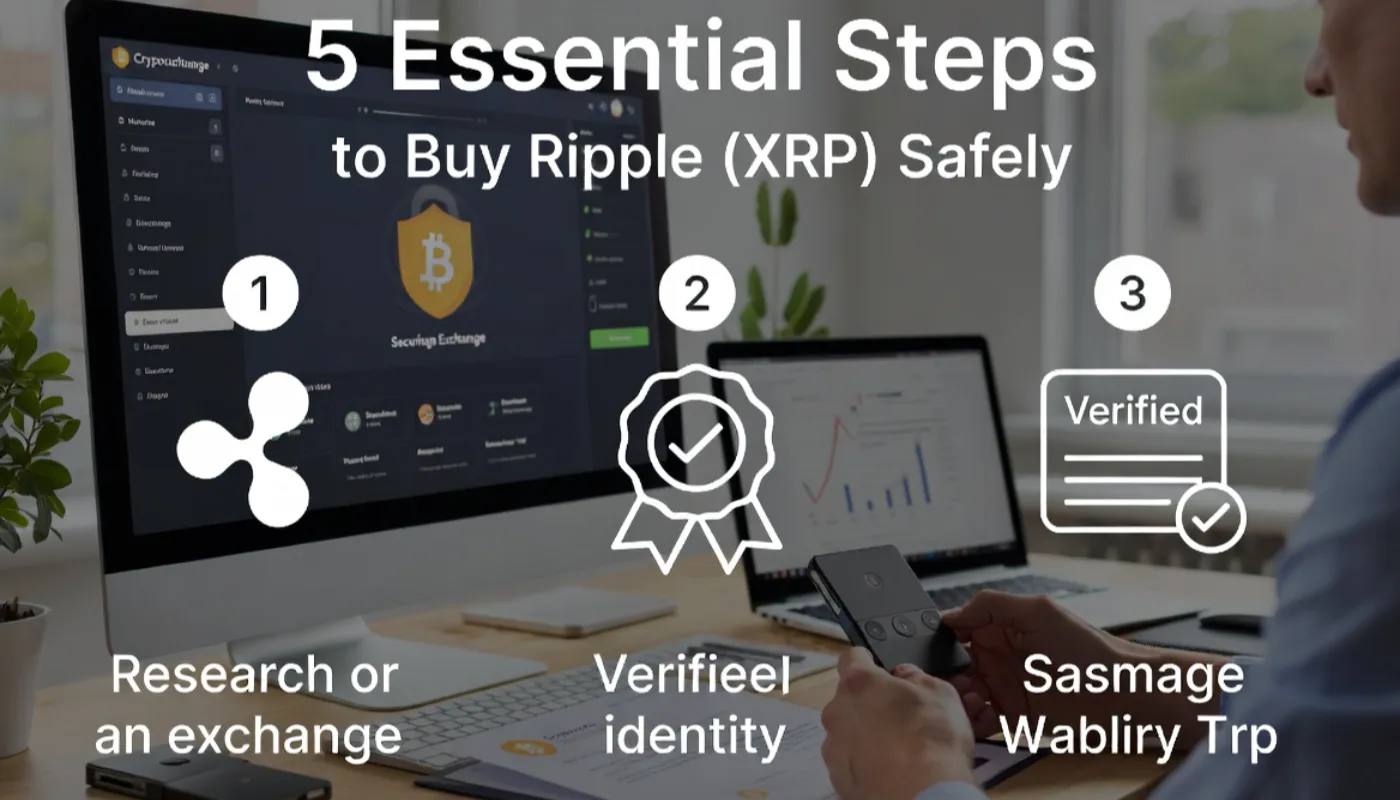
Each step below builds on the last. Following them in order gives you a complete, secure path from choosing an exchange to safely storing your XRP.
Step 1: Choose a Reliable Exchange
Pick an exchange that openly lists its security practices, supports XRP trading in your country, and has a track record without major breaches.
Reputation matters here: several once-prominent exchanges, including FTX, collapsed with customer funds still inside them.
Compare fees, supported payment methods, and verified user reviews before committing to one platform.
Step 2: Create and Verify Your Account
Sign up using your email, then complete identity verification if the exchange requires it.
Most regulated platforms require a know-your-customer (KYC) check, which means submitting a government-issued ID. Set a strong, unique password and enable two-factor authentication immediately.
The same account hygiene principles covered in our Bitcoin security tips guide apply directly to any exchange account holding XRP.
Step 3: Fund Your Account
Deposit funds using a bank transfer, debit or credit card, or an existing cryptocurrency balance. Payment options and any associated fees vary by exchange, so check before depositing a large amount.
If you already hold another asset, such as Bitcoin or Ethereum, many exchanges let you trade directly into XRP without converting to cash first.
Step 4: Place Your Order
Once funded, search for XRP and choose an order type. A market order executes instantly at the current price. A limit order only executes once XRP reaches a price you set.
A stop-limit order automatically sells your XRP if the price drops below a level you choose, which can help manage downside risk. Start with a small amount to confirm the process works before committing more.
Step 5: Move XRP to a Secure Wallet
After buying, transfer your XRP off the exchange and into a wallet you control. Leaving funds on an exchange exposes them to platform-level risk, including hacks or unexpected withdrawal freezes.
For long-term holdings, our comparison of the best cold wallets available today covers hardware options that apply to XRP as well as Bitcoin.
If you’re setting up your first wallet of any kind, our walkthrough on setting up a wallet step by step explains the underlying process, which carries over directly to XRP-compatible wallets.
Common Mistakes to Avoid When You Buy Ripple (XRP)
- Trusting fake giveaways. Scammers regularly promise free XRP or double-your-money schemes; legitimate platforms never ask you to send funds to receive a reward.
- Leaving XRP sitting on an exchange long after purchase, rather than moving it to self-custody.
- Skipping research on fees. Trading and withdrawal costs vary significantly between exchanges and add up over time.
- Assuming all countries treat XRP identically. Regulatory approaches still vary, and our guide to the most crypto-friendly countries is a useful starting point before trading internationally.
XRP Beyond Trading: Why It Has Real-World Use
Unlike many tokens built primarily for speculation, XRP was designed for fast, low-cost cross-border payments through RippleNet, the company’s payment network.
Transfers typically settle in three to five seconds at a fraction of a cent in fees.
This utility is part of why institutions, not just retail traders, have shown sustained interest in the token, distinguishing it from many purely speculative altcoins discussed across the broader blockchain ecosystem.
XRP Compared to Other Major Cryptocurrencies
Understanding how XRP stacks up against other major assets helps put your purchase decision in context.
Unlike Bitcoin, which functions primarily as a scarce store of value with a fixed 21 million coin supply, XRP was built specifically for payment settlement speed. Where Bitcoin transactions can take minutes to confirm, XRP transfers typically settle in three to five seconds.
| Feature | XRP | Bitcoin | Ethereum |
| Primary purpose | Fast, low-cost payments | Store of value | Smart contract platform |
| Typical settlement time | 3 to 5 seconds | 10 minutes or more | Seconds to minutes |
| Regulatory status (US) | Resolved August 2025 | Treated as a commodity | ETFs trading since 2024 |
| Spot ETF availability | Since November 2025 | Since January 2024 | Since July 2024 |
This distinction matters when deciding how much of any portfolio to allocate to XRP versus other assets.
Many investors treat XRP, Bitcoin, and Ethereum as serving different roles rather than competing directly, since each token’s underlying design solves a different problem.
Buying Ripple (XRP) in 2026 comes with a regulatory clarity that simply didn’t exist a year ago. The SEC case is closed, spot ETFs have launched, and the process of buying XRP directly is no more complicated than buying any other major cryptocurrency.
Stick to the five steps above: pick a reliable exchange, verify your account, fund it carefully, buy with a clear order type, and move your XRP to secure storage afterward.
If you’re weighing XRP against other major assets before committing funds, the comparison above offers a useful starting point.
With the legal uncertainty behind it, XRP now sits on steadier ground than at any point in its recent history, though it remains a volatile asset and deserves the same careful approach as any other cryptocurrency investment.
Frequently Asked Questions
Is it safe to buy Ripple (XRP) now that the SEC case is over?
The legal resolution removed a major source of uncertainty, but XRP remains a volatile asset like any other cryptocurrency. Safety also depends on your own habits, including which exchange you use and how you store your XRP afterward.
How much XRP should a beginner buy?
Start with a small amount you’re comfortable risking while you learn the process. XRP divides into fractional units, so there’s no minimum whole-coin purchase required.
Can I buy Ripple (XRP) through an ETF instead of directly?
Yes. Spot XRP ETFs from issuers including Bitwise, Grayscale, and Franklin Templeton have traded in the US since November 2025. ETFs offer regulated exposure without self-custody, but they don’t give you direct ownership of the underlying XRP the way buying it directly does.
Where should I store XRP after buying it?
Move it to a private wallet rather than leaving it on an exchange. The same self-custody habits covered in our guide to investing in Bitcoin safely apply just as directly to protecting XRP holdings long term.
Is XRP legal to buy in the United States?
Yes. Following Judge Torres’s 2023 ruling and the case’s full resolution in August 2025, retail purchases of XRP on US exchanges are not treated as securities transactions. Always confirm current rules in your specific state or country before trading.