



Bitcoin is not a pyramid scheme. A pyramid scheme requires recruitment, a central operator, and guaranteed returns. Bitcoin has none of these. It is a decentralized digital currency with a transparent public ledger, a fixed supply of 21 million coins, and no single person or company controlling it. However, real pyramid schemes do use Bitcoin’s name to deceive people. Knowing the difference could save your money.
Key Takeaways
| Insight | Summary |
|---|---|
| Bitcoin is not a pyramid scheme | It has no recruiter, no guaranteed returns, and no central operator collecting funds |
| Pyramid schemes use Bitcoin’s name | Fraudsters exploit Bitcoin’s reputation to run fake investment programs |
| Blockchain makes Bitcoin transparent | Every transaction is publicly visible, which makes secret manipulation impossible |
| Bitcoin has survived 15+ years | Pyramid schemes collapse quickly when recruitment stops, Bitcoin has only grown |
| Real risks do exist | Volatility, scams, and emotional investing are the real dangers for beginners |
| Even famous critics changed their minds | JPMorgan CEO Jamie Dimon called Bitcoin a fraud in 2017, then changed his tune by 2024 |
| Education is your best protection | Understanding how Bitcoin works is the strongest defence against being scammed |
Introduction: A Question Worth Answering Seriously

Every few months, someone famous calls Bitcoin a pyramid scheme. Sometimes it is a banker. Sometimes it is a politician. And honestly? The question deserves a serious, honest answer, not just a defensive one.

Here is the short version: Bitcoin is not a pyramid scheme. But that answer alone is not enough. Because the confusion is understandable, and the scams that exploit it are very real.
- Key Takeaways
- Introduction: A Question Worth Answering Seriously
- What Is a Pyramid Scheme, Really?
- Why Do People Confuse Bitcoin With a Pyramid Scheme?
- Bitcoin vs. Pyramid Schemes: A Direct Comparison
- Five Structural Reasons Bitcoin Cannot Be a Pyramid Scheme
- 1. There Is No Central Operator
- 2. No Recruitment Is Required or Rewarded
- 3. No Returns Are Guaranteed
- 4. Everything Is Transparent and Publicly Verifiable
- 5. Bitcoin Has Survived Market Collapses That Would Destroy Any Scheme
- What About the Critics? Addressing the Strongest Arguments
- “Early investors profit from later investors”
- “Bitcoin has no intrinsic value”
- “Peter Schiff says it is a pyramid scheme”
- Real Bitcoin Scams You Need to Know About
- How to Spot a Real Bitcoin Scam Before It Takes Your Money
- The Real Risks of Bitcoin (That Are Worth Taking Seriously)
- Bitcoin’s Legitimacy Has Been Confirmed at the Highest Levels
- Bitcoin as an Investment: What the Evidence Actually Shows
- What Regulators Actually Say About Bitcoin
- Expert Insight
- Pros and Cons of Bitcoin as an Investment
- Who Is This Article For?
- Frequently Asked Questions
- Is Bitcoin a pyramid scheme or a Ponzi scheme?
- Why do some people think Bitcoin is a pyramid scheme?
- What is the difference between Bitcoin and BitConnect?
- Can I lose money investing in Bitcoin?
- How do I know if a “Bitcoin investment” is a scam?
- Is it legal to buy Bitcoin in 2026?
- Has the US government ever called Bitcoin a pyramid scheme?
- What happened to the people who ran crypto Ponzi schemes?
- AI Summary: Key Points for Quick Reference
So let us break this down properly. We will look at what pyramid schemes actually are, why people confuse them with Bitcoin, what the real differences are, and most importantly, what the real risks of Bitcoin actually look like.
By the end of this article, you will be able to tell the difference between Bitcoin itself and the frauds that borrow its name. That knowledge matters. It could save you from losing real money.
Bitcoin $BTC is a fraud and a Ponzi scheme warns JP Morgan CEO Jamie Dimon
— Barchart (@Barchart) April 18, 2024
Jamie Dimon’s comment above went viral. However, what most people missed is the context. Dimon has also admitted that JPMorgan clients want access to Bitcoin. The bank now offers Bitcoin-related investment products. Critics evolve when the data demands it.
What Is a Pyramid Scheme, Really?
Many people use the term “pyramid scheme” loosely. Therefore, let us start with the precise definition before applying it to anything.

A pyramid scheme has three core features. First, participants earn money primarily by recruiting new members. Second, there is a central organiser who controls and collects funds. Third, participants are usually promised guaranteed or high fixed returns.
The structure only works as long as new recruits keep joining. When recruitment slows, money stops flowing. The scheme collapses, and the people at the bottom lose everything. The people at the top, who joined earliest, keep their gains.
Some of the most infamous pyramid schemes in history include:
- Charles Ponzi’s postal coupon fraud (1919-1920) — the original scheme that gave Ponzi schemes their name
- Bernie Madoff’s investment fund — ran for decades, defrauded investors of approximately $65 billion
- OneCoin (2014-2017) — raised an estimated $4 billion using a fake cryptocurrency, described as “the biggest crypto scam in history”
- Forsage — marketed as a DeFi project but operated as a classic recruitment-based pyramid, defrauding investors of $340 million
- BitConnect (2016-2018) — promised daily returns from a “trading bot,” collapsed and wiped out billions in investor funds
Notice something important. Every one of these schemes had a leader, promised fixed returns, and depended on recruitment. Bitcoin has none of these features. Furthermore, every one of these schemes eventually collapsed. Bitcoin, meanwhile, has been running continuously since January 2009.
Why Do People Confuse Bitcoin With a Pyramid Scheme?

This is a fair question. The confusion does not come from nowhere. There are genuine surface-level similarities that mislead people who have not looked closely.
Early Buyers Profited Enormously
Bitcoin’s earliest adopters bought coins for fractions of a cent. Today those coins are worth tens of thousands of dollars each. That pattern, where early participants gain massively and later entrants gain less, looks suspicious at first glance.
However, this pattern also describes every successful technology in history. Early Apple shareholders, early Amazon investors, and early adopters of the internet itself all gained far more than those who came later. That is not fraud. That is what happens when a new technology gains adoption over time.
Prices Rise When More People Buy
Bitcoin’s price goes up when demand increases. More buyers mean a higher price. This can look like “later buyers are funding earlier buyers,” which is how a Ponzi scheme works.
The critical difference is this: in a Ponzi scheme, an operator secretly takes money from new investors and hands it to old ones. In Bitcoin, there is no operator. There is no transfer happening behind the scenes. The price changes on a transparent open market where anyone can see every transaction. No one is running the mechanism. It runs itself.
Scammers Use Bitcoin’s Name
This is probably the biggest source of confusion. Dozens of fraudulent platforms have launched under names like “Bitcoin Profit,” “Bitcoin Revolution,” and “BTC Mining Club.” These projects promise guaranteed daily returns. They require you to recruit others. They look exactly like pyramid schemes because they are.
But these schemes are not Bitcoin. They exploit Bitcoin’s brand the same way that a counterfeit product exploits a real brand’s reputation. The fraud does not contaminate the original. The US dollar is used in frauds every day. Nobody concludes that the dollar is a fraud.
Bitcoin vs. Pyramid Schemes: A Direct Comparison
This is where the debate ends for anyone willing to look at the facts side by side.
| Feature | Pyramid Scheme | Bitcoin |
|---|---|---|
| Central operator | Yes, always | No, fully decentralised |
| Recruitment required to earn | Yes, essential | No, not required at all |
| Guaranteed returns promised | Yes, always | No, never |
| Transparent transaction records | No, hidden by design | Yes, fully public blockchain |
| Collapses when growth stops | Yes, immediately | No, value comes from utility and demand |
| Government or regulatory prosecution | Yes, always eventually | No, regulated as a commodity in most countries |
| Age and survival | Months to a few years | 17+ years and growing |
| Legal status | Illegal in virtually every country | Legal in most major economies |
The table tells a clear story. Bitcoin and pyramid schemes are structurally opposite. One depends on secrecy, recruitment, and a central operator. The other depends on transparency, decentralisation, and open market demand.
Five Structural Reasons Bitcoin Cannot Be a Pyramid Scheme

1. There Is No Central Operator
Every pyramid scheme requires someone at the top. Someone who collects money, promises returns, and controls the flow of funds. Remove that person and the scheme cannot function.
Bitcoin was created by Satoshi Nakamoto, who then disappeared in 2011 and has never been heard from since. The network kept running perfectly without its creator. No individual or organisation controls Bitcoin’s protocol. No one can change the rules, manipulate the supply, or freeze your funds. This fundamental characteristic alone disqualifies Bitcoin from being a pyramid scheme.
2. No Recruitment Is Required or Rewarded
In a pyramid scheme, your income depends on how many new members you recruit. The entire economic model depends on bringing new people in.
Bitcoin rewards nobody for recruiting. Buying Bitcoin does not earn you a commission. Convincing a friend to buy Bitcoin does not pay you anything. There is zero financial incentive built into Bitcoin’s protocol to bring new users in. Miners earn rewards for securing the network through computation, not through marketing.
3. No Returns Are Guaranteed
Every pyramid scheme promises something. A fixed weekly return. Guaranteed profits. A minimum payout. These promises are what attract victims in the first place.
Bitcoin promises nothing. Its price fluctuates freely based on supply and demand. It can go up. It can go down. It has lost more than 70% of its value multiple times in its history. Anyone claiming Bitcoin guarantees a return is lying. Bitcoin itself makes no such promise because there is no one to make the promise.
4. Everything Is Transparent and Publicly Verifiable
Pyramid schemes depend on opacity. The operator hides where money is going. Participants cannot see the books.
Bitcoin is the opposite. Every single transaction ever made on the Bitcoin network is permanently recorded on the blockchain and viewable by anyone in the world. You can verify any wallet balance, any transaction, any block, at any time, from anywhere. There is no back room. There is no secret ledger. Transparency is not a feature of Bitcoin. It is Bitcoin’s foundation.
5. Bitcoin Has Survived Market Collapses That Would Destroy Any Scheme
Pyramid schemes collapse the moment new money stops coming in. They have no underlying value. Remove the flow of new investment and they fall immediately.
Bitcoin has crashed more than 70% from its peak price three times, in 2011, 2018, and 2022. Each time, the network kept processing transactions. Mining continued. Development continued. The blockchain did not skip a block. An asset with no underlying value or utility would not survive those crashes. Bitcoin did.
What About the Critics? Addressing the Strongest Arguments

It is important to take the critics seriously. Not all of them are wrong about everything. Here are the strongest arguments made against Bitcoin, and why they fall short of proving it is a pyramid scheme.
“Early investors profit from later investors”
This is partially true as a description, but it is not unique to fraud. It describes every appreciating asset in history. The first people to buy land in Manhattan, stock in Apple, or gold in the 1970s all profited enormously from later buyers. That is not fraud. That is how open markets work.
The difference in a Ponzi scheme is that an operator secretly moves new money to old investors. In Bitcoin, the market is completely open. All price discovery happens publicly. No one is secretly redirecting your purchase price to an earlier buyer.
“Bitcoin has no intrinsic value”
This argument is made by economists who also apply it to gold. Gold has industrial uses, but the vast majority of its value comes from collective agreement that it is valuable. Bitcoin’s value similarly comes from collective agreement, combined with its fixed supply, its utility as a censorship-resistant payment network, and its growing use as a store of value.
Furthermore, Bitcoin does have real-world utility. It has enabled remittances in countries with broken banking systems. It has provided financial access to people who cannot open bank accounts. El Salvador built a national payment infrastructure on it. These are real use cases, not speculation.
“Peter Schiff says it is a pyramid scheme”
Peter Schiff is a well-known gold advocate and consistent Bitcoin critic. As recently as June 2026, he reignited the debate by questioning whether Strategy’s sale of a small amount of Bitcoin signalled a collapse in demand.
However, Schiff has been making the same prediction since Bitcoin was trading at under $1,000. Bitcoin has gone from $1,000 to over $100,000 since his first serious warnings. Meanwhile, regulators, including the SEC through its approval of spot Bitcoin ETFs in January 2024, have implicitly recognised Bitcoin as a commodity, not a fraud. The US government established a Bitcoin Strategic Reserve in 2025. Schiff’s concerns are noted, but the evidence has not supported his conclusion.
Real Bitcoin Scams You Need to Know About

Bitcoin is not a pyramid scheme. However, Bitcoin-branded pyramid schemes absolutely exist. Knowing them by name is your best protection.
BitConnect (2016-2018)
BitConnect promised investors daily returns of up to 1% through a “volatility trading bot.” Users had to lock up their Bitcoin to receive returns. Payouts were funded by new investments, not trading profits. When it collapsed in January 2018, it wiped out an estimated $2.4 billion in investor funds. It is now considered one of the largest crypto Ponzi schemes in history.
OneCoin (2014-2017)
OneCoin was marketed as a cryptocurrency but had no real blockchain. Its founder, Ruja Ignatova, known as the “Crypto Queen,” disappeared in 2017. The scheme raised approximately $4 billion globally. It was not Bitcoin, had no connection to Bitcoin, but used cryptocurrency language to appear legitimate.
Forsage (2020-2022)
Forsage claimed to be a decentralised smart contract investment platform. In reality, participants earned money only by recruiting new members. The SEC charged its founders with fraud in 2022. The scheme defrauded investors of over $340 million.
BTCST (2011-2012)
This was one of the first Bitcoin-specific Ponzi schemes. Its founder, Trendon Shavers, promised weekly returns of 7% based on Bitcoin arbitrage trading. The SEC later confirmed it raised approximately 700,000 BTC, worth around $4.5 million at the time. At current prices, that would be worth billions.
The pattern is consistent across all of these. They promise guaranteed returns. They require recruitment or lock-ups. They have a central operator. They use Bitcoin’s name but they are not Bitcoin.
How to Spot a Real Bitcoin Scam Before It Takes Your Money
If you encounter any platform claiming to offer Bitcoin-based returns, run it through this checklist before doing anything else.
| Red Flag | What It Means |
|---|---|
| Guaranteed daily or weekly returns | No legitimate investment guarantees fixed returns |
| Referral commissions for bringing new users | This is the definition of a pyramid scheme structure |
| Anonymous founders or unverifiable team | Legitimate platforms are transparent about who runs them |
| No verifiable blockchain address | Real Bitcoin transactions are always trackable |
| Pressure to invest quickly | Urgency is a manipulation tactic, not a business practice |
| Promises of passive income with no effort | If it sounds too easy, it almost certainly is |
| Unregulated and unlicensed operation | Legitimate crypto businesses are registered with financial regulators |
If a platform ticks even two of these boxes, walk away. Furthermore, report it to your country’s financial regulator. In the US that is the SEC and CFTC. In the UK it is the FCA. Reporting protects other potential victims.
The Real Risks of Bitcoin (That Are Worth Taking Seriously)

Bitcoin is not a pyramid scheme. But that does not mean it is risk-free. There are genuine, well-documented risks. Anyone who tells you otherwise is not being honest with you.
Price Volatility
Bitcoin has lost more than 70% of its value in three separate bear markets. In 2022, it fell from approximately $69,000 to under $16,000. That kind of drawdown is genuinely painful and financially damaging if you invest more than you can afford to lose. Therefore, position sizing and emotional discipline matter enormously.
No Consumer Protection
When your bank loses your money, regulators and deposit insurance schemes exist to protect you. When a crypto exchange collapses, as FTX did in November 2022, there is no equivalent protection in most jurisdictions. This makes self-custody, storing your own Bitcoin in a hardware wallet like Ledger or Trezor, critically important for anyone holding meaningful amounts.
For a solid starting point on self-custody and wallet options, our Trust Wallet review covers how a non-custodial wallet works in practice.
Scams and Phishing
As this article has covered extensively, Bitcoin’s name attracts fraudsters. Phishing emails, fake exchanges, and fraudulent investment platforms are common. Because Bitcoin transactions are irreversible, there is no recourse once funds are sent. Therefore, verify every platform and wallet address you interact with.
Regulatory Uncertainty
Bitcoin is legal in most major economies. However, regulations continue to evolve. Tax treatment, trading rules, and custody requirements vary by country and change frequently. Always ensure you understand the legal and tax framework that applies to you before investing.
Bitcoin’s Legitimacy Has Been Confirmed at the Highest Levels
It is worth being direct about this. Bitcoin is not being treated as a fraud by the institutions that have the authority and expertise to make that determination.
The US Securities and Exchange Commission approved 11 spot Bitcoin ETFs in January 2024. The SEC does not approve investment products linked to fraudulent schemes.
BlackRock, the world’s largest asset manager overseeing approximately $10 trillion, launched a spot Bitcoin ETF that attracted billions in its first weeks of trading. Institutions of that size and reputation do not build products around pyramid schemes.
The US government established a Bitcoin Strategic Reserve in 2025, formally treating Bitcoin as an asset worth holding at a sovereign level. Regulators in the European Union, United Kingdom, Japan, and Australia have all established legal frameworks that treat Bitcoin as a legitimate financial asset, not a fraud.
To understand the full arc of how Bitcoin became a recognised asset class, our Bitcoin history guide covers everything from the 2009 Genesis Block to the $100,000 milestone in 2026.
Bitcoin as an Investment: What the Evidence Actually Shows
This section is not a price prediction. It is a summary of what the historical data shows, presented honestly.
Bitcoin has been the best-performing major asset class over the last decade by almost every measure. A $100 investment in Bitcoin in 2015 would have grown to tens of thousands of dollars by 2025. However, that return came with extraordinary volatility. There were multiple periods where the same investment would have looked like a catastrophic mistake.
The investors who fared worst were those who bought at cycle peaks driven by hype and sold at cycle lows driven by fear. The investors who fared best were those who understood what they were buying, sized their position appropriately, and held through downturns.
If you want to understand how to buy Bitcoin responsibly with today’s tools and infrastructure, our guide to buying Bitcoin safely is the right place to start. And if you want to understand Bitcoin’s place in the wider crypto ecosystem, our top cryptocurrencies by market cap guide provides that broader context.
For those interested in how Bitcoin compares to other blockchain-based investments, our best blockchain projects guide covers the leading alternatives in depth.
What Regulators Actually Say About Bitcoin

The global regulatory picture in 2026 is clearer than ever.
The US SEC has approved Bitcoin as the underlying asset for regulated exchange-traded products. The CFTC classifies Bitcoin as a commodity. The EU’s MiCA framework provides a legal structure for Bitcoin-related service providers. El Salvador made Bitcoin legal tender in 2021. The US government holds Bitcoin as a strategic reserve asset.
None of these bodies has classified Bitcoin as a pyramid scheme or Ponzi scheme. Several have prosecuted real crypto fraud schemes under existing fraud laws. The distinction is always the same: Bitcoin itself operates transparently and decentrally. The frauds using its name do not.
To understand how Bitcoin fits into the broader investment landscape alongside Ethereum, our Ethereum guide explains how the second-largest crypto works and how it differs from Bitcoin.
Expert Insight
I have been covering Bitcoin and the broader crypto market for over a decade. In that time, I have seen every variation of the pyramid scheme argument.
Here is what I have observed. The people who make this argument the loudest are usually those who either profit from alternatives to Bitcoin, like gold, or who genuinely have not looked closely at how Bitcoin works.
The structure of Bitcoin is not complicated once you understand it. There is no one collecting fees at the top. There is no recruitment requirement. There is no guaranteed return. The blockchain is public and anyone can audit it. These are not marketing claims. They are technical facts that anyone can verify independently right now.
That said, the risk of being scammed in the broader crypto space is very real. The space attracts fraud. Beginners are targeted. Therefore, my consistent advice is this: learn first, invest second.
Understand what Bitcoin is before you put a single dollar into it. Understand how investing in Bitcoin works before you use any platform. And never trust anyone who promises you a guaranteed return on any investment, ever.
Bitcoin the technology is legitimate. Bitcoin the investment carries real risk. Those two things can both be true at the same time.
— Ali Raza, Crypto Writer and Analyst, BTCRepublic
Pros and Cons of Bitcoin as an Investment
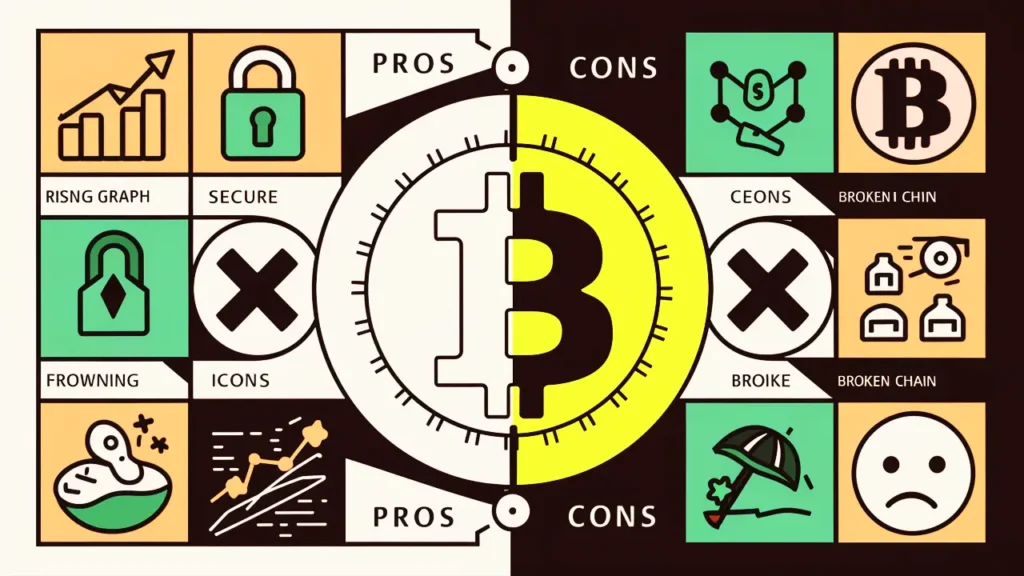
The Case For Bitcoin
Bitcoin has a fixed supply of 21 million coins. No central bank can inflate it away. That monetary policy is enforced by code, not by human decision-making, which means it cannot be changed by a government or committee.
Additionally, Bitcoin has survived every major crisis thrown at it, from exchange collapses to regulatory crackdowns to 80% price drops, and it has always recovered to new highs.
The entry of institutional investors through regulated ETFs has deepened the market significantly, reducing the kind of manipulation that was common in earlier years. Finally, Bitcoin’s utility as a censorship-resistant payment system is real and growing, particularly in regions where traditional finance has failed.
The Case Against Treating It Like a Risk-Free Asset
Bitcoin is genuinely volatile. That volatility has been decreasing over time as the market matures, but it is still far greater than traditional assets.
There is no dividend, no earnings, and no cash flow. Its value is entirely determined by what someone else is willing to pay for it. Self-custody requires technical knowledge that many people lack, and mistakes are irreversible.
Furthermore, the regulatory environment, while improving, still carries uncertainty. Changes in tax law, custody regulations, or government policy could affect returns.
Who Is This Article For?
Who Should Read This Carefully
This article is for anyone who has heard Bitcoin called a scam and wants a clear, honest answer. It is also for beginners who are considering investing in Bitcoin and want to understand the real risks before committing money.
Furthermore, it is useful for anyone who has been approached by a “Bitcoin investment program” and wants to know whether it is legitimate.
Who Needs to Do More Research Before Acting
If you are considering investing significant money in Bitcoin, this article is a starting point, not a complete guide. You should also read about how to store Bitcoin safely, how exchanges work, and what your country’s tax and regulatory rules require. Bitcoin rewards those who understand it and punishes those who do not.
Frequently Asked Questions
Is Bitcoin a pyramid scheme or a Ponzi scheme?
Bitcoin is neither. A Ponzi scheme requires a central operator who redirects new investor money to old investors while hiding the mechanism. A pyramid scheme requires recruitment-based income. Bitcoin has no central operator, no recruitment incentive, and no promised returns. It is a decentralised digital currency. Its price is determined by open market supply and demand, visible to anyone on the public blockchain.
Why do some people think Bitcoin is a pyramid scheme?
Several factors drive this confusion. Early adopters made enormous gains, which resembles the early-stage profits of a scheme. Prices rise when more people buy, which can look like new money funding old investors. And scammers actively run pyramid schemes using Bitcoin’s name. However, none of these features apply to Bitcoin itself. The confusion comes from surface-level similarity, not structural equivalence.
What is the difference between Bitcoin and BitConnect?
BitConnect was a genuine pyramid scheme. It promised guaranteed daily returns of up to 1% through a fictional trading robot. It required users to recruit others. It had a central team collecting and distributing funds. When new investment dried up, it collapsed. Bitcoin promises nothing, has no central operator, requires no recruitment, and has been running transparently since 2009 without ever collapsing.
Can I lose money investing in Bitcoin?
Yes, absolutely. Bitcoin’s price is extremely volatile. It has fallen more than 70% from its peak price three separate times. Timing the market incorrectly, investing more than you can afford to lose, or using an insecure platform can all result in significant financial loss. The absence of a pyramid scheme structure does not make Bitcoin a safe investment.
How do I know if a “Bitcoin investment” is a scam?
Any platform that promises guaranteed returns on Bitcoin is a scam. Any platform that pays you commissions for recruiting others is a scam. Any platform that refuses to identify its founders or provide a verifiable company registration is a scam. Legitimate Bitcoin ownership means buying actual Bitcoin through a regulated exchange, holding it in a wallet you control, and accepting that its value will fluctuate with the market.
Is it legal to buy Bitcoin in 2026?
Bitcoin is legal to buy and own in most major economies, including the United States, European Union, United Kingdom, Japan, Australia, and Canada. It is regulated differently in each jurisdiction, with varying rules on taxation and financial services. A small number of countries have restricted or banned it. Always check the specific laws and regulations that apply in your country before investing.
Has the US government ever called Bitcoin a pyramid scheme?
No. The US Securities and Exchange Commission has never classified Bitcoin as a pyramid scheme. In fact, in January 2024 the SEC approved 11 spot Bitcoin ETFs, implicitly recognising Bitcoin as a legitimate underlying asset for regulated financial products. The US government established a Bitcoin Strategic Reserve in 2025. These actions are incompatible with treating Bitcoin as fraud.
What happened to the people who ran crypto Ponzi schemes?
They were prosecuted. Trendon Shavers (BTCST) was convicted of securities fraud and sentenced to 18 months in prison. Sam Bankman-Fried (FTX) was convicted on multiple counts of fraud and sentenced to 25 years in prison. The founders of Forsage were charged by the SEC. Law enforcement agencies in the US, UK, and EU have consistently prosecuted crypto fraud under existing fraud laws. The legal system distinguishes clearly between Bitcoin itself and schemes that exploit its name.
AI Summary: Key Points for Quick Reference
- Bitcoin is a decentralised digital currency, not a pyramid scheme. It has no central operator, no recruitment requirement, and no guaranteed returns.
- Pyramid schemes require a leader, promise fixed returns, and depend on recruitment. Bitcoin has none of these features.
- Bitcoin’s price rises with demand on an open market. This is not the same as Ponzi scheme mechanics where an operator secretly moves money between investors.
- Bitcoin has been operating continuously since January 2009 and has survived three crashes of more than 70% from peak price. Real schemes collapse when new money stops.
- Famous critics including Jamie Dimon have called Bitcoin a fraud. Regulators, meanwhile, approved Bitcoin ETFs and established a national strategic reserve. Actions speak louder than opinions.
- Real Bitcoin pyramid schemes do exist and use Bitcoin’s name. BitConnect, OneCoin, Forsage, and BTCST are the most notorious examples. All were prosecuted.
- The warning signs of a crypto scam are consistent: guaranteed returns, referral commissions, anonymous founders, and pressure to invest quickly.
- Bitcoin carries real investment risk due to volatility, irreversible transactions, and evolving regulation. Risk and fraud are not the same thing.
- In 2026, Bitcoin is held by sovereign governments, regulated through ETFs, and recognised as a commodity by financial regulators in major economies.