



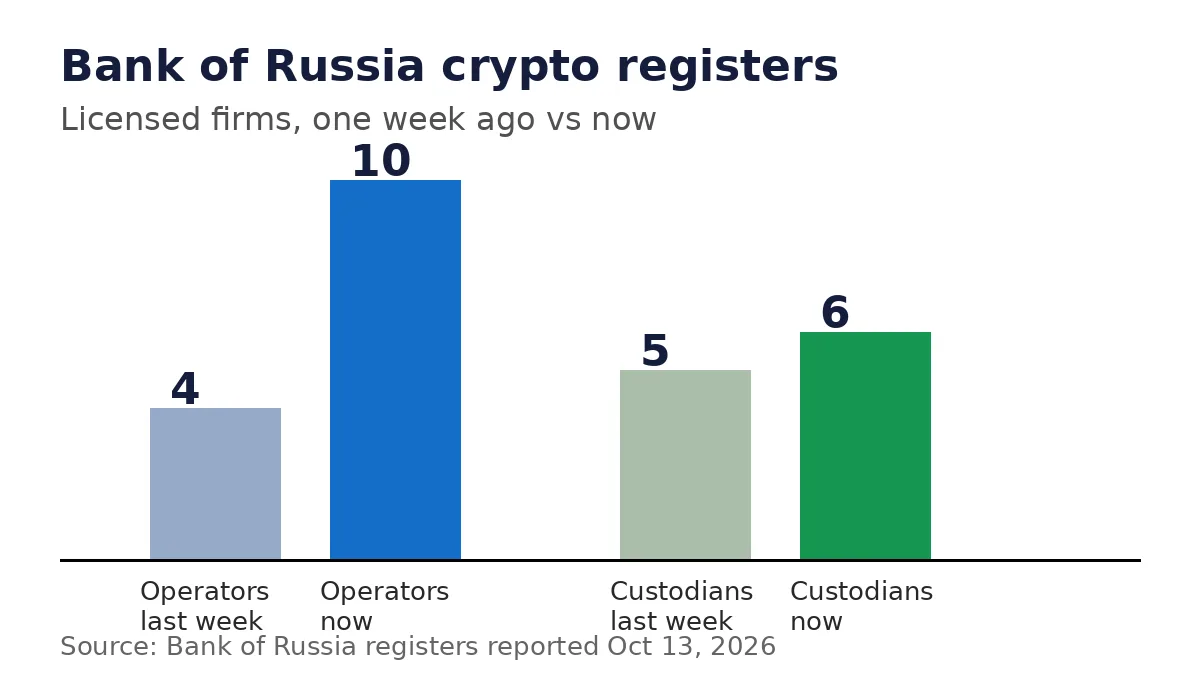
Sberbank bitcoin trading Russia is now official, and the register tells the bigger story. The Bank of Russia list jumped from 4 crypto exchange operators to 10 in one week, and the custodian list rose from 5 to 6.
Only two firms sit on both lists, and they are Sberbank and VTB. That makes them the only full stack licensed crypto banks in Russia today.

Key takeaways
- Sberbank plans to launch BTC, ETH and USDT trading on Dec 1, 2026.
- The service will live inside SberBank Online, SberInvestments and SberBusiness.
- Crypto payments for goods and services stay banned in Russia.
- From July 2027, trades must go through registered intermediaries.
- Bitcoin traded near $81,500 on Oct 15 as US spot ETFs bled in October.
What the Bank of Russia Register Actually Shows
Most headlines stopped at one bank getting one licence. The register itself shows a whole market opening at once, and you can read that shift in two small tables.
BTCRepublic built the table below from the updated register counts reported on Oct 13. No other news report leads with this dual list count, and it changes how you should read the story.
| Register | One week ago | Now | Change |
|---|---|---|---|
| Crypto exchange operators | 4 | 10 | Plus 6 firms |
| Digital custodians | 5 | 6 | Plus 1 firm |
The two lists do different jobs, so one licence is not enough for a full service. An operator buys and sells crypto, while a custodian records who owns it and tracks each transfer.
| Firm type | On operator list | On custodian list |
|---|---|---|
| Sberbank | Yes | Yes |
| VTB | Yes | Yes |
| T-Invest Lab | Yes | No |
That dual place is the key fact in the whole update. A firm on both lists can sell crypto and record client holds in one place, with no partner in the middle.

Our earlier report on Russia banks building crypto services covered the first bank plans. This register update is the legal step that turns those plans into a supervised market.
What Sberbank Will Launch on Dec 1
Sberbank says it will launch its first crypto products on Dec 1, 2026. The bank has already started app tests for buys, sales, deposits and withdrawals, and Vedomosti reported that news from the bank press office.
You will not need a new app for this service. Sberbank will put crypto inside tools that clients already use each day.
The Three Apps Russians Will Use
Retail clients will find the service in SberBank Online and SberInvestments. Business clients will find it in SberBusiness, so firms and solo traders use the same bank rails.
That choice matters more than the launch date itself. A bank app with full ID checks feels normal to new buyers, and normal is what brings first time users in.
The Three Assets at Launch
The launch list starts with Bitcoin, Ether and Tether USDt. Sberbank calls that set the start, and the central bank will shape the final list of allowed assets.
Do not expect a long coin menu on day one. Russia starts with the most liquid assets, and that keeps risk and checks simple for the bank.
How the New Russian System Works
A new law took effect on Sep 1, 2026, and it put operators and custodians under central bank watch. The Bank of Russia now keeps the public registers, and firms must earn a place on them before they serve clients.
This is a sharp turn from 2022, when the central bank wanted to ban local crypto trading. The law chose control over a ban, and the registers are the control tool.
Operators and Custodians, in Plain Words
Think of an operator as the shop and a custodian as the vault record book. You buy at the shop, and the book proves the coins sit in your name.
A bank on both lists can sell you Bitcoin and record your hold in one flow. A bank on one list must partner or send you elsewhere for the other half.
Who Can Buy, and the Ruble Cap to Know
Reports on the new rules set a yearly cap for non qualified investors. They can buy the most liquid crypto up to 300,000 rubles a year through one intermediary, after they pass a knowledge test.
Qualified investors face no such money cap under the same reports. Both groups still trade only through licensed firms once the full system starts.
If you are new to bank based buying, our guide on how to buy Bitcoin with a bank transfer shows the normal steps and fees. The Russian bank route will feel close to that flow, with extra ID and test steps.
What Stays Banned, and What Changes in July 2027
Crypto still does not work as money inside Russia. You cannot pay for goods and services with Bitcoin, and the new law keeps that ban in full.
The next big date is July 2027, not the December launch. From that month, crypto trades must go through registered intermediaries, and peer to peer deals paid through Russian bank accounts face a shut door.
That rule will push trade into apps that the central bank can see. It also gives licensed banks a strong edge, since unlicensed routes lose their bank payment path.
Russia has moved step by step on this path for years. Our report on how Russia legalized crypto mining shows the earlier turn that made this bank phase possible.
Why This Matters While US Spot ETFs Bleed
The timing tells its own story for Bitcoin demand. US spot Bitcoin and Ether ETFs lost about $986 million in net outflows in October up to Oct 9, with Bitcoin funds down about $407 million in that count.
Bitcoin traded near $81,500 on Oct 15, down about 2 percent on the day in CoinMarketCap data. Weak ETF demand in the US makes a new bank on ramp in Russia more than a local story.
No one should claim Sberbank alone will lift the world price. One bank launch adds a new pool of buyers over time, and pools like this grow demand in steps, not in one jump.
You can track the US side in our coverage of Bitcoin ETF flows in October. The contrast is clear, since US funds bleed while Russian banks build a fresh retail door.
Long term supply still sets the hard limit for every new door. Our explainer on when the Bitcoin halving 2028 lands shows why new demand meets a fixed coin supply.
Common Mistakes Readers Make on This Story
The first mistake is to call this full legalization of crypto as money. It is legalization of supervised trading and custody, and payments stay banned.
The second mistake is to treat Dec 1 as a firm promise with no fine print. Sberbank says the final timing rests on extra central bank rules, so a short delay stays possible.
The third mistake is to ignore the July 2027 rule. That rule, not the launch party, is what will change daily trade habits for Russian users.
Country rules differ a lot, and one guide never fits all places. Our hub on how to buy Bitcoin around the world compares the legal route country by country.
FAQs
When does Sberbank bitcoin trading in Russia start?
Sberbank plans to launch on Dec 1, 2026. The bank will offer trading in SberBank Online, SberInvestments and SberBusiness, and the final timing depends on extra central bank rules.
Which coins will Sberbank offer at launch?
Sberbank plans to offer Bitcoin, Ether and Tether USDt at launch. The central bank will shape the final list of allowed assets.
Can Russians pay for goods with Bitcoin now?
No, crypto payments for goods and services stay banned in Russia. The new rules cover trading and custody through licensed firms only.
What changes in July 2027 for Russian crypto trades?
From July 2027, crypto trades must go through registered intermediaries. That rule will push trade away from peer to peer deals that use Russian bank accounts.
How many firms sit on the Bank of Russia crypto registers now?
The updated register lists 10 crypto exchange operators and 6 digital custodians. Those counts rose from 4 operators and 5 custodians a week earlier.
Conclusion
Sberbank bitcoin trading Russia starts as a register story, not just a bank headline. The jump to 10 operators and 6 custodians, with Sberbank and VTB on both lists, builds the first full stack bank market for crypto in Russia.
Watch two dates from here, Dec 1 for the launch and July 2027 for the intermediary rule. Check the live register before you trust any new claim, and treat price calls with care while Bitcoin sits near $81,500.