



US spot Bitcoin ETFs pulled in $102.7 million on October 1, the first trading day of the month, flipping back to inflows just one day after $148.7 million walked out the door. On its own, the number is modest. But it arrived on the same day a weak September jobs report crushed the odds of an October Fed rate hike from about 70% to roughly 13-14%, according to CME FedWatch. Two bullish signals, one day, and Bitcoin is suddenly holding near $84,000 again.
Key takeaways
- US spot Bitcoin ETFs attracted $102.7M in net inflows on Oct 1, reversing the previous session’s $148.7M outflows (SoSoValue).
- September’s jobs report (29,000 jobs vs ~84,000 expected) collapsed October Fed hike odds from ~70% to roughly 13-14% on CME FedWatch.
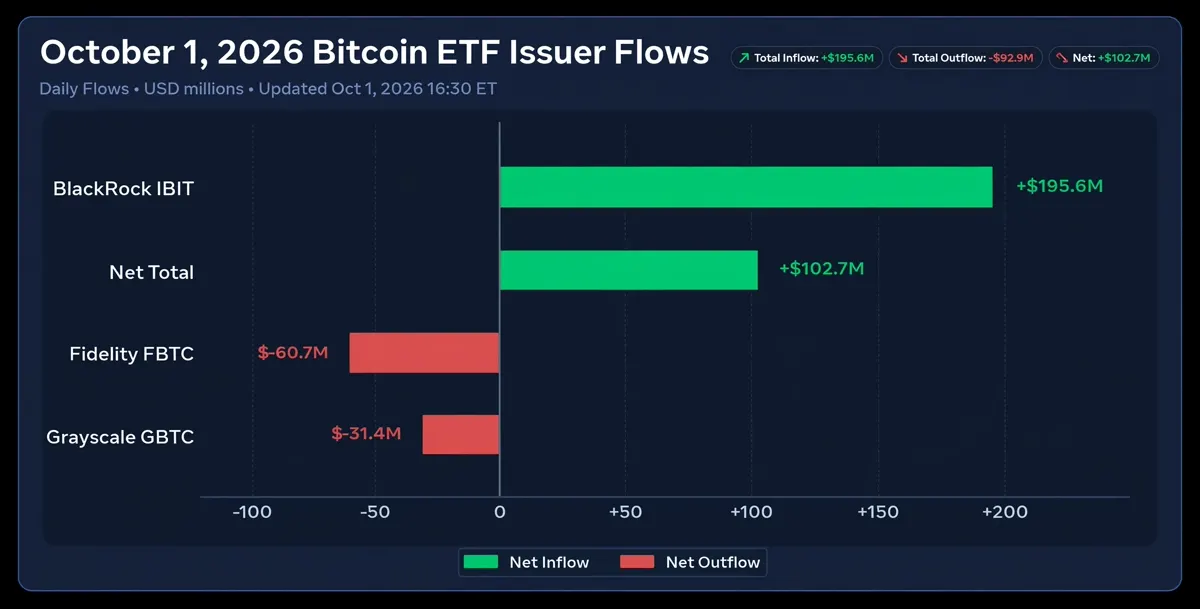
- BlackRock’s IBIT carried the whole session with +$195.6M, while Fidelity’s FBTC (-$60.7M) and Grayscale’s GBTC (-$31.4M) saw outflows.
- The inflow caps the strongest quarter of 2026 for the funds: $6.34B in Q3, with Bitcoin up 42.71%.
- Caution: one day is not a trend. Friday’s $87K spike faded fast, and Ether ETFs kept bleeding with $55.4M in outflows.
The numbers behind October’s first inflow day
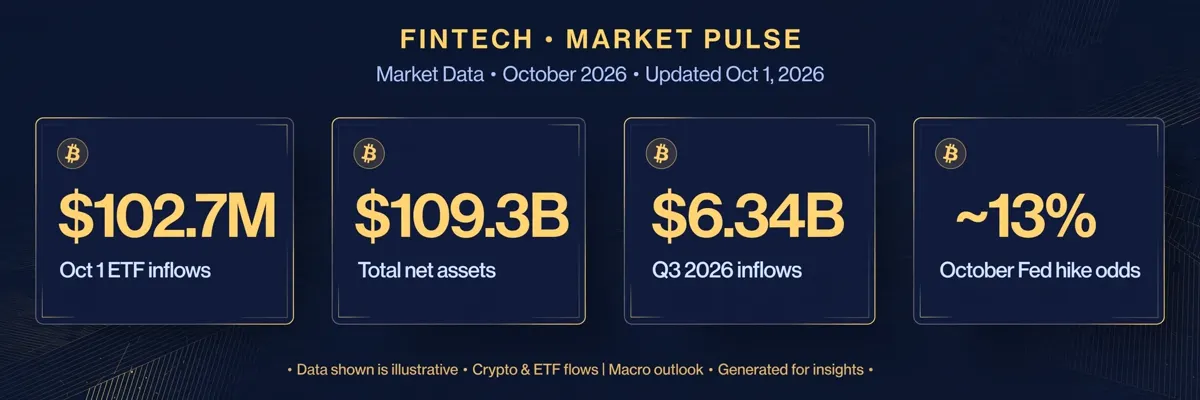
Let us start with what actually happened on Thursday. After a rough final day of September that saw $148.7 million leave the funds, US spot Bitcoin ETFs bounced back with $102.7 million of net inflows on October 1. Combined net assets climbed to $109.3 billion, and cumulative net inflows since launch reached $57.6 billion, according to SoSoValue data.

That is the headline. The detail underneath is more interesting, because the money did not come from everywhere at once.
- The numbers behind October’s first inflow day
- What killed the October rate hike
- Context: this caps the strongest quarter of 2026
- But do not ignore the fine print
- What to watch next
- Frequently asked questions
- How much did Bitcoin ETFs gain on October 1, 2026?
- What happened to the odds of an October Fed rate hike?
- What did the September jobs report show?
- How much did Bitcoin ETFs attract in Q3 2026?
- Did Ethereum ETFs also see inflows?
- Do Bitcoin ETF inflows always push the price up?
- The bottom line
BlackRock did all the heavy lifting
BlackRock’s iShares Bitcoin Trust (IBIT) absorbed $195.6 million on its own. Without IBIT, the whole group would have finished deep in the red. Fidelity’s FBTC lost $60.7 million and Grayscale’s GBTC lost another $31.4 million, with a few smaller products also showing redemptions. The session was less “institutions are buying Bitcoin again” and more “BlackRock is buying while others are selling.”
We have seen this movie before. In September, Fidelity drove almost all of a $324.6 million daily inflow. Money moves between issuers, fee structures, and allocation vehicles all the time, so a single green day tells you less about broad demand than the trend around it. For the full September story, read our breakdown of why September Bitcoin ETF inflows hit $2.65 billion.
What killed the October rate hike
Here is the bigger story. For weeks, traders had been pricing in a decent chance that the Federal Reserve would hike rates again at its October 27-28 meeting. At one point, CME FedWatch showed the odds at roughly 70%. Then the data turned, the Fed speakers turned, and the jobs report buried the hike almost completely.

The jobs report in plain English
The US economy added only 29,000 jobs in September, well below the roughly 84,000 economists expected. The unemployment rate ticked up to 4.2%, and revisions wiped another 60,000 jobs off July and August. It was, in short, a clear miss. After the release, CME FedWatch showed October hike odds at just 13-14%, while prediction market Kalshi put it around 18%.
We had flagged this report as a make-or-break moment for Bitcoin days ago in our Bitcoin September jobs report preview. It broke the dovish way.
What the Fed itself said this week
The repricing did not start with the jobs data. On September 29, New York Fed President John Williams said there was “no need for urgency” on another hike, sending October hike odds from about 70% to a coin flip in one day. On October 1, Fed Vice Chair Philip Jefferson added that policymakers would need “more time” to make a judgment. Add softer inflation prints, and the market stopped fighting the Fed entirely.
Why this helps Bitcoin
Rate hikes are bad for risk assets. They make safe Treasury yields more attractive and pull money away from things like Bitcoin. When hike odds collapse, that headwind disappears, and traders feel safer betting on growth. It does not guarantee a rally, but it removes one of the biggest reasons to sell. We walked through this exact mechanism after the last Fed move in our piece on the Fed rate hike’s impact on Bitcoin.
Context: this caps the strongest quarter of 2026
Zoom out, and October 1 looks like the cherry on top of a remarkable turnaround. The third quarter brought $6.34 billion of net inflows into US spot Bitcoin ETFs, the strongest quarter of the year, ending three straight quarters of redemptions. Bitcoin gained 42.71% over the quarter, its best Q3 since 2017.
September’s record week
The momentum peaked in late September, when the funds recorded a record $2.39 billion weekly inflow, the biggest single week since October 2025. September alone contributed $2.65 billion of the quarter’s total. October’s first-day inflow is small by comparison, but it confirms the selling stopped at quarter-end.
Wall Street is turning bullish again
Citigroup just raised its 12-month Bitcoin price target from $82,000 to $113,000, citing stronger crypto activity and renewed ETF inflows. You can read our full breakdown of why Citi turned bullish on Bitcoin. A big bank moving its target up while ETF money returns is the kind of combination that gets retail investors paying attention.
But do not ignore the fine print
Now the honest part. One green day does not make a trend. As we noted, the entire October 1 inflow came from IBIT while other big issuers bled. Friday’s price action was equally telling: Bitcoin briefly touched $87,085 after the jobs report, then faded all the way back to around $84,500 as roughly $433 million in leveraged positions got liquidated. Lower rate-hike odds did not translate into sustained upside.
The broader crypto ETF complex is also split. Ether ETFs recorded $55.4 million in outflows on October 1, their third straight day of bleeding (about $118 million total). Solana ETFs shed around $6 million, while XRP ETFs managed $4 million of inflows. Money is being selective, and right now it is selecting Bitcoin over altcoins.
ETF FLOWS: US SPOT CRYPTO ETFs FLOWS DATA UPDATE (01-10-2026) YESTERDAY Bitcoin ETFs: +1,213 $BTC (+$102.67M) Ethereum ETFs: -20,527 $ETH (-$55.37M) SOLANA ETFs: -50.02K $SOL (-$5.91M) XRP ETFs: +2.71M $XRP (+$4.07M)
– Crypto Patel (@CryptoPatel), October 2, 2026
What to watch next
Three things decide whether this becomes a real trend. First, September inflation data lands this week, and hot inflation could revive hike talk instantly. Second, the Fed meets October 27-28, where a formal pause would confirm what markets already believe. Third, ETF flows themselves: a streak of green days means real demand, while another flip to red would confirm this was just quarter-end noise.
The Crypto Fear & Greed Index sits at 72, still in “Greed” territory. Greed plus good macro news is a fine setup, but greed plus leverage is how $433 million gets liquidated in a day. Stay sharp.
Frequently asked questions
Quick answers to the most common questions about October’s ETF inflows and the Fed’s next move.
How much did Bitcoin ETFs gain on October 1, 2026?
US spot Bitcoin ETFs recorded $102.7 million in net inflows on October 1, 2026, reversing $148.7 million in outflows the previous day. BlackRock’s IBIT contributed $195.6 million, offsetting outflows from Fidelity’s FBTC ($60.7M) and Grayscale’s GBTC ($31.4M).
What happened to the odds of an October Fed rate hike?
CME FedWatch showed October hike odds collapsing from about 70% to roughly 13-14% after the weak September jobs report, dovish comments from Fed officials John Williams and Philip Jefferson, and softer inflation data.
What did the September jobs report show?
The US added only 29,000 jobs in September, far below the roughly 84,000 economists expected. The unemployment rate rose to 4.2%, and July and August figures were revised down by a combined 60,000 jobs.
How much did Bitcoin ETFs attract in Q3 2026?
US spot Bitcoin ETFs pulled in $6.34 billion in Q3 2026, their strongest quarter of the year, including $2.65 billion in September. Bitcoin gained 42.71% over the quarter.
Did Ethereum ETFs also see inflows?
No. Ether ETFs recorded $55.4 million in outflows on October 1, their third consecutive day of outflows totaling about $118 million, signaling continued weakness in Ethereum ETF demand.
Do Bitcoin ETF inflows always push the price up?
No. On October 2, Bitcoin briefly touched $87,085 but faded back to around $84,500 as $433 million in leveraged positions were liquidated. Flows reflect demand, but leverage, sentiment, and macro data all move the price too.
The bottom line
October opened with a one-two punch for Bitcoin bulls: $103 million back into the ETFs and an almost-dead October rate hike. The macro headwind that haunted the market all year just lost its teeth. But concentration risk (one issuer carrying the day) and fragile leverage (a $433 million wipeout) mean this story is fragile. Watch the flow streak, the inflation data, and the Fed meeting on October 27-28. That is where the trend gets decided.
Price action matters here too: the triangle forming under $87,000 could decide whether those ETF inflows turn into a breakout.
Those inflows came just as the weak September jobs report killed October Fed hike odds and briefly pushed Bitcoin past $87K.
For a newer altcoin ETF case, check the XRP forecast to 2030 and what ETF demand would have to do.
The story has since gone global, with Thailand approving local Bitcoin and Ether ETFs for listing on the Stock Exchange of Thailand from October 16.
Traders are now watching Bitcoin CPI fed hike odds ahead of the October 14 print as the next test for this inflow story.
Flows later flipped hard the other way in the $771 million liquidation drop below $82,000, which shows how fast ETF support can vanish.