


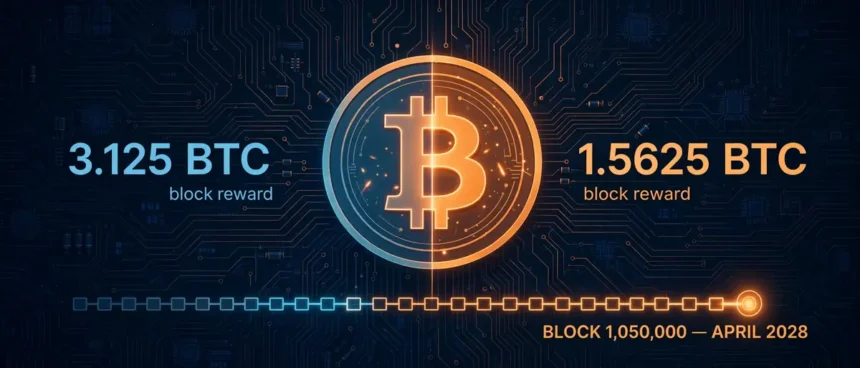
The Bitcoin halving 2028 is Bitcoin’s next scheduled supply cut. It is expected around April 2028, when the network mines block 1,050,000.
At that moment, the reward miners earn for each new block drops from 3.125 to 1.5625 BTC. That cuts the number of new bitcoins entering the market roughly in half.

Answer: The Bitcoin halving 2028 will halve Bitcoin’s new-supply rate. No more, no less.
- What Is the Bitcoin Halving? (Simple Explanation)
- When Is the Bitcoin Halving 2028?
- The trigger is block 1,050,000, not a calendar date
- Why estimates shift
- Current estimates and where we are now
- What Changes in 2028: Block Reward and New Supply
- The block reward: 3.125 → 1.5625 BTC
- Daily-issuance math made concrete: ~450 → ~225 BTC/day
- Issuance vs. inflation rate: why the distinction matters
- Why the Halving Matters: Supply, Scarcity, and the Market
- What Happens to Bitcoin Miners After the Bitcoin Halving 2028?
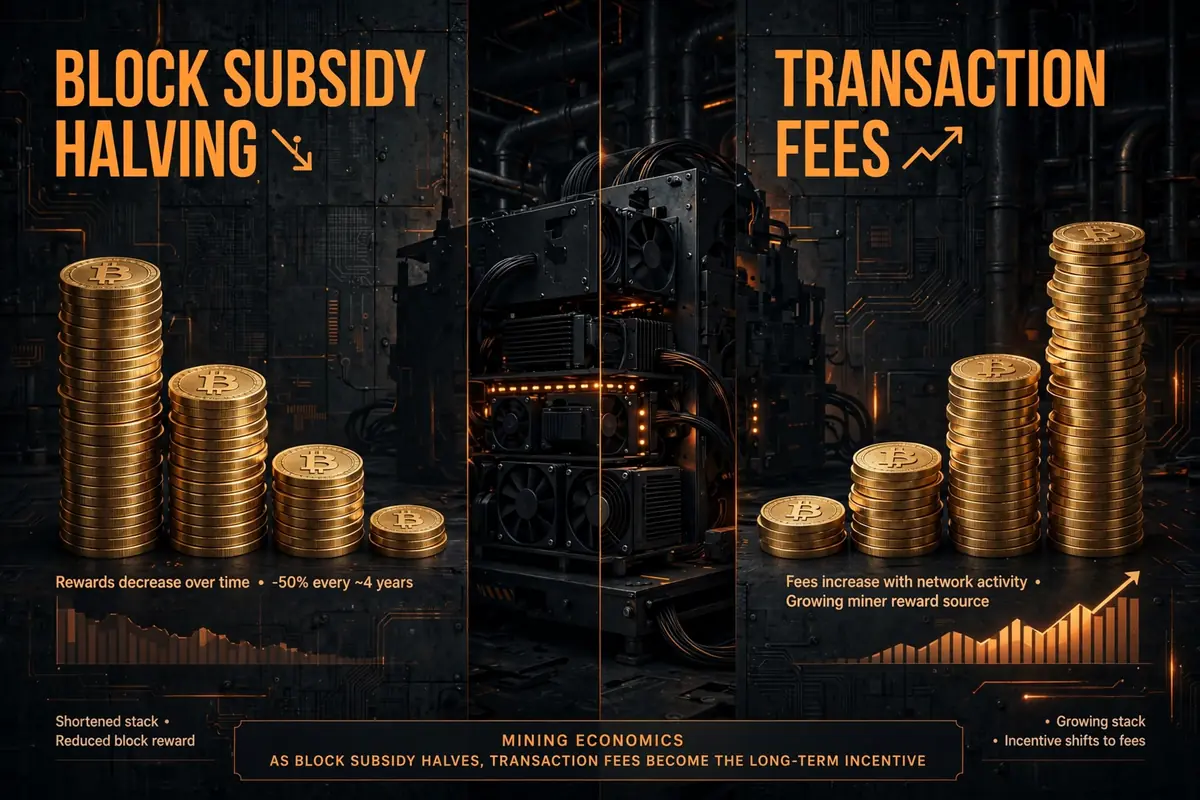
- Miners don’t just “earn half”: subsidy vs. transaction fees
- How miners adapt (efficient machines, cheap power, difficulty adjustment sequence)
- The long-term security-budget question (fees carrying the network toward 2140)
- What Happened After Previous Halvings: The Honest Price History
- Halving history table (2012, 2016, 2020, 2024)
- The diminishing-returns trend: ~8,700% → ~2,940% → ~690% → ~94%
- How long after a halving Bitcoin usually peaks, and the 2024 cycle’s broken timing
- Does the Halving Guarantee a Price Increase?
- What the halving provably does vs. what is only pattern
- Will Bitcoin Go Up After the Bitcoin Halving 2028? (Honest Answer)
- Is Bitcoin’s 4-year cycle broken this time?
- Bitcoin Halving 2028 vs. Alternatives and Comparisons
- Bitcoin’s halvings vs. other coins’ emission schedules
- Halving vs. other price drivers (ETF flows, macro, adoption)
- Common Mistakes and Misconceptions About the Bitcoin Halving 2028
- What Should a Beginner Do Before the Bitcoin Halving 2028? (Practical, Sober, Non-Financial-Advice)
- A sober framework: learn first, plan, avoid FOMO
- DCA basics and why timing the halving is hard
- Halving-hype scams to watch for
- Where to follow the countdown reliably
- Bitcoin Halving 2028: Frequently Asked Questions
- Conclusion
- Next Step
Why it matters: fewer new coins sold by miners means less constant selling pressure on the market. Every past halving has been followed, eventually, by a major bull run.
How it happens: no committee votes, no ceremony. The code rule simply activates when block 1,050,000 is mined.
Example: in 2024, the reward fell from 6.25 to 3.125 BTC. Bitcoin then rallied roughly 94% from its halving-day price to its October 2025 peak near $126,000.
That does not mean 2028 will repeat the pattern. But it is the pattern every beginner should understand before forming an opinion.

What this guide covers: a plain-English definition of the halving. The real trigger (block height, not a date). The exact reward change and what it means in daily numbers.
It also covers what happens to miners. The honest price history of all four past halvings.
Whether a price rise is guaranteed. And a practical, scam-aware checklist for beginners.
Nothing here is financial advice. This guide gives you just the mechanics, the data, and the plain questions to ask.
Key Takeaways
- The Bitcoin halving 2028 is triggered by block 1,050,000, not by a calendar date, so every “date” you see is an estimate.
- The block reward falls from 3.125 to 1.5625 BTC, cutting new daily supply from ~450 to ~225 BTC.
- Past halvings were followed by big rallies, but the gains shrank each time: ~8,700% → ~2,940% → ~690% → ~94%.
- Miners do not simply “earn half.” Transaction fees are a separate, growing part of their revenue.
- No halving guarantees a price increase. It halves new supply; the price still depends on demand.
What Is the Bitcoin Halving? (Simple Explanation)
You have probably heard that Bitcoin has a fixed supply. The halving is the rule that enforces it.
This section explains the idea in plain words. Then it shows why the “four years” part is really about block math.
The halving in simple terms
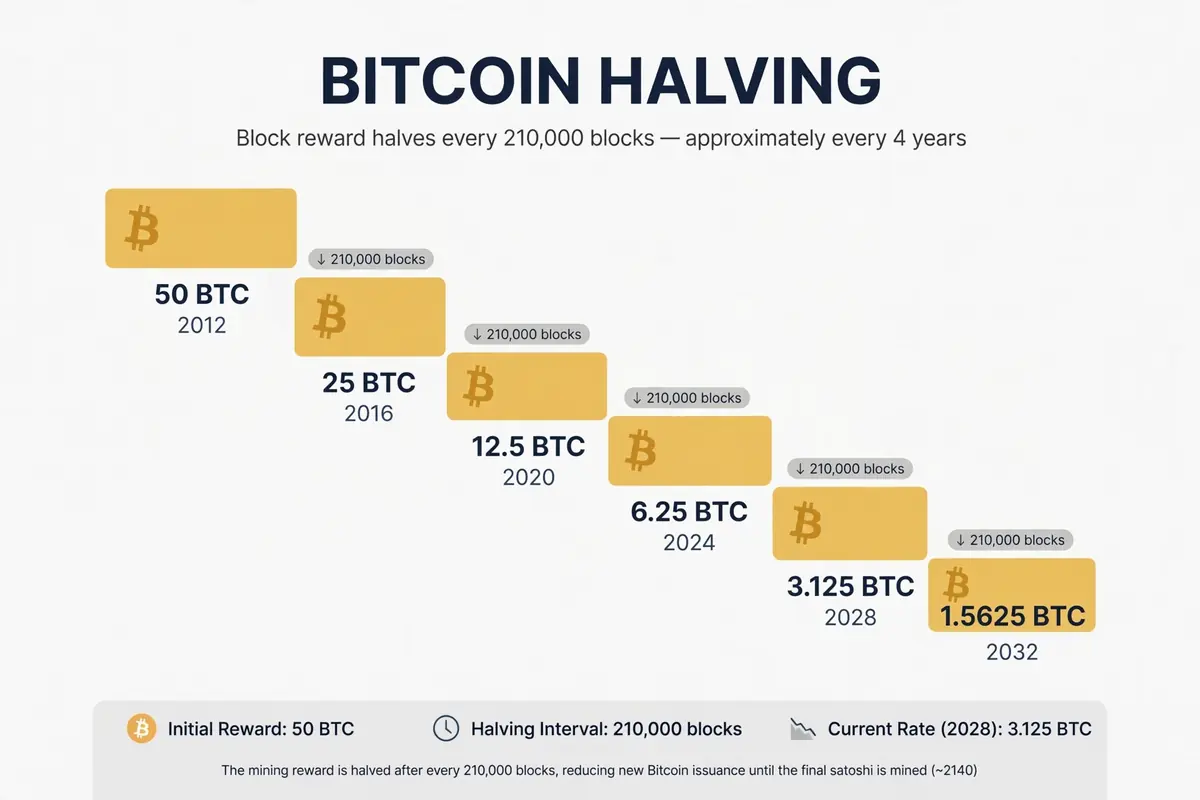
New bitcoins are not printed. They are issued to miners as a reward for adding new blocks to the blockchain. A halving cuts that reward exactly in half.
Think of it like a gold mine. By unchangeable rule, it produces half as much gold per day every four years. This goes on forever, until the gold runs out.
Here is the sequence, step by step:
- A miner builds a block. A block is a bundle of recent transactions. The miner adds it to the chain.
- The protocol pays the miner a fixed reward (the block subsidy). Right now that reward is 3.125 BTC per block.
- Every 210,000 blocks, the reward halves. That is the halving. In 2028, it goes from 3.125 to 1.5625 BTC.
- This continues until roughly the year 2140. That is when the last of Bitcoin’s 21 million coins will be mined.
If you are still fuzzy on what Bitcoin is at the network level, read that guide first. The halving only makes sense once you understand that new coins enter the world solely through miners’ rewards.
Why Bitcoin halves every four years
The “four years” is not written on a calendar. Bitcoin targets a new block roughly every 10 minutes.
Multiply 210,000 blocks by 10 minutes and you get about 1,458 days, roughly four years. So the four-year rhythm is a consequence of block math, not a scheduled appointment.
Why design it this way at all? Two reasons:
- Controlled scarcity. Bitcoin’s creator set a hard cap of 21 million coins. High early rewards helped the network grow when few people cared. The halvings then steadily tighten supply, like gold getting harder to mine, except the schedule is written in code and cannot be renegotiated.
- Predictability. Everyone can see the entire future supply schedule in advance. No central bank can surprise miners or holders by changing it. That predictability is why the halving has become a market event everyone sees coming, years ahead.
When Is the Bitcoin Halving 2028?
The short answer is April 2028. The honest answer is a block number, not a date.
Below, you will see why every countdown is only a guess, why those guesses move around, and where things stand right now.
The trigger is block 1,050,000, not a calendar date
The halving happens when the Bitcoin network mines block number 1,050,000. Full stop. No date is baked into the code.
Every countdown website you see is projecting forward from the current block height. It uses an average block time to guess the date. That is why the “date” drifts.
Why estimates shift
Three things move the estimate:
- Difficulty adjustments. Every 2,016 blocks (roughly two weeks), Bitcoin retunes mining difficulty to keep blocks near the 10-minute target. Faster hardware moves the halving estimate earlier, and slower miners move it later.
- Hashrate growth. When new mining capacity comes online, blocks arrive slightly faster than 10 minutes. This lasts until the next adjustment catches up.
- Network congestion and luck. Mining has randomness built in. Some days are simply faster or slower.
The honest way to say it: “April 2028” is a projection, not a promise. It could land a few weeks earlier or later.
Current estimates and where we are now
As of late September 2026, trackers place the Bitcoin halving 2028 around mid-April 2028. CoinWarz shows roughly April 15, 2028. OKLink estimates around April 13, 2028.
On-chain analysts put halving progress at roughly ~61% of blocks mined. That means about ~81,000 blocks remaining, with the network around block 968,000.
On-chain analyst Root (@therationalroot) marked the milestone with a widely shared “Halving progress 61%. #Bitcoin” post on September 22, 2026. Crypto outlets including U.Today, CoinTurk, and Crypto-Economy picked it up.
Do this to track it yourself, then forget the exact day:
- Bookmark a countdown page (CoinWarz or a block explorer with a halving estimate).
- Watch the block height, not the date. The important number is how close we are to 1,050,000.
- Recheck quarterly, not daily. The estimate will wobble by days and weeks. That is normal, not news.
What Changes in 2028: Block Reward and New Supply
Two numbers change at the Bitcoin halving 2028. The reward paid per block goes down. The total new coins per day goes down with it.
Here is the exact math, kept simple.
The block reward: 3.125 → 1.5625 BTC
After block 1,050,000, the miner who finds each block receives 1.5625 BTC as the subsidy. That is down from 3.125 BTC.
For perspective, the first miners in 2009–2012 received 50 BTC per block. Each halving moves Bitcoin one step closer to its endgame: a network secured by fees rather than new coins.
Daily-issuance math made concrete: ~450 → ~225 BTC/day
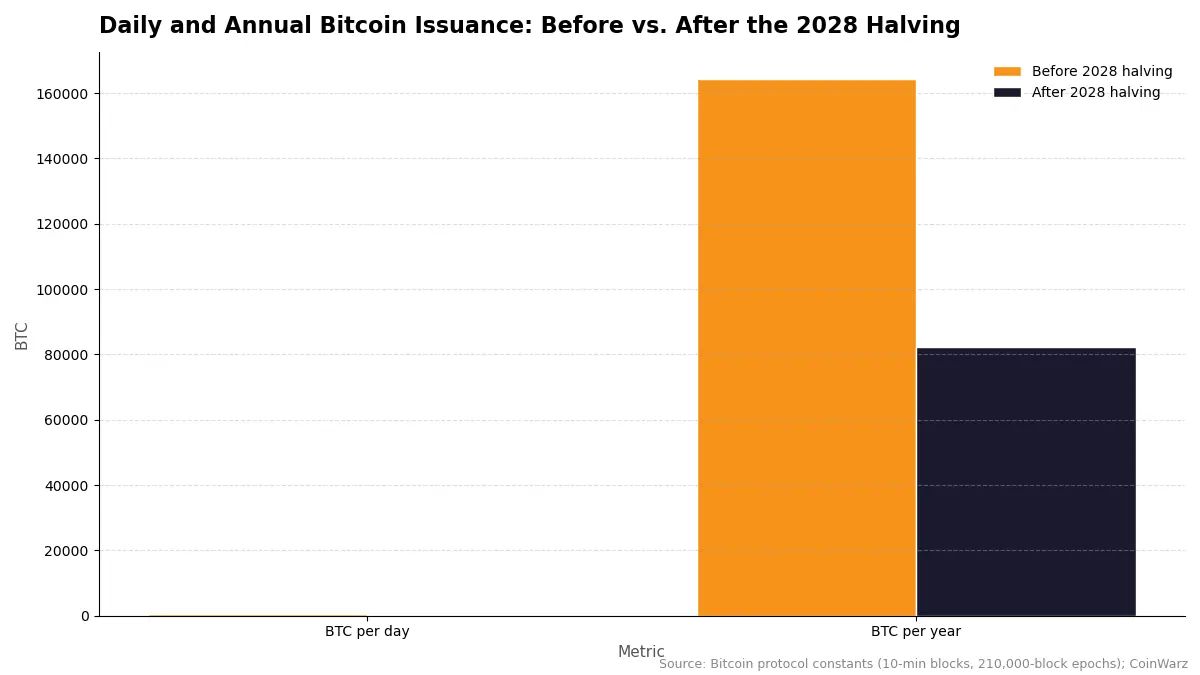
The reward is per block, but the market feels it per day. Roughly 144 blocks are mined each day (one every 10 minutes). Run the multiplication:
| Metric | Before the Bitcoin halving 2028 | After the Bitcoin halving 2028 |
|---|---|---|
| Block subsidy | 3.125 BTC | 1.5625 BTC |
| New coins per day (≈144 blocks) | ~450 BTC/day | ~225 BTC/day |
| New coins per year | ~164,250 BTC/year | ~82,125 BTC/year |
| Coins issued per 210,000-block epoch | 656,250 BTC | 328,125 BTC |
| Annual inflation rate (approx.) | ~0.8% | ~0.4% |
That ~225 BTC/day figure is the one worth memorizing. Spot Bitcoin ETF products routinely absorb hundreds of bitcoins a day in new demand.
Cutting fresh supply from ~450 to ~225 BTC/day is not an abstraction. It is a daily number you can hold next to daily buying.
Issuance vs. inflation rate: why the distinction matters
Beginners often hear “halving cuts inflation” and picture prices rising. What it actually cuts is the issuance rate: the pace at which new coins appear.
After 2028, Bitcoin’s annual inflation rate drops to roughly 0.4%. That is already below gold’s long-run supply growth.
But two things matter more than the rate:
- The absolute daily flow shrinks. Even with a tiny inflation rate, miners sell coins each day to cover costs. That daily selling puts pressure on the market. Halving that flow is the concrete market effect.
- The existing supply is huge relative to new coins. About 20.09 million BTC already exist (as of late September 2026). The halving changes how fast the remaining trickle arrives. It does not touch the 20.09 million already circulating. That is why the price effect is real but limited, and why the returns have diminished each cycle.
Why the Halving Matters: Supply, Scarcity, and the Market
Here is the mechanism, stripped of hype:
- Step 1: The Bitcoin halving 2028 halves new supply. Provable, automatic, certain.
- Step 2: Miners sell a large share of what they earn to pay electricity and hardware bills. Fewer new coins means less structural selling. Provable in principle, measurable in practice.
- Step 3: If demand stays the same or grows, through ETF inflows, corporate treasuries, or new buyers, the reduced flow tips the balance toward higher prices. This is where certainty ends and probability begins.
Step 3 is where the spot Bitcoin ETFs’ role in this cycle becomes essential context. The 2024 cycle showed what happens when a powerful new demand channel (US spot ETFs) meets a shrinking supply schedule.
Bitcoin set a new all-time high before the halving. Something that had never happened in previous cycles. The Bitcoin halving 2028 will play out in a market where institutions can buy through regulated products at a scale no earlier halving ever saw.
That is the real reason the Bitcoin halving 2028 matters. It is the one part of the supply-demand equation that is guaranteed in advance. That lets you reason clearly about the one variable nobody can predict: demand.
What Happens to Bitcoin Miners After the Bitcoin Halving 2028?
Miners are the workers who keep the Bitcoin network running. The Bitcoin halving 2028 cuts their pay, but the story is more interesting than “they earn half.”
Here is how their income really works, how they prepare, and the big long-term question about who funds network security.
Miners don’t just “earn half”: subsidy vs. transaction fees
This is the most under-explained part of every halving guide. A miner’s revenue per block has two parts:
- The block subsidy. These are the newly minted coins (3.125 BTC now, 1.5625 after 2028). This is the part that halves.
- Transaction fees. Users pay these fees to get their transactions into a block. These do not halve.
The 2024 halving block is the perfect illustration. When miner ViaBTC produced block 840,000, users desperate to inscribe Runes tokens and rare satoshis paid a record 37.67 BTC in transaction fees.
That was worth about $2.4 million at the time, on top of the new 3.125 BTC subsidy. The miner collected roughly 40.7 BTC in total. The subsidy was cut in half, yet total revenue for that block was extraordinary. (Source: Cointelegraph, citing mempool.space data.)
That was an exceptional block, not a normal one. Do not extrapolate from it. The point is narrower: miner income is subsidy plus fees, and only one of the two shrinks at the halving.
For the full picture of miner economics today, read the honest math on mining profitability in 2026.
How miners adapt (efficient machines, cheap power, difficulty adjustment sequence)
Miners know the Bitcoin halving 2028 is coming years in advance, so they prepare in a predictable sequence:
- Upgrade hardware before the cut. Older, less efficient ASICs stop being profitable at half the subsidy. Operators replace them with the newest machines.
- Chase cheaper power. Mining margins are fundamentally an energy game. Bitcoin mining activity keeps shifting toward the cheapest electricity on earth. And Bitcoin mining in the US has become a political talking point in its own right.
- Less efficient miners drop off in the weeks after the Bitcoin halving 2028. Hashrate falls temporarily.
- The difficulty adjustment then kicks in. With less competition, the network automatically lowers difficulty. This restores margins for the surviving miners and brings block times back to ~10 minutes.
This cycle has repeated after every halving. It is one of Bitcoin’s most reliable self-correcting mechanisms. The difficulty adjustment absorbs the shock so the network keeps ticking.
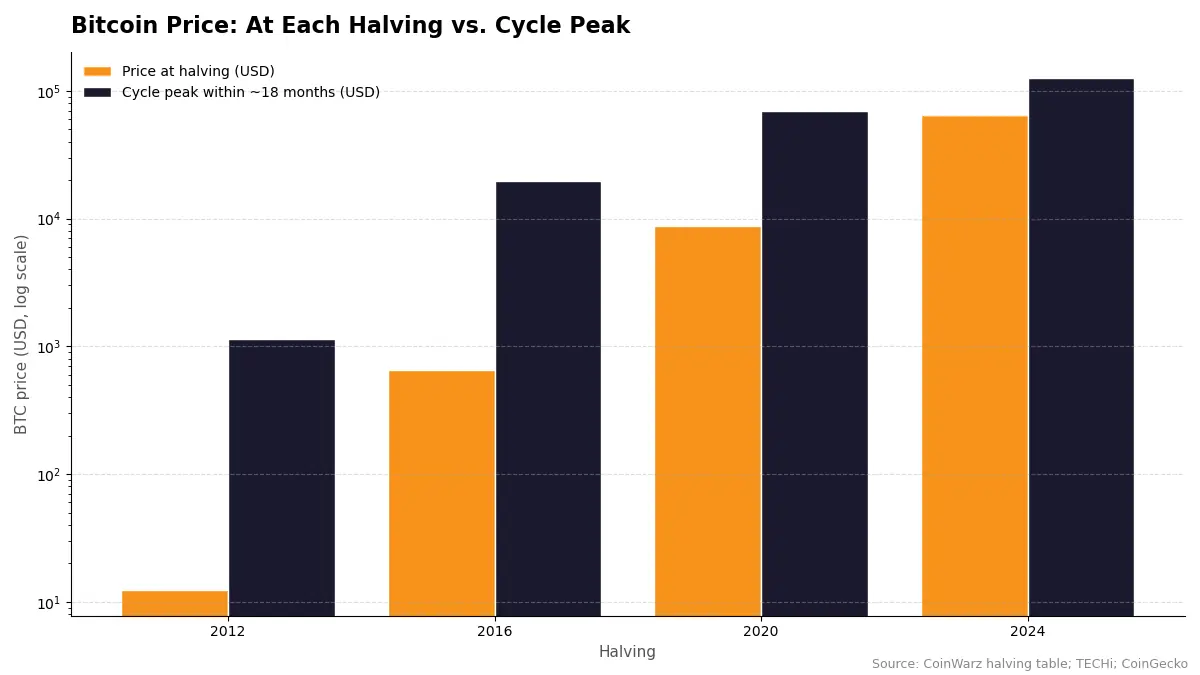
~450 → ~225
New BTC issued per day (2028 halving)
1.5625 BTC
Block reward after April 2028
~0.4%
Annual inflation rate after 2028
The long-term security-budget question (fees carrying the network toward 2140)
Zoom out, and the halving schedule poses an honest long-term question: who pays for network security when the subsidy tends to zero? Around the year 2140, the last fraction of the 21 millionth bitcoin will be mined. The subsidy will effectively vanish. From then on, miners will be paid entirely by transaction fees.
That is not a 2028 problem. But every halving nudges the network one step closer to it. Fees must gradually take over.
The 2024 halving block, with its 37.67 BTC in fees, offered an early, admittedly extreme, glimpse of a fee-funded future. Whether fee markets can reliably fund security decades from now remains one of Bitcoin’s open research questions. It is worth knowing it exists rather than pretending the halvings have no long-term side.
What Happened After Previous Halvings: The Honest Price History
Stories about the halving are easy to find. Data is better.
Here is the verified record of all four past halvings, then the trend the numbers reveal.
Halving history table (2012, 2016, 2020, 2024)
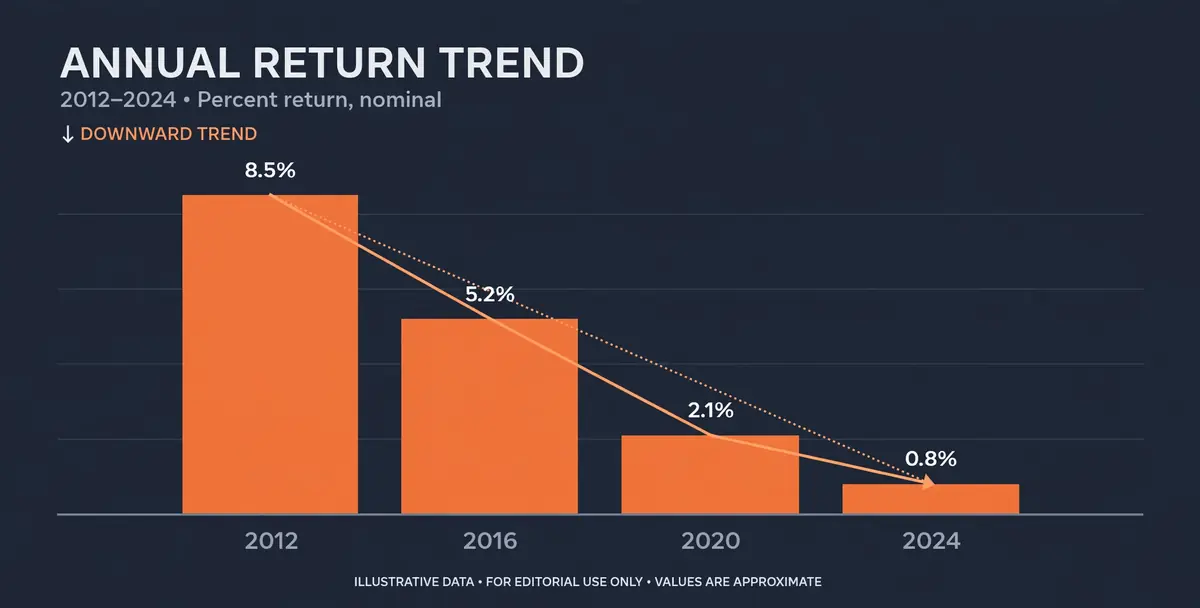
Here is the verified record: dates, blocks, rewards, prices, cycle peaks, and approximate returns. Prices are approximate and vary slightly by source. The pattern is consistent across all of them.
| Halving | Date | Block | Reward change | BTC price at halving | Cycle peak (~18 mo. after) | Approx. return |
|---|---|---|---|---|---|---|
| 1st | Nov 28, 2012 | 210,000 | 50 → 25 BTC | ~$12 | ~$1,150 (Nov 2013) | ~+8,700% |
| 2nd | Jul 9, 2016 | 420,000 | 25 → 12.5 BTC | ~$650 | ~$19,783 (Dec 2017) | ~+2,940% |
| 3rd | May 11, 2020 | 630,000 | 12.5 → 6.25 BTC | ~$8,727 | ~$69,000 (Nov 2021) | ~+690% |
| 4th | Apr 20, 2024 | 840,000 | 6.25 → 3.125 BTC | ~$64,968 | ~$126,000 (Oct 2025) | ~+94% |
| 5th | ~Apr 2028 (est.) | 1,050,000 | 3.125 → 1.5625 BTC | TBD | TBD | TBD |
The diminishing-returns trend: ~8,700% → ~2,940% → ~690% → ~94%
Two facts sit side by side, and both are true:
- Every halving so far was followed by a major bull run. That is a 4-for-4 record on direction.
- The magnitude collapsed each time. ~8,700% became ~2,940%, then ~690%, then ~94%.
Why? Mostly arithmetic and size. When Bitcoin’s market was tiny, a few million dollars of sustained buying moved the price enormously.
Now it is one of the largest assets on earth. Moving it takes vastly more money.
The supply cut gets proportionally smaller in absolute terms too. Cutting 1.5625 BTC per block off a ~20.09-million-coin supply base is simply a smaller shock than cutting 25 BTC per block was in 2012.
A fair read: expect continued direction, diminishing drama. That framing respects the data without worshipping it.
How long after a halving Bitcoin usually peaks, and the 2024 cycle’s broken timing
Historically, the cycle peak arrived roughly 12–18 months after the halving. November 2013 (~12 months after 2012). December 2017 (~17 months after 2016).
November 2021 (~18 months after 2020). And October 2025 (~18 months after 2024).
But the 2024 cycle broke a different part of the pattern. Bitcoin set a new all-time high before the halving, powered by spot ETF inflows. That had never happened before.
Previous cycles bottomed and re-accumulated for months after the halving before exploding upward. This time, institutional demand front-ran the schedule.
That is the “market structure changed” argument in one sentence. It is the strongest reason not to copy-paste old cycle timing onto 2028.
Does the Halving Guarantee a Price Increase?
This is the most important question in the guide. The honest answer has two parts: what the halving is proven to do, and what history only suggests.
What the halving provably does vs. what is only pattern
Be precise about the two columns:
Provable (mechanics):
– Halves the rate of new supply, forever.
– Reduces miners’ subsidy revenue, pressuring the least efficient miners.
– Lowers Bitcoin’s annual inflation to ~0.4%.
Pattern (history, not law):
– Price rallied after all four halvings.
– Pre-halving rallies occurred in 2015 (+34%) and 2019 (+92%), per The Motley Fool’s analysis of the cycle data.
– Peaks arrived 12–18 months after each halving.
The first column is a guarantee. The second column is a record, and records describe the past, not the future.
Will Bitcoin Go Up After the Bitcoin Halving 2028? (Honest Answer)
No one can tell you that, and anyone who does is selling something. Here is the honest version:
- The supply argument favors higher prices if demand holds or grows. That is real economic logic, not magic.
- Demand is the whole question. ETFs, corporate treasuries, macro conditions, and regulation will decide the outcome far more than the supply cut itself.
- The market knows the halving is coming. This is the strongest counterargument to the supply thesis. Unlike 2012, when few people were watching, the 2028 halving is priced into millions of investors’ expectations. Markets famously front-run predictable events. “Buy the rumor, sell the news” is real, and the 2016 halving was followed by a ~30% drop before the bull run truly started.
So: bullish mechanics, uncertain outcome. Plan for the mechanics. Do not bet the house on the pattern.
Is Bitcoin’s 4-year cycle broken this time?
This is the liveliest debate in Bitcoin markets right now, so hear both sides:
The “broken or compressed” case: analyst Discover (@0x_Discover) argued in a widely shared September 13, 2026 post that if Bitcoin bottomed roughly 650 days before the 2028 halving, “the entire cycle could be speeding up.” Bitcoin may have broken the 4-year cycle, or at least compressed it. ETF-driven demand, corporate accumulation, and a maturing market mean old timing models may no longer fit.
The “cycle intact” case: past cycles also deviated and then rhymed. The 2024 cycle kept the essential shape (halving, then rally, then peak ~18 months later) even while front-running the timing.
Diminishing returns and longer, flatter cycles were already the trend. What looks “broken” may just be the next step in the same evolution.
Your takeaway as a beginner: do not plan as if the old cycle is law, and do not plan as if it is dead. Either way, the strategy that survives both outcomes is the same. You will find it in the practical section below.
Bitcoin Halving 2028 vs. Alternatives and Comparisons
The Bitcoin halving 2028 does not exist in a vacuum. Here is how Bitcoin’s model compares to other coins, and how the halving stacks up against the other forces that move the price.
Bitcoin’s halvings vs. other coins’ emission schedules
Bitcoin is not the only asset with a shrinking supply schedule, but its approach is the strictest:
- Litecoin copies Bitcoin’s halving model (every 840,000 blocks, ~4 years) with the same mechanic on a smaller stage.
- Ethereum took a different path: no halvings, but a fee-burning mechanism (EIP-1559) that can make ETH supply shrink during heavy usage. Its supply reacts to demand rather than following a fixed calendar.
- Most altcoins have founder-controlled or inflationary schedules that can be changed by governance votes.
Bitcoin’s edge is not that its model is cleverest. It is that the model cannot be changed by anyone. Predictability is the product.
Halving vs. other price drivers (ETF flows, macro, adoption)
The Bitcoin halving 2028 is one driver among several, and probably not the biggest anymore:
| Driver | What it does | How certain it is |
|---|---|---|
| Halving supply cut | Halves new daily supply (~450 → ~225 BTC) | Certain (code) |
| ETF flows | Adds large, persistent institutional demand | Uncertain (market-dependent) |
| Macro (rates, liquidity) | Determines how much money seeks risk assets | Uncertain (economy-dependent) |
| Adoption & regulation | Expands or restricts the buyer base | Uncertain (policy-dependent) |
Bitcoin’s market position among the largest assets means macro forces now move it like a macro asset. Treat the halving as the predictable tailwind, not the whole story.
Common Mistakes and Misconceptions About the Bitcoin Halving 2028
Run through this checklist before you discuss the Bitcoin halving 2028 with anyone:
- [ ] “The date is fixed.” No. The trigger is block 1,050,000, and estimates shift by weeks. Treat “April 2028” as a projection.
- [ ] “Miners will earn half.” They earn half the subsidy. Fees are separate and sometimes substantial.
- [ ] “Halving = guaranteed bull run.” Four-for-four on direction so far, but direction is not a promise, and magnitude has collapsed each cycle.
- [ ] “Buy on halving day.” Past halvings were followed by choppy months. 2016 dropped ~30% shortly after. The event is a process, not a launch button.
- [ ] “Halving cuts inflation to zero.” It cuts the new-issuance rate to ~0.4% annually. The existing ~20.09M coins are untouched.
- [ ] “This time the cycle will repeat exactly.” ETF-era market structure already broke one timing pattern in 2024. Expect rhyme, not replay.
- [ ] Ignoring fees and difficulty. Both are part of the real mechanics. The subsidy is not the whole story of miner economics or network security.
What Should a Beginner Do Before the Bitcoin Halving 2028? (Practical, Sober, Non-Financial-Advice)
Knowledge without a plan is just trivia. Below is a simple framework to follow, the basics of dollar-cost averaging, the scams to watch for, and where to track the countdown.
A sober framework: learn first, plan, avoid FOMO
None of this is financial advice. It is a learning and planning framework. Talk to a qualified professional before making investment decisions.
Do this, in this order:
- Learn the mechanics first. If you finished this guide, you have done step one. Understand why the halving matters before you decide whether it matters to your plans.
- Decide your time horizon in writing. Halving cycles play out over 12–24 months. If your horizon is weeks, the halving is the wrong event to trade on.
- Separate the event from the noise. As 2028 approaches, media hype will spike. The mechanics in this guide will not change. The narratives around them will.
- Never invest money you cannot afford to lose. Bitcoin has had multiple 70–80% drawdowns between halvings. The halving does not remove that risk.
DCA basics and why timing the halving is hard
Dollar-cost averaging (DCA) means buying a fixed amount on a fixed schedule. It exists precisely because timing events like halvings is hard.
Professionals get cycle timing wrong constantly. The 2024 cycle’s front-running surprised most of them.
The honest case for DCA around a halving:
- It removes the timing decision you are bad at making (everyone is).
- It turns volatility into an advantage, buying more when prices dip.
- It matches the halving’s real timeframe. The supply effect plays out over months and years, not on halving day.
What it does not do: guarantee profits. DCA into a falling market still loses money. It is a discipline tool, not a return generator.
Learn the mechanics
Read this guide and a beginner Bitcoin primer. Do not act on headlines you cannot explain.
Write down your plan
Time horizon, amounts you can afford to lose, and the conditions under which you would sell. Decide before the hype.
Set up tracking, not trading
Bookmark a halving countdown and a block explorer. Watch block 1,050,000 approach like a student, not a gambler.
Revisit quarterly
Check progress a few times a year. Daily countdown-watching produces anxiety, not insight.
Halving-hype scams to watch for
Every halving brings a wave of scams dressed in event branding. Memorize these red flags:
Warning: Any “halving giveaway,” “double your BTC for the halving,” or “official halving airdrop” is a scam. Bitcoin’s protocol has no giveaways, no official promotions, and no one who can “register” your coins for the halving. Real halvings require nothing from you.
- Fake giveaways on social media impersonating exchanges or influencers (“send 0.1 BTC, get 0.2 back for the halving”).
- Phishing sites with countdown timers that ask for your wallet’s seed phrase. No legitimate site ever needs it.
- “Pre-halving investment pools” promising guaranteed returns tied to the event. Guaranteed returns + crypto = fraud.
- Pump-and-dump groups using halving hype to inflate obscure coins, not Bitcoin.
The rule is simple: the halving happens to the network, not to your wallet. Anyone asking you to do something for the halving is lying.
Where to follow the countdown reliably
Stick to primary or near-primary sources:
- CoinWarz halving page: full epoch table (dates, blocks, rewards, historical prices) plus a live estimate.
- mempool.space: a real block explorer where you can watch blocks approach 1,050,000 directly.
- OKLink / major exchange countdown pages: convenient, but treat their dates as estimates.
Avoid random “halving countdown” sites plastered with ads and price predictions. They are built to harvest clicks, not to inform you.
Bitcoin Halving 2028: Frequently Asked Questions
When is the next Bitcoin halving in 2028?
Expected around mid-April 2028 (current estimates range from roughly April 13–15, 2028). It is triggered when block 1,050,000 is mined.
The date is a projection that shifts with network hashrate and difficulty adjustments. The block height is the only fixed fact.
What will the Bitcoin block reward be after the 2028 halving?
1.5625 BTC per block, down from 3.125 BTC. That is the fifth halving: 50 → 25 → 12.5 → 6.25 → 3.125 → 1.5625.
What is the Bitcoin halving in simple terms?
Every 210,000 blocks (roughly four years), the reward miners receive for new blocks is cut in half. This slows the creation of new bitcoins. It is Bitcoin’s built-in scarcity mechanism on the road to the 21 million cap.
Does the Bitcoin halving guarantee a price increase?
No. It guarantees a halved supply-issuance rate. It guarantees nothing about price.
All four past halvings were followed by major rallies, but past performance is not a promise. And the market now knows the halving is coming, which changes the dynamics.
What happens to Bitcoin miners after the Bitcoin halving 2028?
Their subsidy revenue halves overnight. The least efficient miners shut down, difficulty adjusts downward, and survivors keep mining.
Fees remain a separate, unaffected revenue stream. And miners prepared for this years in advance. For how Bitcoin works at the mining level, see our full guide. For the complete beginner’s walkthrough, see Bitcoin mining explained for beginners.
How long after a halving does Bitcoin usually peak?
Roughly 12–18 months after each of the four halvings. But the 2024 cycle already broke the pre-halving timing (new ATH before the halving on ETF flows). Treat the old schedule as a rough guide, not a timetable.
Why does Bitcoin halve every four years?
It does not halve “every four years” by design. It halves every 210,000 blocks, which works out to roughly four years at ~10 minutes per block. The purpose is controlled, predictable scarcity on the way to the 21 million coin limit.
What happened to the price after previous halvings (2012, 2016, 2020, 2024)?
2012: ~$12 → ~$1,150 (~+8,700%). 2016: ~$650 → ~$19,783 (~+2,940%).
2020: ~$8,727 → ~$69,000 (~+690%). 2024: ~$64,968 → ~$126,000 (~+94%). Same direction every time, sharply smaller magnitude each time.
Is Bitcoin’s 4-year cycle broken this time?
Debated. Analysts like Discover argue ETF-era demand may have broken or compressed the cycle. Others say the 2024 cycle kept the essential shape and the trend was already toward longer, flatter cycles.
The practical answer: plan in a way that survives either outcome. Learn the mechanics, avoid leverage and FOMO, and think in years.
Conclusion
The Bitcoin halving 2028 is simple at its core. At block 1,050,000, expected around April 2028, the block reward falls from 3.125 to 1.5625 BTC.
New daily supply drops from roughly 450 to 225 BTC. That is the certain part: a smaller, quieter supply shock than any halving before it.
The price history is genuinely impressive and genuinely limited. Four halvings, four subsequent bull runs, and a clear decay in magnitude from ~8,700% to ~94%.
The 2024 cycle added a new chapter: an all-time high before the halving, driven by ETF demand. That is your reminder that patterns describe the past.
What the Bitcoin halving 2028 provably does is halve new supply. Everything else depends on demand, and demand is the part nobody can schedule.
Remember one thing: the Bitcoin halving 2028 is a supply event, not a price promise. Understand the mechanics, respect the data, ignore the hype, and you will be better prepared for the Bitcoin halving 2028 than most of the market.
Next Step
Keep learning while the countdown runs. Start with what Bitcoin is if the network basics are still fuzzy. Read our guide to how Bitcoin works for the mining mechanics behind this article.
And follow the spot Bitcoin ETFs’ role in this cycle for the demand side of the 2028 equation. Bookmark a countdown tracker, check it quarterly, and revisit this guide as block 1,050,000 approaches. The patient student beats the anxious trader every cycle.
Track the Bitcoin halving 2028 countdown on CoinWarz and watch blocks approach 1,050,000 on mempool.space.