

Yes, you can buy Bitcoin in Taiwan in 2026, and the simplest route runs through a Taiwan exchange registered with the Financial Supervisory Commission (FSC). You verify your identity, deposit New Taiwan dollars (NTD) from a bank account in your own name, and buy Bitcoin (BTC) on a BTC/TWD order book.
This guide shows how to buy Bitcoin in Taiwan step by step, what it costs, and which traps to avoid.

Key takeaways
- Use an FSC-registered exchange such as MAX or BitoPro for your first NTD deposit.
- Fund with a bank transfer from an account in your own name, or with cash through a convenience store code where the exchange still offers it.
- Taiwanese credit cards cannot fund crypto buys, a rule the FSC set out in July 2022.
- Keep your records, because gains for individuals generally count as property transaction income and join your comprehensive income tax return.
- Move larger holdings to a wallet you control, and never share your seed phrase with anyone.
Is Bitcoin legal in Taiwan?
Bitcoin is legal to own and trade in Taiwan, but it is not legal tender. The central bank and the FSC treat Bitcoin as a virtual asset, not as money issued by the state.
- Is Bitcoin legal in Taiwan?
- How to buy Bitcoin in Taiwan in 6 steps
- Step 1: Pick an FSC-registered exchange
- Step 2: Verify your identity
- Step 3: Deposit New Taiwan dollars
- Step 4: Buy Bitcoin on the order book
- Step 5: Store your Bitcoin safely
- Step 6: Keep records for tax and proof
- Taiwan buyer route map: which way fits you?
- Where to buy Bitcoin in Taiwan: local exchanges compared
- Can you pay cash at 7-Eleven?
- Can you use a credit card in Taiwan?
- Taiwan crypto law in 2026: registration today, licensing next
- Tax on Bitcoin in Taiwan: what beginners must track
- P2P and global exchanges: a careful second route
- Common mistakes Taiwan beginners make
- How much Bitcoin should a beginner buy first?
- Frequently asked questions
- Is it legal to buy Bitcoin in Taiwan?
- Which exchange is best for beginners in Taiwan?
- Can I buy Bitcoin with cash in Taiwan?
- Can I use a credit card to buy Bitcoin in Taiwan?
- Do I pay tax on Bitcoin gains in Taiwan?
- Should I keep Bitcoin on the exchange?
- Final word
That distinction shapes every rule that follows, from exchange registration to tax.
Taiwan never banned Bitcoin trading the way mainland China did. Instead, Taiwan built a registration system for exchanges, then passed a full licensing law in 2026 that is still moving toward force.
You should still check the FSC register before you deposit, because an exchange that markets to Taiwan users without registration breaks the current rules.
How to buy Bitcoin in Taiwan in 6 steps
Most beginners finish the whole process in under an hour once their documents are ready. The slow part is identity verification, not the trade itself.

Follow the steps in order, and test with a small amount first.
Step 1: Pick an FSC-registered exchange
Start with MAX (run by MaiCoin Group) or BitoPro, the two local names beginners meet first. Both sit on the FSC register, both take NTD, and both hold customer NTD in a bank trust account apart from company funds.
XREX and KryptoGO also appear on the register, and they suit users who need US dollar corridors or business flows.
Check the register yourself on the FSC Securities and Futures Bureau page before you sign up. A slick app and a Taipei office do not prove registration, and offshore platforms that target Taiwan users without a local entity sit outside that protection.
Step 2: Verify your identity
Local exchanges ask for a Taiwanese national ID or an Alien Resident Certificate, a Taiwan mobile number, and a selfie check. You then bind a bank account that carries exactly the same name as your exchange account.
Deposits from any other name will bounce or stall, so do not borrow a family member account for a shortcut.
Level 2 verification unlocks full trading, deposits, and withdrawals on most local platforms. Reports also note that BitoPro caps new accounts at NT$100,000 per day for the first 31 days after verification.
Plan a large first buy around that cap, or split it across days.
Step 3: Deposit New Taiwan dollars
Send NTD by online banking or ATM transfer to the trust account the exchange shows you. The account details belong to you alone, and the exchange matches the sender name to your verified identity.
Transfers to Far Eastern International Bank often land within minutes during banking hours, while other banks can take longer.
Reports say Taiwanese banks cap non-designated online transfers at NT$30,000 per transaction. You can designate the exchange trust account as a payee to raise that limit, although some banks still refuse crypto-related payees.
Confirm the limit with your own bank before you move a large sum.
Step 4: Buy Bitcoin on the order book
Place a limit order on the BTC/TWD pair if you want control over price, or a market order if you want speed. A limit order lets you set your price and wait, and makers who add liquidity usually pay the lower fee.
A market order fills at once, but it can slip on a thin local order book when the amount is large.
Many traders buy USDT first and then BTC, especially when they plan to move funds to an offshore platform later. Beginners should skip that extra hop, because each hop adds a fee, a network choice, and a chance to send coins to the wrong address.
Buy BTC directly with NTD on your first run.
Step 5: Store your Bitcoin safely
Leave only trading funds on the exchange, and move long-term holdings to a wallet whose keys you control. A hardware wallet suits larger amounts, while a reputable mobile wallet suits small spending money.
Write your seed phrase on paper, store it offline, and never type it into a website, app, or chat.
Test the wallet first with a tiny transfer, then confirm the coins arrived before you move the rest. One wrong character in an address can lose coins for good, and no exchange support team can reverse a Bitcoin transfer.
For a fuller walkthrough, see our guide on how to store Bitcoin offline long term.
Step 6: Keep records for tax and proof
Download your trade history and deposit records every month, and keep them with your bank statements. Taiwan exchanges give you clean local records, which makes tax filing far easier than a trail spread across offshore platforms.
Good records also help if your bank ever asks where a large transfer came from.
Taiwan buyer route map: which way fits you?
Competitor guides list exchanges and stop there, but the real choice in Taiwan is the route your money takes. The table below compares the three routes a beginner in Taiwan actually faces, with the trade-off of each one.
Use it to pick one route for your first buy, not all three at once.
| Route | How it works | Best for | Watch out for |
|---|---|---|---|
| NTD bank transfer to MAX or BitoPro | Deposit NTD to your own-name trust account, buy BTC/TWD | Most beginners, clean tax records | Bank transfer caps, name mismatch delays |
| Convenience store cash code (MaiCoin iBon) | Generate a code in the app, pay cash at 7-Eleven | Cash buyers, small first buys | Availability changes, cash limits apply |
| Offshore USDT hop | Buy USDT locally, send it offshore, trade there | Coins local exchanges do not list | Network fees, wrong-address risk, weaker local protection |
The bank transfer route wins for most beginners, because it keeps your money inside the FSC-registered system from start to finish. The convenience store route helps if you hold cash and want a small first buy without a bank transfer.
The offshore hop only makes sense after you understand networks, fees, and self-custody, because it adds risk at every step.
Where to buy Bitcoin in Taiwan: local exchanges compared
MAX and BitoPro lead the local market, and they differ in ways that matter to a beginner. MAX grew out of MaiCoin, the oldest Taiwan exchange, founded in 2014, and it offers the deepest USDT/TWD market of the local pair.
BitoPro, founded in 2018, offers a wider coin list, grid bots, recurring buys, and a mobile app many beginners find easier.
Both platforms report more than one million members, and both focus on spot trading rather than leverage. Neither platform should serve as your long-term vault, even with trust accounts and cold storage in place.
Exchanges can freeze, fail, or suffer breaches, so self-custody still matters after a safe buy.
Fees: what a Taiwan buy really costs
Local spot fees sit in a narrow band, so the fee table below uses entry-tier rates reported in October 2026. MAX charges makers 0.08 percent and takers 0.16 percent at its entry tier, while BitoPro charges makers 0.10 percent and takers 0.20 percent.
TWD withdrawals cost about NT$30 on both platforms at entry level, and USDT deposits carry no platform fee on either one.
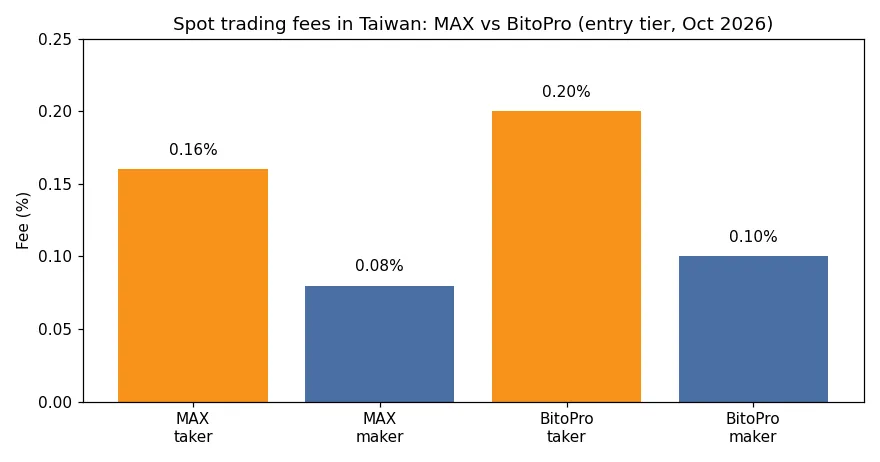
One-click buy screens hide a spread inside the quoted price, so the order book usually beats them for larger amounts. Check the official fee page before you trade, because tiers, discounts, and network fees change with volume and market conditions.
A NT$100,000 taker buy on BitoPro at 0.20 percent costs NT$200 in trading fees alone, before any withdrawal fee.
Can you pay cash at 7-Eleven?
Yes, MaiCoin built its early fame on convenience store buys, and its iBon route lets you pay cash at 7-Eleven. You generate a payment code in the MaiCoin app, take it to the store, and pay cash at the counter.
The system grew from Taiwan’s dense convenience store network, which put a cash on-ramp within walking distance of most city residents.
Treat the iBon route as a small-buy tool, not a main channel, and confirm it still shows in your app before you travel to a store. Cash routes carry their own limits, and store staff cannot fix a code problem or reverse a payment.
Bank transfer remains the cleaner route for larger amounts and clearer records.

Can you use a credit card in Taiwan?
No, Taiwanese credit cards cannot fund crypto buys, and this rule surprises many newcomers. The FSC wrote to the bankers association on 4 July 2022 and asked credit card acquirers to stop signing virtual asset firms as merchants.
Acquirers got three months to comply, and the FSC framed cards as payment tools for goods and services, not for speculative trading.
That rule explains why local exchanges list bank transfer and cash, but not card deposits. A site that promises instant card buys in Taiwan usually routes you offshore, charges a high processor fee, or breaks local rules.
Skip it, and use the bank transfer route instead.
Taiwan crypto law in 2026: registration today, licensing next
Taiwan law changed twice in two years, and beginners need the timeline straight. The old system asked exchanges to file an anti-money laundering (AML) declaration, then required full AML registration.
Firms that had filed earlier had to apply for AML registration by 31 March 2025 and complete it before 30 September 2025.
| Date | What changed | What it means for you |
|---|---|---|
| July 2021 | AML rules for crypto firms began | Exchanges started KYC and transaction monitoring |
| 4 July 2022 | FSC credit card letter | Taiwanese cards stopped funding crypto buys |
| 30 November 2024 | AML enforcement sharpened | FSC fined MaiCoin and BitoPro over AML gaps |
| 30 September 2025 | AML registration deadline passed | Registered firms form the safe shortlist today |
| 30 June 2026 | Virtual Asset Service Act passed | Full FSC licensing replaces AML registration in time |
| First quarter 2027 at earliest | Act and subordinate rules take effect together | Existing firms get 12 months to apply, 21 months to win a licence |
The Virtual Asset Service Act passed its third reading in the Legislative Yuan on 30 June 2026, and it names the FSC as sole regulator. It moves Taiwan from AML registration to permission-based licensing across seven provider categories, and it adds custody, capital, cybersecurity, and market conduct duties.
The Act is not yet in force, and the FSC has said it will take effect together with nine subordinate regulations, in the first quarter of 2027 at the earliest.
Stablecoin rules form part of the same Act, and they matter even if you only buy Bitcoin. Domestic stablecoin issuance will need central bank agreement plus FSC permission, full reserves held in trust, and redemption at face value, with no interest or yield paid.
Operating without the required licence can bring up to seven years in prison and a fine of up to NT$100 million, which shows how seriously Taiwan now treats unregistered activity.
Tax on Bitcoin in Taiwan: what beginners must track
Taiwan has no separate crypto tax code, so general income tax rules carry the load. The Ministry of Finance treats gains from non-securities virtual currencies for individuals as property transaction income, which joins your comprehensive income.
You subtract your original cost and related expenses from the sale price, and the result faces progressive individual rates from 5 percent to 40 percent.
Frequent or large-scale trading can shift your treatment toward business income, which brings registration and business tax duties. Keep every buy price, fee, and sale price, because your cost basis decides your tax bill.
This section gives general information only, and it is not tax advice, so talk to a Taiwan accountant before a large sale.
P2P and global exchanges: a careful second route
Some Taiwan users also trade on global platforms such as Binance, Kraken, or OKX, usually for coins local exchanges do not list. Global access varies by platform and verification level, and derivatives on some platforms stay geo-blocked for Taiwan users.
P2P trades add counterparty risk, so use platform escrow only, never pay a seller outside the platform, and never release coins before you confirm payment.
A common safe pattern runs like this: buy USDT on MAX or BitoPro, send it offshore over a low-cost network such as Arbitrum, trade there, then send USDT back and sell it for NTD locally. Check the network on both sides before you send, because a USDT token on the wrong network can strand funds.
Beginners should master the local route first, then add the offshore hop only when they need a coin they cannot buy at home.
Common mistakes Taiwan beginners make
Many first buys go wrong in the same few ways, and all of them are avoidable. Read the list once before you deposit, and keep it open during your first trade.
- Depositing NTD from a bank account in a different name, which stalls or bounces the transfer.
- Buying on a one-click screen and paying a hidden spread instead of using the order book.
- Trusting a Telegram seller, a fake exchange app, or anyone who promises guaranteed returns.
- Leaving a large holding on an exchange for months instead of moving it to self-custody.
- Sharing a seed phrase with support staff, a friend, or a website that claims it needs it for verification.
- Forgetting to save trade records, then facing a tax filing with no cost basis to show.
Scam pressure in Taiwan often arrives through social apps, fake investment groups, and cloned exchange websites. Real exchanges never ask for your seed phrase, never promise fixed profits, and never rush you to deposit through a personal account.
If a deal needs secrecy, speed, and a personal bank account, walk away from it.
How much Bitcoin should a beginner buy first?
Start with an amount you can afford to lose in full, and treat the first buy as a learning run. A small test deposit proves your bank link works, your verification holds, and your wallet receives coins.
Scale up only after you can deposit, buy, withdraw, and store coins without help.
Bitcoin price moves fast, and no guide can promise a return, so avoid loans, leverage, and borrowed money for a first buy. Regular small buys suit beginners better than one large timed bet, because they spread price risk across weeks.
Decide your budget before you open the app, and stick to it when prices spike.
Frequently asked questions
Here are the short answers to the questions Taiwan beginners ask most often.
Is it legal to buy Bitcoin in Taiwan?
Yes, owning and trading Bitcoin is legal in Taiwan, but Bitcoin is not legal tender. Local exchanges must register with the FSC, and the Virtual Asset Service Act passed in June 2026 will add full licensing once it takes effect.
Which exchange is best for beginners in Taiwan?
MAX suits beginners who want the deepest local USDT/TWD market and a simple NTD route, while BitoPro suits beginners who want more coins, recurring buys, and grid tools. Both are FSC-registered, so pick the interface you find easier and test it with a small deposit first.
Can I buy Bitcoin with cash in Taiwan?
Yes, MaiCoin offers a convenience store cash route through 7-Eleven iBon codes, but availability and limits can change. Confirm the option in your app before you go to a store, and use bank transfer for larger amounts.
Can I use a credit card to buy Bitcoin in Taiwan?
No, Taiwanese credit cards cannot fund crypto buys under the FSC rule set out in July 2022. Use a bank transfer from an account in your own name, or a cash code where the exchange still offers one.
Do I pay tax on Bitcoin gains in Taiwan?
Yes, gains for individuals generally count as property transaction income and join your comprehensive income tax return at progressive rates from 5 percent to 40 percent. Keep your cost basis and trade records, and ask a Taiwan accountant about frequent trading, which can count as business income.
Should I keep Bitcoin on the exchange?
Keep only trading funds on the exchange, and move long-term holdings to a wallet whose keys you control. Test with a small transfer first, store your seed phrase offline, and never share it with anyone.
Final word
Taiwan gives beginners a clear and legal path to Bitcoin, as long as they stay inside the registered system. Pick MAX or BitoPro, verify with your own ID and bank account, deposit NTD, and buy on the order book.
Then store your coins safely, keep your records, and ignore anyone who promises easy profits.
If you plan to explore other countries next, start with our guide to buying Bitcoin around the world, then compare Taiwan with how to buy Bitcoin in Japan and how to buy Bitcoin in South Korea. Readers who want a safer setup can also read our best Bitcoin wallets for beginners guide and our guide to buying Bitcoin in New Zealand, plus how to buy Bitcoin in Mexico for a contrasting cash-heavy market.