


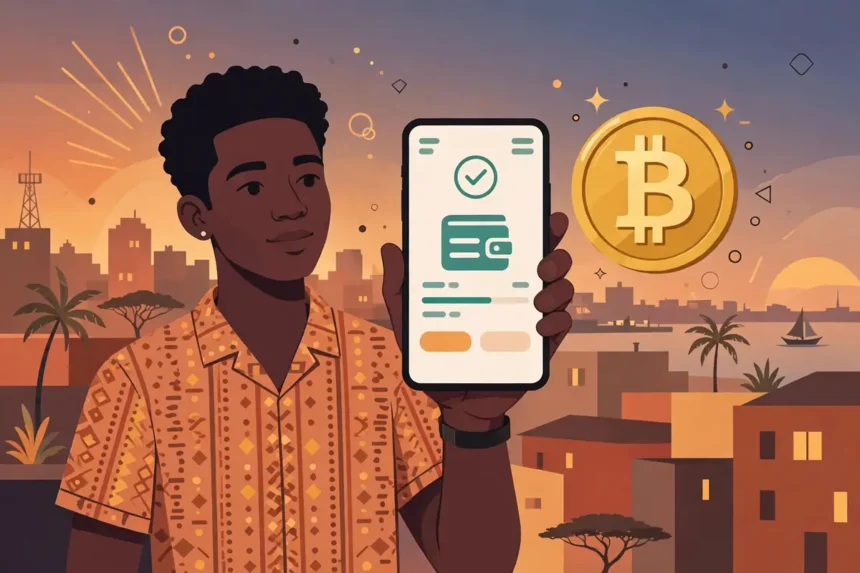
Yes, you can buy Bitcoin in Tanzania in 2026, and the route most Tanzanians actually use starts with mobile money, not a bank card. You send Tanzanian shillings (TZS) through M-Pesa, Airtel Money, or Mixx by Yas to buy USDT from a peer-to-peer (P2P) merchant, then you trade that USDT for Bitcoin (BTC) on the same exchange.
This guide walks through that mobile-money-first route step by step, explains the fees and the legal picture honestly, and shows how to avoid the scams that target first-time buyers.

Key takeaways
- Is Bitcoin legal in Tanzania?
- How to buy Bitcoin in Tanzania in 6 steps
- Step 1: Pick a P2P exchange with a live TZS desk
- Step 2: Verify your identity with your NIDA ID or passport
- Step 3: Buy USDT with mobile money through escrow
- Step 4: Trade USDT for Bitcoin on the spot market
- Step 5: Move larger holdings to a wallet you control
- Step 6: Save every receipt and record for tax
- Tanzania buyer route map: which way fits you?
- Where to buy Bitcoin in Tanzania: platforms compared
- Mobile money first: M-Pesa, Airtel Money, and Mixx by Yas
- Common mistakes Tanzania beginners make
- How much Bitcoin should a beginner buy first?
- Frequently asked questions
- Is Bitcoin legal in Tanzania?
- What is the easiest way to buy Bitcoin in Tanzania?
- Which exchanges work in Tanzania?
- Do I need ID to buy Bitcoin in Tanzania?
- Can I buy Bitcoin with M-Pesa?
- Do I pay tax on Bitcoin in Tanzania?
- Should I keep Bitcoin on the exchange?
- Final word
- Start with a P2P trade: TZS through mobile money into USDT, then USDT into BTC on the spot market.
- Use platform escrow for every P2P trade, and never pay a seller outside the exchange.
- Bitcoin is not legal tender in Tanzania, and the Bank of Tanzania warned against it in 2019, yet no specific law bans owning it, and a High Court ruling treated crypto contracts as valid.
- Keep every receipt, because the Finance Act 2024 added a 3 percent withholding tax on digital asset exchanges and transfers.
- Verify with your NIDA ID or passport, match every name exactly, and move larger holdings to a wallet you control.
Is Bitcoin legal in Tanzania?
Bitcoin is not legal tender in Tanzania, and only the Tanzanian shilling holds that status. The Bank of Tanzania said so clearly in a public notice in November 2019, when it warned that virtual currencies were not legally authorized and that people who used them did so at their own risk.
That warning still shapes the market today, because Tanzania has no dedicated crypto law that licenses exchanges or defines Bitcoin as a regulated asset. A buyer therefore uses global exchanges and P2P desks that operate without a Tanzanian licence, and no local regulator protects the trade if something goes wrong.
The picture is more mixed than a simple ban, though, and beginners should know both sides before they judge the risk. The Finance Act 2024, assented on 30 June 2024, introduced a 3 percent withholding tax on payments for digital asset exchanges and transfers from 1 July 2024, which treats crypto trading as a taxable economic activity even while it stays unlicensed.
Then the High Court (Commercial Division) ruled in the Yellow Card case in 2024 that crypto transactions are not inherently illegal in Tanzania, and that contracts involving them can still stand under general contract law. The court also noted that service providers and users must pay taxes under Tanzanian law, which points the same way as the Finance Act: unregulated does not mean outlawed, but it also does not mean protected.

In July 2026, Bank of Tanzania Governor Emmanuel Tutuba said at the Dar es Salaam International Trade Fair that the central bank is finalizing rules for cryptocurrencies and stablecoins. He pointed to money laundering and terrorist financing risks, to complaints from people who lost money, and to young investors who need protection, so the rules may arrive soon and change how platforms operate.
Until those rules land, treat every buy as a private, at-your-own-risk trade, and never present Bitcoin as an approved payment method or investment product in Tanzania.
| Date | What changed | What it means for you |
|---|---|---|
| November 2019 | Bank of Tanzania public notice on virtual currencies | Bitcoin is not legal tender, and use sits outside official approval |
| 30 June 2024 | Finance Act 2024 assented | Digital asset exchanges and transfers became taxable activity |
| 1 July 2024 | 3 percent withholding tax took effect | Keep records, because tax can apply even without a licence regime |
| 2024 | High Court ruling in the Yellow Card case | Crypto contracts are not automatically invalid, and tax still applies |
| July 2026 | Bank of Tanzania says crypto rules are being finalized | Expect new platform and consumer rules, and watch for updates before large buys |
How to buy Bitcoin in Tanzania in 6 steps
Most beginners finish the whole process in under an hour once their documents are ready. The slow part is identity verification, not the trade itself.
Follow the steps in order, and test with a small amount first.
Step 1: Pick a P2P exchange with a live TZS desk
Start with a large global exchange that runs an active TZS peer-to-peer desk, such as Binance or MEXC, or a P2P-friendly platform such as Bitget. Open the P2P section, filter for TZS, and confirm that merchants actually accept M-Pesa, Airtel Money, or Mixx by Yas before you register.
Check the merchant list at the time you plan to trade, because a desk that looked busy last week can thin out on weekends or holidays. A live desk with several merchants competing on price usually gives you a fairer rate than a single seller who sets the price alone.
Step 2: Verify your identity with your NIDA ID or passport
Tanzanian buyers usually verify with a NIDA ID, while foreign residents use a passport, and you must enter your names in the exact order printed on the document. Verification often clears within hours when the details match, and it can stall for days when a name order, a blurry photo, or a mismatched phone number breaks the check.
Use your own mobile money account and your own bank details throughout, because a name mismatch between your exchange account and your payment account is the most common reason a first trade stalls. Do not borrow a relative account for a shortcut, since the exchange can freeze funds that arrive under a different name.
Step 3: Buy USDT with mobile money through escrow
Pick a merchant with a strong record, ideally hundreds of completed trades and a completion rate near 98 percent or higher, and open the order inside the exchange. Send the exact TZS amount to the exact mobile money number the order shows, then mark the order as paid only after your mobile money transfer confirms.
Escrow holds the merchant USDT until the merchant confirms your payment, and guides report that release usually takes 5 to 15 minutes for a clean trade. Never release payment outside the platform, never accept a WhatsApp side deal, and never send money to a different number the seller mentions in chat.
Step 4: Trade USDT for Bitcoin on the spot market
Once USDT lands in your exchange wallet, go to the BTC/USDT spot pair and place a limit order if you want control over price. A limit order lets you set your price and wait, and it usually beats a one-click convert screen, which hides a spread inside the quoted price.
A market order fills at once, but it can slip when the order book is thin, so beginners should prefer a limit order for a first buy. Buy BTC directly with USDT, and skip extra hops through other coins, because each hop adds a fee and a chance to pick the wrong network.
Step 5: Move larger holdings to a wallet you control
Leave only trading funds on the exchange, and move long-term holdings to a wallet whose keys you control. A hardware wallet suits larger amounts, while a reputable mobile wallet suits small spending money, and you can read our guide on how to get a Bitcoin wallet before you choose.
Test the wallet first with a tiny transfer, then confirm the coins arrived before you move the rest. Write your seed phrase on paper, store it offline, and never type it into a website, app, or chat, because no real support team ever needs it.
Step 6: Save every receipt and record for tax
Download your P2P order records, mobile money receipts, USDT conversion history, and BTC trade history after every buy. Keep them together with dates and amounts, because the 3 percent withholding position and any future tax rules will turn on records you can actually show.
Good records also help if your mobile money provider or bank ever asks where a large transfer came from. This section gives general information only, and it is not tax advice, so talk to a Tanzanian accountant before a large sale.
Tanzania buyer route map: which way fits you?
Competitor guides list exchanges and stop there, but the real choice in Tanzania is the route your money takes. The table below compares the three routes a beginner in Tanzania actually faces, with the trade-off of each one, and it is the part of this guide no generic exchange list gives you.
Use it to pick one route for your first buy, not all three at once.
| Route | How it works | Best for | Watch out for |
|---|---|---|---|
| Mobile money P2P into USDT, then BTC spot | Pay TZS by M-Pesa, Airtel Money, or Mixx by Yas to a P2P merchant under escrow, then trade USDT for BTC | Most beginners, the route locals actually use | Merchant spreads, fake payment claims, wrong-network transfers |
| Broker app with bank funding, such as Yellow Card | Buy through an African broker app with local payment options, then hold or withdraw BTC | Buyers who want a simpler buy screen | Higher broker spreads, fewer trading tools, withdrawal limits to check |
| Card or third-party checkout on a global exchange | Pay by card or a third-party merchant where the platform offers it, often in dollars rather than TZS | Buyers with a working international card | High processor fees, possible card declines, weaker TZS paper trail |
The mobile money P2P route wins for most beginners, because it starts and ends in shillings, uses payment apps Tanzanians already trust, and leaves a clean mobile money receipt for every step. The broker route suits a buyer who values simplicity over price, while the card route only makes sense if you already hold a card that works internationally and you accept the extra cost.
Whichever route you pick, compare the final BTC amount after every fee, not the headline rate, because spreads and withdrawal fees decide what you actually receive.
Where to buy Bitcoin in Tanzania: platforms compared
Binance runs the deepest TZS P2P desk most Tanzanians meet first, and its Africa expansion added direct fiat channels and P2P trading across more than 30 countries, including TZS. MEXC also runs a live TZS desk with mobile money merchants, and Bitget offers P2P trading for Tanzanian users alongside spot trading.
Yellow Card takes a different shape, as an African broker founded in 2019 that lets users buy and sell with local bank options and also serve as merchants. It suits a buyer who wants a simple buy screen, but it gives up the order book control and merchant competition that a P2P desk offers.
Older list articles still name platforms such as Remitano, LocalCryptos, and Bitpesa, yet beginners should check current availability inside the app before trusting an old list. Platforms close, change country support, or drop payment methods without warning, and a dead listing can waste a whole afternoon.
Judge any platform by three live tests: a TZS desk with active merchants today, a withdrawal route you can actually use, and support that answers in a language you understand. If any test fails, pick another platform before you deposit.
Fees: what a Tanzania buy really costs
A Tanzania buy carries four costs, and beginners who count only one of them overpay. The P2P merchant spread sets your USDT price above the mid-market rate, the spot trading fee takes a small cut of the BTC trade, the Bitcoin withdrawal fee applies when you move coins off the exchange, and your mobile money provider may charge its own transfer fee.
One-click convert screens hide the spread inside the price, so the spot order book usually gives you more BTC for the same shillings. Check the official fee page before you trade, because tiers, discounts, and network fees change with volume and market conditions, and never trust a fee figure from an old blog post.
Mobile money first: M-Pesa, Airtel Money, and Mixx by Yas
Tanzania runs on mobile money, and that fact explains why the P2P route works better here than a bank transfer route. Vodacom M-Pesa leads the market, Airtel Money runs a close second, and Mixx by Yas (the renamed Tigo Pesa service) gives P2P merchants a third rail that many buyers already use daily.
That familiarity cuts both ways, because scammers also know these apps well, and they exploit the trust people place in a mobile money receipt. A genuine P2P trade stays inside the exchange from order to release, while a scam moves the conversation to WhatsApp, changes the payment number, or asks you to release coins before payment confirms.
Keep your mobile money PIN private, confirm the recipient name and number character by character, and screenshot every confirmation before you close the app. If a merchant asks you to mark an order as paid before you send money, cancel the order and report the merchant, because that request breaks the escrow protection that makes P2P safe.
Daily mobile money limits can also cap a large buy, so check your wallet limit before you start a big order. Split a large buy across days or merchants if you hit the limit, rather than rushing into a side deal that skips escrow.
Common mistakes Tanzania beginners make
Many first buys go wrong in the same few ways, and all of them are avoidable. Read the list once before you deposit, and keep it open during your first trade.
- Paying a P2P seller outside the exchange, which removes escrow protection and leaves no way to recover the money.
- Marking an order as paid before the mobile money transfer confirms, which lets a dishonest seller claim payment you never sent.
- Trusting a Telegram seller, a fake exchange app, or anyone who promises guaranteed returns on Bitcoin.
- Sending USDT or BTC on the wrong network, which can strand coins or lose them for good.
- Leaving a large holding on an exchange for months instead of moving it to self-custody.
- Sharing a seed phrase with support staff, a friend, or a website that claims it needs it for verification.
- Deleting mobile money receipts and P2P records, then facing a tax question with no paper trail to show.
Scam pressure in Tanzania often arrives through social apps, fake investment groups, and cloned exchange websites. Real exchanges never ask for your seed phrase, never promise fixed profits, and never rush you to deposit through a personal account.
If a deal needs secrecy, speed, and a personal mobile money account, walk away from it.
How much Bitcoin should a beginner buy first?
Start with an amount you can afford to lose in full, and treat the first buy as a learning run. A small test trade proves your mobile money link works, your verification holds, and your wallet receives coins.
Scale up only after you can deposit, buy, withdraw, and store coins without help.
Bitcoin price moves fast, and no guide can promise a return, so avoid loans, leverage, and borrowed money for a first buy. Regular small buys suit beginners better than one large timed bet, because they spread price risk across weeks.
Decide your budget before you open the app, and stick to it when prices spike.
Frequently asked questions
Here are the short answers to the questions Tanzania beginners ask most often.
Is Bitcoin legal in Tanzania?
Bitcoin is not legal tender in Tanzania, and the Bank of Tanzania warned against it in 2019, yet no specific law bans owning it. A 2024 High Court ruling treated crypto contracts as valid, while the Finance Act 2024 added a 3 percent withholding tax, and the central bank said in July 2026 that new rules are being finalized.
What is the easiest way to buy Bitcoin in Tanzania?
The easiest proven route runs through mobile money P2P: pay TZS by M-Pesa, Airtel Money, or Mixx by Yas to a verified P2P merchant under escrow, receive USDT, then trade USDT for BTC on the spot market. It uses payment apps you already know, and it leaves a receipt at every step.
Which exchanges work in Tanzania?
Binance, MEXC, and Bitget run P2P desks that serve Tanzanian users with TZS merchants, while Yellow Card offers a simpler African broker route. Check the live TZS desk, merchant activity, and withdrawal options inside the app before you deposit, because availability changes over time.
Do I need ID to buy Bitcoin in Tanzania?
Yes, reputable exchanges require identity verification before larger buys, fiat withdrawals, or full account access. Tanzanians usually verify with a NIDA ID, foreign residents use a passport, and your names must match your payment account exactly.
Can I buy Bitcoin with M-Pesa?
Yes, M-Pesa works through P2P merchants on global exchanges, not as a direct exchange deposit in most cases. You pay the merchant by M-Pesa inside an escrow order, the merchant releases USDT, and you then trade that USDT for Bitcoin.
Do I pay tax on Bitcoin in Tanzania?
Tanzania has no separate capital gains code for crypto, but the Finance Act 2024 added a 3 percent withholding tax on digital asset exchanges and transfers. Keep every receipt and trade record, and ask a Tanzanian accountant about your own position before a large sale.
Should I keep Bitcoin on the exchange?
Keep only trading funds on the exchange, and move long-term holdings to a wallet whose keys you control. Test with a small transfer first, store your seed phrase offline, and never share it with anyone.
Final word
Tanzania gives beginners a practical path to Bitcoin, as long as they stay inside escrow, keep their records, and respect the legal warning that still stands. Pick a live TZS P2P desk, verify with your own ID, pay by mobile money under escrow, trade USDT for BTC on the spot market, and store your coins safely.
Then ignore anyone who promises easy profits, and watch for the Bank of Tanzania rules that could change the market next.
If you plan to explore other countries next, start with our guide to buying Bitcoin around the world, then compare Tanzania with how to buy Bitcoin in South Korea, how to buy Bitcoin in Saudi Arabia, and how to buy Bitcoin in Sri Lanka. Readers who want a contrasting registered market can also read our guide to buying Bitcoin in Taiwan, and anyone curious about spending can read what you can buy with Bitcoin.