



Yes, you can buy Bitcoin legally in New Zealand, and most first buys take about 15 minutes once you pass identity checks. The safe route runs in a fixed order: check the platform on the Financial Service Providers Register, check the FMA warnings list, verify your identity, fund the account by NZ bank transfer, and buy.
That order matters more than the platform name. On 21 October 2026, converter data put one Bitcoin near NZ$145,700, so a NZ$1,000 buy gets you a small slice of a coin, and the fees and checks decide how much of that slice you actually keep.

If the basics still feel fuzzy, read our complete guide to what Bitcoin is and how it works first. Readers comparing countries can also browse our country guides hub for buying Bitcoin around the world.
- Is Bitcoin legal in New Zealand in 2026?
- Step one: check the register before you pay anyone
- Where Kiwis actually buy in 2026
- Stacked: Bitcoin only, straight to your wallet
- Swyftx: the Easy Crypto successor
- Independent Reserve: the order-book route
- What about big offshore exchanges?
- The real cost of a NZ$1,000 buy
- Step by step: your first buy
- Step 1: Create the account and verify
- Step 2: Deposit NZD by bank transfer
- Step 3: Buy Bitcoin
- Step 4: Move larger amounts to your own wallet
- The Cryptopia lesson: why self-custody is in this guide
- Tax in New Zealand: the record habit that saves you later
- Common mistakes and scams
- Skipping the register check
- Paying by card to save time
- Leaving everything on the platform
- Keeping no tax records
- FAQs
- Conclusion
Key takeaways
- Buying, holding and selling Bitcoin is legal in New Zealand. Bitcoin is not legal tender, and no shop must accept it.
- Check any platform on the Financial Service Providers Register and the FMA warnings list before you deposit a single dollar.
- Easy Crypto closed on 30 March 2026 after Swyftx bought it. Its customers moved to Swyftx, which now takes direct NZD bank deposits.
- A NZ$1,000 buy costs about NZ$5 to NZ$10.20 on the bank routes in our table below. Paying by card on the same platform can push the cost near NZ$37.
- Inland Revenue treats crypto as property. Keep dated records from your first buy, because a later sale, swap or spend can create a tax bill.
Is Bitcoin legal in New Zealand in 2026?
Yes. New Zealand law lets you own, buy, sell and trade Bitcoin, and local platforms operate openly under local rules.
No law makes Bitcoin legal tender. The New Zealand dollar stays the only currency anyone must accept for a debt.
How platforms are watched
Platforms that serve New Zealanders must register on the Financial Service Providers Register, follow anti-money-laundering law, and verify every customer. The Financial Markets Authority, the FMA, publishes warnings about scams and unregistered operators.
Registration is a legal minimum, not a quality stamp. It gives you a complaint path and a dispute scheme, but it never guarantees a platform stays solvent.

Why the register check comes first
Scammers clone real company names, registration numbers and logos, then point victims at lookalike websites. A two minute register check, done through the official listing and not through a link in an ad, cuts most of that risk.
New Zealand readers get a very different picture from readers in some other markets. Our Nepal guide explains a market where a central bank ban blocks buyers, while New Zealand lets you buy openly if you use the checks.
Step one: check the register before you pay anyone
Do this check before you create an account, not after you deposit. It takes about two minutes and it is the single step most guides skip.
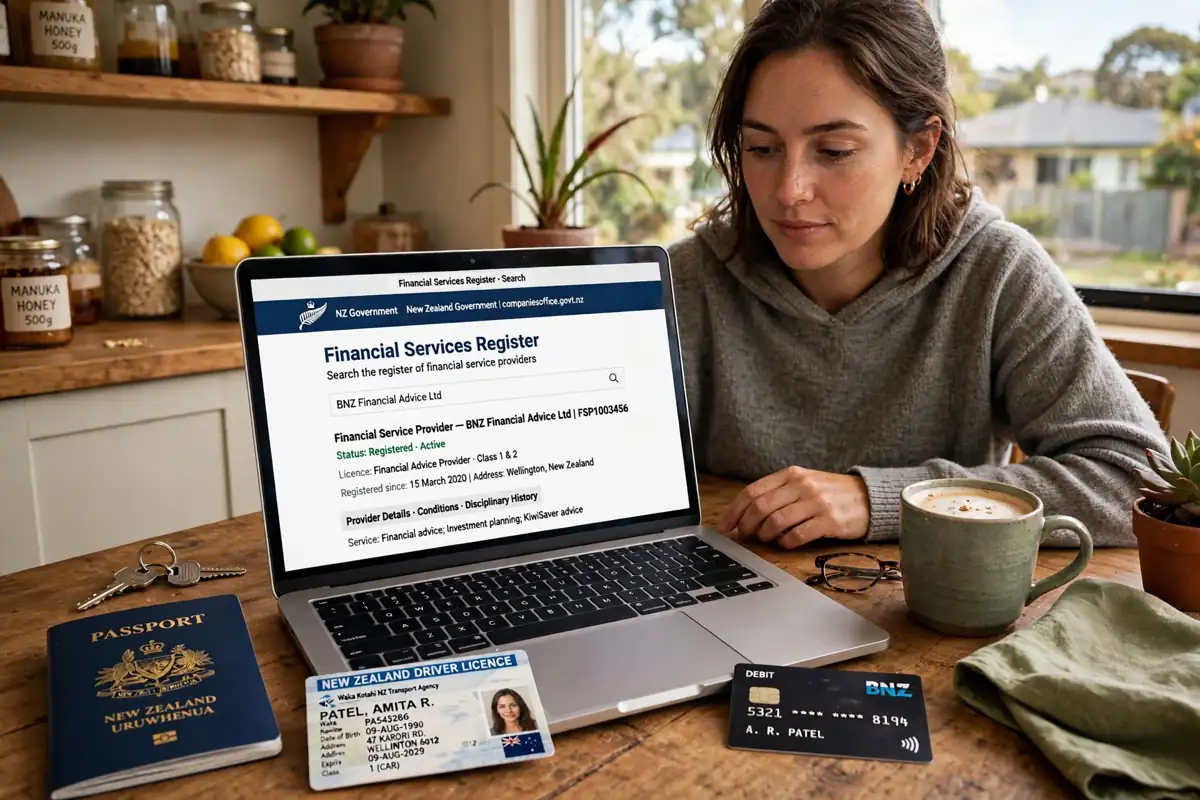
Open the Financial Service Providers Register and search the exact legal name of the company, not just its brand name. Then open the FMA warnings and alerts list and search the same name and website address.
What a good result looks like
A genuine listing shows the company name, its FSP number, its New Zealand address and the services it can offer. Stacked, for example, trades through Lightning Pay Limited and lists FSP1005773 on its own site, and you can match that number on the register.
Cross-check that the website address on the register matches the site in your browser, letter for letter. Clone sites often change one character and copy everything else.
What a bad result looks like
Treat a missing listing as a hard stop, not a grey area. The FMA warns again and again that platforms claiming New Zealand ties while missing from the register are running scams, and investors report blocked withdrawals.
Also walk away if a stranger on WhatsApp, Telegram or social media offers to buy for you. The FMA names those channels as the main route for fake crypto offers in New Zealand.
Where Kiwis actually buy in 2026
The local market changed this year, and old guides still send readers to a platform that no longer trades. Here is the honest current picture, checked on 21 October 2026.
Three routes cover most beginners: Stacked for Bitcoin-only self-custody, Swyftx for a large exchange with direct NZD banking, and Independent Reserve for order-book trading. Each one fits a different kind of buyer.
Stacked: Bitcoin only, straight to your wallet
Stacked is the rebranded Lightning Pay, run by a Queenstown team. It sells Bitcoin only, charges a flat 1 percent fee on most payment methods, and sends coins straight to a wallet you control.
Buys start at NZ$6, and Lightning delivery lands in seconds. The trade-off is simple: you must handle your own wallet and seed phrase from day one.
Swyftx: the Easy Crypto successor
Swyftx bought Easy Crypto in March 2025, and Easy Crypto stopped trading on 30 March 2026. Swyftx secured Kiwibank banking and started direct NZD deposits and withdrawals in January 2026, so former Easy Crypto users now buy there.
Its standard trading fee starts at 0.6 percent and falls with volume. Quotes also include a spread, and the platform shows that spread before you confirm.
Independent Reserve: the order-book route
Independent Reserve runs a real order book with NZD markets, so the price you see comes from other traders, not from a broker quote. Trading fees start at 0.5 percent and fall to 0.02 percent at high volume.
That structure suits larger or repeat buys. Small deposits can face extra charges on some routes, so check the fee page before you send a small test amount.
What about big offshore exchanges?
Large offshore platforms often price Bitcoin in US or Australian dollars for New Zealand users. That adds a currency conversion cost on top of the trading fee, and it can quietly beat the fee you tried to save.
They also sit outside the local register check this guide starts with. If you use one anyway, price the full NZD round trip first, like our Australia guide does for AUD platforms next door.
The real cost of a NZ$1,000 buy
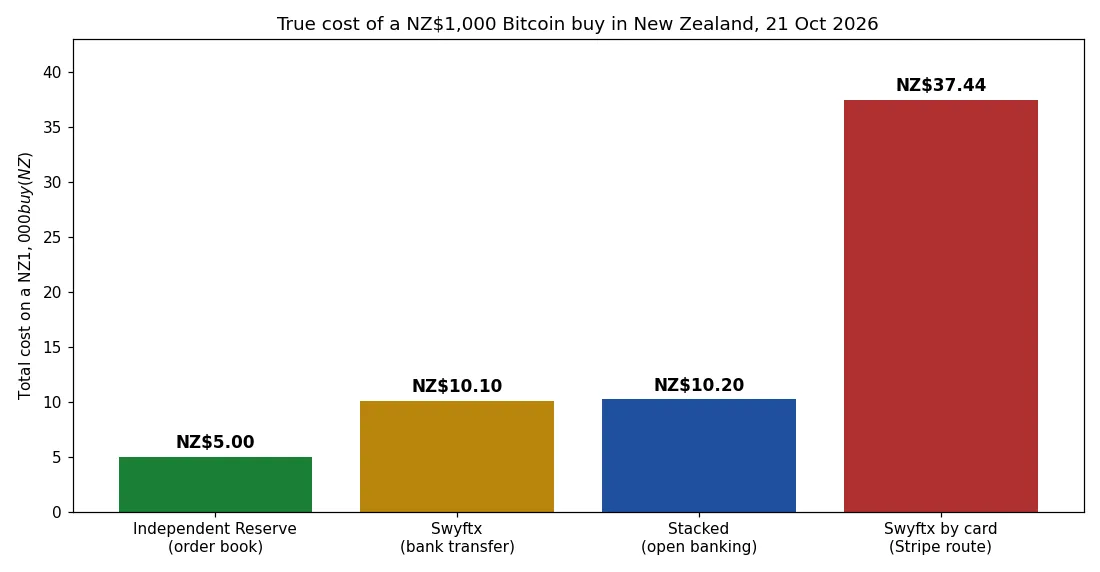
Headline fees lie by omission, because the trading fee is only one part of what a buy costs. Our table prices one identical NZ$1,000 Bitcoin buy on each main route, using fee schedules checked on 21 October 2026.
We count the trading fee, the spread where the platform charges one, and the payment cost. Crypto withdrawal network fees change with network load, so the table notes them instead of guessing a number.
| Route | Trading fee | Spread | Payment cost | Total on NZ$1,000 |
|---|---|---|---|---|
| Independent Reserve, order book | NZ$5.00 (0.5%) | None, order book pricing | Check small-deposit charges | About NZ$5.00 plus withdrawal network fee |
| Swyftx, bank transfer | NZ$6.00 (0.6%) | About NZ$4.10 (0.41% on Bitcoin) | Free NZD bank deposit | About NZ$10.10 plus withdrawal network fee |
| Stacked, open banking | NZ$10.00 (1%) | None claimed, rate shown before you confirm | NZ$0.20 bank fee on a test buy | About NZ$10.20, Lightning delivery free |
| Swyftx, card deposit via Stripe | NZ$6.00 (0.6%) | About NZ$4.10 | NZ$27.34 (2.734% card fee) | About NZ$37.44 |
The trap nobody prices: paying the wrong way
The card row is the lesson of the whole table. The same platform and the same coin cost about NZ$27 more on a NZ$1,000 buy, only because the deposit came by card instead of bank transfer.
Card routes through third parties run higher still. Swyftx lists its Banxa card route at a 1.99 percent fee plus a spread of up to 4 percent, which can pass NZ$59 on NZ$1,000 before the trading fee.
How to read this table honestly
Fees and spreads move, and platforms change tiers without much noise. Recheck the live fee page on the day you buy, and treat any difference from this table as normal.
The ranking lesson survives small changes. Bank transfer in NZD beats card deposits, and a visible fee beats a hidden spread every time.
Step by step: your first buy
With the register check done and a platform picked, the buy itself follows five plain steps. Keep your passport or driver licence beside you before you start.
Most beginners finish in about 15 minutes. Verification reviews can add a day on busy platforms, so do not fund a time-sensitive buy at the last minute.
Step 1: Create the account and verify
Sign up with your real name and address, then complete identity verification with a New Zealand passport or driver licence. Swyftx also asks New Zealand customers for a selfie check before the first NZD deposit.
Turn on two-factor authentication right away. An authenticator app beats text codes, because scammers target phone numbers.
Step 2: Deposit NZD by bank transfer
Send money from a bank account in your own name, and copy the reference code exactly as the platform shows it. Swyftx charges nothing for NZD bank deposits, and deposits usually land within a few hours but can take one to three days.
Start with a small test deposit if the amount feels large. A NZ$50 test costs a little time and removes most first-buy stress.
Step 3: Buy Bitcoin
Enter the NZD amount, check the fee and the spread on the confirmation screen, and only then confirm. On Stacked, the coins go straight to your wallet; on Swyftx and Independent Reserve, they land in your platform account first.
Save the confirmation screen or export the trade record now. Future you, at tax time, will thank present you.
Step 4: Move larger amounts to your own wallet
Leave small learning amounts on the platform if you must, but move serious money to a wallet you control. Our walkthrough on how to use Sparrow Wallet for free Bitcoin self-custody covers the desktop setup step by step.
Send a tiny test withdrawal first and confirm it arrives. Only then send the rest, and double-check the address on the wallet screen itself.
The Cryptopia lesson: why self-custody is in this guide
New Zealand already lived through the worst version of leaving coins on a platform. Cryptopia, a Christchurch exchange, suffered a hack in January 2019 and lost crypto worth about NZ$30 million at the time.
Liquidators took over in May 2019, and the claims process ran for years. A High Court ruling in 2020 confirmed the coins were property held on trust, and verified holders only began receiving distributions years later.
What that history changes for you
It does not mean every platform fails. It means the platform step and the storage step are two different decisions, and this guide treats them that way.
Read how to store Bitcoin safely, with hot wallets and cold wallets compared, before your holdings grow past learning money. European readers follow the same storage logic after buys like the ones in our Germany guide to buying Bitcoin with SEPA transfers.
Tax in New Zealand: the record habit that saves you later
Inland Revenue, the IRD, treats cryptoassets as a form of property for tax purposes. The IRD states that treatment depends on the characteristics and use of the asset, not on its name.
That one fact drives everything else. New Zealand has no separate capital gains tax, so crypto profits fall under the normal income tax rules.
When a tax bill can appear
The IRD says income from selling, trading or exchanging cryptoassets is generally taxable, and it adds that income to your other income for the year. Swapping one coin for another counts as a disposal, even if you never touch New Zealand dollars.
Whether your own sale is taxable depends on your facts, and the key question is your purpose when you acquired the coins. State it that carefully to yourself, and get advice if real money is involved.
The record template
The IRD now matches exchange data against tax returns and follows up on differences, and it says New Zealand has about 355,000 crypto users. A simple dated record, kept from your first buy, turns a scary letter into a boring one.
| Write down | Example entry |
|---|---|
| Date and platform | 21 Oct 2026, Swyftx |
| What you did | Bought Bitcoin with NZD |
| NZD amount and fees | NZ$1,000 total, NZ$10.10 in fee and spread |
| Bitcoin received | Amount in BTC from your trade confirmation |
| Wallet address used | The address you withdrew to, if you withdrew |
| Why you bought | One honest line in your own words |
Keep screenshots of each trade confirmation in the same folder. Records answer questions years later, when platform emails and memory both fail.
Common mistakes and scams
Most losses in this market come from process errors, not from the Bitcoin price. These are the ones New Zealand regulators and platforms warn about most.
Every one of them is cheap to avoid before the buy and expensive to fix after it.
Skipping the register check
Fake platforms copy real brands and advertise on social media with celebrity faces and guaranteed returns. If the name is missing from the register or sits on the FMA warnings list, your money has no local complaint path.
Paying by card to save time
The cost table above shows the price of that shortcut. Card deposits add percent-level fees and third-party spreads, while an NZD bank transfer on the main platforms costs nothing.
Leaving everything on the platform
Cryptopia holders waited years for partial returns. Move amounts that matter to a wallet you control, back up the seed phrase on paper or steel, and never store it in a photo or a cloud note.
Keeping no tax records
The IRD receives exchange data and now gets overseas data through the Crypto-Asset Reporting Framework. A buyer with dated records answers in minutes; a buyer without them reconstructs years of trades at the worst possible moment.
FAQs
Is it legal to buy Bitcoin in New Zealand?
Yes. Buying, holding and selling Bitcoin is legal in New Zealand, and local platforms operate openly under New Zealand rules, though Bitcoin is not legal tender.
How do I check if a crypto platform is registered in New Zealand?
Search the Financial Service Providers Register for the company legal name and FSP number, then search the same name on the FMA warnings and alerts list before you deposit.
Is Easy Crypto still open?
No. Swyftx acquired Easy Crypto in March 2025, and Easy Crypto stopped trading on 30 March 2026, with customers moving to Swyftx.
What is the cheapest way to buy Bitcoin in New Zealand?
On the fee schedules checked on 21 October 2026, an order-book buy on Independent Reserve cost about NZ$5 in trading fees on NZ$1,000, while bank-funded buys on Swyftx and Stacked cost about NZ$10.10 and NZ$10.20 in total.
Do I pay tax when I buy Bitcoin in New Zealand?
Buying with New Zealand dollars creates no tax bill by itself, but the IRD treats crypto as property and says income from selling, trading or exchanging it is generally taxable, so keep dated records from your first buy.
What ID do I need to buy Bitcoin in New Zealand?
Platforms verify your identity under anti-money-laundering law, usually with a New Zealand passport or driver licence, and some also require a selfie check before your first deposit.
Conclusion
You now know how to buy bitcoin in new zealand the careful way: register check first, NZD bank transfer second, card deposits never. Stacked, Swyftx and Independent Reserve each serve a real type of buyer, and our NZ$1,000 table shows the true cost gap between them.
Your next step is small and concrete. Open the register, run the two searches from step one, and make a test buy you can record in the template above.