


Etsy does not accept Bitcoin at checkout, and no setting in your shop changes that. If you sell on Etsy and want to take Bitcoin, the payment has to happen somewhere else.
That somewhere else is your own store. You run it next to your Etsy shop, you take Bitcoin there with a payment gateway, and every order that starts on Etsy still gets paid through Etsy.

This guide shows you how to accept Bitcoin payments on Etsy the legal way in 2026, what it costs, and the October policy change that killed the old workaround.
- Key Takeaways
- Can You Accept Bitcoin on Etsy? The Short Answer
- The October 2026 Rule Change That Killed the Old Workaround
- How to Accept Bitcoin Payments on Etsy the Legal Way
- Step 1: Set up your own store
- Step 2: Add a Bitcoin gateway
- Step 3: Tell buyers on your own channels, not on Etsy
- Step 4: Keep every Etsy order on Etsy
- NOWPayments vs BTCPay Server: Which Gateway Fits an Etsy Seller?
- What Bitcoin Saves You: Real Fee Math on a $50 Sale
- What to Do When a Buyer Asks to Pay in Bitcoin
- 5 Mistakes That Get Etsy Shops in Trouble
- Taxes: Bitcoin Income Still Counts
- Frequently Asked Questions
- Does Etsy accept Bitcoin?
- Can I add Bitcoin as a payment method in my Etsy shop settings?
- Is it legal to take Bitcoin from an Etsy buyer?
- What is the cheapest way to accept Bitcoin as a seller?
- Do I still pay Etsy fees if a buyer pays me in Bitcoin?
- Can I put a link to my own store in my Etsy shop?
- Sources
- The Bottom Line
Key Takeaways
- Etsy has no Bitcoin checkout, and its Help Center payment list for November 2026 still shows no cryptocurrency option.
- Etsy’s Off-Platform Transactions Policy, updated October 5, 2026, now bans naming cryptocurrency as a way to pay for an item, so the old “Other” payment method trick is a suspension risk.
- The compliant route is your own store plus a gateway: NOWPayments charges 0.5 percent per sale, and BTCPay Server charges no per-sale fee at all.
- On a $50 item with $6 shipping, Etsy takes $5.77 in fees while a Bitcoin sale through NOWPayments costs $0.28.
- Never steer an Etsy buyer to pay off Etsy in messages, listings, or QR codes. Etsy scans for it, and the penalty runs from warnings to a closed shop.
Can You Accept Bitcoin on Etsy? The Short Answer
No. Etsy runs every payment through Etsy Payments in most countries, and its checkout list covers cards, PayPal where available, Apple Pay, Google Pay, Etsy gift cards, and Klarna installments in some countries.
Bitcoin is not on that list, and Etsy has no plan on its help pages to add it.
That surprises a lot of sellers because older guides say otherwise. Those guides describe a manual payment method called “Other” that used to let a buyer pay however the seller liked, including crypto.
That door is now closed, and the next section explains why.

The October 2026 Rule Change That Killed the Old Workaround
On October 5, 2026, Etsy rewrote its Off-Platform Transactions Policy and started enforcing it hard from October 6. The new text bans sellers from naming an off-platform payment method, and it gives cryptocurrency as the example, as a way to pay for an item.
Read that twice. It is not a gray area anymore.
Writing “I accept Bitcoin” in a listing, a shop policy, or a message to a buyer now breaks a written rule, and Etsy has been removing listings and flagging shops for it since the change rolled out.
What the policy bans, in plain English
Four things matter for a seller who wants to take crypto. First, you cannot tell a buyer to pay through a personal website, a social media shop, or another marketplace.
Second, you cannot ask for or share contact details, like an email or a social handle, to finish a sale off Etsy.
Third, you cannot offer a discount, a free item, or cheaper shipping to pull a buyer off Etsy. Fourth, you cannot use a QR code to send a buyer off Etsy to pay.
Break any of these and you risk a warning, a message restriction, or a closed shop.
Warning: the old advice is now the risky advice. Any guide that tells you to enable “Other” in your payment settings and take Bitcoin from Etsy buyers is describing a setup that Etsy’s October 2026 policy now bans by name.
Do not follow it.
How to Accept Bitcoin Payments on Etsy the Legal Way
The legal way is simple to state and takes real work to build. You keep your Etsy shop exactly as it is, and you build a second sales channel that you own, usually a small store on Shopify or WooCommerce, where Bitcoin checkout lives.
Buyers who find you on your own site, your social pages, or a web search can pay in Bitcoin there. Buyers who find you on Etsy pay through Etsy, every time.
The two channels stay separate, and that separation is what keeps your shop safe.
Step 1: Set up your own store
Pick the platform you already know. Shopify is the fastest start if you want a hosted store, and you can accept Bitcoin on Shopify in seven steps.
WooCommerce fits if you already run WordPress, and our WooCommerce Bitcoin setup covers that path. BigCommerce Bitcoin checkout is a third hosted option if you want more built-in tools.
List your best sellers there first, not your whole catalog. Ten products live beats a hundred products half finished.
Price your products in dollars, not Bitcoin, because Bitcoin’s price moves all day and every gateway converts the dollar price to Bitcoin at the moment the buyer pays.
Step 2: Add a Bitcoin gateway
Install a crypto payment gateway on your store. NOWPayments plugs into Shopify and WooCommerce, charges 0.5 percent per sale, and accepts more than 200 coins.
BTCPay Server is the free option: it charges no per-sale fee, you host it yourself, and you keep every cent after your hosting cost.
Connect your wallet, turn on auto-conversion to a stablecoin like USDT if you do not want price swings, and run one test payment yourself before you tell anyone about it. A test sale catches the broken settings that a real customer never forgives.
Step 3: Tell buyers on your own channels, not on Etsy
Announce Bitcoin payments where you control the audience: your own website, your Instagram bio, your newsletter, your market stall. People who find you there are your customers, and Etsy has no say over how they pay you.
Do not put the announcement in your Etsy listings, your shop policies, or your Etsy messages. That is the exact behavior the October policy bans, and Etsy scans messages for payment names like Bitcoin, Venmo, and PayPal.
Step 4: Keep every Etsy order on Etsy
When an Etsy buyer asks to pay in Bitcoin, say no politely and point them back to Etsy checkout. One off-platform sale can cost you the shop that brings in most of your orders, and it is never worth it.
The habit to build is simple. Etsy money moves through Etsy, and Bitcoin money moves through your own store.
Never mix the two, and never let a buyer talk you into mixing them.
NOWPayments vs BTCPay Server: Which Gateway Fits an Etsy Seller?
Two gateways cover almost every small seller, and they fit different needs. NOWPayments is the easy one: you install a plugin, paste an API key, and you can take Bitcoin in about ten minutes.
BTCPay Server is the cheap one: no per-sale fee, but you set it up and host it yourself.
Pick NOWPayments if you want speed and you sell a few orders a week. Pick BTCPay Server if you sell every day and the fees start to add up.
Either way, you keep far more of each sale than Etsy keeps.
| Gateway | Fee per sale | Setup | Best for |
|---|---|---|---|
| NOWPayments | 0.5% | Plugin, about 10 minutes | Sellers who want it live today |
| BTCPay Server | 0% (you pay hosting) | Self-hosted setup | High-volume sellers who want zero fees |
| Etsy Payments | 3% + $0.25 (US) plus 6.5% transaction fee | Built into Etsy | Etsy orders only, no Bitcoin |
If you want the full picture before you choose, our Bitcoin payment processors compared guide walks through BTCPay, BitPay, and Coinbase Commerce side by side.
What Bitcoin Saves You: Real Fee Math on a $50 Sale
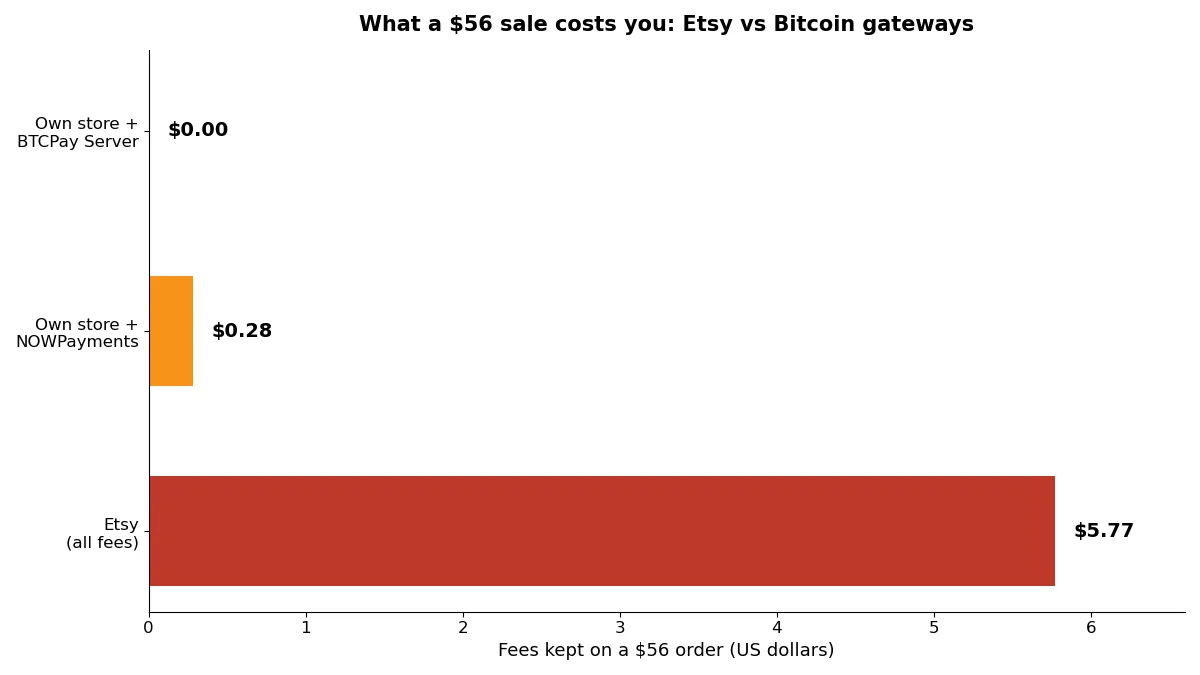
Fees are where the two channels pull apart. Take a handmade mug that sells for $50 with $6 shipping, so the buyer pays $56 in total.
On Etsy, three fees stack up. The listing fee is $0.20.
The transaction fee is 6.5 percent of $56, which is $3.64. The payment processing fee in the US is 3 percent of $56 plus $0.25, which is $1.93.
Add them up and Etsy keeps $5.77, or about 10.3 percent of the order.
On your own store, the same $56 order paid in Bitcoin through NOWPayments costs 0.5 percent, which is $0.28. Through BTCPay Server, the gateway fee is $0.00.
That is $5.49 back in your pocket on every single order, before your store hosting, which is a flat monthly cost and not a cut of each sale.
| Fee | Etsy | Own store + NOWPayments | Own store + BTCPay Server |
|---|---|---|---|
| Listing fee | $0.20 | $0.00 | $0.00 |
| Transaction fee | $3.64 (6.5%) | $0.00 | $0.00 |
| Payment processing | $1.93 (3% + $0.25) | $0.28 (0.5%) | $0.00 |
| Total on a $56 order | $5.77 | $0.28 | $0.00 |
The gap is real, but keep it in perspective. Etsy brings you about 87 million active buyers, and your own store brings you nobody until you market it.
The smart play is to use Etsy for discovery and your own store for repeat buyers who already trust you.
What to Do When a Buyer Asks to Pay in Bitcoin
It will happen. A buyer messages you on Etsy and asks if they can pay in Bitcoin instead.
The safe answer is short, polite, and firm: all payments go through Etsy checkout, because that is how buyer protection works.
Do not share your wallet address in the message. Do not share your email so they can “sort it out” with you.
Etsy scans messages for wallet talk and contact details, and a flagged thread can restrict your messaging or your shop.
You can still win that buyer. Point them to your own store only if they found you outside Etsy, never inside an Etsy message thread.
If they came through Etsy, finish the sale on Etsy and move on.
5 Mistakes That Get Etsy Shops in Trouble
Most shops that get flagged for payment rules make one of these five mistakes. None of them feel like rule-breaking in the moment, and all of them are written down in Etsy’s policies.
- Naming Bitcoin in a listing or shop policy. The October 2026 policy names cryptocurrency outright. A line like “we accept Bitcoin” in your policies is now a violation on its own.
- Taking a custom order to email and invoicing in crypto. A custom order that starts in Etsy Messages must be paid through Etsy, usually as a custom listing. Moving it to email to take Bitcoin is fee avoidance.
- Offering a discount for paying off Etsy. A “pay in Bitcoin and save 10 percent” offer is banned twice over: it names an off-platform method and it offers an off-platform incentive.
- Hiding a wallet address in a QR code. Etsy bans QR codes that send buyers off the platform, and a QR code that opens a wallet is the same thing in Etsy’s eyes.
- Using package inserts to pull Etsy buyers to your site. A business card in the parcel is fine on its own, but a card that offers a discount for buying the same item on your website is steering, and Etsy treats it as fee avoidance.
Taxes: Bitcoin Income Still Counts
Getting paid in Bitcoin does not make the income invisible. In most countries, crypto you receive for goods counts as business income at its value when you receive it, and swapping it later can trigger a second tax event.
Keep a record of every sale: the date, the dollar value, the amount of Bitcoin, and the wallet it went to. A simple spreadsheet beats a shoebox of screenshots when tax season arrives.
If your sales grow, talk to a tax professional who knows crypto, because the rules change by country and they change often.
Frequently Asked Questions
Here are the questions Etsy sellers keep asking about Bitcoin payments.
Does Etsy accept Bitcoin?
No. Etsy’s checkout list covers cards, PayPal where available, Apple Pay, Google Pay, Etsy gift cards, and Klarna installments in some countries.
Cryptocurrency is not on the list, and Etsy’s Help Center pages from November 2026 still show no crypto option.
Can I add Bitcoin as a payment method in my Etsy shop settings?
No. Etsy Payments is the only checkout for sellers in most countries, and it has no Bitcoin option.
The old manual “Other” payment method is no longer a safe workaround, because Etsy’s October 2026 policy bans naming cryptocurrency as a way to pay for an item.
Is it legal to take Bitcoin from an Etsy buyer?
Taking Bitcoin itself is legal in most places, but taking it for an Etsy order breaks Etsy’s rules. Etsy’s Off-Platform Transactions Policy, updated October 5, 2026, bans asking a buyer to pay off Etsy and bans naming cryptocurrency as a payment method for an item.
A sale that starts on Etsy has to finish on Etsy.
What is the cheapest way to accept Bitcoin as a seller?
BTCPay Server is the cheapest gateway because it charges no per-sale fee, though you host it yourself. NOWPayments is the easiest option at 0.5 percent per sale with plugins for Shopify and WooCommerce.
Both beat Etsy’s combined fees, which run to about 10.3 percent on a typical US order.
Do I still pay Etsy fees if a buyer pays me in Bitcoin?
If the sale happens on Etsy, yes, Etsy still charges its fees, because the order went through Etsy checkout. If you take Bitcoin on your own store for a buyer who found you outside Etsy, you pay no Etsy fee on that sale, only your gateway fee.
Can I put a link to my own store in my Etsy shop?
Yes, in limited places. Etsy lets sellers link a personal website in the shop’s About section, as long as the link does not urge buyers to leave Etsy to make a purchase.
Links in listings, messages, or QR codes that push buyers off Etsy are banned.
Sources
- Etsy Payments Policy (Etsy)
- Etsy Fees and Payments Policy (Etsy)
- NOWPayments (gateway fees and supported coins)
Etsy’s Off-Platform Transactions Policy, updated October 5, 2026, was also consulted for this guide.
The Bottom Line
You cannot take Bitcoin through Etsy checkout, and since October 2026 you cannot even advertise it to Etsy buyers. The sellers who win with Bitcoin are the ones who build a small store of their own, take crypto there, and let Etsy do what it does best: bring new buyers to the door.
Start with your ten best products, add NOWPayments or BTCPay Server, and run one test payment today. Your next step is our complete guide to accepting Bitcoin payments, which walks through every gateway and setup in one place.