



Glassnode data shows bitcoin treasury companies stopped buying at scale, even though they now sit in profit. The firms Glassnode tracks hold Bitcoin at an average cost of about $80,200, and every month since June they added less than a tenth of their November 2024 peak month.
Bitcoin traded near $82,880 on the morning of October 22, only about 3.3 percent above that $80,200 cost basis. Price has closed above the line every day since September 18, but the buying never came back with the recovery.

Key takeaways
- Glassnode puts the average treasury company cost basis near $80,200, and the US spot ETF cost basis sits in the same $80,000 to $81,500 zone.
- The October 15 sweep hit an hourly close near $80,100, tested both groups at once, and recovered the next hour.
- Monthly treasury buying since June runs below 10 percent of the November 2024 peak, a drop of more than 90 percent.
- Bitcoin sits boxed between the $80,200 floor and heavy supply near $86,700, where 6 to 12 month holders break even.
- US spot ETFs took in about $653 million on October 19, so ETF flows now carry the demand side while treasuries wait.
The $80,200 Floor, in Glassnode’s Own Terms
Glassnode published its Week 42 report, titled Swept and Refilled, with treasury data as of October 19. The firm says it derived the $80,200 figure from the holdings and unrealized profit of the treasury companies it tracks.
- The $80,200 Floor, in Glassnode’s Own Terms
- The Buying Strike: Below 10 Percent of the Peak
- The Box: A Tested Floor and a Heavy Ceiling
- ETFs Now Carry the Demand Side
- A Note on the Wrong $43,200 Figure
- Common Mistakes Readers Make With This Data
- Frequently Asked Questions
- Conclusion: Watch the Edges of the Box
The report puts the treasury line just under the ETF line, with both cost bases between $80,000 and $81,500. Readers can read the primary report on the Glassnode research site and check every figure in this article against it.
The October 15 Sweep That Tested It Live
Bitcoin dipped hard on October 15, and the deepest hourly close reached about $80,100. The next hourly close moved back above the ETF cost basis, so the market tested the floor and held it within two hours.
Glassnode says the sweep traded through the largest block of bids on the Binance spot book, which sat at $80,000. Those bids refilled by October 20, but buyers rebuilt them smaller than at their peak.
Why a Cost Basis Works as a Floor
A cost basis marks the average price a group paid for its coins. Holders defend that line in practice because a drop below it turns their whole position into a paper loss.

Glassnode states the risk plainly in the report. A daily close below $80,000 would put both the average ETF holder and the average treasury holder at a loss on average.
Our coverage of Strategy holding 848,000 BTC after its third quarter gain shows how large that treasury group has become. A group that big changes the map, because its break-even line now acts as a market level, not just an accounting number.
The Buying Strike: Below 10 Percent of the Peak
The headline number in the report is not the floor, it is the missing demand. Every month since June added less than a tenth of the peak month, November 2024, even as price recovered above the cost basis.
That pattern breaks the loop that powered the 2024 to 2025 treasury boom. Buying pushed price up, price lifted share prices, and rich share prices funded more buying.

Why Profitable Holders Stopped Buying: Our Analysis
This section shares our analysis, not a Glassnode claim. Glassnode reports the slowdown, and the reasons below reflect how treasury financing normally works.
First, many treasury stocks lost their fat premium over the value of their Bitcoin. A company that trades near its net asset value raises far less cheap money for new coins, so boards slow the program.
Second, financing costs more now than it did during the boom. Glassnode notes the two-year Treasury yield reached 4.8 percent this year, and expensive debt makes boards demand a clearer payoff before they add leverage.
Third, index risk now hangs over the biggest names. Our report on Strategy buying back its STRC shares for $192 million shows management already juggles capital tools instead of simply issuing stock to buy coins.
Fourth, boards likely wait for proof that the floor holds. A treasurer who buys just 3 percent above break-even risks fresh paper losses on one bad daily close, so patience costs little.
What the MSCI Decision Adds
MSCI adopted new rules on October 15 for what it calls non-operating companies. Its test run flagged Strategy and Metaplanet, and MSCI will publish the final removal list on November 11.
Strategy shares fell nearly 10 percent on October 16, their worst day since February, while Bitcoin barely moved. A removal would force index funds to sell the stock, and Glassnode asks whether Strategy would keep buying Bitcoin under that pressure.
Readers who follow the Capital B treasury loss story already know the other side of this trade. Treasury stocks carry real accounting and market risk, even when the company sells no coins at all.
The Box: A Tested Floor and a Heavy Ceiling
Our own math, built only from the Glassnode levels and the October 22 price, shows how tight the range has become. No other outlet has laid the levels out this way, so readers can judge the box at a glance.
Bitcoin needs a rise of only about 4.6 percent to reach the $86,700 ceiling. It needs a fall of only about 3.2 percent to lose the $80,200 floor, so the next break in either direction sits close.
| Level | Price | Distance from $82,880 | What it means |
|---|---|---|---|
| 1 to 2 year holder cost basis | Near $100,000 | About 20.7 percent above | The next big break-even line after $86,700 |
| Main ask block on Binance | $86,500 to $87,500 | About 4.4 to 5.6 percent above | The first heavy resistance on the order book |
| 6 to 12 month holder cost basis | Near $86,700 | About 4.6 percent above | A daily close above it puts that group back in profit |
| Bitcoin price, morning of Oct 22 | Near $82,880 | Reference point | Price sits inside the box, closer to the floor |
| US spot ETF cost basis zone | $80,000 to $81,500 | About 1.7 to 3.5 percent below | The zone the October 15 sweep tested |
| Treasury company cost basis | Near $80,200 | About 3.2 percent below | The floor this article tracks |
| True Market Mean | Near $77,600 | About 6.4 percent below | The next support if the floor fails |
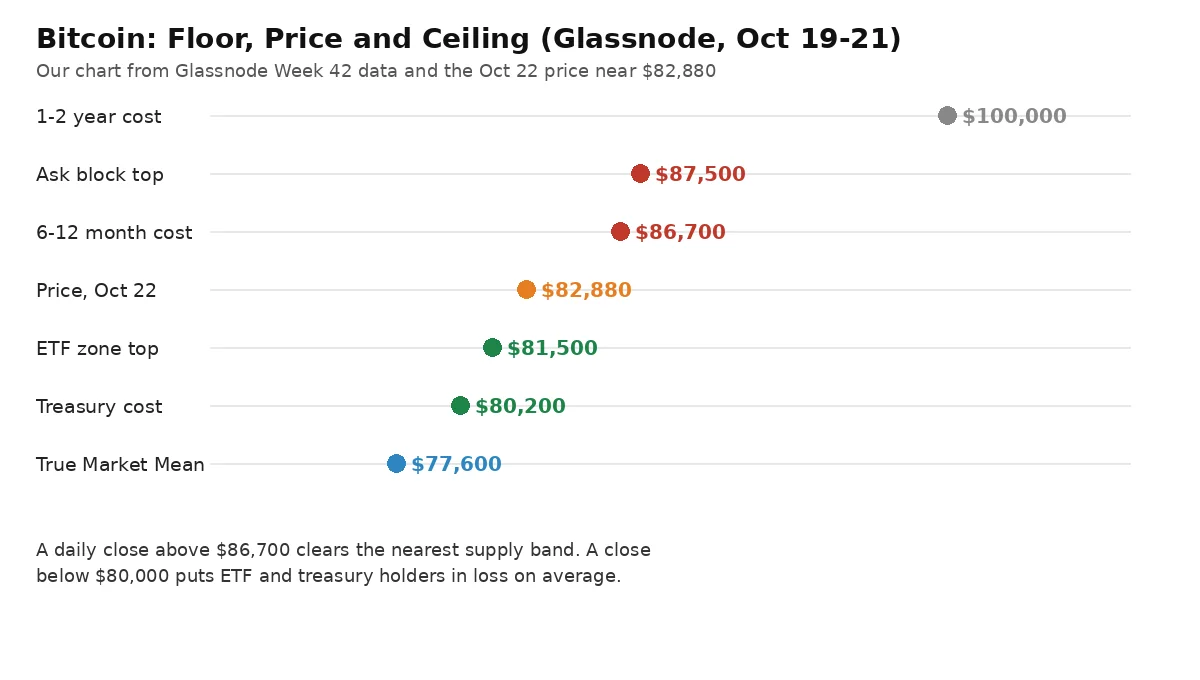
Glassnode adds two details that sharpen the ceiling picture. The two largest liquidation clusters now sit above price, near $85,000 and $87,000, while a bright line remains below price near $79,600.
A move toward $87,000 could gain speed as shorts close, but the same zone holds the ask block. Traders saw a similar wall in Bitcoin’s repeated rejection at $87,000, and the order book still defends that area.
What a Break Each Way Would Mean
A daily close above $86,700 would put 6 to 12 month buyers back in profit on average. Glassnode says that close would also clear the nearest band of overhead supply, and it would test whether sellers return at $87,500.
A daily close below $80,000 would flip the story. Both big holder groups would sit in loss, and the True Market Mean near $77,600 would come into view as the next line.
Selling pressure has eased for now, which helps the bulls wait. Glassnode says the 1 to 2 year group now moves less than a third as many coins a day as it moved at its start of October peak, and profit taking runs at about half its September high pace.
ETFs Now Carry the Demand Side
The demand baton has passed from corporate treasuries to the funds. US spot ETFs took in about $653 million on Monday, October 19, their largest day since September 22, and that single day turned the weekly flow positive again.
Farside data adds a fresh example, with Fidelity’s FBTC recording a $212.7 million inflow in its latest print. Readers can compare that pace with Bitcoin ETFs opening October with $103 million in inflows to see how uneven the month has run.
Glassnode sounds one clear warning about the ETF bid. Trading volume stayed thin on the big inflow day, and the 30-day average volume sits below a quarter of its level a year ago.
Inflows that repeat on rising volume would show demand broadening beyond a single day. Until volume confirms the flows, our Bitcoin price prediction for 2026 treats the box, not a breakout, as the base case.
Macro timing also matters this month. The Fed decides rates on October 28, and our explainer on how a Fed rate hike hits Bitcoin shows why traders hesitate to chase price into that meeting.
A Note on the Wrong $43,200 Figure
One low quality aggregator printed the treasury cost basis as $43,200 this week. That figure conflicts with the primary Glassnode report, which states about $80,200 in plain text.
PANews, KuCoin, Blockchain.News and Bitcoinsistemi all carried the same $80,200 figure from the report. This article uses $80,200 because the primary source says $80,200, and readers should distrust any version built on the $43,200 number.
Common Mistakes Readers Make With This Data
Many readers treat a cost basis as a wall that price can never cross. It marks an average, not a guarantee, and half the story sits in whether holders buy, sell, or simply wait at that line.
Others assume profitable treasuries must keep buying. The data shows the opposite this year, because financing terms and share premiums decide buying power more than paper profit does.
A third mistake treats one ETF inflow day as a trend. Glassnode pairs the $653 million day with thin volume for a reason, and a trend needs repeat flows on stronger trade.
Frequently Asked Questions
What is the Bitcoin treasury company cost basis?
Glassnode estimates the treasury companies it tracks hold Bitcoin at an average cost of about $80,200. The firm derived the figure from their holdings and unrealized profit, with data as of October 19, 2026.
Why have Bitcoin treasury companies stopped buying?
Their monthly buying since June has run below 10 percent of the November 2024 peak. Our analysis points to thinner share premiums, costlier financing, index removal risk, and boards waiting for the price floor to prove itself.
What happened when Bitcoin tested $80,000 on October 15?
The deepest hourly close reached about $80,100, and the next hourly close recovered above the ETF cost basis. Binance bids at $80,000 were mostly taken out in the sweep, then refilled by October 20 at a smaller size.
What price would clear the supply above Bitcoin?
A daily close above $86,700 would put 6 to 12 month holders back in profit on average. Glassnode says that close would clear the nearest band of overhead supply, though asks run up to $87,500.
What happens if Bitcoin closes below $80,000?
A daily close below $80,000 would put the average ETF holder and treasury holder at a loss on average. The next support Glassnode names is the True Market Mean near $77,600.
Conclusion: Watch the Edges of the Box
Bitcoin treasury companies stopped buying, and that single fact reshapes the current market. The group that drove the last boom now defends a break-even line at $80,200 instead of chasing price higher.
Readers should watch three dates and two prices next. The Fed decides on October 28, MSCI publishes its list on November 11, and daily closes above $86,700 or below $80,000 will tell readers which side of the box breaks first.