



Capital B booked a capital b bitcoin treasury loss of 69.5 million euros in the first half of 2026, and it sold no Bitcoin to book it. The Paris listed firm reported the loss on October 15, and a single non-cash accounting charge explains almost all of it.
That charge was a 67.5 million euro impairment on its Bitcoin holdings, measured at the June 30 price. No cash left the company, no coins left the wallet, and the firm kept buying through the same period.

Key takeaways
- Capital B reported a net loss of 69.5 million euros for H1 2026, against a 1.9 million euro loss a year earlier.
- A 67.5 million euro Bitcoin impairment drove about 97 percent of that loss, and the company says it had no cash impact.
- Revenue rose 3.5 percent to 5.8 million euros, and the operating units posted adjusted EBITDA of 0.6 million euros.
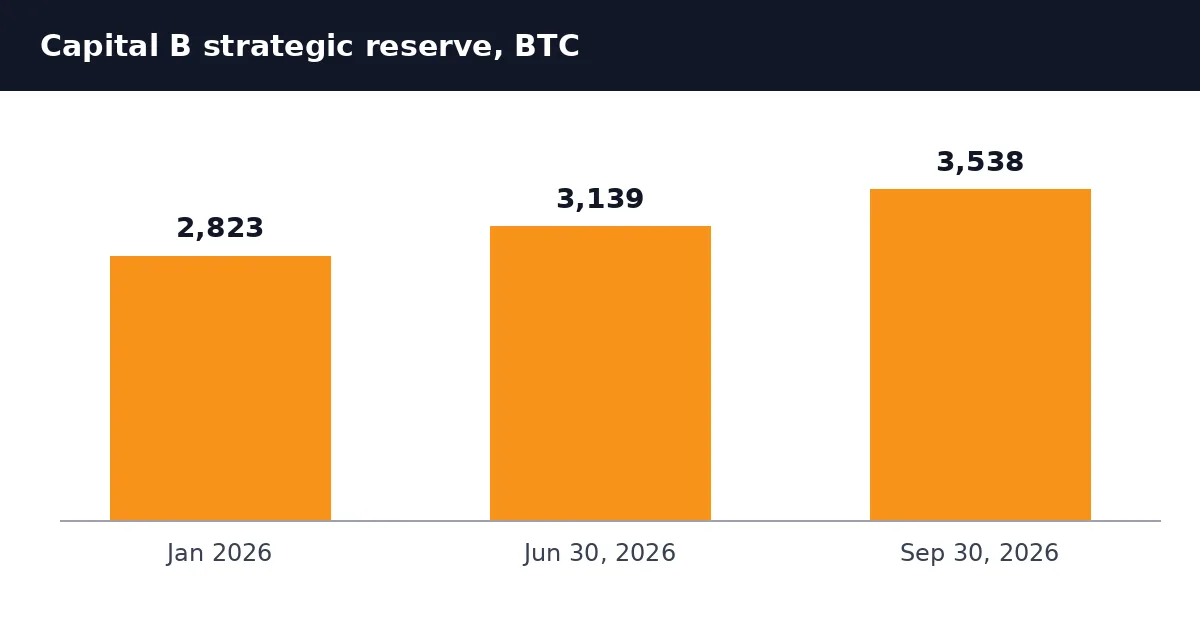
- The strategic reserve grew from 2,823 BTC in January to 3,538 BTC on September 30, at an average cost of 87,805 euros per coin.
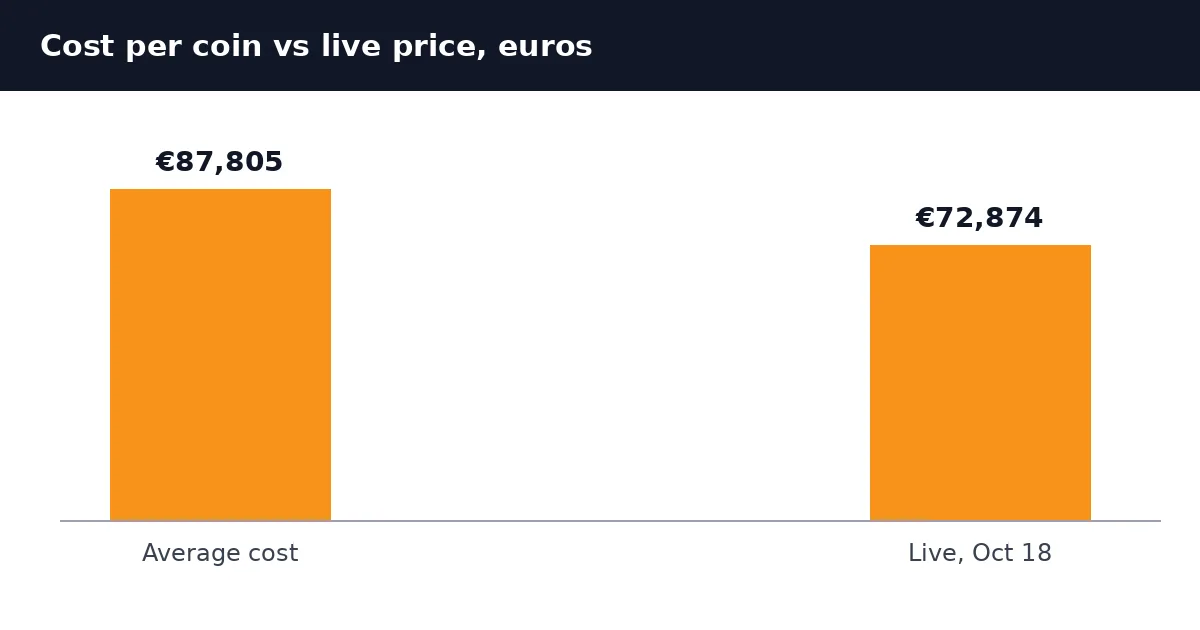
- At the October 18 price near 72,874 euros, that stack sits about 52.8 million euros below its total cost in our own calculation.
What Capital B Actually Reported on October 15
Capital B trades on Euronext Growth Paris under the ticker ALCPB, and it calls itself Europe’s first Bitcoin Treasury Company. The firm adopted that strategy in November 2024, and it still runs data intelligence, AI, and tech consulting units beside the treasury.
- What Capital B Actually Reported on October 15
- The Accounting Trap: Write It Down, Never Write It Back Up
- The Underwater Stack They Kept Adding To
- Two French Firms, Two Opposite Reads of the Same Fall
- What to Watch Next at Capital B
- Common Mistakes When Reading a Treasury Loss
- Frequently Asked Questions
- Conclusion
The half-year release separates the treasury charge from the trading business, and readers need that split to read the headline correctly. Our table below rebuilds the headline from the parts the company itself reported.
| Item, H1 2026 | Figure | Cash or accounting? |
|---|---|---|
| Net loss | 69.5 million euros | Headline total |
| Bitcoin impairment charge | 67.5 million euros | Accounting only, no cash impact |
| Loss left after the charge | About 2.0 million euros | Close to the 1.9 million euro loss a year earlier |
| Revenue | 5.8 million euros, up 3.5 percent | Real sales from operating units |
| Operating segments adjusted EBITDA | 0.6 million euros, up 9.8 percent | Operating result before group costs |
| Group adjusted EBITDA | Negative 1.1 million euros | Includes 2.2 million euros of treasury company running costs |
The balance sheet tells the same split story in a second way. Total assets reached 317.1 million euros on June 30, up from 297.2 million euros at the end of 2025, while shareholders’ equity fell to 86.8 million euros from 109.4 million euros.
The Detail Most Headlines Skipped
Some secondary headlines converted the impairment into dollars and then printed the dollar figure as a euro figure, which inflated the charge to 75.9 million euros. The company’s own release puts the impairment at 67.5 million euros, and that is the only figure this article uses.
The stock reaction also stayed calm next to the size of the headline. Early trading on the Friday after the release lifted the shares about 0.5 percent, although the stock still sits about 25 percent lower this year.

The Accounting Trap: Write It Down, Never Write It Back Up
Here is the plain version of the rule that created this loss. Under the IFRS model Capital B reports under, Bitcoin sits on the books as an intangible asset, and the company must cut its carrying value when the market price falls below cost.
The rule then blocks the reverse move in profit and loss when the price recovers. A fall becomes a reported loss at once, and a later rise stays invisible in earnings until the company actually sells.

Why the June 30 Date Matters So Much
The impairment uses one date, June 30, and one price on that date. Bitcoin can fall into that date, recover the next week, and the half-year report still carries the full charge with no offsetting gain.
That timing quirk explains how a firm can report its largest ever loss in a half where its coin count rose. The loss measures a price snapshot, and it does not measure coins sold, cash spent, or customers lost.
How the US Rules Now Differ
US firms now follow a fair value model under the FASB update that took effect for fiscal years starting after December 15, 2024. Those firms mark crypto to market each period, and both gains and losses flow through net income.
A US treasury in the same price fall would also book a loss, and readers who follow Strategy’s Bitcoin holdings and its slowing weekly buying see those swings in its results too. The difference sits in the recovery: the US firm books the rebound as income, and the IFRS firm does not.
The Underwater Stack They Kept Adding To
Capital B held 2,823 BTC in January, 3,139 BTC on June 30, and 3,538 BTC on September 30. The company added 715 coins across those nine months, a rise of 25.3 percent, and it held the September count steady to the October 15 reporting date.
The firm also holds 61 BTC apart from the strategic reserve for operational liquidity. It reported 4.6 million euros in cash on September 30, and cash plus that operational Bitcoin totaled 9.1 million euros.
Our Own Cost Versus Market Math
The company paid 310.6 million euros in total for the reserve, which gives the reported average cost of 87,805 euros per coin. We checked Bitcoin near 81,901 dollars on October 18, with EUR/USD near 1.1239, which puts one coin near 72,874 euros.
That live price sits 14,931 euros below the average cost, a gap of about 17.0 percent per coin. Across 3,538 coins, the reserve carries a market value near 257.8 million euros against its 310.6 million euro cost, an unrealised gap near 52.8 million euros in our calculation.
| Measure, October 18, 2026 | Value |
|---|---|
| Strategic reserve | 3,538 BTC |
| Total acquisition cost | 310.6 million euros |
| Average cost per coin | 87,805 euros |
| Live price used in this article | About 72,874 euros (81,901 dollars at EUR/USD 1.1239) |
| Gap per coin | 14,931 euros, about 17.0 percent below cost |
| Market value of the reserve | About 257.8 million euros |
| Unrealised gap on the full stack | About 52.8 million euros |
Two warnings belong beside that table, and honest readers should keep both. Bitcoin moves fast, so the gap will widen or shrink with the price, and anyone tracking Bitcoin price predictions for the rest of 2026 knows how wide the forecast range still runs.
The second warning cuts the other way for the bulls. An unrealised gap is not a realised loss, and it only becomes one if the company sells at that price, which it has not done.
Where the Buying Money Came From
Equity raises funded the buying, not operating cash flow. The company raised 27.5 million euros in the first half, and it raised a further 31.7 million euros between July 1 and October 15.
September brought the largest single purchase of the year, 376 BTC for 25.3 million euros, which works out near 67,287 euros per coin. A separate September raise of 0.98 million euros funded a smaller purchase of 13 BTC, and the firm reported a BTC yield of 2.2 percent for the first nine months.
Shareholders approved broad financing capacity in June, and the company completed a 10-for-1 reverse stock split in July. Both moves serve the same plan: keep the share structure ready for more raises, and keep converting those raises into Bitcoin.
Two French Firms, Two Opposite Reads of the Same Fall
Sequans, a French chip firm listed in New York, read the same market in the opposite way. It announced on September 24 that it had sold its final 314 BTC and completed a full exit from its Bitcoin treasury strategy.
Sequans once held more than 3,200 BTC, and it began trimming the stack less than six months after it launched the strategy. It redeemed its convertible debt in May, it now holds no crypto, and it carries no debt outside government financed research projects.
What the Split Really Shows
Sequans framed its exit as a return to a pure chip business, not as a call on the Bitcoin price. Its product revenue grew more than 80 percent year over year in the second quarter, and management chose a simple balance sheet over a treasury side bet.
Capital B made the mirror image choice, and it keeps a working business beside the treasury instead of becoming a pure holding vehicle. Readers who want the base case for that bet can start with what Bitcoin is and how it works, then judge the treasury layer on top of it.
The contrast matters because both firms faced the same price, the same accounting pressure, and the same debt questions. One firm treated Bitcoin as a temporary balance sheet tool, and the other treats it as the strategy itself, much like Strategy’s treasury moves in the US market treat it as the core of the company.
What to Watch Next at Capital B
The next test is funding, not accounting. The firm needs fresh equity to keep buying at this pace, and each raise dilutes holders while it adds coins, so the BTC per share figure matters more than the raw coin count.
That is why the reported 2.2 percent BTC yield deserves more attention than the 3,538 headline. A rising coin count with a flat per share figure would mean new holders funded old holders’ story, and the audited full year report due in early 2027 will show the updated net asset picture.
European readers who hold Bitcoin directly face a different set of choices from a listed treasury. Our guide on how to buy Bitcoin in France walks through the licensed routes, and it shows why direct holders never face an impairment headline on their own holdings.
Institutional treasuries elsewhere keep moving in both directions at once. American Bitcoin growing its holdings to 8,300 BTC shows the accumulation side, and Sequans shows the exit side in the same season.
Common Mistakes When Reading a Treasury Loss
The first mistake treats an impairment as cash out the door. Capital B spent no 67.5 million euros on this charge, and its cash position moved for other reasons entirely.
The second mistake treats the headline loss as the operating result. The operating units grew revenue and lifted their adjusted EBITDA, and the group loss after the charge sits near 2.0 million euros, close to last year’s level.
The third mistake assumes the charge can reverse on paper if Bitcoin rallies. Under this IFRS model it cannot flow back through profit and loss, so a price recovery helps the market value and the share story, not the reported earnings line.
Frequently Asked Questions
Did Capital B sell any Bitcoin to book this loss?
No. The 69.5 million euro loss came mainly from a 67.5 million euro non-cash impairment charge, and the company says that charge had no cash impact and involved no sale.
How much Bitcoin does Capital B hold?
Capital B held 3,538 BTC in its strategic reserve on September 30, 2026, plus 61 BTC held separately for operational liquidity.
What did Capital B pay for its Bitcoin on average?
The company paid 310.6 million euros in total for the reserve, which gives an average acquisition cost of 87,805 euros per coin.
Why can Capital B not book the gain back if Bitcoin recovers?
Under the IFRS model it reports under, Bitcoin is carried as an intangible asset that must be written down when the price falls below cost, but the writedown cannot be reversed back through profit and loss when the price rises.
How does Sequans differ from Capital B?
Sequans sold its final 314 BTC on September 24, 2026 and exited its Bitcoin treasury strategy completely, while Capital B added 715 BTC during 2026 and kept buying.
Conclusion
The capital b bitcoin treasury loss is real on paper and misleading as a headline. Strip out one non-cash charge and Capital B looks like a small consulting group with a modest loss, a growing coin stack, and a funding machine that still works.
The honest risk sits in the math, not the headline. The stack costs 87,805 euros per coin against a live price near 72,874 euros, and only a sustained price recovery, not an accounting rule, can close that 52.8 million euro gap.