



Stellar trades near $0.179 on October 22, 2026, about 80 percent below its all time high. That gap explains why forecasts for XLM split so widely this month.
This stellar price prediction 2026 2030 guide maps both sides with dated numbers and one check most guides skip.

The short answer comes first. Our base case puts XLM near $0.21 at the end of 2026, near $0.28 in 2027, and near $0.60 in 2030.
- Stellar price today: where XLM stands on October 22, 2026
- Our Stellar price prediction 2026 2030: bear, base and bull cases
- The market cap reality check most XLM forecasts skip
- Why published XLM forecasts disagree so widely
- The bull case: stablecoins, real world assets and new rails
- The bear case: supply, competition and the value capture problem
- Support and resistance levels that decide each case
- Year by year: what each period needs
- Common mistakes readers make with XLM forecasts
- Is XLM a good long term hold?
- Frequently Asked Questions
- Conclusion
The bear case holds it at $0.25 in 2030, and the bull case reaches $1.10 in 2030.
Key takeaways
- XLM trades near $0.179 with a market cap near $6.31 billion on October 22, 2026.
- About 35.22 billion XLM circulate today, out of a total supply of 50 billion.
- Our base case reaches $0.60 by 2030, and our bull case reaches $1.10.
- A $0.50 price needs a $17.61 billion market cap at todays supply, so treat $1 calls with care.
- Support sits near $0.174 and $0.153, and resistance sits near $0.19 to $0.20.
- Every long term number in this guide is a scenario, not a promise.
Stellar price today: where XLM stands on October 22, 2026
Price context comes before any forecast. A coin near its high needs a different read than a coin in repair mode, and XLM sits deep in repair mode today.
Trackers put XLM between $0.179 and $0.180 today, down about 14 percent over 30 days and about 40 percent over one year. Bitcoin trades near $82,195 today, so the whole market sits below its best levels, not just Stellar.
You can compare that backdrop in our Bitcoin price prediction for October 2026 and the level that decides the next move.

The numbers that frame every forecast
XLM reached its all time high near $0.876 on January 3, 2018. It now sits almost exactly on its 200 day moving average near $0.18, and it trades below its 20 day average near $0.19 and its 50 day average near $0.20.
About 35.22 billion XLM circulate today, which gives the $6.31 billion market cap at todays price. The total supply stays at 50 billion, so about 14.78 billion XLM still sit outside circulation and will enter over time.
What Stellar does, in plain words
Stellar runs a public network built for fast, cheap payments and for issuing tokens that track real assets. The network settles transfers in seconds and charges tiny fees, and banks and payment firms use it to move stablecoins across borders.
XLM pays those fees and acts as a bridge asset between currencies on the network. Nobody can print more than the 50 billion total supply, and the Stellar Development Foundation holds and releases much of the supply that still sits outside circulation.
Our Stellar price prediction 2026 2030: bear, base and bull cases
We built three cases, and each case states what must happen for it to win. We set the ranges inside the wider ranges that major forecast sites publish, and we explain the gap in the next sections.
| Year | Bear case | Base case | Bull case |
|---|---|---|---|
| 2026 | $0.10 | $0.21 | $0.30 |
| 2027 | $0.13 | $0.28 | $0.48 |
| 2028 | $0.16 | $0.38 | $0.65 |
| 2029 | $0.20 | $0.50 | $0.85 |
| 2030 | $0.25 | $0.60 | $1.10 |
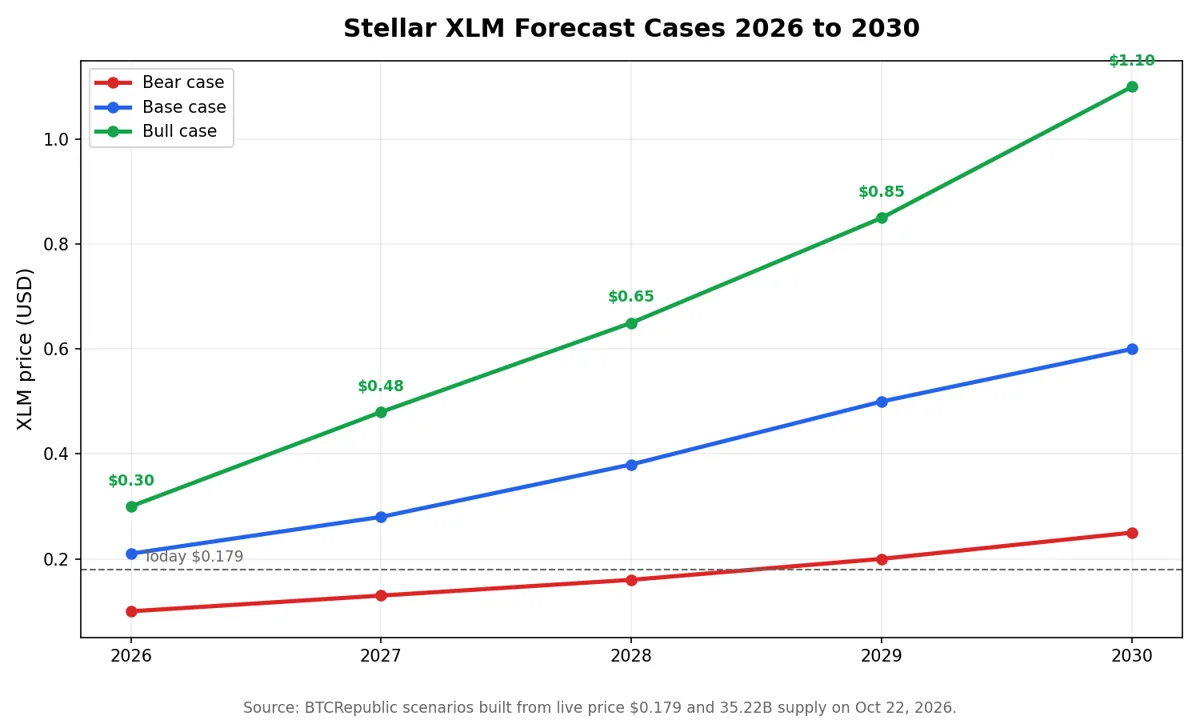
The bear case needs no disaster. It only needs slow payment growth, a flat Bitcoin market, and steady supply releases that meet weak demand.
The bull case needs real volume. It needs stablecoin and tokenised asset work to turn into daily paid use, plus a strong Bitcoin cycle that lifts all large altcoins.
Our Bitcoin price prediction 2026 with five year end targets shows why that Bitcoin path matters so much for XLM.
The market cap reality check most XLM forecasts skip
Price alone tells you very little when a coin has 35 billion units. Market cap tells you what buyers must pay in total, and that number exposes weak forecasts fast.
We ran this check with todays circulating supply of 35.22 billion XLM. We did not borrow the table from any other site, and you can redo every line with one simple sum: price times 35.22 billion.
| XLM price | Market cap at todays supply | What it means |
|---|---|---|
| $0.10 (2026 bear) | $3.52 billion | Below todays value, a weak market outcome |
| $0.21 (2026 base) | $7.40 billion | A modest recovery, well below past peaks |
| $0.50 (2029 base) | $17.61 billion | About 2.8 times todays value, needs real growth |
| $0.60 (2030 base) | $21.13 billion | A large network value, but not a record claim |
| $0.876 (2018 high price) | $30.85 billion | The value a return to that price needs today |
| $1.10 (2030 bull) | $38.74 billion | Needs years of real adoption and a strong cycle |
Now apply the same check to the loudest calls online. Some pages put XLM above $5 by 2030, and that price needs a market cap near $176 billion at todays supply.
That value would place XLM among the very largest crypto assets in the world. It can happen only if Stellar wins a huge share of global payments, and no data today proves that outcome.
Why published XLM forecasts disagree so widely
Forecast sites use very different tools, so their numbers clash. Model sites lean on past price patterns, while fundamental writers lean on partnerships and hope that use follows.
CoinStats put its 2026 range at $0.14 to $0.30, with an average near $0.21. The same site put its 2030 range at $0.28 to $1.10, with an average near $0.72.
What the main models say
Blockspot models put XLM near $0.10 to $0.25 by the end of 2026. The same model puts the end of 2030 near $0.48 to $0.79, which sits close to our base case for 2030.
Coinbird models an average near $0.22 in 2026 and near $0.61 in 2030. Our table sits inside that wide band, and we chose the middle path on purpose.
You will see the same split in other large altcoins. Our XRP price prediction 2026 to 2030 and the ETF question and our Ethereum price prediction 2026 2030 with bear, base and bull cases both show model gaps just as wide.
The bull case: stablecoins, real world assets and new rails
Stellar just posted its strongest usage quarter in years, and the Stellar Development Foundation shared the numbers on October 19, 2026. Stablecoin transfer volume hit $25.1 billion in the third quarter, up 121 percent from the second quarter and up 314 percent from a year earlier.
Total network volume reached $33.2 billion in the same quarter, up 71 percent from the second quarter. Real world assets on the network reached $4.1 billion, up 36 percent in one quarter and up 548 percent from a year earlier.

Real work that can lift demand
Bank tests give those numbers weight. US Bank completed a live test of its USBDC stablecoin on Stellar on September 9, 2026, and it used the freeze and clawback tools that regulated issuers need.
Developer activity rose with the volume. Stellar counted 3,922 monthly active developers, added new Tier 1 validators, shipped two protocol upgrades, and held 99.99 percent uptime in the quarter.
Chainlink went live on Stellar on October 14, 2026, and its price feeds give lending and asset apps a trusted data source. That link matters because tokenised assets need reliable prices before banks will lend against them.
The Protocol 30 upgrade ahead
Stellar calls its next upgrade Bell, or Protocol 30, and validators vote on the testnet on November 3, 2026. The mainnet vote follows on November 23, 2026, and holders need to take no action for the change.
Bell adds post quantum signature checks for smart contracts, a new contract address format, and ledger times in milliseconds. Those changes help large fintech firms and custodians plug into Stellar with less custom work.
An upgrade alone does not create buyers. It only removes friction, so our bull case still needs the stablecoin and asset volume to keep growing after Bell ships.
The bear case: supply, competition and the value capture problem
Stellar sets its fees in tiny fixed amounts, and that design cuts both ways. A user pays a very small fee per transaction, so heavy network use does not force demand for XLM to rise in step with volume.
That means strong usage numbers can coexist with a flat price for a long time. Honest forecasts must admit that point, and our bear case does exactly that.
Supply that buyers must absorb
About 14.78 billion XLM still sit outside circulation today. Foundation releases add supply over time, and buyers must absorb that supply before the price can climb and stay up.
Competition adds a second drag. XRP, Solana, and bank led stablecoin rails all chase the same cross border payment work, and Stellar must win real corridors, not just pilots.
Price has lagged the network before
The third quarter proved that point in real time. Usage rose sharply, yet XLM fell about 14 percent over 30 days and still trades below its 20 day and 50 day averages.
Our bear case takes that warning seriously. It keeps XLM at $0.25 in 2030 if paid volume grows but token demand stays weak.
Support and resistance levels that decide each case
Levels give you a simple test for each case. Price action confirms or rejects a forecast long before the year ends.
First support sits near $0.174, close to the low that traders defended this month. Second support sits near $0.153, the broader floor where buyers showed stronger interest in past sell offs.
Resistance above the price
First resistance sits in the $0.19 to $0.20 zone, where the 20 day and 50 day averages now sit. A weekly close above $0.20 would show real demand and would open the path toward $0.22.
The $0.234 to $0.237 zone marks the late September 2026 peak. Above that level, $0.30, our 2026 bull case, marks the next test for buyers.
Altcoin levels work the same way across the market. Our Chainlink price prediction 2026 2030 with bear, base and bull cases uses the same support first method for LINK.
Year by year: what each period needs
Short periods depend on charts and Bitcoin. Long periods depend on paid use, regulation and trust, and those forces move much more slowly.
Bitcoin still sets the weather for every altcoin. JPMorgans long term work, which we covered in our JPMorgan Bitcoin 10 year forecast that tops stocks and gold, shows how even big banks now model Bitcoin first and altcoins second.
2026 to 2027: repair first
XLM must hold $0.174 and reclaim $0.20 in this period. A clean Protocol 30 vote, more bank stablecoin pilots, and steady asset growth would support the base case near $0.28 in 2027.
A Bitcoin slide back toward the low $70,000 range would hurt that plan fast. In that world, our bear case near $0.13 in 2027 looks much more likely.
2028 to 2030: proof or fade
By 2028, pilot projects must show real, repeated paid volume. Talk and test announcements will no longer move the price, because traders will ask for volume and fee data instead.
Our base case near $0.60 in 2030 needs steady growth on that proof. Our bull case near $1.10 needs Stellar to win a clear lead in stablecoin payments or tokenised assets, plus a strong full market cycle.
Other networks face the same proof test. Our Hedera price prediction 2026 2030 with bear, base and bull cases lays out a similar split between promise and proof.
Common mistakes readers make with XLM forecasts
The first mistake treats a price target as a promise. A forecast maps a path, and the path breaks the moment its base facts change.
The second mistake ignores supply. A $1 XLM and a $1 coin with 1 billion units are not the same claim, and the market cap check in this guide shows why.
Watch out for these traps
- Posts that quote a $5 target never show the $176 billion market cap it needs.
- Posts that count a bank pilot as live buying confuse a test with daily demand.
- Posts that ignore the 14.78 billion XLM still outside circulation miss the supply buyers must absorb.
The third mistake chases usage headlines alone. Stablecoin volume can double while the price falls, as the third quarter just showed, because fees stay tiny by design.
Is XLM a good long term hold?
Stellar offers a rare mix of bank grade payment tools, fast growth in stablecoins and assets, and a long track record since 2014. It also carries a clear value capture problem, tough competition, and a large supply that still grows toward 50 billion.
That mix suits a patient holder who sizes the position with care. It does not suit anyone who needs a sure gain by a fixed date, and this article is not financial advice.
Frequently Asked Questions
What is a realistic Stellar price prediction for 2026?
A realistic range for the end of 2026 runs from about $0.10 in a bear case to $0.30 in a bull case, with a base case near $0.21. XLM trades near $0.179 on October 22, 2026, so the base case needs only a modest recovery and a weekly close above $0.20.
Can XLM reach $1 by 2030?
Yes, $1 by 2030 is possible in a strong bull market, but it sits close to our bull case of $1.10 and well above our base case of $0.60. A $1 price needs a market cap of $35.22 billion at todays circulating supply of 35.22 billion XLM, so it needs years of real adoption and a strong Bitcoin cycle.
What will XLM be worth in 2030?
Our scenarios put XLM at $0.25 in a bear case, $0.60 in a base case and $1.10 in a bull case in 2030. Published forecasts disagree widely, from an average near $0.72 at CoinStats to a 2030 range near $0.48 to $0.79 at Blockspot.
Why do XLM forecasts disagree so much?
Forecast sites use different tools, so their numbers clash. Model sites lean on past price patterns, while fundamental writers lean on bank pilots and future use, and Stellar fees set at tiny fixed amounts make the link between network use and XLM demand weaker than on many other networks.
What price levels matter most for XLM right now?
Support sits near $0.174 first, then near $0.153, the broader floor from past sell offs. Resistance sits in the $0.19 to $0.20 zone, where the 20 day and 50 day averages sit, then near $0.234 to $0.237, the late September 2026 peak.
Is Stellar a good investment in 2026?
That depends on your risk tolerance, and this article is not financial advice. Stellar posted $25.1 billion in stablecoin volume in the third quarter of 2026 and holds $4.1 billion in real world assets, but its price fell about 14 percent over 30 days and about 14.78 billion XLM still sit outside circulation.
Never invest money you cannot afford to lose.
Conclusion
Stellar does not need hype, and it needs proof in paid, repeated volume. Our base case of $0.60 by 2030 rewards that proof without assuming Stellar wins the whole payments market.
Watch $0.20 first, then watch stablecoin volume each quarter. Those two checks will tell you which case is winning long before 2030 arrives.