



Bitcoin rebounds above 80000 after midterms, and that headline is true. It is also incomplete, because the price and the big institutional money moved in opposite directions first.
Bitcoin traded near $80,450 on the morning of November 5, up about 4.7% in 24 hours. US spot Bitcoin ETFs had just closed out three straight days of outflows worth about $1.16 billion, then logged a small $35.1 million inflow on November 4.

So the rebound is real, but the confirmation is thin. This article separates the three signals, price, ETF flows and liquidations, and shows what each one actually proves.
- What happened overnight
- The ETF divergence, in plain numbers
- Our divergence scorecard: three signals, three stories
- Why Washington still matters more than the chart
- What would change my mind
- Mistakes to avoid when you read rebound headlines
- Frequently Asked Questions
- Did Bitcoin really rebound above $80,000 after the midterms?
- Did Bitcoin ETFs keep bleeding on November 5?
- What caused the jump: the election or the short squeeze?
- Does the Democratic sweep kill the CLARITY Act?
- Should I buy Bitcoin because it reclaimed $80,000?
- The bottom line
- Bitcoin reclaimed $80,000 after Democrats won both chambers of Congress in the November 3 midterms.
- US spot Bitcoin ETFs lost about $1.16 billion across October 30, November 2 and November 3, then took in $35.1 million on November 4.
- Crypto liquidations hit about $974.8 million in 24 hours, and shorts made up $575.5 million of that total.
- CoinShares research head James Butterfill says Bitcoin had largely priced in a Democratic sweep, so the relief rally fits the setup.
- Butterfill also warns that the CLARITY Act faces a harder path under a Democratic Congress, and that matters more for crypto companies than for Bitcoin itself.
What happened overnight
Democrats won majorities in the House and the Senate on November 3. The new majorities take office in January, and they will set up divided government for the final two years of President Donald Trump’s term.
Bitcoin first dipped toward $75,618 as results came in, then turned hard. Traders who had bet on further falls had to buy back in a hurry, and that forced buying pushed the price through $80,000.
The price move in numbers
Bitcoin traded in a 24 hour range of about $75,695 to $81,004, and it sat near the top of that range on the morning of November 5. The move left Bitcoin about 36% below its all time high of $126,080 from October 6, 2025, so one green day did not erase the wider drawdown.
Ethereum joined the move and traded near $2,418, up about 6.8% in 24 hours. That breadth helps the rebound story, because a Bitcoin only spike on thin volume would look weaker.

The squeeze behind the jump
Coinglass data put total crypto liquidations at about $974.8 million in 24 hours. Short positions made up $575.5 million of that total, or about 59% across the market.
Bitcoin liquidations reached about $396 million, and shorts made up about 78% of that figure. Forced buying on that scale can lift a price fast, and it can also run out fast once the shorts are gone.
The ETF divergence, in plain numbers
US spot Bitcoin ETFs bled for three straight trading sessions before the rebound. SoSoValue data put the outflows at $643.3 million on October 30, $398.6 million on November 2 and $115.6 million on November 3.
BlackRock’s IBIT drove most of the damage, and it shed about $95 million on November 3 alone. Bitwise’s BITB and Fidelity’s FBTC took in money on some of those days, but their inflows only softened the total.
Then November 4 broke the streak, barely. The funds took in a net $35.1 million, led by ARKB with $19.9 million and BITB with $15.2 million, while other funds posted zero.
That twist matters for this story, because the morning queue for this article assumed the bleeding was still running. Fresh flow data changed the picture, and this article reports the updated picture instead of the stale one.
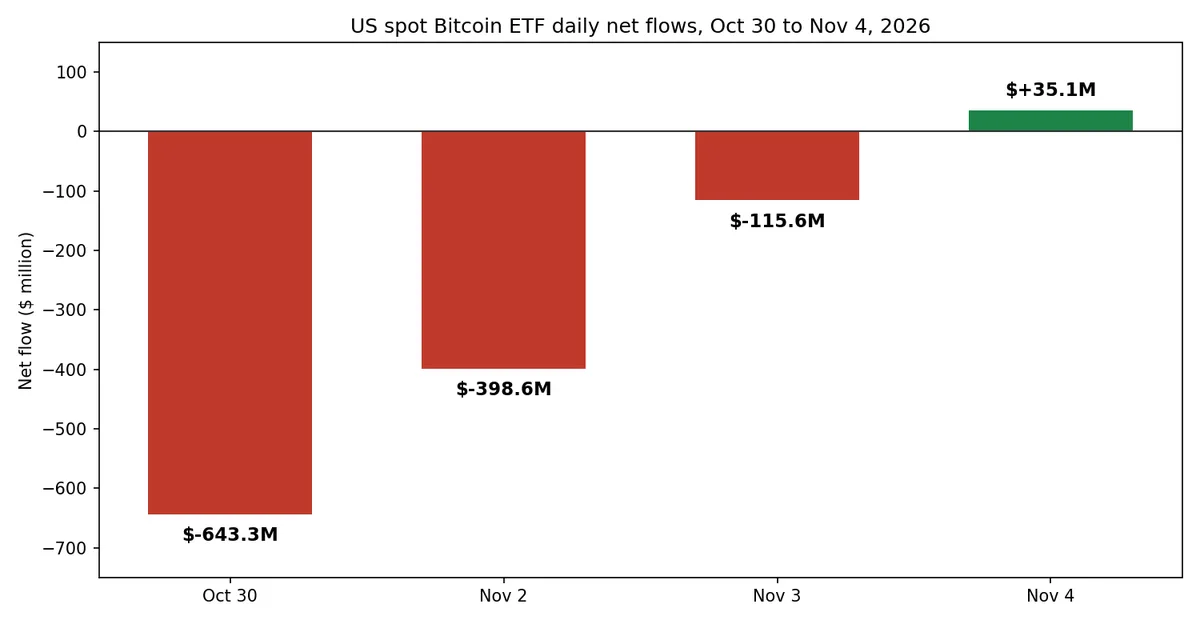
| Trading day | Net ETF flow | What it meant |
|---|---|---|
| October 30 | Negative $643.3 million | The heaviest outflow day of the streak |
| November 2 | Negative $398.6 million | Outflows eased, but IBIT alone lost $405.3 million |
| November 3 | Negative $115.6 million | The smallest outflow, and the third straight losing day |
| November 4 | Positive $35.1 million | A small inflow that broke the streak without erasing it |
Readers should treat the November 4 figure as preliminary, because SoSoValue numbers have faced revisions before. US spot Bitcoin ETFs had already logged a long outflow streak in earlier sessions, so one small inflow does not count as a trend yet.
Our divergence scorecard: three signals, three stories
Most rebound stories pick one number and build a verdict on it. That approach fails here, because the three main signals point in different directions.
The table below is the original element of this article. It scores each signal on its own, instead of forcing all three into one bullish or bearish label.
| Signal | What it says | What it does not prove |
|---|---|---|
| Price: near $80,450, up about 4.7% in 24 hours | Buyers took back $80,000 after a dip to about $75,618 | It does not prove a new uptrend, since Bitcoin still sits about 36% below its all time high |
| ETF flows: negative $1.16 billion over three days, then positive $35.1 million | Institutions sold first, then paused on November 4 | It does not prove institutions flipped bullish, since $35.1 million covers only about 3% of the three day outflow |
| Liquidations: about $974.8 million in 24 hours, mostly shorts | Forced buying powered much of the jump | It does not prove fresh long term demand, since forced buying ends when the shorts run out |
Put together, the scorecard reads like this: a relief rally with a squeeze engine, not a confirmed institutional buying wave. Bitcoin held $80,000 before the Fed decision in an earlier calm stretch too, and calm before a big event can look thinner than it feels.
Exchange outflows told a supply story behind an earlier $81,000 bounce, and that story differed from this one. Exchange supply and ETF flows measure different holders, so readers should not merge them into one signal.
Why Washington still matters more than the chart
James Butterfill, head of research at CoinShares, gave the clearest read on the election result. He said, “My sense is that bitcoin had largely priced in a Democratic sweep, leaving room for a relief rally as uncertainty clears.”
That quote reframes the rally in a useful way. Markets often move hardest when an expected event finally stops being uncertain, not when the event itself surprises anyone.
Butterfill then added the warning that matters most for the months ahead.
He warned: “The greater concern is slower crypto reform. CLARITY faces a harder path, while investigations into Trump-linked ventures could consume political capital and generate uncomfortable headlines across the sector.”
The Digital Asset Market Clarity Act would define how federal securities and commodities regulators oversee crypto assets and trading platforms. The CLARITY Act failed a Senate procedural vote in September, when senators voted 49 to 50 against advancing it, short of the 60 votes needed.
US Representative French Hill had sought approval after the midterms, but a Congress controlled by the opposition makes that path harder. Butterfill finished with the line that should anchor every forecast here: “For Bitcoin, real yields, dollar liquidity and ETP flows still carry more weight than the elections.”
In plain terms, Washington sets the speed limit for crypto companies, while rates, liquidity and fund flows drive Bitcoin day to day. Readers who mix those two up will misread both.
What would change my mind
I would upgrade this rebound from relief rally to something stronger on two pieces of evidence. First, ETF inflows would need to run for several sessions and grow past the $35.1 million trickle, not just repeat it.
Second, Bitcoin would need to hold above $80,000 through US trading and the next jobs data, without leaning on another liquidation wave. Liquidations hit longs ahead of CPI in an earlier session, and that episode showed how fast leverage can reverse a move in either direction.
I would downgrade the rebound if ETF flows turn negative again at size, or if Bitcoin slips back under $78,000 on rising volume. Either outcome would show that the squeeze, not new demand, did the heavy lifting.
Year-end targets for 2026 already span a wide range, from a $74,000 floor to far higher dreams. That spread is honest, because nobody can price Washington, rates and fund flows together with precision right now.
Mistakes to avoid when you read rebound headlines
Do not treat a round number as a verdict. Bitcoin crossed $80,000 before, and it fell back before, so the level marks a battleground rather than a finish line.
Do not treat ETF outflows as proof that every holder sold. ETF flows track fund shares, and they say nothing about direct holders, companies or long term wallets.
Do not treat liquidations as demand. A short squeeze creates buying, but the buyers in a squeeze buy because they must, not because they chose a long term position.
Do not promise yourself a direction from one day of data. One inflow day after three outflow days is a pause, and pauses deserve patience rather than celebration or panic.
Frequently Asked Questions
These are the questions readers keep asking after a fast rebound like this one, answered with the numbers above and nothing extra.
Did Bitcoin really rebound above $80,000 after the midterms?
Yes. Bitcoin traded near $80,450 on the morning of November 5, up about 4.7% in 24 hours, after dipping toward $75,618 as midterm results came in.
Did Bitcoin ETFs keep bleeding on November 5?
No, not on the latest reported day. US spot Bitcoin ETFs lost about $1.16 billion across October 30, November 2 and November 3, then took in a net $35.1 million on November 4, which broke the three day outflow streak.
What caused the jump: the election or the short squeeze?
Both played a part. The election result removed uncertainty that markets had already priced in, and the short squeeze then turned that relief into forced buying worth about $575.5 million in liquidated short positions across crypto in 24 hours.
Does the Democratic sweep kill the CLARITY Act?
It does not kill it outright, but it makes passage harder. The bill already failed a Senate procedural vote 49 to 50 in September, and a Democratic Congress gives it a tougher path, according to CoinShares research head James Butterfill.
Should I buy Bitcoin because it reclaimed $80,000?
No single price level answers that question. This article is not investment advice, and a rebound powered partly by forced buying deserves confirmation from ETF inflows and a hold above $80,000 before anyone treats it as a new trend.
The bottom line
Bitcoin rebounds above 80000 after midterms, and the relief makes sense. Markets hate uncertainty, and the midterms removed a big chunk of it in one night.
But the ETF ledger still shows a $1.16 billion hole from three days, with only $35.1 million patched back on November 4. Until inflows grow and the price holds without a squeeze, call this a rebound, not a reversal.
Watch the next two ETF sessions and the next hold above $80,000. Those two checks will tell you more than any headline from this morning.