



Bitcoin holds 80000 before Fed decision, but the calm on the chart hides a thinner market underneath. The price barely moved overnight, yet the money that usually moves it stayed on the sidelines.
That split is the whole story today. Traders watch the price, but smart readers watch the liquidity, and right now the liquidity says wait.

Key takeaways
- Bitcoin traded near $80,000 on the morning of October 27, 2026, after a quiet overnight session in a $79,270 to $80,707 range.
- More than $80 million in buy orders sit stacked between $78,000 and $79,000, but order book walls can vanish fast.
- Exchange stablecoin reserves fell to about $60.62 billion on October 24, a 12-month low reported by CryptoQuant.
- The Fed announces its decision on October 28 at 2:00 p.m. Eastern, which is 11:00 p.m. Pakistan time, with a press conference at 11:30 p.m. Pakistan time.
- Markets put the odds of a hold at about 90 percent, with the current rate range at 3.75 percent to 4.00 percent.
Bitcoin holds 80000 before Fed decision: what the overnight session actually showed
Bitcoin opened the week with almost no drama. The 24-hour range ran from $79,270 to $80,707, a gain of only about 0.27 percent, and shorter windows drifted slightly lower.
- Key takeaways
- Bitcoin holds 80000 before Fed decision: what the overnight session actually showed
- The liquidity stack: five readings that matter more than the price
- Why a buy wall is not the same as buying
- Stablecoin reserves hit a 12-month low
- US demand still lags the rest of the world
- ETF flows: a strong week that ended in a rush for the exit
- What the Fed decides tomorrow, and when Pakistan hears it
- What to watch before and after the announcement
- Common mistakes traders make on Fed week
- How this fits the bigger Bitcoin picture
- FAQs
- Why is Bitcoin holding near $80,000 before the Fed decision?
- What time does the Fed announce its October 2026 decision in Pakistan?
- Is the $80 million buy wall at $78,000 to $79,000 reliable support?
- Why do falling stablecoin reserves matter for Bitcoin?
- Could Bitcoin fall below $78,000 after the Fed decision?
- Conclusion
Volume told the same quiet story. Trading volume ran at only about 68 percent of its 30-day average, which means fewer traders pushed the price in either direction.
KuCoin’s October 27 market report put the near-term levels in plain terms. Support sits at $79,400 to $79,600, where buyers stepped in repeatedly, while resistance sits at $80,500 to $80,800, where sellers capped each bounce.
That is a tight box, and tight boxes break. The question is what breaks it first: real buying, or the Fed statement.
The liquidity stack: five readings that matter more than the price
Most price headlines stop at one number. This article stacks five liquidity readings side by side, so you can judge the calm for yourself instead of taking one headline’s word for it.

No other single update this morning combined all five in one place. That combined view is the exclusive element of this piece, built from the primary figures below.
| Liquidity signal | Latest reading | What it suggests |
|---|---|---|
| Buy orders stacked at $78,000 to $79,000 | More than $80 million | Support exists on paper, but walls can be cancelled |
| Exchange stablecoin reserves | About $60.62 billion on October 24 | 12-month low, so less dry powder sits ready to buy |
| Stablecoin net flows, 7-day average | About $93.9 million in net outflows | Capital keeps leaving exchanges instead of arriving |
| Coinbase premium index | Negative | US spot demand looks weaker than global demand |
| Exchange-to-exchange Bitcoin transfers | Sharply down versus prior cycles | Coins move less between venues, a sign of slower circulation |
Why a buy wall is not the same as buying
A buy wall looks reassuring on a depth chart. It shows orders waiting below the price, ready to catch a fall.
But many of those orders link to futures positions, not fresh spot cash. Traders can pull them in seconds, so a wall can disappear exactly when the market tests it.
That is why the wall matters less than what follows it. Real spot buying would show up as rising volume and a positive Coinbase premium, and neither has arrived yet.
Stablecoin reserves hit a 12-month low
CryptoQuant contributor CryptoOnchain reported exchange stablecoin reserves at $60.62 billion on October 24. That marks the lowest level in 12 months.
Stablecoins act as the market’s ready cash. When reserves fall, traders hold less money parked on exchanges and ready to deploy.
The seven-day average net outflow of about $93.9 million points the same way. Money has drained out of exchanges over the past week instead of flowing in.
US demand still lags the rest of the world
The Coinbase premium index compares Bitcoin’s price on Coinbase with global venues like Binance. A negative reading means Bitcoin trades cheaper in the US than abroad.
CryptoQuant analysts read a long negative run as weaker US buying, whether from institutions selling or simply buying less. Coinbase’s own weekly review agreed, noting the premium stayed negative through October.
Separately, CryptoQuant analyst R3N flagged that transfers of Bitcoin between exchanges have fallen sharply versus prior cycles. Coins now circulate less between venues, which fits a market that waits instead of trades.
ETF flows: a strong week that ended in a rush for the exit
US spot Bitcoin ETFs took in about $301 million net for the week ending October 23, according to Farside Investors data. That ended a two-week outflow streak, but the weekly total hides a sharp reversal.
The funds drew about $1.07 billion from Monday to Wednesday as Bitcoin climbed toward $84,777. Then investors pulled about $774 million on Thursday and Friday as the price slid back toward $80,000.
For the full month of October, the funds still sit about $314 million in net outflows. One good week did not erase a weak month.
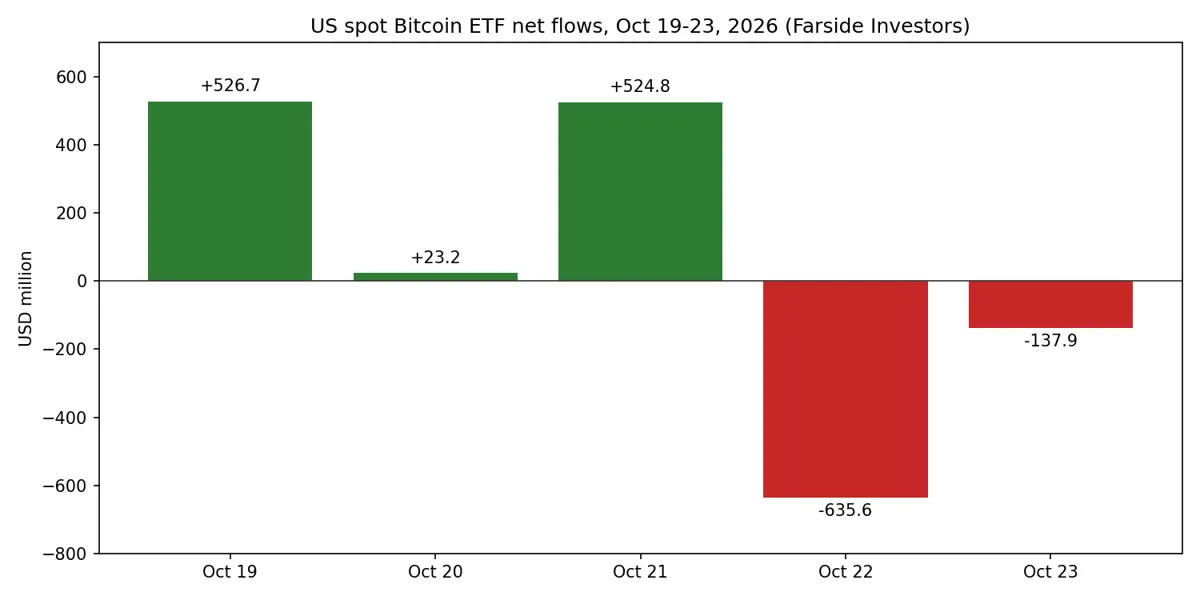
| Date | Bitcoin ETF net flow |
|---|---|
| October 19 | Plus $526.7 million |
| October 20 | Plus $23.2 million |
| October 21 | Plus $524.8 million |
| October 22 | Minus $635.6 million |
| October 23 | Minus $137.9 million |
Source: Farside Investors, as reported October 26, 2026. The pattern matters more than any single day: buyers showed up early, then sellers took over late.
That late-week exit lines up with the thin overnight session. Traders who sold on Thursday and Friday had little reason to rush back on Monday, one day before the Fed speaks.
Readers who want the wider ETF history can start with our earlier report on the longest streak of daily net outflows for US Bitcoin ETFs. It shows how unusual this year’s flow pattern has become.
What the Fed decides tomorrow, and when Pakistan hears it
The Federal Open Market Committee meets on October 27 and 28. It announces its decision on Wednesday, October 28 at 2:00 p.m. Eastern time.
For readers in Pakistan, that lands at 11:00 p.m. on October 28. Chair Kevin Warsh follows with a press conference at 2:30 p.m. Eastern, or 11:30 p.m. Pakistan time.
Markets expect a hold. Futures pricing puts the chance of no change at about 90 percent, and a Reuters poll found 94 of 100 economists expect rates to stay at 3.75 percent to 4.00 percent.
The same poll found all 100 economists expect a hike in December. That makes tomorrow’s press conference more important than the rate itself, because traders want clues about December.
Our earlier calendar piece explained why this week carries two triggers at once, and it still frames the timing well: see Bitcoin FOMC October 2026: two dates, one direction question. Today’s piece differs from that one on purpose, because it focuses on liquidity instead of the calendar.
Why a hold can still move Bitcoin
A hold sounds like no news. It can still move markets if the statement sounds tougher or softer than traders expect.
Hawkish language about December would support the dollar and pressure risk assets. Softer language about December could do the opposite and invite a relief bounce.
Bitcoin also faces a second pressure that has nothing to do with the Fed. Coinbase strategist Colin Basco warned that if the $80,000 to $82,000 zone fails, the next support sits near $73,000 to $75,000.
That warning connects directly to the buy wall. The wall sits just below $80,000, and a failed hold of that zone would test whether the wall turns into real buying or simply disappears.
What to watch before and after the announcement
Watch volume first. A breakout on thin volume usually reverses, while a breakout on rising volume carries more weight.
Watch the Coinbase premium second. A flip back to positive would signal US buyers returning, which this market has lacked for months.
Watch ETF flows third. Fresh inflows after the Fed decision would show institutions treating the statement as a reason to buy, not a reason to wait.
Watch stablecoin reserves fourth. Rising reserves would mean fresh cash parked on exchanges, ready to deploy if the price moves.
None of these signals predict the price. Together, they show whether any move has real backing or just thin air behind it.
Common mistakes traders make on Fed week
Many traders bet big before the statement. They treat a widely expected hold as a safe outcome, then get caught by one hawkish sentence.
Others trust the buy wall blindly. They assume stacked orders guarantee support, then watch the wall vanish during a fast drop.
A third group reads one ETF day as a trend. Thursday’s $635.6 million outflow looked dramatic alone, but the full week told a more balanced story.
All three mistakes share one root: they treat one signal as the whole market. Fed week punishes that habit more than most weeks do.
How this fits the bigger Bitcoin picture
Bitcoin still trades about 36 percent below its all-time high of $126,080 from October 2025. The calm near $80,000 sits inside a much larger correction, not above it.
Sentiment reflects that middle ground. The Crypto Fear and Greed Index read 48 on October 27, squarely neutral, after falling from greed levels a week earlier.
That context matters for new readers. A quiet day near $80,000 does not mean the market recovered, and it does not mean it collapsed either.
It means the market waits, with thin liquidity, for a central bank to speak. Our earlier analysis of past downturns gives that wait useful perspective: Bitcoin bear market: how low could BTC go, historical drawdowns compared.
Two more pieces round out the macro background. The October CPI report and Fed hike odds explain how inflation data shaped this meeting, and the $771 million liquidation day below $82,000 shows how fast thin markets can move.
For the other side of the rate debate, see what happens if the Fed actually cuts rates. It lays out the case traders hope for, even though a cut looks unlikely this week.
Finally, the demand backdrop has shifted this half of the year. Bitcoin treasury companies stopped buying, which leaves ETFs carrying more of the demand load than before.
FAQs
These answers cover the questions readers ask most about Bitcoin, liquidity and this week’s Fed decision.
Why is Bitcoin holding near $80,000 before the Fed decision?
Bitcoin holds near $80,000 because buyers defend the $79,400 to $79,600 zone while sellers cap rallies near $80,500 to $80,800, and most traders wait for the October 28 Fed statement before taking bigger positions.
What time does the Fed announce its October 2026 decision in Pakistan?
The Fed announces its decision on October 28 at 2:00 p.m. Eastern time, which is 11:00 p.m. Pakistan time, followed by a press conference at 11:30 p.m. Pakistan time.
Is the $80 million buy wall at $78,000 to $79,000 reliable support?
Not on its own, because many stacked orders link to futures positions and traders can cancel them quickly, so the wall only matters if real spot buying follows when the price tests it.
Why do falling stablecoin reserves matter for Bitcoin?
Falling stablecoin reserves matter because stablecoins act as ready cash on exchanges, and reserves at a 12-month low of about $60.62 billion mean less money sits parked and ready to buy Bitcoin.
Could Bitcoin fall below $78,000 after the Fed decision?
Yes, it could, and Coinbase strategist Colin Basco flagged $73,000 to $75,000 as the next support zone if the $80,000 to $82,000 area fails, though no outcome is guaranteed.
Conclusion
Bitcoin holds 80000 before Fed decision, but holding is not the same as strength. The price stayed still because few traders acted, not because many traders agreed.
The liquidity stack tells the honest story. A buy wall waits below, stablecoin cash sits at a 12-month low, US demand lags, and ETF buyers left late last week.
Tomorrow night, the Fed speaks at 11:00 p.m. Pakistan time. Watch volume, the Coinbase premium, ETF flows and stablecoin reserves after that moment, and you will know faster than the price alone whether this calm turns into a real move.






