



Wells Fargo now reports the largest Bitcoin ETF position of any big bank. Its third quarter filing with the U.S. Securities and Exchange Commission lists 49,577,094 shares of BlackRock’s iShares Bitcoin Trust, worth about $2.35 billion on September 30, 2026.
The headline number hides the real story. About 85 percent of those shares sit in the bank’s two brokerage arms as client money, not as a bet from Wells Fargo’s own balance sheet.

And the stake has already lost about $557 million of paper value since the September 30 snapshot, because Bitcoin has fallen roughly 23 percent since then.
- Key Takeaways
- What the Filing Actually Says
- Whose Money Is It Really?
- What the Stake Is Worth Today
- How Wells Fargo Compares With JPMorgan and Goldman Sachs
- What a 13F Can and Cannot Tell You
- What to Watch Next
- Frequently Asked Questions
- Did Wells Fargo buy $2.35 billion of Bitcoin?
- How many IBIT shares does Wells Fargo hold?
- What is Wells Fargo’s Bitcoin ETF stake worth now?
- Who is the largest institutional Bitcoin ETF holder?
- When will we know if Wells Fargo sold during the crash?
- The Bottom Line
Key Takeaways
- Wells Fargo reported 49,577,094 IBIT shares worth about $2.35 billion at September 30, more than double its June 30 position of 24,396,222 shares worth $812.2 million.
- Galaxy Research says about 85 percent of the position sits in Wells Fargo’s brokerage businesses, which means the money belongs mostly to the bank’s customers.
- At IBIT’s November 17 close of $36.14, the same stake is worth about $1.79 billion, a paper loss of roughly $557 million since September 30.
- Across all spot Bitcoin ETFs, Wells Fargo’s exposure equals about 30,553 BTC, which Galaxy ranks as the largest institutional Bitcoin ETF holding.
- A 13F filing is a snapshot from September 30. It says nothing about what Wells Fargo or its clients bought or sold during the October and November sell-off.
What the Filing Actually Says
Wells Fargo filed its third quarter Form 13F-HR with the SEC on November 16, 2026. The filing covers positions held on September 30 by the bank and its affiliated investment managers.
It lists 49,577,094 shares of BlackRock’s iShares Bitcoin Trust, known by its ticker IBIT.
The share count rose by 25,180,872 shares in three months, an increase of about 103 percent. The dollar value rose even faster, from about $812.2 million at the end of June to about $2.35 billion at the end of September.
Bitcoin gained about 42 percent during the quarter, so part of the jump came from price gains and part came from new buying.

BlackRock’s own filing puts IBIT’s net asset value at $47.38 per share on September 30. Multiply that by Wells Fargo’s share count and you get about $2.349 billion, which matches the reported figure.
The fund held 801,033 BTC against 1,414,760,000 shares outstanding that day. That math gives Wells Fargo indirect exposure to about 28,070 BTC through IBIT alone, or about 3.5 percent of the fund’s Bitcoin.
The numbers at a glance
| Figure | June 30, 2026 | September 30, 2026 | Change |
|---|---|---|---|
| IBIT shares reported | 24,396,222 | 49,577,094 | Up 103% |
| Reported value | $812.2 million | $2.35 billion | Up 189% |
| Bitcoin equivalent (IBIT only) | About 14,000 BTC | About 28,070 BTC | Doubled |
| All spot Bitcoin ETFs | 15,917 BTC | 30,553 BTC | Up 92% |
The filing also lists call options covering 717,200 IBIT shares and put options covering 540,000 shares. Those contracts sit outside the 49.58 million share total.
A 13F does not capture every short position or hedge, so the long holdings alone do not describe the full economic exposure of every account.
Whose Money Is It Really?
This is the detail most headlines skip. Galaxy Research head of firmwide research Alex Thorn said about 85 percent of Wells Fargo’s third quarter IBIT shares were booked through its two brokerage businesses.
That means the shares belong to the bank’s wealth management and brokerage clients, not to Wells Fargo’s trading desk.
The distinction matters for two reasons. First, it changes what the filing proves.
It shows that Wells Fargo’s customers want Bitcoin exposure through a regulated ETF, and that the bank’s advisers now let them buy it. It does not show that Wells Fargo itself went long on Bitcoin with $2.35 billion of its own cash.
Second, it changes who takes the loss when the price falls. The customers who hold IBIT in their brokerage accounts carry the risk.
Wells Fargo earns fees for custody, advice and execution either way. That is a very different business from a corporate treasury buying Bitcoin for its own balance sheet.
The same logic applies to the other big banks. JPMorgan’s filing also folds in 17 affiliated managers, and its positions can include client, fund and discretionary holdings rather than one proprietary bet.
A 13F adds up every entity under one manager’s umbrella. It never names the ultimate owner of each share.
What the Stake Is Worth Today
The September 30 snapshot is now seven weeks old, and Bitcoin has had a rough seven weeks. Bitcoin traded near $83,700 on September 30.
It traded near $64,427 on the morning of November 18, a drop of about 23 percent. IBIT closed at $36.14 on November 17, down from its $47.38 net asset value on September 30.
Apply the November 17 close to Wells Fargo’s reported share count and the stake is worth about $1.79 billion today. That is roughly $557 million less than the $2.35 billion headline figure.
Nobody outside the bank knows whether its clients held, added or sold during the fall, because the filing only records September 30.
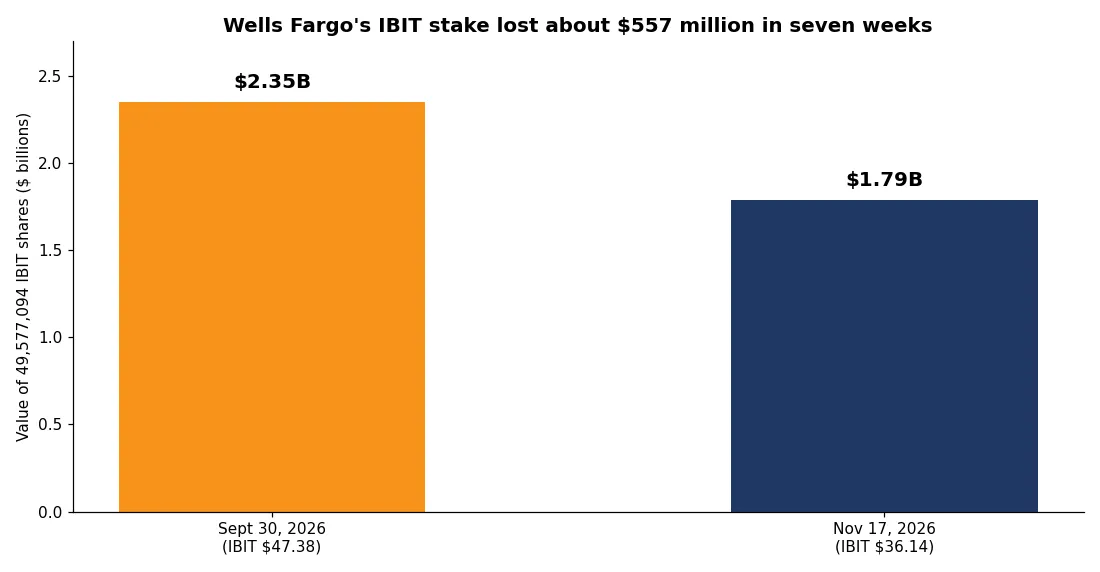
Wells Fargo IBIT stake: September 30 vs November 17
| Measure | September 30, 2026 | November 17, 2026 |
|---|---|---|
| IBIT price | $47.38 (NAV) | $36.14 (close) |
| Bitcoin price | About $83,700 | About $64,427 |
| 49,577,094 shares worth | About $2.35 billion | About $1.79 billion |
| Change since September 30 | Snapshot date | Down about $557 million |
Our own price check this morning puts Bitcoin near $64,427, with IBIT’s after hours price at $36.64 after the November 17 close. Even at the after hours price, the stake is worth about $1.82 billion, still roughly $530 million below the September 30 value.
The exact loss depends on the minute you check, but the direction does not change.
The wider ETF market tells the same story. Spot Bitcoin ETFs saw more than $1 billion in outflows after September 30, and IBIT alone bled for 11 straight sessions in that stretch.
The next filing will show whether Wells Fargo’s clients joined that exit or bought the dip.
How Wells Fargo Compares With JPMorgan and Goldman Sachs
Wells Fargo leads the bank pack by a wide margin, but the gap looks different once you compare like with like. Goldman Sachs more than doubled its reported spot Bitcoin ETF holdings to about $1.28 billion in the third quarter.
JPMorgan reported 11,408,930 IBIT shares worth about $540 million, up from $355.7 million in June. The Wells Fargo Bitcoin ETF holder crown sits on client money, not on the bank’s own trading book.
Goldman’s filing also shows its Ether ETF exposure climbing nearly sixfold to about $1.22 billion. Wells Fargo raised its own Ether position too, lifting its stake in BlackRock’s ETHA by 125 percent to 22 million shares.
The banks are not betting on Bitcoin alone. They are building broad crypto ETF exposure for clients who ask for it.
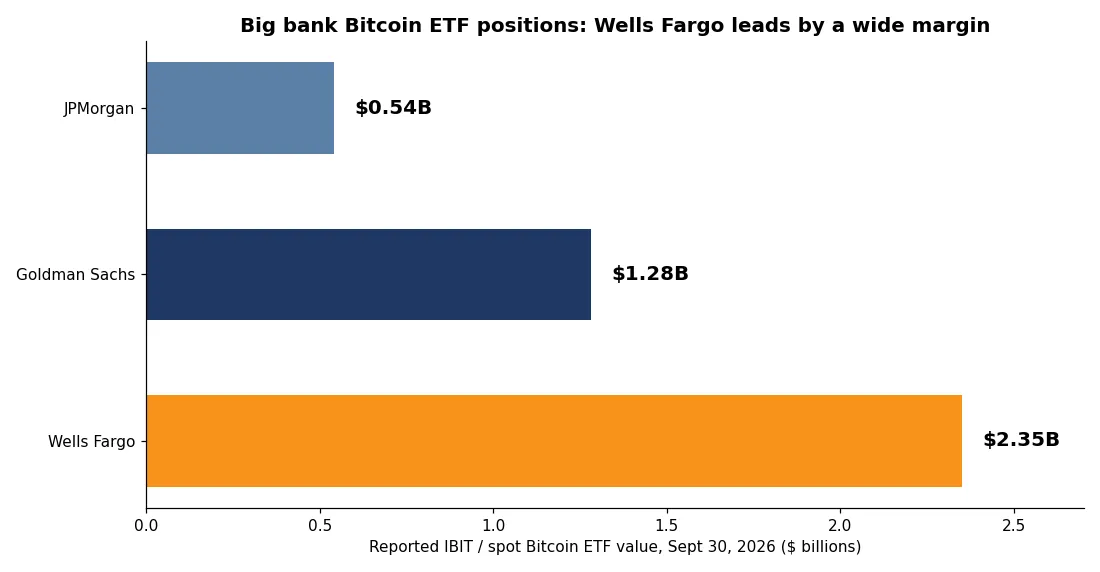
Big bank Bitcoin ETF positions, September 30, 2026
| Bank | IBIT shares | IBIT value | All spot Bitcoin ETFs |
|---|---|---|---|
| Wells Fargo | 49,577,094 | About $2.35 billion | 30,553 BTC equivalent |
| Goldman Sachs | Not disclosed separately | About $1.28 billion | About $1.28 billion |
| JPMorgan | 11,408,930 | About $540 million | About $549 million |
Put the Wells Fargo figure next to the corporate treasuries and the scale gets clearer. Its 28,070 BTC of IBIT exposure sits within 7 percent of the 30,221 BTC that Tesla and SpaceX hold directly combined.
A bank’s brokerage clients now hold nearly as much Bitcoin exposure through one ETF as two of the most famous corporate buyers hold outright. That is how fast the ETF wrapper has closed the gap between Wall Street distribution and direct ownership.
For more on how the fund itself has performed, read our report on BlackRock’s IBIT ETF hitting a monthly high on $290 million in inflows. For the other side of the trade, see BlackRock’s Bitcoin ETF selling off $54.8 million in one day.
What a 13F Can and Cannot Tell You
A Form 13F is a quarterly list that large investment managers must file with the SEC. Any manager with discretion over at least $100 million in covered securities must disclose its positions as of the last day of the quarter.
Managers get 45 days after quarter end to file, which is why a September 30 snapshot only became public in mid November.
The form answers one narrow question: which listed U.S. securities did this manager hold, long, on the last day of the quarter. It does not say who the ultimate owner is.
It does not show trades made after the snapshot date. It does not capture every hedge, short position or offsetting trade.
That is why the “largest holder” label needs care. Galaxy’s ranking counts reported ETF exposure across all spot Bitcoin funds, and Wells Fargo tops that list at 30,553 BTC equivalent.
But the ranking measures reported exposure, not conviction. A bank whose clients piled into IBIT through brokerage accounts can top the list without ever making a directional bet of its own.
The timing also matters. The September 30 snapshot caught Bitcoin near its quarterly high.
The market has since dropped about 23 percent, and Bitcoin has dropped out of the world’s top 15 assets after the crash toward $63,000. A filing that looks triumphant in November can describe a position that is already deep underwater.
What to Watch Next
The next hard date is February 16, 2027. That is when the fourth quarter 13F filings fall due, and they will show positions as of December 31, 2026.
That filing will answer the question this one cannot: did Wells Fargo’s clients hold through the sell-off, add to their positions, or sell into the decline.
Two signals will matter before then. The first is ETF flow data, which updates daily and shows whether money keeps leaving spot Bitcoin ETFs or starts to return.
The second is Bitcoin’s own price action around the $60,000 to $62,600 zone, which analysts have flagged as the key test in the coming weeks. Our guide to how low Bitcoin could go based on historical drawdowns puts the current drop in context.
Goldman’s older filing also gives a useful baseline. Read how Goldman Sachs raised its spot Bitcoin ETF holdings to $418 million in an earlier quarter to see how fast these bank positions have grown.
And the midterms rally shows how quickly sentiment can flip: Bitcoin rebounded above $80,000 after the midterms, but ETFs told a different story.
Frequently Asked Questions
Here are the questions readers keep asking about this filing, with short answers.
Did Wells Fargo buy $2.35 billion of Bitcoin?
No, Wells Fargo reported 49,577,094 shares of BlackRock’s IBIT ETF worth about $2.35 billion on September 30, 2026. About 85 percent of those shares sit in its brokerage arms as client holdings, not as the bank’s own money.
The filing also reports ETF shares, not direct Bitcoin holdings.
How many IBIT shares does Wells Fargo hold?
Wells Fargo reported 49,577,094 IBIT shares as of September 30, 2026, up 103 percent from 24,396,222 shares on June 30. The filing also lists call options on 717,200 IBIT shares and put options on 540,000 shares, which sit outside the share total.
What is Wells Fargo’s Bitcoin ETF stake worth now?
At IBIT’s November 17 close of $36.14, the reported 49,577,094 shares are worth about $1.79 billion. That is roughly $557 million less than the $2.35 billion value on September 30, because Bitcoin has fallen about 23 percent since then.
The real figure depends on whether clients held, added or sold, which the filing cannot show.
Who is the largest institutional Bitcoin ETF holder?
Wells Fargo ranks first by reported exposure, with about 30,553 BTC equivalent across all spot Bitcoin ETFs, according to Galaxy Research. Goldman Sachs reported about $1.28 billion in spot Bitcoin ETF holdings and JPMorgan reported about $540 million in IBIT, both far below Wells Fargo’s $2.35 billion IBIT position.
The Wells Fargo Bitcoin ETF holder ranking measures reported client exposure, not the bank’s own conviction.
When will we know if Wells Fargo sold during the crash?
The next Form 13F covers positions as of December 31, 2026, and is due February 16, 2027. Until then, daily ETF flow data and Bitcoin’s price action are the only public signals about whether Wells Fargo’s clients held or sold during the October and November decline.
The Bottom Line
Wells Fargo’s $2.35 billion IBIT position is real, and it is the largest reported Bitcoin ETF holding among the big banks. But the number describes September 30, not today.
About 85 percent of it is client money in brokerage accounts, and the same shares are worth about $1.79 billion after Bitcoin’s fall to near $64,427. The Wells Fargo Bitcoin ETF holder story is, at its core, a story about client demand.
The filing proves that demand for Bitcoin exposure through regulated ETFs has reached the biggest U.S. banks’ customers. It does not prove that Wells Fargo itself is betting on Bitcoin.
Watch the February 16 filing to learn whether those customers stayed in the trade.






