



Here is the short, calm answer first. The CLARITY Act failed to advance in the Senate on September 15, 2026, on a 49-50 procedural vote.
The Senate never actually voted on crypto policy. It voted on whether to even debate the bill, and a procedural rule says you need 60 votes for that.

Why does that matter to you? Because nothing about your Bitcoin, your ETF, your exchange account, or your crypto taxes changed overnight.
- What Actually Happened on September 15, 2026
- Why the CLARITY Act Failed Its 49-Vote Test: The Cloture Explainer for Beginners
- What Is the CLARITY Act, Anyway?
- The core idea: who regulates which crypto asset
- What the bill would have done for exchanges, stablecoins, and DeFi
- How the CLARITY Act differs from the GENIUS Act
- How Did Bitcoin React? The 48-Hour “Disaster” That Wasn’t
- What Changes for Your Coins Today vs Yesterday
- Your Bitcoin and other coins
- Your spot Bitcoin ETF
- Your exchange account and taxes
- Where crypto regulation was already working anyway
- Who Regulates Crypto Now? The SEC and CFTC Take the Pen
- The SEC’s path: Regulation Crypto Assets
- The CFTC’s role and the March 2026 joint guidance
- What “security vs commodity” actually means for a beginner
- Key Dates Timeline: What to Watch Next
- October 20, 2026: SEC Regulation Crypto Assets comment period closes
- November 3, 2026 elections, then the lame-duck session
- January 2027: GENIUS Act foreign-stablecoin reciprocity kicks in
- July 2028: GENIUS Act licensed-issuer deadline
- 2027 and beyond: possible new market-structure bill in the next Congress
- Could the CLARITY Act Be Revived?
- Investor Checklist: What to Actually Do Now
- Common Mistakes People Make Reading This News
- Myth: “The Senate voted against crypto”
- Myth: “Crypto is now unregulated”
- Myth: “Your coins are in danger”
- Myth: “The vote caused the whole crash”
- Frequently Asked Questions
- Conclusion
The rules of crypto now get written by two government agencies, the SEC and the CFTC, instead of Congress. That is the whole story in one paragraph.
This article walks you through exactly what happened on September 15, why 49 votes somehow “lost,” how Bitcoin reacted (spoiler: it recovered in days), who makes the rules now, the key dates to watch, and a simple checklist of what you should actually do. Let us get into it.
Key Takeaways
- The CLARITY Act failed on a 49-50 cloture vote on Sept 15, 2026. It needed 60 votes just to start debate, so crypto policy itself was never voted on.
- Bitcoin dipped about 3.4% on the news, then reclaimed $80K by Sept 18 and topped $86K by Sept 22. ETF outflows of $450M essentially reversed within 72 hours.
- Nothing changed for your holdings: no coins became illegal, no ETF shut down, no new tax rule appeared.
- Regulation now moves through the SEC and CFTC. The next key date is October 20, 2026, when the SEC’s Regulation Crypto Assets comment period closes.
What Actually Happened on September 15, 2026
Let us start with plain facts. On September 15, 2026, the US Senate took a vote called a “cloture motion” on the motion to proceed to H.R. 3633, the Digital Asset Market Clarity Act.
The result was 49 in favor and 50 against. Because of Senate rules, the motion needed 60 votes to pass. So the bill never even reached a real debate.

One senator, Chris Coons, did not vote at all. On the Republican side, four senators voted no: Susan Collins, Josh Hawley, Jerry Moran, and Thom Tillis. Every Democrat who was present also voted no.
Here is a detail worth knowing. Senator Tillis actually switched his vote from yes to no in the final minutes.
He did it on purpose, as a parliamentary trick. By being on the losing side, he earned the right to file a motion to reconsider later. That move keeps the bill alive on the Senate calendar instead of burying it completely.
The bill had a long road before this day. The House of Representatives had passed it 294-134 back on July 17, 2025.
The Senate Banking Committee advanced it on May 14, 2026. And the final draft, released just one day before the vote on September 14, already carried more than 120 changes requested by Democrats.
So why did it die? The sticking points were politics, not technology.
The big fights were over ethics provisions about crypto holdings by government officials (including the President), rules on stablecoin yield (whether stablecoin issuers can pay interest-like rewards), consumer protections, and provisions around DeFi and illicit finance. In other words, the bill tripped on Washington arguments, not on anyone disagreeing with crypto itself.
Senator Cynthia Lummis, the bill’s lead sponsor, said before the vote that it was “over” if cloture failed. But here is the twist.
Negotiations actually resumed the same day as the vote. The CLARITY Act failed its big moment, but the people writing crypto law did not stop working.
Why the CLARITY Act Failed Its 49-Vote Test: The Cloture Explainer for Beginners
This is the part that confuses almost everyone. How can a bill with 49 votes “fail” when only 50 people voted against it?
If you took that headline at face value, you might think the Senate voted against crypto. That is the myth to bust right now.
The Senate never voted on crypto policy at all. It voted on whether to open the door to the debate room, and the door has a special lock.
What cloture actually is
Think of the Senate like a very formal meeting room with an unusual rule. Before the group can even start discussing a proposal, most of the room has to agree to open the discussion.
That vote is called cloture. And the rule says 60 out of 100 senators must agree.
The idea is that a small minority cannot be bullied into a debate they are not ready for. The price of that protection is that even a proposal with 49 supporters dies if 41 senators refuse to open the door.
That is exactly what happened here. The 49-50 vote was about the door, not the proposal.
So did the Senate reject crypto?
No. Let me say that plainly because it is the most important correction in this story.
The Senate rejected starting the debate on one specific bill. Crypto itself was never on trial.
This matters for you as an investor. A headline like “Senate blocks crypto bill” sounds like the government turned against crypto.
The reality is that senators were arguing about ethics rules for politicians, stablecoin interest payments, and consumer-protection wording. Your coins were never in the room.
What Is the CLARITY Act, Anyway?
Okay, so what was this bill that everyone is talking about? In simple terms, the CLARITY Act was a market-structure law. That is a fancy way of saying it was meant to finally answer one basic question: which crypto assets are regulated by which agency?
Right now, crypto regulation in America is blurry. One agency (the SEC) polices stocks and securities. Another agency (the CFTC) polices commodities like gold and wheat.
Many crypto tokens sit in a gray zone where nobody is sure which agency is in charge. The bill was designed to draw that line clearly, so exchanges, token builders, and investors would know exactly which rules apply.
The core idea: who regulates which crypto asset
Here is the simple version. Under the CLARITY Act, a token that behaves like a stock would be an SEC-regulated security.
A token that behaves like a commodity would be CFTC-regulated. The bill also included a “mature blockchain test,” a set of conditions under which a crypto network could be judged decentralized enough to sit under the CFTC rather than the SEC.
For beginners, think of it like two referees on a soccer field. Right now, both referees sometimes blow the whistle at the same time, and the players are confused about whose whistle to listen to. The CLARITY Act would have told each referee exactly which parts of the field were theirs.
What the bill would have done for exchanges, stablecoins, and DeFi
For exchanges like Coinbase, the bill would have given a clear registration path instead of the current guessing game. For stablecoins, it would have set federal rules on who can issue them and what reserves they must hold. For DeFi (decentralized finance), it would have defined where responsibility sits when there is no company in charge.
None of that is happening now, at least not through Congress. But remember the key point.
The existing agencies, the SEC and CFTC working together on crypto rules, are still writing guidance. The gray zone is shrinking on its own, just more slowly.
How the CLARITY Act differs from the GENIUS Act
Beginners mix these two up all the time, so let us separate them. The GENIUS Act is about stablecoins, the dollar-pegged tokens like USDT and USDC.
It was signed into law by President Trump in July 2025. It is already real, and its rules roll out in stages through 2027 and 2028. You can read more about it in our piece on how the GENIUS Act is already law.
The CLARITY Act was about everything else: the broader market structure for all other crypto assets. One was a stablecoin law that passed. The other was a market-structure law that failed.
Knowing the difference helps you ignore half the confused takes online.

How Did Bitcoin React? The 48-Hour “Disaster” That Wasn’t
Now the part every investor cares about. The headlines made it sound like a disaster.
The market told a different story. The panic was sharp, leveraged, and fast, and it fully reversed within about 72 hours. Let us look at the real numbers, step by step.
-3.4%
BTC dip on Sept 15 (intraday low ~$75,664)
$86K+
BTC by Sept 22, briefly $87K
+$433M
Spot BTC ETF inflows on Sept 18
The price drop
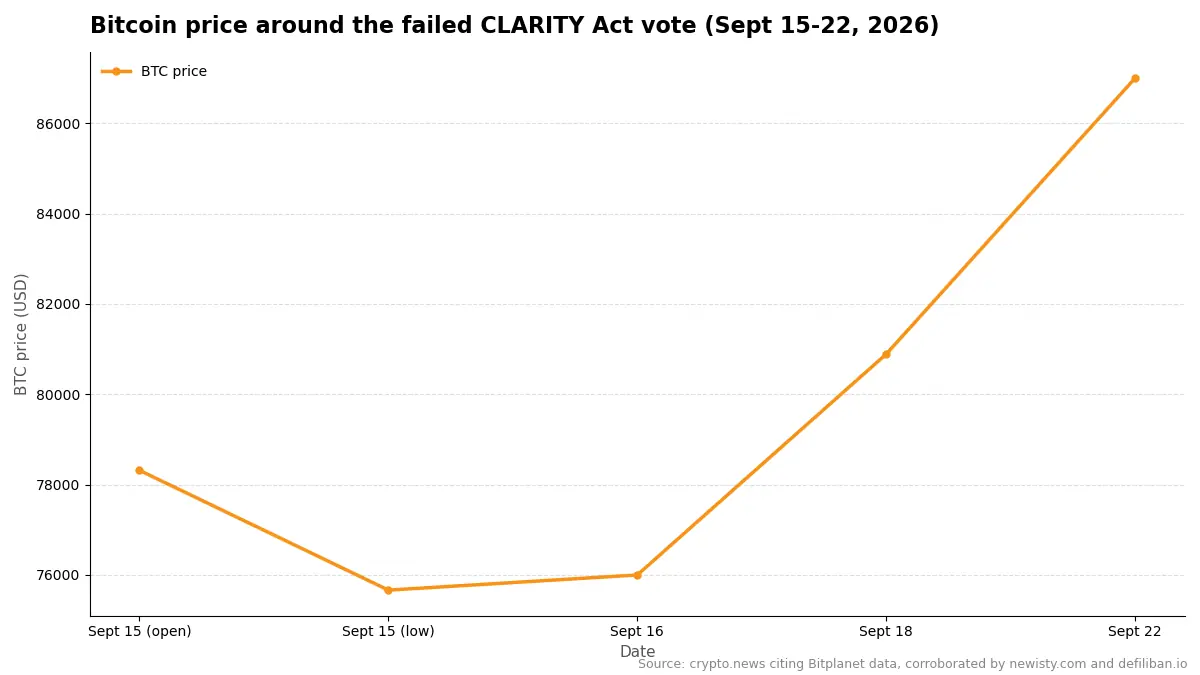
On the day of the vote, Bitcoin opened around $78,316. When the failed vote became clear, the price slid to an intraday low near $75,664, a drop of roughly 3.4%. Crypto liquidations spiked hard: over $300 million of positions were wiped out in just 20 minutes after the vote, and total 24-hour liquidations topped $665 million.
One honest note here. Bitcoin was already slipping before the vote.
Traders were nervous about the Federal Reserve meeting the next day, and analysts caution against blaming the whole decline on the bill. The vote was one factor among several, not the whole story.
The recovery
Then the market shrugged. By September 18, Bitcoin was back above $80,000, up about 5.8% from the September 15 low. By September 22, it pushed above $86,000 and briefly touched $87,000, its highest level since late January.
What actually moved the market? The Federal Reserve.
On September 16, the day after the vote, the Fed raised interest rates by 25 basis points to a 3.75-4.00% range, its first hike since July 2023. Crypto rallied on the liquidity story, not the legislation story. If you want the full picture of why Fed decisions move crypto prices, we have a dedicated explainer.
ETF flows and liquidations
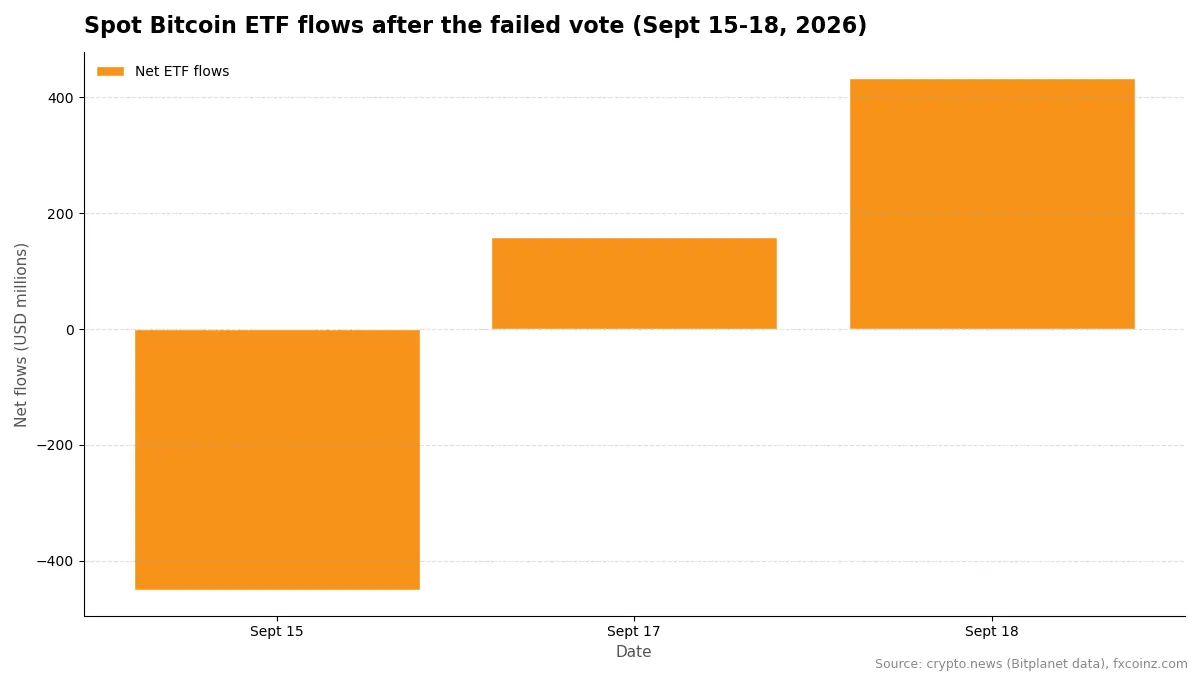
The ETF data tells the same “sharp scare, fast recovery” story. On September 15, the 12 US spot Bitcoin ETFs saw net outflows of $450.4 million. Fidelity’s FBTC alone lost $214.8 million, and BlackRock’s IBIT lost $161.7 million.
Then the money came back. September 17 brought $159.5 million of inflows, and September 18 added another $433 million. If you are still fuzzy on how spot Bitcoin ETFs actually work, that context makes these numbers much easier to read.
Here is another clue that this was never a lasting crisis. Prediction markets had already priced in the failure before senators voted.
Polymarket odds of passage fell from around 82% in February to 39% in July, then to 18-25% right before the vote, and about 6% after it. The smart money knew it was coming, which is why Bitcoin’s reaction was a wobble, not a crash.
What Arthur Hayes said
BitMEX co-founder Arthur Hayes gave the counter-narrative that fits this data perfectly. Days after the vote, he argued that crypto never needed the bill at all.
Liquidity, meaning the flow of dollars through the financial system, is what actually moves crypto prices, not legislation. And the week proved his point: a rate decision moved Bitcoin far more than a failed Senate vote.
See we didn’t need some nonsense piece of crypto regulation, Clarity Act, just a rate hike that puts more dollars in the hands of rich people to consume more financial assets.
Arthur Hayes (@CryptoHayes) · September 18, 2026 · View on X
What Changes for Your Coins Today vs Yesterday
Here is the section no competitor gives you: a plain translation of this story into your portfolio. Let us compare September 14 (the day before the vote) with today, holding by holding.
The honest answer is short. Nothing about your holdings changed.
Your exchanges, your ETFs, your tax rules, and the coins you own are exactly as they were on September 14. The CLARITY Act failed, and your crypto life is untouched. Let us walk through each piece so you can see it for yourself.
Your Bitcoin and other coins
Your Bitcoin is still your Bitcoin. Bitcoin is treated as a commodity, not a security, and that did not change. The same goes for the other major coins: Ethereum, Solana, and XRP were already classified as digital commodities under the March 2026 joint SEC and CFTC guidance.
No coin became illegal. No token was delisted because of this vote.
If you are curious about how one famous case resolved, read about XRP’s long legal battle with the SEC. That story ended with clarity, and this vote did not reopen it.
Your spot Bitcoin ETF
The ETFs never stopped working normally. The $450 million in outflows on September 15 was investors reacting to headlines, not a structural problem.
Within three days, inflows of $433 million had essentially reversed the panic. The mechanics of your ETF, the fees, the tracking, the redemption process, were never affected by the Senate.
Your exchange account and taxes
Your exchange account works exactly as before. No new trading rules appeared. No new reporting requirements came from this vote.
Crypto taxes in the US follow existing IRS rules, and a failed bill creates no new ones. If anything changed for you, it would have come through agency rulemaking, and that process is still moving separately.
Where crypto regulation was already working anyway
Zoom out, and the picture is calmer than the headlines. The March 2026 SEC and CFTC joint guidance already classified 16 major cryptos as digital commodities.
The GENIUS Act stablecoin law is on track and rolling out on schedule. Banks continue entering crypto through existing OCC rules. The system was not waiting for the CLARITY Act to function, and it does not need to wait now.

Who Regulates Crypto Now? The SEC and CFTC Take the Pen
With Congress stalled, the pen moves to the agencies. This is actually how a lot of US financial regulation works day to day: Congress writes the big framework, but agencies write the detailed rules. On crypto, the SEC and CFTC are now writing those rules directly, and they were already doing it before the vote.
In plain English, here is the split. The SEC handles crypto that looks like a security (stocks, investment contracts). The CFTC handles crypto that looks like a commodity (digital assets traded like gold or wheat).
Most of the big coins you own now sit in the agency-rulemaking pipeline instead of the congressional pipeline.
The SEC’s path: Regulation Crypto Assets
The SEC’s flagship move is a proposed rule called Regulation Crypto Assets. It is designed to clarify how tokens, exchanges, and intermediaries should register and comply.
The key date: the public comment period closes on October 20, 2026. After that, the SEC reviews the comments and moves toward a final rule.
For investors, this is the single most important date on the calendar right now. It is where the real rulebook gets written.
The CFTC’s role and the March 2026 joint guidance
The CFTC regulates crypto commodities and derivatives. Back in March 2026, the SEC and CFTC issued joint guidance classifying 16 cryptocurrencies, including ETH, SOL, and XRP, as digital commodities. That guidance already settled a huge part of what the CLARITY Act was trying to settle, which is another reason the vote’s failure stung less than the headlines suggested.
What “security vs commodity” actually means for a beginner
Let us make this concrete with an analogy. A security is like a share in a company: you buy it expecting the people running the company to make it grow. A commodity is like a sack of wheat or a bar of gold: you buy it expecting the market, not any single person, to decide its price.
Bitcoin is treated as a commodity because no single company runs it. Nobody promises you profits.
That classification matters because commodities get lighter, market-based regulation. And that classification did not change when the CLARITY Act failed. Your Bitcoin is still a commodity, today just like yesterday.
Key Dates Timeline: What to Watch Next
Politics is noise. The calendar is signal. If you want to know what actually happens to US crypto regulation now that the CLARITY Act failed, watch these dates, not the headlines.
| Date | What happens | Why it matters for you |
|---|---|---|
| Oct 20, 2026 | SEC’s Regulation Crypto Assets comment period closes | The moment agency-written crypto rules move toward final form |
| Nov 3, 2026 | US midterm elections | Reshapes Congress, then the lame-duck session begins |
| Late 2026 | Lame-duck session | The best remaining window to revive the CLARITY Act this Congress |
| Jan 18, 2027 | GENIUS Act foreign-stablecoin reciprocity starts | Foreign stablecoins reach US users only under reciprocal rules |
| Jul 18, 2028 | GENIUS Act licensed-issuer deadline | Only licensed issuers can serve US stablecoin users |
| 2027 onward | Possible new market-structure bill | Next Congress could write the CLARITY Act’s successor |
October 20, 2026: SEC Regulation Crypto Assets comment period closes
This is the big one. When the comment period closes, the SEC digests industry and public feedback and starts shaping the final rule.
Whatever comes out of this process becomes the real operating manual for tokens and exchanges. If you follow only one date, follow this one.
November 3, 2026 elections, then the lame-duck session
The midterm elections reshape Congress. After them comes the “lame-duck” session, the stretch between the election and the new Congress taking over.
Lame ducks are famous for passing bills that were stuck, because departing lawmakers have less to lose. This is the realistic revival window for the CLARITY Act.
January 2027: GENIUS Act foreign-stablecoin reciprocity kicks in
Under the GENIUS Act timeline, foreign stablecoins will only be able to reach US persons under reciprocal arrangements starting January 18, 2027. If you hold stablecoins, this is the date when the issuer landscape starts changing in a real, practical way.
July 2028: GENIUS Act licensed-issuer deadline
By July 18, 2028, only licensed stablecoin issuers can operate in the US market. That is the endgame of the GENIUS Act. Stablecoin products you use today may look different by then, and the stablecoin yield debate (whether issuers can pay you rewards) will be settled in this process.
2027 and beyond: possible new market-structure bill in the next Congress
If the lame-duck session passes without a revival, the realistic path is a fresh market-structure bill in the next Congress. Analysts already note that rewrite discussions have begun. The CLARITY Act failed in 2026, but its core idea, a clear SEC/CFTC line, will likely return in a new form.

Could the CLARITY Act Be Revived?
Short answer: stalled, not buried. The bill is in a coma, not a coffin. Here is why that matters and what the realistic paths look like.
Remember Tillis’s parliamentary trick. By switching his vote to no in the final minutes, he earned the right to file a motion to reconsider.
That keeps the bill alive on the Senate calendar. And Senator Lummis said negotiations resumed the same day as the vote. The people who wrote the bill have not walked away from it.
The lame-duck path
After the November 3 elections, the lame-duck session opens the most realistic window. Departing senators and a reshuffled power balance can make stalled bills suddenly movable. This is the path Lummis’s team is watching most closely.
The “next Congress” rewrite path
Crypto news outlets report that rewrite discussions are already underway. Instead of reviving the exact failed bill, the next Congress could take a fresh market-structure bill built from the CLARITY Act’s bones, with the ethics and stablecoin-yield fights renegotiated from scratch. The CLARITY Act failed, but the market-structure project survives it.
What prediction markets say
Prediction markets give the revival about 6% odds before year-end. That is low, but it is not zero, and it reflects the lame-duck possibility. Treat these odds as a weather forecast, not a prophecy: useful for expectations, useless for decisions.
Investor Checklist: What to Actually Do Now
Enough analysis. Here is the practical part. This section is the “what to do on Monday morning” answer, and it is deliberately short.
Do
First, watch the SEC comment period closing on October 20, 2026. That is where real rules get shaped.
Second, keep an eye on the lame-duck session after the November 3 elections, since that is the revival window. Third, expect banks to keep entering crypto through existing OCC banking rules, because that trend never depended on Congress.
Fourth, follow the stablecoin yield debate, since it affects savings-type crypto products you might use.
Don’t
Do not panic-sell on political headlines. The market recovered in 72 hours, and the panic sellers of September 15 missed the rebound to $87,000.
Do not assume “failed” means “banned.” Nothing was banned; the bill failed, and your coins are legal and unchanged. And do not ignore the tax and exchange rules that already exist, because those are the rules that actually apply to you right now.
Tip: The most dangerous mistake in crypto is confusing a political headline with a change in your portfolio. The CLARITY Act failed, and your wallet looks exactly the same as yesterday. Trade the market, not the Senate.
Common Mistakes People Make Reading This News
This story created at least four widespread myths. Let us clear them up one by one, because each one costs investors money when they act on it.
Myth: “The Senate voted against crypto”
The Senate never voted on crypto policy. It voted on a cloture motion, a procedural question about whether to start debating the bill. Crypto itself was never on trial, and no senator voted on whether crypto is good or bad.
Myth: “Crypto is now unregulated”
Crypto is not unregulated in America. The SEC already polices crypto securities, the CFTC already polices crypto commodities and derivatives, and the March 2026 joint guidance already classified 16 major assets. Agency rulemaking continues right now, including the SEC’s Regulation Crypto Assets proposal with its October 20 comment deadline.
Myth: “Your coins are in danger”
Nothing about your holdings changed on September 15. No coin became illegal, no exchange was forced to delist, no ETF shut down, and no new tax rule appeared. The people who acted on this myth sold near the low and watched Bitcoin climb back above $86,000 within a week.
Myth: “The vote caused the whole crash”
Bitcoin was already sliding before the vote, with traders bracing for the September 16 Fed meeting. Analysts explicitly warn against attributing the whole decline to the bill. And whatever the vote contributed, the recovery showed the market’s true verdict: a rate decision mattered more than a Senate vote.
Frequently Asked Questions
Did the CLARITY Act pass?
No. On September 15, 2026, the Senate failed to advance the bill on a 49-50 cloture vote.
Because 60 votes are needed just to begin debate, the bill never reached a real vote on its contents. The House had passed it 294-134 back in July 2025, but that no longer matters while the Senate cannot open debate.
Is the CLARITY Act dead?
Effectively yes for 2026, but not permanently. Senator Tillis’s motion to reconsider keeps the bill alive on the Senate calendar.
Negotiations resumed the same day as the vote. The realistic paths are a lame-duck session revival after the November 3 elections, or a rewritten market-structure bill in the next Congress.
Will the CLARITY Act be revived in the lame-duck session?
It is possible but unlikely. Prediction markets give it about 6% odds of passage before year-end.
The lame-duck session after the November 3 elections is the most realistic window, and negotiations did resume the same day as the vote. But with the bill stalled on ethics and stablecoin-yield fights, a full rewrite in the next Congress may be more likely than a clean revival.
What does the failed CLARITY Act vote mean for Bitcoin investors?
Practically, very little. Your Bitcoin’s legal status did not change, your ETFs kept working normally, and no new tax or trading rules appeared.
The market’s own reaction tells the story: Bitcoin dipped about 3.4% on September 15, then recovered above $80,000 by September 18 and above $86,000 by September 22. What matters going forward is agency rulemaking, especially the SEC’s October 20 comment deadline, not the Senate vote.
How did Bitcoin react to the failed CLARITY Act vote?
Bitcoin fell roughly 3.4% on September 15, hitting an intraday low near $75,664, with over $665 million in crypto liquidations in 24 hours. But the panic reversed fast.
By September 18 Bitcoin was back above $80,000, and by September 22 it topped $86,000, briefly touching $87,000. ETF outflows of $450.4 million on September 15 flipped into inflows of $433 million on September 18. The bigger market mover that week was the Fed’s September 16 rate hike, not the Senate vote.
Conclusion
Let us land this plane. The CLARITY Act failed on a procedural technicality, not on crypto.
A 49-50 cloture vote could not open the door to debate, and the bill died on Washington arguments about ethics rules and stablecoin yields. The Senate never voted on whether crypto is good or bad, and your coins never noticed.
The market already told you the rest. Bitcoin dipped 3.4%, then recovered in days.
The panic sellers of September 15 missed the run to $87,000 a week later. Prediction markets had priced in the failure long before senators voted. Liquidity moved the market; legislation was noise.
What comes next is quieter but more important. The SEC and CFTC now hold the pen, the SEC’s Regulation Crypto Assets comment period closes October 20, 2026, and the GENIUS Act rolls out through 2027 and 2028.
Watch the calendar, not the politics. And when the next screaming headline arrives, ask one question first: did anything change about my coins? If the answer is no, close the tab and carry on.
| Question | Short answer |
|---|---|
| Did the bill pass? | No. 49-50 cloture vote, 60 needed. |
| Did your coins change? | No. Holdings, ETFs, taxes untouched. |
| Who writes the rules now? | The SEC and CFTC, through rulemaking. |
| Next key date? | Oct 20, 2026: SEC comment period closes. |
Next step
Want to stay ahead of the rules that actually shape your portfolio? Follow the SEC’s Regulation Crypto Assets rulemaking and the lame-duck revival watch.
And if you are new to this whole regulatory landscape, start with our explainer on how the SEC and CFTC are coordinating on crypto regulation, then read how Bitcoin stacks up against gold as a store of value. Knowledge is the cheapest edge in crypto.
Hester Peirce’s exit from the SEC today leaves the agency down to two commissioners, making quick agency rulemaking even less likely.