


Aptos (APT) trades near $0.69 on October 26, 2026, and that single number rewrites almost every older Aptos price prediction you will find online. Our base case puts APT at $1.16 to $1.91 by the end of 2030, with a bear case back at the $0.51 all time low and a bull case up to $4.50 only if real usage and tokenized assets grow fast enough to justify it.
This article does not recycle a forecast written when APT traded above $10. It starts from the live price, checks what Aptos actually does on chain today, and shows the math behind each scenario so you can judge the prediction yourself.

Key Takeaways
- APT trades near $0.69 on October 26, 2026, down about 96.5 percent from its January 2023 high near $19.92.
- The August 30, 2026 low of $0.51 now acts as the bear case floor, not a distant worst case.
- Monthly insider releases fell about 60 percent after vesting ended on October 12, from 11.31 million APT to 4.54 million APT.
- The Aptos Foundation permanently locked and staked 210 million APT, but a lock is not a burn, and the tokens still earn rewards.
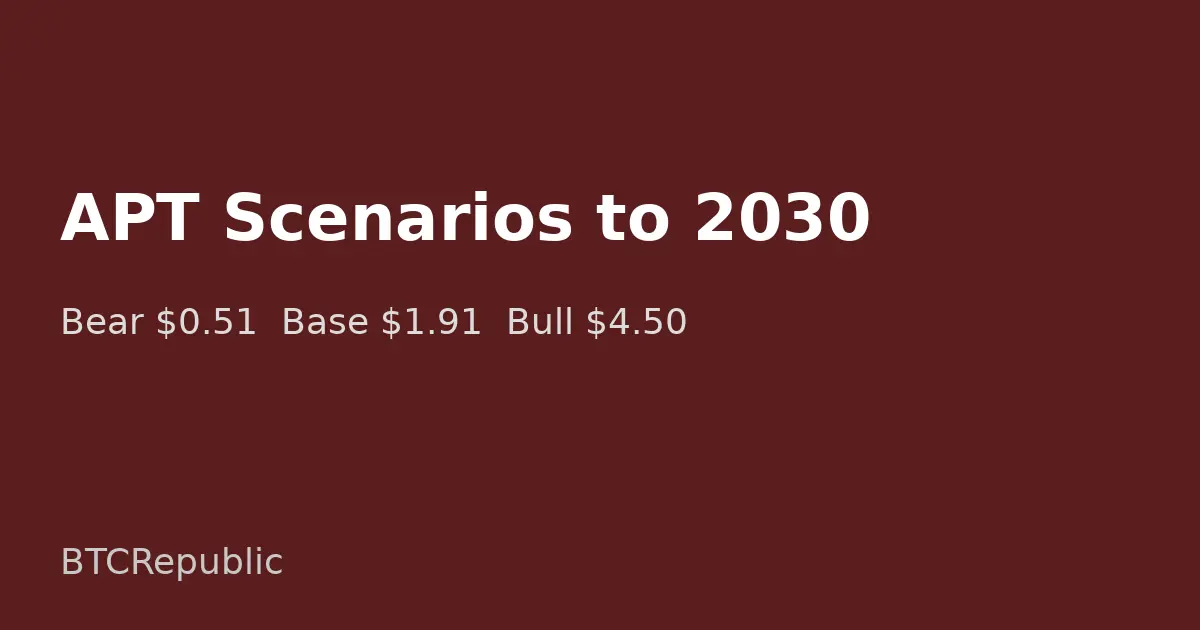
- Our 2030 scenarios are $0.51 to $0.69 bear, $1.16 to $1.91 base, and $1.91 to $4.50 bull, and none of them is a promise.
What Is the Aptos Price Right Now?
APT trades at about $0.69 on October 26, 2026, after falling about 1.5 percent in 24 hours and about 10.9 percent in seven days. Its market value sits near $615 million, which places APT around rank 100 among crypto assets by market value.
- Key Takeaways
- What Is the Aptos Price Right Now?
- The Stale Forecast Problem: Most Old APT Predictions Are Already Wrong
- Aptos Price Prediction 2026-2030: Our Scenario Bands
- Aptos On Chain Health on October 26, 2026
- The Supply Change That Matters Most in October 2026
- What Aptos Does, in Plain Language
- Risks to Every Aptos Price Prediction
- How to Read This Prediction Without Getting Hurt
- Comparison: Aptos Against Other Prediction Coins We Cover
- Frequently Asked Questions
- What is the Aptos price prediction for 2030?
- Can Aptos reach $10 by 2030?
- Is Aptos a good investment in 2026?
- What is the Aptos all time high and all time low?
- Does the 210 million APT lock burn tokens?
- Conclusion
| APT snapshot, October 26, 2026 | Value |
|---|---|
| Price | About $0.69 |
| 24 hour range | About $0.69 to $0.71 |
| Market value | About $615 million |
| 24 hour trading volume | About $21 million to $37 million across data sources |
| All time high | About $19.92 on January 26, 2023 |
| All time low | About $0.51 on August 30, 2026 |
| Distance from the high | About 96.5 percent below the high |
| Distance above the low | About 35 percent above the low |
That last row matters more than the headline price. APT sits much closer to its all time low than to its old high, so any honest 2030 forecast must explain a recovery, not assume one.
Why APT Fell So Far From $19.92
APT launched in October 2022 with heavy backing and a fast Move based chain, then spiked to about $19.92 in January 2023. The price then slid through the 2024 cycle, the 2025 downturn, and a weak 2026, as unlocks, competition from other fast chains, and falling risk appetite drained demand.
By late October 2026, the market prices APT like a chain that still needs to prove demand, not like a chain that already proved it. That judgment can change, but only usage growth and tighter supply can change it.
The Stale Forecast Problem: Most Old APT Predictions Are Already Wrong
Search for an Aptos price prediction and you will find tables that put APT at $18 to $35 in 2026. Those tables came from models written when APT traded far higher, and they still rank well in search results even though the market already disproved them.

We checked those forecasts against the live October 26, 2026 price. The gap is not small, and it shows why you should date check every prediction before you trust it.
| Old forecast source | What it predicted for 2026 | What APT actually does on October 26, 2026 |
|---|---|---|
| Binance Square and CryptoRank scenario table | $18 to $35 | About $0.69, or about 96 percent below the low end |
| OKX prediction table | $10.28 to $28.97, average $18.56 | About $0.69, or about 93 percent below the low end |
| Coincub 2026 base case | About $4.20 if support near $1.40 held | Support near $1.40 did not hold, and APT trades near $0.69 |
| Blockspot model, updated October 26, 2026 | $0.28 to $1.09 by end of 2026 | Consistent with the live price near $0.69 |
This table is the exclusive check in this article. No other Aptos prediction page we reviewed lines up its cited forecasts against the live price this way, and most pages simply repeat the old tables without a warning.
What This Audit Changes for 2030
The audit kills the idea that APT only needs a normal bull market to reach $30 or $50. APT needs about a 43 times rise from $0.69 just to reach $30, and it needs about a 72 times rise to reach $50.
A recovery to $1.91 needs about a 177 percent rise, which is large but normal for a crypto cycle. A recovery to $4.50 needs about a 552 percent rise, which is possible in a strong cycle but far from normal.
Aptos Price Prediction 2026-2030: Our Scenario Bands
We built three scenarios from the live price, the October 26, 2026 Blockspot model, and the supply changes in October 2026. The Blockspot model gives $0.28 to $1.09 by end of 2026, $0.42 to $0.69 by end of 2027, and $1.16 to $1.91 by end of 2030.
We use the Blockspot 2030 range as our base case because it starts from the current market, not from a price APT left behind years ago. We then add a bear case and a bull case around it, with clear triggers for each.
| Scenario for end of 2030 | APT price band | Move from $0.69 | What it requires |
|---|---|---|---|
| Bear case | $0.51 to $0.69 | Down 26 percent to flat | Weak demand, low DeFi use, and a soft crypto market |
| Base case | $1.16 to $1.91 | Up 68 percent to 177 percent | Steady usage growth, stablecoin and asset growth, and a normal cycle recovery |
| Bull case | $1.91 to $4.50 | Up 177 percent to 552 percent | Fast tokenized asset growth, real institutional use, and a strong bull market |
At $1.91, APT would carry a market value near $2.29 billion if about 1.20 billion APT circulate, which is about 3.7 times the current market value. At $4.50, the market value would reach near $5.40 billion on the same supply, which is still far below Solana at about $59 billion.
Those market value checks keep the scenarios honest. They show that even the bull case does not need APT to beat the biggest chains, but it does need APT to earn a much larger share of crypto capital than it holds today.
What Must Happen for the Bull Case?
Tokenized real world assets on Aptos must keep growing from the current $761 million in active assets toward several billion dollars. Stablecoin use must grow with that asset base, and developers must turn the encrypted mempool upgrade into apps that people actually use every day.
Institutional funds already operate tokenized funds on Aptos, including funds linked to Franklin Templeton and BlackRock, according to Cryptopolitan reporting. The bull case needs those funds to expand, not just exist.
What Breaks the Base Case?
Three things break the base case fast. First, a long crypto bear market can keep APT near its low even if Aptos ships good technology.
Second, low DeFi activity can starve APT of demand, because a chain with $42.6 million in DeFi value locked does not generate much fee or token demand on its own. Third, competition from Sui and Solana can absorb the same developers and users that Aptos needs.
Aptos On Chain Health on October 26, 2026
DefiLlama data for October 26, 2026 paints a mixed picture. Aptos processes a lot of transactions, but it earns very little in chain fees, and its DeFi base looks small next to its stablecoin and asset footprint.
| On chain metric, October 26, 2026 | Value |
|---|---|
| DeFi total value locked | About $42.6 million |
| Stablecoin market value on Aptos | About $867 million |
| Real world asset active value | About $761 million |
| DEX volume in 24 hours | About $4.29 million |
| Active addresses in 24 hours | About 24,414 |
| Transactions in 24 hours | About 11.73 million |
| Chain fees in 24 hours | About $3,226 |
High transaction counts with low fees tell a clear story. Aptos can handle volume cheaply, which helps users, but cheap volume does not create token demand by itself.
Stablecoins and Real Assets Matter More Than DeFi TVL Right Now
Stablecoins worth about $867 million sit on Aptos, which is about 20 times the DeFi value locked. Real world assets add another $761 million in active value, which suggests Aptos finds more traction as a settlement and asset chain than as a DeFi speculation chain.
That mix shapes the 2030 outlook. If Aptos grows as a home for tokenized assets and stablecoin payments, APT can recover without a DeFi boom.
If asset growth stalls, the small DeFi base gives APT little support.
The Supply Change That Matters Most in October 2026
Aptos closed its four year insider vesting schedule on October 12, 2026, four years after mainnet launch. Monthly releases to the remaining Community and Foundation pools now total 4.54 million APT, down from 11.31 million APT, which cuts scheduled monthly issuance by about 60 percent.
Annual scheduled releases fall from about 135.7 million APT to about 54.5 million APT. That change removes the two largest scheduled seller groups, early backers and core contributors, from the monthly supply schedule.
The 210 Million APT Lock, Explained Plainly
On October 8, 2026, the Aptos Foundation committed to permanently lock and stake 210 million APT. The Foundation says it will never sell or distribute those tokens, and it plans to fund its operations from staking rewards instead of token sales.
The lock covers about 18 percent of circulating supply on one supply measure, and about 37 percent of the Foundation mainnet holdings. The same overhaul cut staking rewards from 5.19 percent to 2.6 percent per year, raised gas fees tenfold, and set a hard cap of 2.1 billion APT.
A Lock Is Not a Burn, and That Difference Matters
A burn destroys tokens, but this lock keeps all 210 million APT in existence and keeps them earning rewards. At a 2.6 percent reward rate, the locked stake can produce about 5.46 million APT per year before validator commissions, and those rewards can still reach the market.
Reports also note that Aptos has not yet published wallet addresses or on chain transactions that prove the lock. Traders should treat the lock as a strong commitment, not as verified on chain proof, until Aptos publishes that proof.
What Aptos Does, in Plain Language
Aptos is a layer 1 blockchain, which means it runs its own network instead of building on another chain. It uses the Move programming language, which its creators designed to make smart contracts safer and easier to upgrade.
Validators secure the network through proof of stake, and APT holders can stake APT to help secure the network and earn rewards. Developers use APT to pay gas fees, and users need APT to interact with Aptos apps.
The October 2026 encrypted mempool upgrade aims to protect users from frontrunning, where traders jump ahead of ordinary transactions. Aptos shipped that upgrade on mainnet with a small latency cost, which shows the chain still ships technical improvements even while its price falls.
Risks to Every Aptos Price Prediction
Regulation can change fast, and a harsh rule in a major market can hurt all altcoins at once. Competition can also hurt Aptos, because Sui uses a similar Move based design and Solana already holds far more users and capital.
Supply still grows through staking rewards, even after the vesting cut. About 763 million APT, or about 63 percent of total supply, sits staked, and those stakes mint about 19.8 million APT per year at the new 2.6 percent rate.
Technical signals also lean weak in late October 2026. Blockspot reports a bearish short term trend, a fear reading near 25 out of 100, and six straight red days into October 26, which warns short term traders against buying a falling price on hope alone.
How to Read This Prediction Without Getting Hurt
Treat every price band in this article as a scenario, not as a target date for a trade. Nobody knows where APT trades in 2030, and anyone who claims certainty about a four year crypto price is selling confidence, not analysis.
Watch three signals instead of watching daily price noise. Watch monthly active addresses and DEX volume, watch stablecoin and real asset totals on Aptos, and watch whether Aptos publishes on chain proof for the 210 million APT lock.
If those signals rise together, the base case gains strength. If they flatline while the price rises, treat the rise as speculation, not as a fundamental recovery.
Comparison: Aptos Against Other Prediction Coins We Cover
Readers often compare APT with other layer 1 coins, so context helps. Our Sui price prediction for 2026 to 2030 covers the closest Move based rival, and it shows how two similar chains can take very different price paths.
Our Cosmos price prediction for 2026 to 2030 shows a different recovery problem, where a large ecosystem still struggles to turn usage into token demand. Our Tron price prediction for 2026 to 2030 shows the opposite case, where stablecoin payments already drive real demand.
Our Stellar price prediction for 2026 to 2030 and our Hedera price prediction for 2026 to 2030 cover two more payment and enterprise focused chains that compete for the same institutional attention. Our Chainlink price prediction for 2026 to 2030 covers the oracle network that many tokenized asset projects need, and our guide to the best blockchain projects in 2026 puts Aptos in a wider field.
Frequently Asked Questions
Readers ask the same five questions about APT most often. The answers below use only the live price and the scenarios in this article.
What is the Aptos price prediction for 2030?
Our base case puts APT at $1.16 to $1.91 by the end of 2030, based on the October 26, 2026 Blockspot model and the live price near $0.69. Our bear case holds $0.51 to $0.69, and our bull case reaches $1.91 to $4.50 only with fast asset and usage growth.
Can Aptos reach $10 by 2030?
APT can reach $10 only with about a 1,349 percent rise from $0.69, which would need a market value near $12 billion on current circulating supply. That outcome needs a powerful bull market plus major Aptos adoption, so we treat $10 as a stretch bull outcome, not as a base case.
Is Aptos a good investment in 2026?
Aptos offers a real chain, a major supply cut, and growing tokenized assets, but it also carries weak short term momentum, small DeFi use, and strong competition. This article gives information only, not investment advice, so weigh those facts against your own risk tolerance.
What is the Aptos all time high and all time low?
APT reached about $19.92 on January 26, 2023, and it fell to about $0.51 on August 30, 2026. The current price near $0.69 sits about 96.5 percent below the high and about 35 percent above the low.
Does the 210 million APT lock burn tokens?
No, the lock does not burn tokens. The Foundation permanently stakes 210 million APT and pledges never to sell or distribute them, but the tokens stay in existence and still earn staking rewards.
Conclusion
APT at $0.69 tells a humbling story, and honest predictions must start there instead of starting from old highs. The base case to $1.16 to $1.91 by 2030 gives APT a real recovery path, but it demands proof in usage, assets, and supply discipline.
Watch the on chain signals in this article, date check any forecast you read, and let Aptos earn a higher price with real growth. If you want the next update, check our Sui prediction next, because that rival chain will likely shape how the market values Move based chains through 2030.