
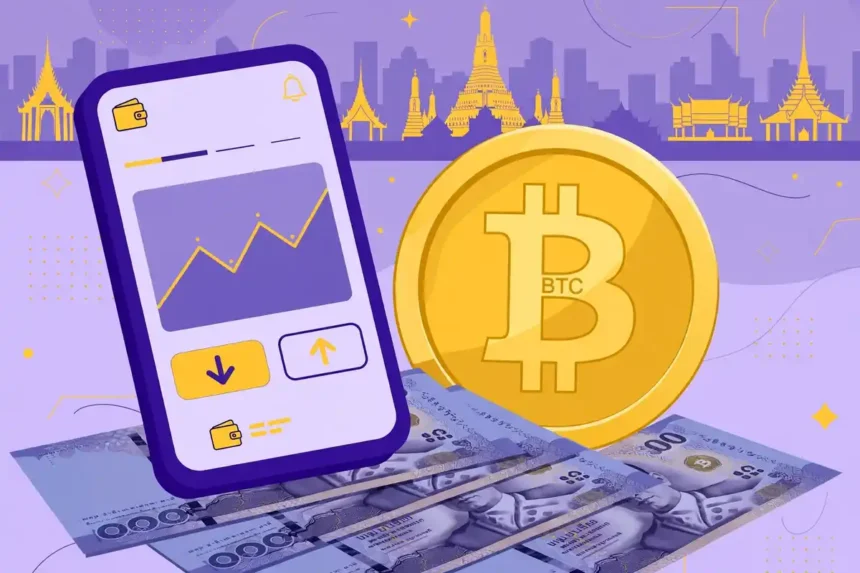
Yes, you can buy Bitcoin in Thailand in 2026, and the safest way is simple. Open an account on an exchange licensed by the Thai Securities and Exchange Commission (SEC), fund it with Thai baht from your bank, pass an ID check, and buy Bitcoin.
That licensed route also decides whether your gains qualify for Thailand’s 2025-2029 capital gains tax break, so the platform you pick matters more here than in most countries.

This guide walks you through the licensed-only route step by step. You will learn which platforms qualify, what ID checks look like, what a first buy really costs, and which traps to avoid.
- Key takeaways
- Is Bitcoin legal in Thailand?
- The licensed-only rule that shapes every choice
- The four licensed routes beginners meet first
- Step by step: buy your first Bitcoin
- What it costs: a worked example
- The tax break, and what it does not cover
- The October 16 ETF hook, and why it differs from owning Bitcoin
- Scams and mistakes to avoid
- Storing your Bitcoin after you buy it
- How this guide compares with other countries
- FAQs
- Is Bitcoin legal in Thailand?
- Which exchange is best for beginners in Thailand?
- Can I buy Bitcoin with Thai baht?
- Do I pay tax on Bitcoin gains in Thailand?
- Can I pay for things with Bitcoin in Thailand?
- Can tourists buy Bitcoin in Thailand?
- Conclusion: start licensed, start small, keep records
It covers Thai residents first, with notes for expats and short-stay visitors where the rules differ.
Key takeaways
- Buy only on an SEC-licensed Thai platform. Unlicensed platforms lost local access from June 28, 2025, and trades on them do not qualify for the tax break.
- Bitkub, Gulf Binance (Binance TH), Orbix Trade, and Upbit Thailand are the licensed names beginners meet first. Bitkub charges a 0.25% trading fee.
- Fund with Thai baht by bank transfer or PromptPay QR. Bitkub accepts QR deposits from 40 baht.
- Gains on licensed platforms are exempt from personal income tax from January 1, 2025 to December 31, 2029. Gains on offshore platforms, peer-to-peer deals, mining, and staking are not covered.
- Bitcoin is legal to own and trade in Thailand, but it is not legal tender. You cannot use it directly to pay for goods and services.
Is Bitcoin legal in Thailand?
Yes. Thailand regulates Bitcoin as a digital asset under its 2018 Digital Asset Business Decree, and the SEC supervises licensed exchanges, brokers, and dealers.
That puts Thailand ahead of many neighbors: trading has clear rules, licensed platforms must follow them, and the tax treatment is written into law.
Legal does not mean the same as normal money, though. The Bank of Thailand has said for years that Bitcoin is not legal tender, and the SEC bars licensed operators from helping customers pay for goods and services with digital assets.

If you want the full picture of how Thailand compares with other countries, see our guide to crypto-friendly countries.
What “not legal tender” means in practice
You can buy, sell, and hold Bitcoin, and you can cash out to baht through a licensed platform. You cannot walk into a shop and pay in Bitcoin as if it were baht.
Some card products convert crypto to baht at the till, but that is a baht payment after a conversion, not a Bitcoin payment.
Tourists should treat this the same way. A shop that takes QR payments or cards does not automatically take crypto, and a crypto-linked card still settles in baht.
Check what the card actually does before you rely on it on a trip.
The licensed-only rule that shapes every choice
Thailand’s whole system runs on one filter: the platform must hold a Thai SEC license. Licensed platforms report transactions, follow custody rules, and answer to the regulator when something goes wrong.
Unlicensed platforms offer none of that protection, and the state has started blocking them outright.
This filter also controls the tax break, which we cover in detail below. A trade only counts as exempt when it happens on a licensed exchange, broker, or dealer.
The same trade on an offshore site or a peer-to-peer deal stays taxable, even if the coin and the price are identical.
The June 28, 2025 blocklist
On May 29, 2025, the SEC named five platforms operating without a license: Bybit, 1000X, CoinEx, OKX, and XT.COM. The Ministry of Digital Economy and Society blocked local access to them from June 28, 2025.
The SEC said the move aimed to protect investors and stop unlicensed platforms from serving as money laundering channels.
The lesson for beginners is blunt. If a platform advertises to Thai users but holds no Thai license, its access can vanish with one regulator notice.
Move your coins off any such platform before you need them, and do not open a new account there.
How to check a license before you sign up
Open the SEC’s list of licensed digital asset operators and search for the exact company name, not just the brand. Scam sites copy brand names and logos, so the company name on the license must match the company running the app you install.
If you cannot find the name on the SEC list, treat the platform as unlicensed and walk away.
Also check the app store listing and the website domain. A real licensed exchange links to its license details and uses one official domain.
A copycat site often uses a lookalike domain and pushes you to deposit fast, which is itself a warning sign.
The four licensed routes beginners meet first
Four names cover most beginner journeys in Thailand, and each suits a different buyer. Bitkub is the biggest local exchange and the default first stop for Thai speakers.
Gulf Binance, which runs Binance TH, pairs a global brand with a local license. Orbix Trade, formerly Satang Pro, leans on PromptPay for fast baht funding.
Upbit Thailand brings a large Asian exchange group into the same licensed frame.
Fees differ by platform and by order type, so read the fee page inside the app before you trade. Only Bitkub’s headline spot fee is widely published at 0.25% per trade, so this guide uses that figure for its worked example and flags other fees as “check before you trade” rather than guessing them.
| Platform | THB funding | Trading fee | Best for |
|---|---|---|---|
| Bitkub | Bank transfer, PromptPay QR from 40 baht | 0.25% per trade | First-time buyers who want Thai language support |
| Gulf Binance (Binance TH) | Thai bank transfer | Check the fee page before you trade | Traders who already know the Binance app |
| Orbix Trade | Bank transfer, PromptPay | Check the fee page before you trade | Buyers who want PromptPay speed |
| Upbit Thailand | Thai bank transfer | Check the fee page before you trade | Buyers who want a large regional exchange |
One more filter applies to every row in that table. All four platforms quote pairs against baht, so you buy Bitcoin with baht and sell it back to baht.
That keeps your tax record simple, because every trade has a clear baht value on both sides.
Step by step: buy your first Bitcoin
The whole process takes one sitting plus the ID check, so set aside 30 minutes and keep your ID and your phone nearby. Follow these steps in order, and do not deposit money before the exchange approves your account.
- Pick one licensed exchange from the table above and install its official app from your phone’s app store.
- Create your account with your real name, email, and phone number, then turn on two-factor authentication before you go further.
- Complete the ID check: Thai citizens use a national ID card, while foreign residents usually submit a passport plus proof of address, then pass a selfie liveness check.
- Wait for approval, which can take minutes or a few days depending on the queue, and do not deposit until the account shows as verified.
- Deposit baht by bank transfer or PromptPay QR from a bank account in your own name, since third-party deposits can get flagged or rejected.
- Open the BTC/THB market, type the baht amount you want to spend, and preview the order before you confirm it.
- Check the confirmation screen: it should show the Bitcoin amount, the fee, and the total baht spent, so save a screenshot for your records.
- Decide where the Bitcoin lives next: leave a small amount on the exchange only if you plan to trade soon, and move the rest to a wallet you control.
Buy a small test amount first if you have never used an exchange. A 500 baht test buy teaches you the deposit, order, and withdrawal screens with almost nothing at stake.
Scale up only after the full loop works, including a withdrawal to your own wallet.
What it costs: a worked example
Fees hide in three places, so look at all three before you judge a platform as cheap. The trading fee applies when you buy, the spread is the gap between the buy and sell price, and the withdrawal fee applies when you move Bitcoin off the exchange.
A platform with a low trading fee can still cost more if its spread or withdrawal fee runs high.
Here is the math on Bitkub, the one platform with a widely published fee. A 10,000 baht buy at 0.25% costs 25 baht in trading fees, so 9,975 baht goes toward Bitcoin before any spread.
If the withdrawal fee is, say, 0.0005 BTC, that fee comes off your Bitcoin amount when you move it out, so a small buy loses a bigger share to the withdrawal fee than a large one does.
The practical rule follows from that math. Bundle withdrawals instead of moving tiny amounts one by one, and compare the final Bitcoin amount across platforms, not just the headline fee.
The cheapest platform is the one that leaves the most Bitcoin in your wallet after every fee, not the one with the lowest advertised rate.
The tax break, and what it does not cover
Thailand’s headline tax rule is generous but narrow. Under Ministerial Regulation 399, published in the Royal Gazette on September 5, 2025, individuals pay no personal income tax on capital gains from crypto sold through SEC-licensed exchanges, brokers, or dealers from January 1, 2025 to December 31, 2029.
The exemption covers spot trades on licensed platforms only, and it ends after 2029 unless the government extends it.
Everything outside that fence stays taxable at normal progressive rates, which run from 5% to 35%. Trades on offshore or unlicensed platforms, peer-to-peer sales, decentralized exchange swaps, staking rewards, mining income, and lending interest all sit outside the exemption.
Company holdings fall under corporate tax rules instead, so this break helps individual traders, not firms.
Keep a record even when the gain is exempt
Exempt does not mean invisible. Keep every trade confirmation, deposit slip, and withdrawal record, with the platform name and the baht value on each side.
If the Revenue Department ever asks how a gain arose, a clean file proves the trade happened on a licensed platform.
This guide is not tax advice, and edge cases like foreign-sourced gains sent into Thailand need a local adviser. When in doubt, pay for one hour of professional advice before you make a large trade.
That hour costs far less than a wrong filing.
The October 16 ETF hook, and why it differs from owning Bitcoin
Thailand added a new way to get Bitcoin exposure in October 2026. Local funds can list Bitcoin and Ether ETFs from October 16, 2026, after the SEC opened the door to local crypto funds.
Our own report on Thailand Bitcoin Ether ETFs approved covers the launch and what it means for local investors.
An ETF and direct Bitcoin ownership are different products, so do not confuse them. An ETF gives you price exposure inside a fund, while direct ownership gives you coins you can move to your own wallet.
If you want to learn how ETF approval works in general, our Bitcoin ETF approval explainer breaks down the mechanics.
For most beginners, the choice comes down to control. Pick the ETF route if you want regulated fund exposure without managing keys or wallets.
Pick direct ownership on a licensed exchange if you want to hold the coins yourself and move them freely.
Scams and mistakes to avoid
Thailand’s licensed market sits next to an active scam market, and beginners are the target. Treat every shortcut as suspect, because licensed platforms never need one.
- Never buy Bitcoin from a stranger on social media or a chat app, even when the price looks better than the exchange rate.
- Never share your exchange password, two-factor codes, or wallet seed phrase with anyone, including people who claim to work for the exchange.
- Never trust a “double your Bitcoin” offer, a celebrity endorsement video, or an investment group that promises fixed daily returns.
- Never send Bitcoin to an address from a message you did not request, and always test a new address with a tiny amount first.
- Never keep your life savings on an exchange, because an exchange account can freeze, get hacked, or face regulatory action.
- Never skip the license check, because an unlicensed platform can lose local access overnight, as the June 2025 blocklist showed.
One mistake deserves its own warning. Some beginners buy on an offshore platform because the fee looks lower, then discover they cannot withdraw to a Thai bank account smoothly.
That single friction can cost more than every fee saving combined, so start licensed and stay licensed.
Storing your Bitcoin after you buy it
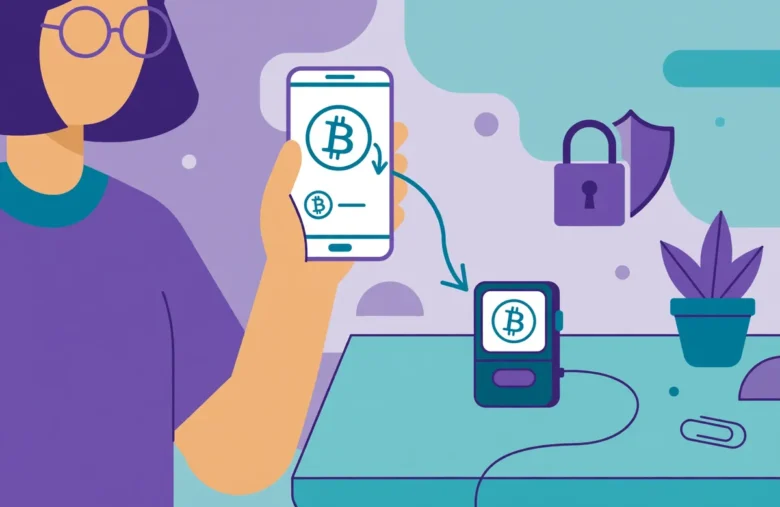
Buying is only half the job. Where the coins sit after the buy decides how safe they are, and the trade-off is simple: convenience on an exchange versus control in your own wallet.
Beginners should understand both before they hold a meaningful amount.
An exchange wallet is convenient for trading, but the exchange holds the keys. Your own wallet, hardware or software, puts the keys in your hands, which means no company can freeze your coins.
That control comes with full responsibility for your seed phrase.
The seed phrase rules that never change
Write your seed phrase on paper, store it somewhere safe and offline, and never photograph it, email it, or type it into a website. Anyone who holds your seed phrase holds your Bitcoin, and no support team can reverse a theft.
If you lose the phrase and the device, the coins are gone, so keep a backup in a second safe place.
Test your backup before you trust it with a large amount. Restore the wallet on a second device with the phrase, confirm the same addresses appear, and only then move the bulk of your coins.
A backup you never tested is a guess, not a safety net.
How this guide compares with other countries
Thailand’s system is stricter than a light-touch market and friendlier than a ban, which is why it rewards a careful reading. The license filter, the tax fence, and the payment ban work together: they push activity onto supervised platforms and punish shortcuts.
Compare that with our how to buy Bitcoin around the world hub to see where Thailand sits in the global picture.
Nearby country guides show the contrast clearly. Our how to buy Bitcoin in Taiwan guide covers a market with different banking rails, and our how to buy Bitcoin in Switzerland guide covers a bank-led system with its own tax logic.
Thailand stands out for one reason: the tax break makes the licensed route the profitable route, not just the safe one.
FAQs
These are the questions Thai beginners ask most, answered from the rules covered above.
Is Bitcoin legal in Thailand?
Yes, Bitcoin is legal in Thailand as a regulated digital asset under the 2018 Digital Asset Business Decree. Trading must happen through SEC-licensed exchanges, brokers, or dealers, and Bitcoin is not legal tender.
Which exchange is best for beginners in Thailand?
Bitkub is the simplest first choice for most beginners because it is the largest licensed local exchange, supports Thai baht funding, and offers Thai language support. Gulf Binance, Orbix Trade, and Upbit Thailand are licensed alternatives worth comparing on fees and funding options.
Can I buy Bitcoin with Thai baht?
Yes, licensed Thai exchanges quote BTC/THB pairs, so you fund your account with baht by bank transfer or PromptPay QR and buy Bitcoin directly. Bitkub accepts QR deposits from 40 baht.
Do I pay tax on Bitcoin gains in Thailand?
Individuals pay no personal income tax on capital gains from crypto sold through SEC-licensed platforms from January 1, 2025 to December 31, 2029. Gains from offshore platforms, peer-to-peer sales, staking, and mining stay taxable, so keep full records of every trade.
Can I pay for things with Bitcoin in Thailand?
No, Bitcoin is not legal tender in Thailand, and licensed operators cannot facilitate crypto payments for goods and services. Card products that convert crypto to baht settle in baht, which is not the same as paying directly in Bitcoin.
Can tourists buy Bitcoin in Thailand?
Tourists face stricter ID checks, and most licensed exchanges focus on residents with local ID and a Thai bank account. A short-stay visitor should check the exchange’s current requirements before traveling, and should not rely on buying Bitcoin locally as a payment method during the trip.
Conclusion: start licensed, start small, keep records
Thailand rewards buyers who follow its rules. Pick one licensed exchange, fund it with baht, buy a small test amount, and move the coins to a wallet you control.
That loop teaches you everything the guides cannot, and it keeps your gains inside the tax exemption.
Your next step takes five minutes. Open the SEC’s licensed operator list, confirm your chosen exchange appears on it, and only then create your account.
If you want to compare before you commit, read our around the world hub and pick the country guide that matches your situation.
Last updated: October 2026.