



Every mining pool pays you for the same work, but the payout method decides how much of the block reward actually reaches your wallet. This guide explains bitcoin mining pool payout methods fpps vs pps in plain language, with real numbers from November 23, 2026.
Bitcoin traded near $61,400 on November 23, 2026. Two days earlier it touched $55,130, its lowest price since September 2024, and the crash squeezed every miner’s margin.

That drop also pushed the price below the cost of mining one coin, a gap we covered in our Bitcoin mining cost gap analysis.
- What Is a Bitcoin Mining Pool Payout Method?
- PPS: Pay Per Share
- FPPS: Full Pay Per Share
- PPLNS: Pay Per Last N Shares
- PPS+: The Hybrid in the Middle
- Bitcoin Mining Pool Payout Methods FPPS vs PPS: The November 2026 Numbers
- What 100 TH/s Earns Under Each Method
- The November 2026 Twist: Fees Are Too Low to Matter
- Live Pool Fee Schedules: Foundry USA, F2Pool, AntPool and ViaBTC
- Which Model Wins for a Home Miner?
- Which Model Wins for a Farm?
- Common Mistakes Miners Make With Payout Methods
- FAQs
- What is the difference between FPPS and PPS?
- Which mining pool payout method pays the most?
- Is FPPS better than PPLNS?
- What does PPLNS mean for a small miner?
- Do mining pools pay transaction fees to miners?
- Can I switch payout methods without losing money?
- Conclusion
- Sources
The short answer is simple. FPPS pays a fixed amount for every share you submit, and it includes an estimate of transaction fees.
PPS pays a fixed amount per share too, but it usually covers only the block subsidy, so you miss the fee income.
PPLNS works differently. It pays you only when the pool finds a block, and your share depends on how much work you submitted in the window before that block.
It charges lower fees, but your income arrives in lumps.

Key takeaways
- FPPS pays a fixed amount per share, covering the 3.125 BTC block subsidy plus an estimate of transaction fees.
- PPS pays a fixed amount per share for the subsidy only, so miners usually lose the fee income.
- PPLNS pays only from blocks the pool actually finds, with lower fees of 0 to 2 percent but lumpier income.
- At November 23, 2026 fee levels, transaction fees add only 0.21 sats per TH per day, about 0.5 percent of the subsidy.
- One hundred TH/s earns about 4,323 sats a day before pool fees, worth about $2.65 at a $61,400 Bitcoin price.
- A 4 percent FPPS fee costs more than the fee income it buys right now, so a low-fee PPLNS pool pays more in expected value.
What Is a Bitcoin Mining Pool Payout Method?
A payout method is the rule a pool uses to turn your submitted work into Bitcoin in your wallet. Every pool runs the same basic idea, but each method splits risk and fees differently between the pool and the miner.
Miners join pools because solo mining is a lottery. A single home machine might wait years to find a block alone, so pools combine thousands of machines and split each reward.
The payout method decides how that split works, and it helps to know how Bitcoin mining works before you pick one.
Shares: The Unit Pools Pay For
Your miner constantly submits shares, which are small proofs that it is working on the pool’s current block. Each share has almost no chance of being the winning block hash, but the pool counts them to measure your contribution.
The pool pays you for shares, not for blocks. That distinction sits at the heart of every payout method, and it explains why some methods pay daily while others pay only when luck strikes.
The Block Reward Has Two Parts
Every block pays a subsidy of newly created Bitcoin, which stands at 3.125 BTC since the April 2024 halving. The block also pays the transaction fees from every transaction inside it, and that second part changes with network demand.
On November 23, 2026, the average block carried only about 0.015 BTC in fees, according to ASICMetrics data from that morning. That is less than half a percent of the subsidy, and it matters a lot for this comparison, as the numbers below show.
PPS: Pay Per Share
PPS pays you a fixed amount for every valid share you submit. The pool works out the expected value of a share from the network difficulty and the block subsidy, then pays that amount whether or not it finds a block that day.
The pool carries all the luck. If it finds no blocks for a day, it still pays you from its own balance.
That safety costs money, so PPS pools usually charge fees of 2 to 4 percent.
What PPS Leaves Out
Classic PPS covers the block subsidy only. The transaction fees stay with the pool operator, and that gap is the model’s biggest weakness for miners.
When fees run high, the gap hurts. During busy periods in past cycles, fees added more than 1 BTC to some blocks, and PPS miners saw none of it.
At today’s low fees, the loss is tiny, but the structure still gives the fee income away.
Who PPS Suits
PPS suits miners who need a fixed daily number they can plan around and who do not care about fee income. It also suits short tests, because you can point a machine at a PPS pool for a day and know exactly what you earned.
Most large pools have moved past plain PPS now. FPPS replaced it at Foundry USA, AntPool and F2Pool, and PPS survives mostly as the subsidy half of the PPS+ hybrid.
FPPS: Full Pay Per Share
FPPS works like PPS, with one addition. It pays a fixed amount per share for the subsidy, plus an estimated share of transaction fees, calculated as an average over a recent window of blocks.
Foundry USA, the world’s largest pool, calculates its FPPS rate each UTC day. It sorts the blocks found that day by their transaction fees, drops the three highest and three lowest, and averages the rest.
That trimmed average becomes the fee part of every share’s pay.
You get paid the same steady amount every day, whether the pool finds many blocks or few. The pool still carries all the variance, and it also carries the risk that its fee estimate runs high or low.
Why FPPS Became the Default
Big miners run on loans, power contracts and payroll. They need revenue they can forecast, so they accept a higher pool fee in exchange for a fixed daily payout.
That demand made FPPS the dominant model at the largest pools.
Foundry USA holds roughly a quarter of network hashrate, AntPool holds about a fifth, and F2Pool holds about a sixth. All three offer FPPS, and together they set the standard the rest of the industry follows.
Who FPPS Suits
FPPS suits miners with fixed costs and thin margins, because a predictable daily payout makes budgeting possible. It also suits anyone who cannot tolerate a week with no payout, such as a home miner paying a monthly power bill.
The trade is the fee. FPPS usually costs 2.5 to 4 percent, and at today’s fee levels that cost buys almost nothing, as the worked math below shows.
PPLNS: Pay Per Last N Shares
PPLNS pays you only when the pool finds a block. When a block lands, the pool looks back at the last N shares submitted before that block and splits the full reward, subsidy plus actual fees, in proportion to each miner’s shares in that window.
If the pool finds three blocks in an hour, you get paid three times. If it finds nothing for two days, you get nothing for two days.
Your long-run average matches the pool’s luck, so a lucky month pays above average and an unlucky month pays below it.
The N Window and Pool Hopping
The N window usually covers the last day or two of pool work. Your shares age out of the window as new shares arrive, so stopping mid-window means your last shares may never get paid.
Pool hopping, jumping between pools to chase luck, loses money under PPLNS for exactly this reason. You leave unpaid shares behind every time you switch, and the pool you join starts counting you from zero.
Who PPLNS Suits
PPLNS suits miners who can wait out dry spells and who mine without interruption for months. It charges the lowest fees, often 0 to 2 percent, because the pool takes no variance risk and passes it to you instead.
AntPool lists PPLNS at 2 percent, and some secondary sources cite a 0 percent PPLNS option there. F2Pool and ViaBTC both list PPLNS at 2 percent.
A miner with steady uptime keeps that fee saving, and it compounds over a year.
PPS+: The Hybrid in the Middle
PPS+ splits the reward into two parts and treats each part differently. The block subsidy pays like PPS, a fixed amount per share, while the transaction fees pay like PPLNS, distributed only from blocks the pool actually finds.
ViaBTC uses PPS+ as its default Bitcoin payout method, and it charges 4 percent on the subsidy part and 2 percent on the fee part. Binance Pool has used the same structure.
The model gives you a stable base with a variable fee bonus on top.
PPS+ has no single standard definition, and ViaBTC’s version is the one most guides describe. Always read the pool’s own page before you assume how its PPS+ works, because the split can differ between pools.
Bitcoin Mining Pool Payout Methods FPPS vs PPS: The November 2026 Numbers
This section works the math from live November 23, 2026 inputs, so you can check every figure yourself. The inputs are a $61,400 Bitcoin price, a seven-day average network hashrate of 1,046 EH/s, difficulty of 134.82 T, a 3.125 BTC subsidy, about 144 blocks a day, and average fees of 0.015 BTC per block.
The subsidy math is simple. The network creates 450 BTC a day in subsidies, which is 144 blocks times 3.125 BTC, spread across 1,046,000,000 TH/s of hashrate.
That works out to 43.02 sats per TH per day.
The fee math is even simpler. Fees add about 2.16 BTC a day across the whole network, which is 144 blocks times 0.015 BTC, spread across the same hashrate.
That works out to 0.21 sats per TH per day, or about 0.5 percent of the subsidy.
Put the two together and one TH/s earns about 43.23 sats a day before pool fees, worth about $0.0265 at a $61,400 Bitcoin price. Hashprice trackers quote roughly $29 per PH per day, which is close to this figure, and the small gap comes from the hashrate window each source uses.
What 100 TH/s Earns Under Each Method
A home miner with one S19j Pro class machine runs about 100 TH/s. The table below shows what that machine earns per day under each payout method, after the pool fee, at November 23, 2026 levels.
| Payout method and pool fee | Sats per day | Dollars per day | Dollars per month |
|---|---|---|---|
| FPPS at 0% (Foundry USA, eligible miners) | 4,323 | $2.65 | $79.63 |
| PPLNS at 0% (AntPool, as some sources cite) | 4,323 | $2.65 | $79.63 |
| PPLNS at 2% (F2Pool, ViaBTC) | 4,236 | $2.60 | $78.03 |
| FPPS at 2.5% (AntPool, lower cited rate) | 4,215 | $2.59 | $77.63 |
| FPPS at 4% (F2Pool, AntPool) | 4,150 | $2.55 | $76.44 |
| PPS at 4% (subsidy only, no fee income) | 4,130 | $2.54 | $76.07 |
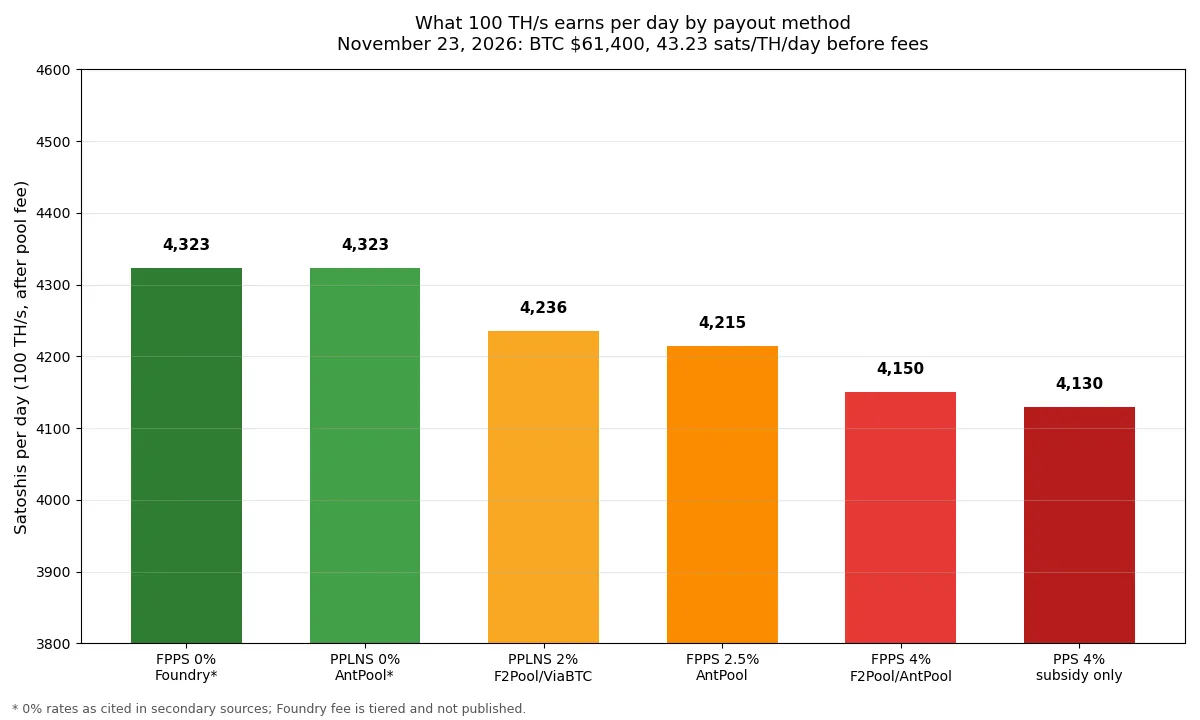
The gap between the best and worst row is only about $0.11 a day for a home miner. That sounds small, but it scales.
At 1 PH/s, which is about five S21 machines, the gap between 0 percent FPPS and 4 percent FPPS is about $3.19 a day, or about $96 a month.
At 10 PH/s, a small farm, the same gap reaches about $31.90 a day, or about $957 a month. The payout method is a small choice for a home miner and a serious one for a farm.
The November 2026 Twist: Fees Are Too Low to Matter
Here is the finding no other payout guide states this plainly. The whole point of FPPS is the fee income it adds over PPS, but right now that fee income is worth 0.21 sats per TH per day, while a 4 percent FPPS fee costs 1.73 sats per TH per day.
You pay eight times more for the fee insurance than the fee income is worth. A 2 percent PPLNS pool pays about $2.60 a day for 100 TH/s, while a 4 percent FPPS pool pays about $2.55, and the PPLNS miner also keeps the real fee income from blocks the pool finds.
This flips when fees spike. The table below shows what the fee part is worth at different fee levels, using the same network inputs.
| Average fees per block | Fee income per TH per day | Fees as share of subsidy |
|---|---|---|
| 0.015 BTC (November 23, 2026) | 0.21 sats | 0.5% |
| 0.10 BTC | 1.38 sats | 3.2% |
| 0.50 BTC | 6.88 sats | 16.0% |
| 1.00 BTC | 13.77 sats | 32.0% |
| 2.00 BTC | 27.53 sats | 64.0% |
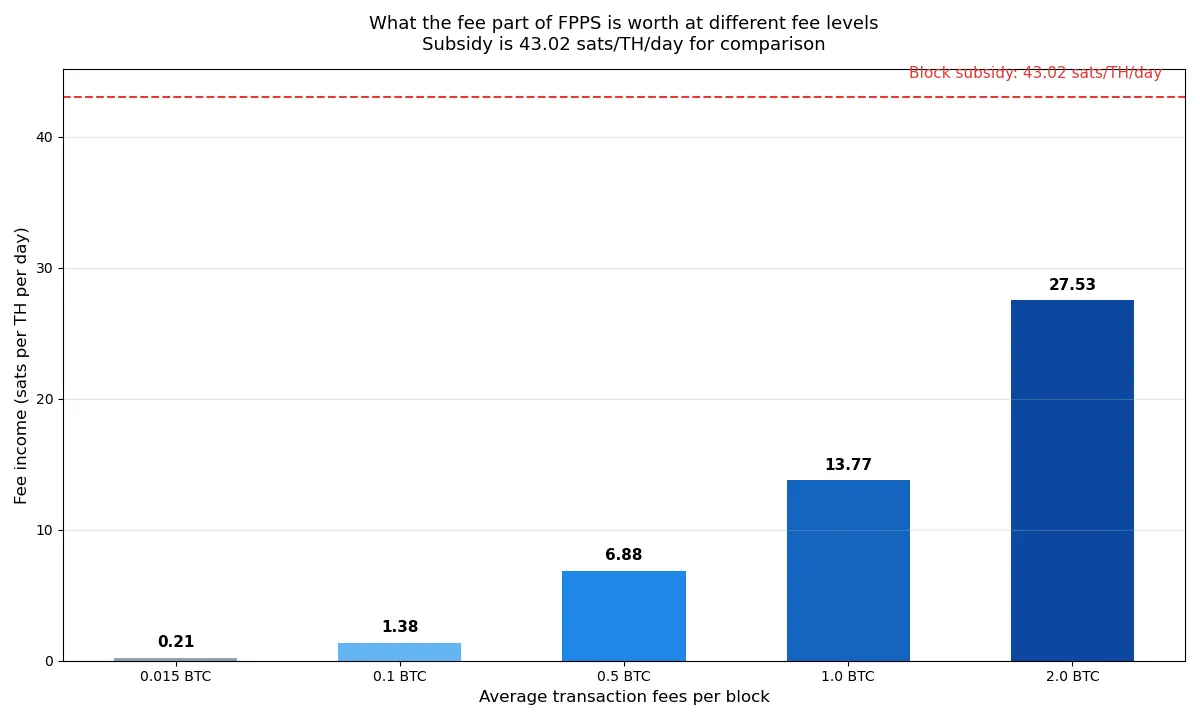
When fees averaged above 1 BTC per block during past busy periods, the fee part was worth a third of the subsidy, and FPPS earned its higher fee. Today it does not, and miners who picked FPPS for the fee income are paying for a benefit that has almost vanished.
Live Pool Fee Schedules: Foundry USA, F2Pool, AntPool and ViaBTC
The table below uses the fee schedules the pools published, as checked in October and November 2026. Foundry USA does not publish a flat rate, because its fee depends on your average quarterly hashrate, and large miners report 0 percent FPPS.
Check the pool’s own page before you connect, because these rates change.
| Pool | Network share | Payout methods | Published fee | Minimum payout |
|---|---|---|---|---|
| Foundry USA | About 25% | FPPS | Tiered, not published, 0% for eligible large miners | 0.01 BTC |
| AntPool | About 20% | FPPS, PPLNS | FPPS 4%, PPLNS 2% | 0.005 BTC |
| F2Pool | About 17% | FPPS, PPLNS | FPPS 4%, PPLNS 2% | 0.005 BTC |
| ViaBTC | About 9% | PPS+, PPLNS, SOLO | PPS+ 4% on subsidy and 2% on fees, PPLNS 2% | About 0.001 BTC |
Pool size matters for PPLNS miners. Foundry USA finds about 36 blocks a day, AntPool about 29, F2Pool about 24, and ViaBTC about 13.
A pool with only 1 percent of hashrate finds about 1.4 blocks a day, so its PPLNS payouts arrive far less often.
Big pools smooth PPLNS variance by finding blocks constantly. A home miner on a large pool’s PPLNS still sees daily payouts on most days, just with more variation in the amount than FPPS gives.
Which Model Wins for a Home Miner?
A home miner with one machine should pick PPLNS at a large pool, if the power bill allows waiting through a slow week. The expected payout is higher, because the fee is 2 percent or less instead of 4 percent, and the variance is mild on a pool that finds 20 or more blocks a day.
Our Bitcoin mining in Texas guide shows how the same choice plays out for miners paying US power rates.
Pick FPPS if you need a fixed daily number to cover a power bill or a loan payment. The cost is about $0.10 a day on 100 TH/s at a 4 percent fee versus a 0 percent option, which is a fair price for certainty when cash flow is tight.
If you are still unsure whether the machine itself earns its keep, run the numbers in our guide to whether Bitcoin mining is still profitable in 2026.
Plain PPS is the weakest choice today. It pays the subsidy only, so it gives up the fee income, and it still charges a PPS-level fee for the stability.
No home miner gains from it while FPPS and PPLNS both exist at the same pools.
Which Model Wins for a Farm?
A farm should treat the payout method as a procurement decision, not a preference. At 10 PH/s, the gap between a 0 percent FPPS deal at Foundry USA and a 4 percent FPPS rate elsewhere is about $957 a month, so negotiating the rate matters more than picking the method.
Large farms usually take FPPS because their lenders and power contracts demand predictable revenue. The fee is a cost of doing business, and a farm with 10 PH/s can negotiate a rate a home miner never sees.
A mid-size farm with patient cash flow can run PPLNS and keep the fee saving. The variance washes out over months at that scale, and the 2 percent saving is real money.
Either way, the farm should measure the pool by actual sats per TH per day, not by the headline fee alone.
Common Mistakes Miners Make With Payout Methods
The first mistake is comparing headline fees without checking what the fee covers. A 4 percent FPPS fee includes fee income, while a 2 percent PPLNS fee leaves you exposed to pool luck, so the two numbers describe different products.
The second mistake is switching pools every week. PPLNS punishes switching, because shares left behind in the old pool’s window never get paid.
Pick a pool, then stay for at least a month before you judge it.
The third mistake is mining on a tiny pool under PPLNS. A pool with 1 percent of hashrate can go days without a block, and a home miner feels every dry day.
Small pools suit SOLO-style gambling, not steady income.
The fourth mistake is ignoring the minimum payout. ViaBTC pays out from about 0.001 BTC, while AntPool and F2Pool set 0.005 BTC, and Foundry USA sets 0.01 BTC.
A home miner earning 4,323 sats a day needs more than a day to reach 0.01 BTC, so a high threshold delays the first payout by weeks.
The fifth mistake is forgetting the stale share rate. A bad connection or a distant server means some of your shares arrive too late and never count, and that loss hits every payout method equally.
Pick a server near your machines before you compare fees.
FAQs
Miners ask the same questions about payout methods again and again. The answers below cover the points that matter most before you point your machines at a pool.
What is the difference between FPPS and PPS?
FPPS pays a fixed amount per share for the block subsidy plus an estimate of transaction fees. PPS pays a fixed amount per share for the subsidy only, so the pool keeps the transaction fees.
Which mining pool payout method pays the most?
No single method always pays the most. PPLNS pays the highest expected value when its fee is lowest, because the pool takes no variance risk, while FPPS pays the most predictable amount, and plain PPS usually pays the least because it excludes fee income.
Is FPPS better than PPLNS?
FPPS is better for miners who need steady daily income to cover fixed costs. PPLNS is better for miners with steady uptime and patient cash flow, because its lower fee keeps more of the expected value over months.
What does PPLNS mean for a small miner?
PPLNS means your payouts arrive only when the pool finds blocks, so income comes in lumps instead of a daily trickle. On a large pool that finds 20 or more blocks a day, a small miner still sees payouts most days, just in varying amounts.
Do mining pools pay transaction fees to miners?
It depends on the method. FPPS includes an estimate of fees in every share payment, PPLNS pays the real fees from blocks the pool finds, PPS+ pays fees only from blocks found, and plain PPS usually keeps the fees for the pool.
Can I switch payout methods without losing money?
Switching from FPPS or PPS to another method costs nothing, because every share is already paid. Switching away from PPLNS can cost money, because shares still sitting in the window may never get paid after you leave.
Conclusion
Choosing between bitcoin mining pool payout methods is not a detail you can ignore, but it is also not the biggest lever in mining. Cheap power and efficient machines matter far more, and the payout method only decides how much of an already thin margin you keep.
At November 2026 fee levels, the honest ranking is simple. PPLNS at a large pool pays the most in expected value, FPPS pays the most predictable amount, and plain PPS pays the least.
The fee income that FPPS exists to capture is worth only 0.21 sats per TH per day right now, so a 4 percent FPPS fee costs eight times what it buys.
Start with PPLNS on a large pool if you can handle lumpier income. Switch to FPPS if your bills demand a fixed daily number.
Re-check the fee market when transaction fees rise again, because the right answer changes with them. To put the rest of the math together, read our guide on Bitcoin mining electricity costs and our complete guide to how to mine Bitcoin.
Sources
- AntPool – official pool site, FPPS and PPLNS fee schedules and minimum payout.
- F2Pool – official pool site, FPPS and PPLNS fee schedules and minimum payout.
- ViaBTC – official pool site, PPS+ and PPLNS fee schedules.
- Foundry USA Pool – official pool page, FPPS model and tiered fee structure.
- Simple Mining Bitcoin Stats – Bitcoin price, network hashrate and difficulty data for November 23, 2026.
- 21BTC Bitcoin Mining Pools – pool fees and minimum payouts checked against official pool sites on October 20, 2026.