



Bitcoin now trades about $27,000 below what it costs to mine one. JPMorgan puts the average production cost near $86,000, while Bitcoin changes hands near $58,900 after breaking below $60,000 for the first time since July.
The gap matters because miners pay real bills in dollars and earn Bitcoin. When the price sits this far under the average cost, the weakest miners must sell coins, switch machines off, or both.

Key takeaways
- JPMorgan estimates the average cost to mine one Bitcoin at about $86,000. Bitcoin trades near $58,900, so the gap is about $27,100.
- Bitcoin fell below $60,000 on November 20 for the first time since July 2. It is down about 24% in November.
- US spot Bitcoin ETFs lost $582.3 million on November 19. BlackRock’s IBIT lost $541.1 million, its biggest one-day outflow ever.
- Mining difficulty fell 9.13% on November 14, the biggest cut since June. Hash rate is sliding as machines switch off.
- The Crypto Fear and Greed Index reads 12, deep in Extreme Fear, after sitting at 50 on November 5.
What JPMorgan’s $86,000 number actually measures
Production cost is the average all-in expense of creating one new Bitcoin. It covers electricity, machines, cooling, repairs, staff, and the capital cost of the mining fleet.
JPMorgan’s team, led by Nikolaos Panigirtzoglou, published the $86,000 central estimate in a report dated November 18. Bitcoin traded near $65,000 that day, so the gap already stood at about $21,000 before the latest leg down.
Why the estimate keeps rising
The bank’s estimate has climbed all year. It stood near $78,000 in June and $85,000 in September before reaching $86,000 in November.
Two forces push it up. Mining difficulty keeps rising over time as more machines join the network, and the newest machines cost more to buy and run.
The estimate is a model, not a bill, so it moves when the bank updates its inputs.

That detail matters for the next section. An average cost hides a wide spread, and the miners at the expensive end feel the squeeze first.
Our guide to whether Bitcoin mining is still profitable in 2026 walks through that spread in plain numbers.
The miner squeeze scoreboard
No single number tells the miner story. I pulled the fresh readings into one table so the squeeze is easy to judge at a glance.
| Gauge | Reading | What it says |
|---|---|---|
| JPMorgan production cost | About $86,000 | Average all-in cost to mine one Bitcoin |
| Bitcoin price, Nov 21 | Near $58,900 | About $27,100 below the cost estimate |
| Price versus cost, Nov 18 | Gap about $21,000 | The gap widened by about $6,100 in three days |
| Mining difficulty | 134.82 trillion, down 9.13% | Biggest cut since June, set Nov 14 |
| Hash rate, weekly average | About 903 EH/s | Down from 1,001 EH/s the week before |
| Hashprice | About $27.79 per PH/s per day | Daily revenue per unit of computing power |
| US spot ETF outflows, Nov | About $3.47 billion | Only 2 positive days in the month |
| Fear and Greed Index | 12, Extreme Fear | Down from 50 on Nov 5 |
| Puell Multiple | 0.93 | Miner revenue below its 365-day average |
Every row points the same way. Revenue per machine is falling, costs are not, and the buyers who usually absorb miner selling have gone quiet.
That combination is what turns a price drop into a miner squeeze.
The demand side confirms it. Bitcoin demand just hit its weakest level of 2026, with CryptoQuant’s apparent demand gauge at about -255,000 BTC.
How the price got here
Bitcoin closed at $80,443 as recently as November 5. Sixteen days later it trades near $58,900, a fall of about 27 percent.
The slide ran through several air pockets. A tech-led rout hit the Nasdaq, leveraged longs piled up, and nearly $2 billion in positions were liquidated in 24 hours as $60,000 gave way.
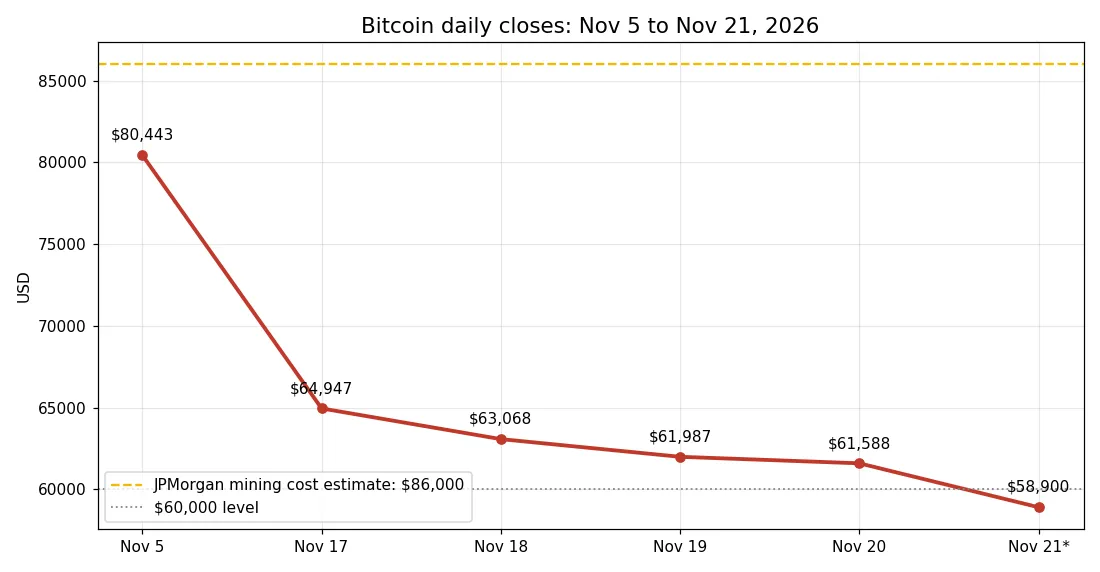
Bitcoin daily closes from November 5 to November 21. The November 21 point is the intraday price near 04:00 UTC. The dashed line marks JPMorgan’s $86,000 production cost estimate. Sources: Finnhub, Binance BTC/USDT, CoinGecko.
The $60,000 break
Bitcoin last traded below $60,000 on July 2, when it touched $59,520. The November 20 break pushed it to an intraday low of $57,716, its lowest since September 2024.
That low sits just above the July low near $57,800. If it breaks, the next widely watched levels sit much lower, and miners with high cash costs face the same math at an even worse price.
The 200-week moving average is another line traders watch when Bitcoin falls this far, this fast.
Miners are already selling
JPMorgan’s warning is not theoretical. Miners moved 2,077 BTC to exchanges on November 10, about 16 times the 30-day daily average of 127 BTC.
It was the largest daily miner transfer since February, and about 97 percent of it came from Antpool.
The public miners tell the same story in their filings. MARA sold 13,597 BTC after September 30 for about $1.1 billion, roughly 40 percent of the coins it held at quarter end.
It had already sold 26,984 BTC in the first nine months of the year.
The sector-wide total is bigger. Fourteen public mining companies sold a combined 108,247 BTC in 2026, worth about $8.08 billion.
Our earlier report on listed companies selling Bitcoin in 2026 breaks down where that money went.
Why some miners hold instead
Not every miner sells into weakness. Some borrow against their coins to pay power bills, which lets them keep their Bitcoin on the books.
Others hold cheap power contracts that keep their cash costs well below the current price.
That split explains the hash rate data. The machines switching off belong mostly to high-cost operators, while low-cost miners keep running.
The network slows a little, but it does not stop, and difficulty adjusts down to compensate.
The catch is that borrowing only delays the problem. If the price stays low, the loans still come due, and the coins behind them may hit the market later.
Selling now or borrowing now are two versions of the same pressure.
What the network itself is saying
Bitcoin’s protocol reacts to miner pain automatically. When machines switch off, blocks slow down, and difficulty falls at the next adjustment to bring block times back to ten minutes.
The November 14 adjustment cut difficulty by 9.13 percent, from 148.36 trillion to 134.82 trillion. It was the biggest single cut since June, and it followed a drop in the weekly average hash rate from about 1,001 EH/s to about 903 EH/s.
Another cut looks likely. The next adjustment lands around November 29, and early estimates already point to a drop of roughly 6 percent.
Each cut lifts revenue per machine by roughly the same share, which gives surviving miners a little breathing room.
Hashprice tells the same story from the revenue side. At about $27.79 per petahash per day, a miner earns far less per machine than it did in October.
The Puell Multiple of 0.93 says miner revenue now sits below its 365-day average.
New readers often ask how this system works at all. Our beginner guide to how Bitcoin mining works explains difficulty, hash rate, and block rewards without jargon.
What has to change before miners stop selling
Three things would ease the pressure. The price needs to recover toward the cost line, difficulty needs to fall further, or power costs need to drop.
A price recovery is the fastest fix, but it needs buyers. US spot Bitcoin ETFs have lost about $3.47 billion in November, with only two positive days in the month.
BlackRock’s IBIT alone lost $541.1 million on November 19, its largest one-day outflow since launch.
US sellers and ETF outflows drove the earlier $62,000 plunge, and the flow has only worsened since.
Difficulty will help on its own schedule. The November 14 cut already lifted expected revenue per unit of hash rate by about 10 percent at a flat price.
A second cut near November 29 would add more relief, but it cannot close a $27,000 gap by itself.
Power costs move slowest of all. Miners sign contracts months ahead, so cheap power arrives through new deals and relocations, not overnight.
Some miners are instead shifting capacity toward AI data centers, which is exactly what the $8.08 billion in treasury sales has funded.
What this means for Bitcoin holders
A price below production cost is not a buy signal by itself. JPMorgan’s $86,000 is a modeled average, not a floor, and Bitcoin has traded below past cost estimates before without bouncing right away.
The honest read is narrower. Miner selling adds supply at the worst moment, while ETF outflows remove the buyers who would absorb it.
That is why the gap matters more than the number alone.
Three mistakes show up every time this happens. The first is treating the cost estimate as a guaranteed bottom.
The second is assuming all miners face the same cost, when low-cost operators keep mining profitably.
The third is reading one day of miner selling as capitulation, when the data shows a mix of selling, borrowing, and holding.
Watch the scoreboard, not the headline. If difficulty keeps falling, hash rate stabilizes, ETF flows turn positive, and the Fear and Greed Index climbs out of single digits, the squeeze is easing.
Until then, miners stay under pressure, and pressure usually shows up in the price first.
FAQs
Here are the questions readers ask most about the mining cost gap.
What does it cost to mine one Bitcoin?
JPMorgan estimates the average production cost at about $86,000, based on its November 18, 2026 report. The figure covers electricity, machines, cooling, repairs, staff, and capital costs across the mining fleet.
Does the $86,000 cost mean Bitcoin cannot fall further?
No. The $86,000 figure is a modeled average, not a price floor, and Bitcoin has traded below past cost estimates before.
Why are miners selling Bitcoin now?
Miners sell to pay power bills, service debt, and fund new projects such as AI data centers. MARA sold 13,597 BTC after September 30, and fourteen public miners sold a combined 108,247 BTC in 2026.
What is hashprice and why does it matter?
Hashprice is the daily revenue a miner earns per unit of computing power, measured in dollars per petahash per second per day. It sat near $27.79 on November 20, and machines with high power costs switch off first when it falls.
Will mining difficulty keep falling?
The next difficulty adjustment lands around November 29, and early estimates point to a cut of roughly 6 percent. Each cut raises revenue per machine and eases the pressure a little.
Bitcoin trades about $27,000 below its average mining cost, and every gauge in the scoreboard points the same way.
The miners who survive this stretch will be the ones with cheap power, efficient machines, and cash to wait. Everyone else is selling, switching off, or borrowing time, and the market will feel that until the flows turn.