


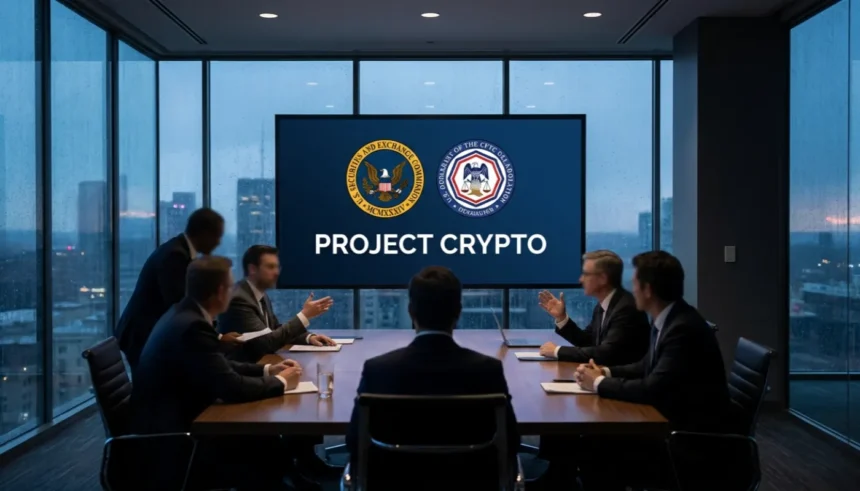
Project Crypto just got a public progress report. SEC Chairman Paul Atkins used a June 30 speech at the Economic Club of New York to reaffirm that federal regulators are pushing crypto markets onto blockchain rails.
His remarks arrived days before America’s 250th anniversary. As a result, the timing carried extra symbolic weight.

A Historic Memorandum Sets the Foundation
The core of Project Crypto rests on a Memorandum of Understanding the SEC and CFTC signed on March 11, 2026. This agreement replaced a 2018 MOU between the agencies.
Consequently, it aligns key definitions, coordinates oversight, and enables secure data sharing between regulators, according to the SEC’s official announcement.
For decades, regulatory turf wars… have stifled innovation.
Atkins said in that release. Meanwhile, CFTC Chairman Michael Selig echoed the sentiment, noting that both agencies’ frameworks must evolve alongside the markets they oversee.
The MOU also launched a Joint Harmonization Initiative, co-led by named officials at each agency. This structure gives the collaboration staying power beyond current leadership. Therefore, it functions as more than a one-time announcement.
Building on Months of Regulatory Groundwork
Atkins framed the June speech as a status update rather than a new policy. Specifically, he pointed to concrete deliverables built on the MOU. In March, the agencies jointly issued an interpretive release establishing a crypto asset taxonomy.

That taxonomy classifies four out of five digital asset categories as non-securities, per the SEC’s June 30 remarks.
This taxonomy matters because it removes guesswork. Before it existed, issuers often couldn’t tell whether SEC oversight applied.
Now, entrepreneurs can determine a token’s status before launch. Similarly, the GENIUS Act’s stablecoin framework and a no-action letter permitting tokenized stock settlement rounded out the agency’s recent progress, Atkins noted.
This regulatory clarity follows a broader pattern this administration has pursued since Trump nominated a pro-crypto SEC chair in late 2024.
It also lands alongside growing institutional activity in digital asset regulation worldwide, as other jurisdictions race to define their own rules.
What Remains Unresolved
Still, an MOU is not legislation. No binding timeline exists for finalizing every aligned definition. Additionally, decentralized exchanges and automated market makers present surveillance challenges neither agency has fully solved.
Traditional oversight tools rely on centralized intermediaries, so on-chain markets require new tooling entirely.
Congress, meanwhile, continues negotiating comprehensive market structure legislation. Banking groups have pushed back on parts of that bill.
Consequently, Atkins and Selig are building regulatory clarity through agency coordination while lawmakers work in parallel. This dual-track approach could speed up practical certainty for builders, even if durable statutory protection still lags behind.
Filings tied to this shift keep surfacing across the industry, including recent ETF-related SEC filings from major asset managers betting that clearer rules are coming.
Conclusion: Project Crypto’s Next Chapter
Project Crypto has moved from concept to concrete agency action in under a year. The March MOU, the crypto asset taxonomy, and Atkins’ June reaffirmation all point the same direction: toward markets operating on-chain, under coordinated federal oversight.
Execution details will determine whether that promise holds. For now, though, the SEC and CFTC are speaking with one voice on crypto for the first time in years.