



Bitcoin fell out of the world’s top 15 assets overnight. Its market value dropped to about $1.26 trillion, and the 8MarketCap ranking placed it 17th, then 18th, before a partial rebound lifted it back to 16th by 09:13 PKT on Sunday, November 15, 2026.
The price tells the same story in one line. Bitcoin touched $62,006, then bounced back above $64,700, but the rebound still left it about $20 billion short of the top 15 cutoff.

Key Takeaways
- Bitcoin ranked 16th among the largest assets in the world at 09:13 PKT, with a market cap of $1.301 trillion and a price of $64,730.
- Overnight it fell as low as 18th, with a market cap near $1.259 trillion, after the price touched $62,006.
- The top 15 cutoff is the Vanguard S&P 500 ETF at $1.321 trillion, so Bitcoin needs a price near $65,700 to climb back in.
- CoinGlass tracked about $597 million in Bitcoin futures liquidations in 24 hours, and US spot Bitcoin ETFs posted a seventh straight day of outflows.
- The ranking moves hourly because Bitcoin trades around the clock while stocks and ETFs sit still over the weekend.
The Live Scoreboard: Bitcoin Market Cap Ranking at 09:13 PKT
8MarketCap ranks every asset in the world by market value, from gold down to small public companies. Its live table at 09:13 PKT put Bitcoin in 16th place, one spot outside the top 15, with a market cap of $1.301 trillion.
- Key Takeaways
- The Live Scoreboard: Bitcoin Market Cap Ranking at 09:13 PKT
- How Bitcoin Lost Three Places in One Night
- What Price Puts Bitcoin Back in the Top 15
- Why the Rank Moves While You Sleep
- What Forced the Selling
- What the Rank Does and Does Not Mean
- What to Watch Next
- Frequently Asked Questions
- Where does Bitcoin rank among the largest assets in the world?
- What price does Bitcoin need to re-enter the top 15?
- Why did Bitcoin fall out of the top 15?
- How far has Bitcoin fallen from its record high?
- Does the ranking affect Bitcoin value?
- The Bottom Line
The five names around Bitcoin show how tight the race is. Less than $300 billion separates 14th place from 18th, so one bad weekend can move Bitcoin several places in either direction.
| Rank | Asset | Market cap | Price | 24h change |
|---|---|---|---|---|
| 14 | Tesla | $1.542T | $390.22 | -1.82% |
| 15 | Vanguard S&P 500 ETF (VOO) | $1.321T | $496.49 | +0.05% |
| 16 | Bitcoin | $1.301T | $64,730 | -3.04% |
| 17 | Eli Lilly | $1.285T | $1,443 | +1.26% |
| 18 | Berkshire Hathaway | $1.259T | $592.94 | +0.53% |
Source: 8MarketCap live ranking, November 15, 2026, 09:13 PKT. Figures move with live prices.
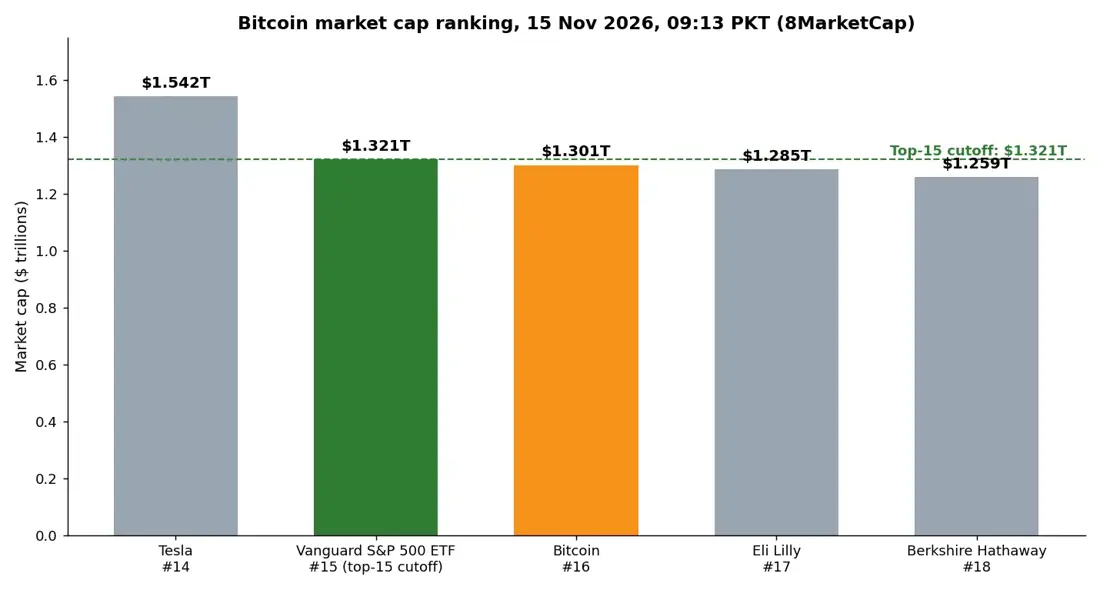
The chart makes the gap easy to see. Bitcoin sits just $20 billion below the Vanguard S&P 500 ETF, and just $16 billion above Eli Lilly, so the 16th place it holds now is not a safe spot.

What the cutoff number means
The cutoff is the market cap of the 15th placed asset, and it changes every time any of these assets moves. Bitcoin must beat the Vanguard S&P 500 ETF, not just reach a round price, and that fund barely moved while Bitcoin fell.
That detail matters for anyone watching the rank. A $1,000 rise in the Bitcoin price adds about $20.1 billion to its market cap at the current supply of 20.11 million coins, which is almost exactly the size of the gap Bitcoin must close.
How Bitcoin Lost Three Places in One Night
Two days ago the picture looked very different. On November 13, Bitcoin ranked 14th among the world’s largest assets with a market cap near $1.39 trillion, and the slide that followed erased about $89 billion of value in two days.
The fall came in two waves. Friday brought heavy selling in US trading, and the weekend brought a second leg down as thin crypto-only liquidity took over while stock markets stayed shut.
| When | Bitcoin rank | Market cap | What happened |
|---|---|---|---|
| Nov 13 | 14th | About $1.39T | Bitcoin held the last top 15 spot before the weekend slide |
| Nov 15, overnight low | 17th, then 18th | About $1.26T | Price touched $62,006 and Eli Lilly, the Vanguard S&P 500 ETF and Berkshire Hathaway all moved ahead |
| Nov 15, 09:13 PKT | 16th | $1.301T | Price bounced back above $64,700 and Bitcoin passed Eli Lilly and Berkshire Hathaway again |
The overnight low deserves a closer look because it broke levels traders had watched for months. Bitcoin printed $62,006, its weakest price since July 14, and it fell below the August 17 low of $62,844 in the same move.
This was not the first sharp fall of the month. Bitcoin already crashed to a two-month low near $73,700 earlier in November, and each bounce since then has faded faster than the one before it.
The 24 hour damage in numbers
Bitcoin fell about 8% in 24 hours at the worst point, and its 7 day loss reached 14.61% on the 8MarketCap table. The whole crypto market lost 9.7% in a day and fell to $2.16 trillion, with ether down 8.5%, Solana down 9.3% and XRP down 7.7%.
Put next to the record high, the scale of the drawdown is stark. Bitcoin peaked at $126,080 on October 6, 2025, so the $62,006 low sat about 51% below that peak, and even the 09:13 PKT price of $64,730 is still nearly 49% below it.
What Price Puts Bitcoin Back in the Top 15
The math is simple, and anyone can check it with two numbers. Market cap equals price times coins in circulation, and 20.11 million Bitcoin now circulate, so the price needed to pass a $1.321 trillion cutoff is about $65,700.
That target sits only about $1,000 above the 09:13 PKT price of $64,730. A single strong hour of trading could close the gap, and a single weak hour could widen it again, which is why the rank will keep flipping while the price stays near this level.
The target moves too, so $65,700 is a snapshot, not a fixed line. If the Vanguard S&P 500 ETF rises on Monday, the cutoff rises with it, and Bitcoin would need a higher price to pass it.
Nobody can promise the price will reach that level. The rebound from $62,006 to $64,730 shows buyers step in below $63,000, but the same weekend also showed sellers return fast above $65,000, so the range near the cutoff looks like a battleground, not a floor.
Why the Rank Moves While You Sleep
The ranking compares assets that trade on very different clocks. Stocks and ETFs close for the weekend, while Bitcoin trades every hour of every day, so a weekend slide moves Bitcoin down a list where most names cannot move at all.
That is exactly what happened this weekend. Eli Lilly gained 1.26% and Berkshire Hathaway gained 0.53% in their last sessions, and those small Friday gains were enough to pass a Bitcoin that kept falling after the stock market closed.
The same effect works in reverse, and it explains the fast rebound in the rank. Bitcoin climbed from 18th to 16th without a single stock trading, simply because its own price recovered while the other names on the list stood still.
Weekend liquidity makes the moves sharper in both directions. Fewer traders are active, order books thin out, and forced selling hits harder, which is why the biggest falls of this sell-off have landed on Saturdays and Sundays.
What Forced the Selling
Three forces hit Bitcoin at the same time, and each one fed the next. Leveraged traders got wiped out, ETF investors kept selling, and rising US interest rate expectations pulled money away from risk assets.
Liquidations did the most visible damage. CoinGlass tracked about $597 million in Bitcoin futures liquidations over 24 hours, and $549 million of that total came from traders who had bet on rising prices, so the forced selling pushed the price down and triggered more forced selling.
The wider market looked worse. Total crypto liquidations passed $1.9 billion in the same window, with about $684 million in Bitcoin positions and $466 million in ether positions closed by force, and more than 97% of the forced selling hit long positions.
ETF flows tell the slower story behind the fast crash. US spot Bitcoin ETFs posted $185.4 million in net outflows on Friday, their seventh straight day of outflows, and the total outflow since October 30 has reached almost $3 billion.
That steady drain matters more than any single day of selling. The outflow streak for US Bitcoin ETFs has run for weeks, and every day of redemptions forces funds to sell Bitcoin into a market that already struggles to find buyers.
Corporate demand has faded at the same time. Bitcoin treasury companies stopped buying at the levels that used to support the price, and listed companies sold Bitcoin in 2026, with miners cashing out $8.08 billion to fund AI projects.
The macro backdrop gave sellers one more reason to act. The 10 year US Treasury yield closed at 5.15% on November 13, and futures markets priced an 88.5% chance of a quarter point Federal Reserve rate rise in December, which pulls capital toward bonds and away from assets like Bitcoin.
Sentiment has now reached the extreme fear zone. The Crypto Fear and Greed Index printed 10 on Sunday, and Bitcoin is heading for a sixth straight weekly loss after closing last Sunday at $74,740.
One more event added pressure on Friday, and it explains part of the timing. MSCI kicked Strategy out of its indexes, which forced index funds to sell and pushed Strategy-linked selling into a market that was already weak.
What the Rank Does and Does Not Mean
The ranking is a scoreboard, not a verdict on Bitcoin itself. It measures market value against other assets at one moment, and it says nothing about the technology, the network, or the number of people who use it.
Even at 16th, Bitcoin is still larger than almost every public company on earth. Walmart sits 19th at $1.016 trillion, Samsung sits 20th at $1.012 trillion, and JPMorgan Chase sits 21st at $919 billion, so Bitcoin still outweighs the biggest bank and the biggest retailer in the United States.
But the direction of travel matters, and the trend is hard to ignore. Bitcoin ranked 14th at $1.39 trillion on November 13, fell to 18th overnight, and now sits 16th, so the asset has spent the weekend sliding down a list it climbed for most of the last two years.
The rank also tells holders something practical about volatility. A 4.4% rebound from $62,006 to $64,730 moved Bitcoin two places in a few hours, which shows how fast the scoreboard changes when the price sits near a cluster of similarly sized assets.
None of this predicts where the price goes next. Bitcoin rebounded above $80,000 after the midterms, and that bounce faded within days, so recent history warns against treating any single rebound as a turning point.
What to Watch Next
Monday brings the first real test of the rebound. US stock markets reopen, ETF flows print again, and the Vanguard S&P 500 ETF starts moving, so the top 15 cutoff will stop standing still for the first time since Friday.
Three numbers decide the rank this week. The first is the Bitcoin price near $65,700, the level that retakes 15th place, and the second is the $62,000 zone, where buyers stepped in overnight and where a second break would open the way toward the July low of $57,742.
The third number is the ETF flow. Another week of outflows near $1 billion would keep steady selling pressure on Bitcoin, while a single day of inflows would show the first sign that the selling wave is losing force.
The Federal Reserve minutes land on November 18, and traders will read them for clues on the December rate decision. A softer message could ease the pressure on risk assets, while a firm message could push Treasury yields higher and add to the selling.
Three numbers that decide the rank this week
Watch $65,700 for the top 15, $62,000 for the overnight low, and the daily ETF flow for the direction of institutional money. If Bitcoin holds above $65,700 while the ETF flow turns positive, the rank should climb back into the top 15 fast.
If the price breaks $62,000 again, the next cluster of assets below Bitcoin sits far away, with Walmart at $1.016 trillion, so the rank could fall several places before it finds a new neighbour to sit next to.
Frequently Asked Questions
Where does Bitcoin rank among the largest assets in the world?
Bitcoin ranked 16th among the largest assets in the world at 09:13 PKT on November 15, 2026, with a market cap of $1.301 trillion and a price of $64,730, according to the 8MarketCap live ranking.
What price does Bitcoin need to re-enter the top 15?
Bitcoin needs a price near $65,700 to pass the Vanguard S&P 500 ETF at $1.321 trillion and retake 15th place, based on 20.11 million coins in circulation, and the target moves whenever the ETF price moves.
Why did Bitcoin fall out of the top 15?
Bitcoin fell out of the top 15 because its price dropped to $62,006 overnight, which cut its market cap to about $1.26 trillion, while Eli Lilly, the Vanguard S&P 500 ETF and Berkshire Hathaway held their value and moved ahead of it.
How far has Bitcoin fallen from its record high?
Bitcoin peaked at $126,080 on October 6, 2025, so the overnight low of $62,006 sat about 51% below that peak, and the price of $64,730 at 09:13 PKT is still nearly 49% below it.
Does the ranking affect Bitcoin value?
No, the ranking does not change Bitcoin value, because the ranking follows the price instead of driving it, and it only compares market caps at one moment in time.
The Bottom Line
Bitcoin lost its top 15 place in a single weekend, then won back two spots before most readers woke up. The $62,006 low, the $597 million in liquidations, and the seventh straight day of ETF outflows explain the fall, and the $65,700 retake price explains what the rebound must achieve.
The rank will keep moving hourly while Bitcoin trades near a cluster of trillion dollar assets. Watch the $65,700 level, the $62,000 low, and the ETF flows on Monday, and treat the ranking as a live scoreboard, not a forecast.