


You can buy Bitcoin in Denmark in about 15 minutes on a MiCA authorised exchange, and the cheapest route starts with a bank transfer, not a card. The part most guides skip is simple: you hold Danish kroner, while most big exchanges price Bitcoin in euros, so the conversion step decides what you really pay.
I have read the generic exchange lists, and they rarely answer the Danish question. This guide does, with a full cost table for a 5,000 DKK buy, the MitID step you will actually meet, and the current tax rule stated plainly.

Key takeaways
- Bitcoin is legal to buy and hold in Denmark, and MiCA rules have applied since 30 December 2024.
- A 5,000 DKK buy costs about 50 to 65 DKK in total on a careful bank transfer route, based on fees checked on 16 October 2026.
- MobilePay feels like the obvious funding choice, but the major exchanges do not list it as a deposit method.
- Speculative gains are taxed as personal income when you sell, and you must keep your own records.
- The much shared 42 percent tax on unrealised gains is a proposal, not Danish law.
How to buy Bitcoin in Denmark, step by step
The short path is this: pick an authorised exchange, verify your identity, fund the account from your Danish bank, then place the buy on the low fee screen. Each step below matches what a first time buyer in Denmark actually sees.
- How to buy Bitcoin in Denmark, step by step
- Step 1: Pick a MiCA authorised exchange
- Step 2: Verify your identity
- Step 3: Fund the account from your Danish bank
- Step 4: Buy on the low fee screen, not the instant screen
- Step 5: Move larger amounts to your own wallet
- The true cost of a 5,000 DKK buy, worked out in full
- Why MobilePay will probably not fund your buy
- What if your bank holds or questions the transfer?
- Is Bitcoin legal in Denmark?
- Tax in Denmark: the current rule, and the proposal that is not law
- Common mistakes Danish buyers make
- FAQs
- Conclusion
Start small if it is your first buy. A test buy of a few hundred kroner teaches you the whole flow for very little risk.
Step 1: Pick a MiCA authorised exchange
Choose a platform that holds a MiCA authorisation in the EU and accepts customers from Denmark. In my view, this one check matters more than any bonus offer or slick app design.
Our roundup of the best crypto exchanges in Europe compares the main names side by side. Kraken, Coinbase and Bitpanda all serve EU customers under MiCA licences from Ireland, Luxembourg and Austria.
Step 2: Verify your identity
Every authorised exchange will ask for photo ID and a selfie check before it lets you deposit. Danish users usually move through this fast, since a passport or driving licence works fine.

You will also use MitID in this journey, most often when you confirm the bank transfer on your bank side. Keep your phone nearby, because a transfer confirmation can time out while you hunt for it.
Step 3: Fund the account from your Danish bank
Most exchanges quote Bitcoin in euros, so your bank will convert kroner to euros on a SEPA transfer. The krone is pegged tightly to the euro, near 7.46 to 7.48 kroner per euro, so the rate itself barely moves.
What does move is your bank spread, which often sits near half a percent. Ask your bank for its euro rate before you send a large amount, and send a small test transfer first.
Step 4: Buy on the low fee screen, not the instant screen
Almost every app has two buy buttons, and they do not charge the same price. The instant button is fast and pricey, while the pro or advanced screen charges a fraction of it.
On Kraken Pro the entry taker fee is 0.80 percent, and on Coinbase Advanced it is 0.60 percent, based on fee schedules checked on 16 October 2026. Bitpanda charges a 0.99 percent premium on Bitcoin buys in its standard app.
Step 5: Move larger amounts to your own wallet
An exchange account is a fine place to learn, and a risky place to store real money for years. Once your balance feels painful to lose, move it to a wallet that only you control.
Our picks for the best Bitcoin wallets for beginners cover simple apps and hardware options. The guide on how to store Bitcoin safely explains hot and cold storage in plain words.
The true cost of a 5,000 DKK buy, worked out in full
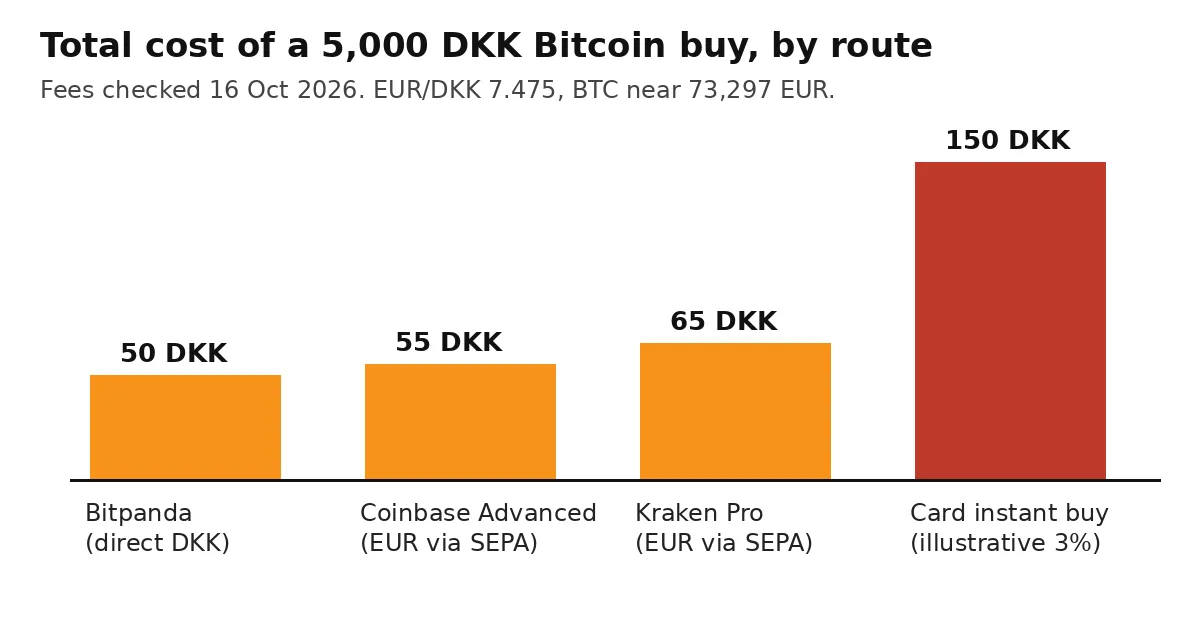
Here is the exclusive part of this guide, and the bit I wish someone had shown me first. The table below follows one 5,000 DKK buy from a Danish bank account to Bitcoin in your account, with every cost counted.
The maths uses rates from 16 October 2026: one euro cost about 7.475 kroner, and one Bitcoin cost about 73,297 euros, or near 547,895 kroner. Prices and fees change, so treat the table as a method you can rerun, not a promise.
| Route | Conversion cost | Trade fee | Total cost | Bitcoin you get |
|---|---|---|---|---|
| Bitpanda, direct DKK deposit | 0 DKK | About 50 DKK (0.99%) | About 50 DKK | About 0.009035 BTC |
| Coinbase Advanced, EUR by SEPA | About 25 DKK (0.5% bank spread) | About 30 DKK (0.60%) | About 55 DKK | About 0.009026 BTC |
| Kraken Pro, EUR by SEPA | About 25 DKK (0.5% bank spread) | About 40 DKK (0.80%) | About 65 DKK | About 0.009008 BTC |
| Card instant buy, illustrative | Built into the price | About 150 DKK at 3% all in | About 150 DKK | About 0.008852 BTC |
The gap between the best and worst row is about 100 DKK on a single small buy. Repeat that habit every month for a year, and the card habit quietly eats more than 1,000 DKK.
One honest caveat: a direct DKK deposit skips the bank spread only when the platform truly settles in kroner. Always read the deposit screen total before you confirm, because that screen is the truth.
Why MobilePay will probably not fund your buy
MobilePay is the default way Danes pay for almost everything, so new buyers expect it at checkout. I understand the instinct, and I had the same thought.
The major MiCA exchanges fund accounts by SEPA transfer, card, or wallets like PayPal, and MobilePay is generally not on that list. If a small unknown site offers MobilePay funding at a great rate, treat that as a warning sign, not a feature.
What if your bank holds or questions the transfer?
Danish banks run checks on transfers to crypto services, and a first transfer can pause while the bank asks what it is for. This is annoying, and it is also normal.
Answer honestly, keep the exchange name and your deposit reference ready, and never split a transfer to dodge a check. If one bank keeps blocking lawful transfers, some buyers open an account at a second bank rather than fighting the first one for weeks.
Is Bitcoin legal in Denmark?
Yes, buying, holding and selling Bitcoin is legal in Denmark. No Danish law bans you from owning it.
Since 30 December 2024, the EU MiCA rulebook has applied in Denmark, and Finanstilsynet, the Danish financial supervisor, oversees crypto service providers. Denmark used the long transition window, which ended on 1 July 2026, so a platform serving Danes today should hold a full authorisation.
New EU reporting rules also start with activity in 2026, and providers must share user and transaction data with the tax authority. Assume every buy and sell on a regulated platform will be visible to Skattestyrelsen in time.
If you are new to the asset itself, our explainer on what Bitcoin is and how it works covers the basics without jargon. For other countries, the country guides hub for buying Bitcoin around the world links every guide in one place, and the Austria guide shows a close cousin of the Danish setup, since buying Bitcoin in Austria also runs on SEPA and MiCA rules.
Tax in Denmark: the current rule, and the proposal that is not law
Here is the current rule in plain words: if you bought Bitcoin as a speculation, your gain is taxed as personal income when you sell. Danish courts have treated Bitcoin buying as speculative by default, so most private buyers fall under this rule.
You calculate gains and losses trade by trade, and you generally cannot just net one loss against another gain the way many people expect. Where you cannot identify which coins you sold, a first in, first out approach is used, and losses get narrower relief than gains get tax.
Now the correction that matters. The Tax Law Council has recommended an inventory style system that could tax the yearly change in your whole portfolio, even on gains you have not sold, at a rate reported near 42 percent.
That system is a proposal under debate, not a law in force today. Any page that tells you Denmark already taxes unrealised gains at 42 percent is wrong, and you should not plan your money around it either way until parliament actually passes something.
Your Skattestyrelsen record checklist
Good records cost you ten minutes now and can save you a real headache later. Skattestyrelsen expects you to report your own gains, so keep the raw material from day one.
- Save the date, the kroner amount, and the Bitcoin amount for every buy and sell.
- Keep the exchange statement or CSV export for each tax year.
- Note every move between your own wallets, with the transaction ID.
- Record the euro to krone rate your bank used on each deposit.
- Store screenshots of any bank hold or question, in case you need to show the money trail.
Common mistakes Danish buyers make
The first mistake is buying on the instant screen and paying card level fees for no reason. The second is sending a large first transfer before a small test has landed.
The third mistake hits at tax time, when a buyer has no records and tries to rebuild a year of trades from memory. The fourth is trusting a social media message that promises to double a deposit, which is always a scam.
My honest view: the boring route wins in Denmark. A regulated exchange, a bank transfer, the low fee screen, and a tidy spreadsheet beat every shortcut I have seen.
FAQs
Q: How to buy Bitcoin in Denmark as a complete beginner?
A: Open an account on a MiCA authorised exchange, verify your ID, send a small SEPA transfer from your Danish bank, and buy on the pro or advanced screen. Start with a test amount, then move larger holdings to your own wallet.
Q: Can I buy Bitcoin with MobilePay in Denmark?
A: Generally no, because the major authorised exchanges do not list MobilePay as a funding method. They accept SEPA bank transfers, cards, and some wallets, so a bank transfer is the normal Danish route.
Q: How much does it cost to buy 5,000 DKK of Bitcoin?
A: On fees checked on 16 October 2026, a careful bank transfer route cost about 50 to 65 DKK in total, including a typical bank conversion spread. A card instant buy at about 3 percent all in cost near 150 DKK.
Q: Do I pay tax on Bitcoin in Denmark?
A: Yes, speculative gains are taxed as personal income when you sell, and you must report them yourself to Skattestyrelsen. The proposed inventory tax on unrealised gains is not law, so the sale based rule is the one that applies today.
Q: What is MitID used for when buying Bitcoin?
A: You will most often use MitID to confirm actions on your Danish bank side, such as approving a SEPA transfer to the exchange. The exchange itself usually verifies you with photo ID and a selfie check.
Conclusion
You now know how to buy Bitcoin in Denmark the cheap and legal way: an authorised exchange, a bank transfer, and the low fee screen. You also know the two things most guides get wrong, the real kroner cost and the tax proposal that is not yet law.
Your next step is small on purpose. Send a test transfer, make one small buy, save your records, and only then decide if Bitcoin deserves a bigger place in your savings.