



The Netherlands does not tax your Bitcoin gains when you sell. It taxes your Bitcoin wealth on January 1, and that single fact catches almost every newcomer by surprise.
Hold 100,000 euro of Bitcoin on January 1, 2026, and the Dutch tax office assumes you earned 6.00% on it. It then taxes that assumed return at 36%, which leaves you a bill of about 878 euro, even if you never sold a single satoshi.

This guide gives you crypto tax in the netherlands box 3 explained in plain language, with the 2026 rates, a worked bill, the escape hatch the Supreme Court forced into law, and the 2028 reform that may change everything. It also names the trap most guides skip: you can owe this tax in a year when Bitcoin falls.
- Key Takeaways
- Your 2026 Box 3 Bill, Worked Out
- How Box 3 Actually Works
- The Trap: You Owe Tax Even When Bitcoin Falls
- The Escape Hatch: Prove Your Actual Return Was Lower
- What the Supreme Court Decided
- When Crypto Lands in Box 1 Instead
- DAC8: The Tax Office Already Knows
- How to Report Your Crypto
- Step 1: List every holding on January 1
- Step 2: Value each holding at the January 1 rate
- Step 3: Add your other Box 3 assets and debts
- Step 4: Subtract the allowance and calculate
- Step 5: Check the actual-return claim
- What Changes in 2027 and 2028
- Common Mistakes
- Frequently Asked Questions
- Do I pay tax when I sell Bitcoin in the Netherlands?
- How much crypto can I hold tax-free in the Netherlands in 2026?
- What is the Box 3 tax rate on crypto in 2026?
- What if my crypto lost value? Can I pay less tax?
- Does the Belastingdienst know about my crypto?
- Will Box 3 change in 2028?
- Sources
This guide is general information only, not tax advice, and tax rules depend on your own situation, so talk to a qualified Dutch tax adviser before you act.
Key Takeaways
- The Netherlands charges no capital gains tax on Bitcoin held as a private investment. Box 3 taxes the value of your holdings on January 1 instead.
- For 2026, crypto sits in the investments bucket with a deemed return of 6.00%, taxed at 36%, above a tax-free allowance of 59,357 euro per person.
- Bitcoin worth 100,000 euro on January 1, 2026 produces a tax bill of about 878 euro, which is 2.16% of the value above the allowance.
- You can owe Box 3 tax even in a year when Bitcoin falls, because the bill is fixed on the January 1 value and ignores what happens after.
- If your actual return was lower than the deemed 6.00%, the tegenbewijsregeling lets you pay tax on the real figure instead, but the 59,357 euro allowance does not apply to that calculation.
- The Supreme Court confirmed on April 25, 2025 that crypto belongs in Box 3, and Dutch exchanges must report your data under DAC8, with the first reports due by January 31, 2027.
- A bill to tax actual returns from 2028 has passed the House of Representatives but still waits for a Senate vote, and a September 2026 cabinet letter that many outlets read as a crypto tax cut never mentions crypto at all.
Your 2026 Box 3 Bill, Worked Out
Most guides quote the 6.00% rate and stop. A worked bill shows what it actually costs, so here is one, step by step, for a single person with no partner and no debts.
Take Anna. She holds 100,000 euro of Bitcoin on January 1, 2026, and nothing else in Box 3.
Her bill has four steps, and each one uses a figure the Belastingdienst published for 2026.

| Step | Calculation | Result |
|---|---|---|
| 1. Value on January 1 | Bitcoin holdings at the reference date | 100,000 euro |
| 2. Minus tax-free allowance | 100,000 minus 59,357 | 40,643 euro taxable base |
| 3. Deemed return at 6.00% | 40,643 times 6.00% | 2,438.58 euro |
| 4. Tax at 36% | 2,438.58 times 36% | 877.89 euro, about 878 euro |
That is the whole bill. Anna pays about 878 euro on 100,000 euro of Bitcoin, which works out to 2.16% of the value above the allowance, because 6.00% times 36% equals 2.16%.
That is crypto tax in the netherlands box 3 explained in numbers, not slogans.
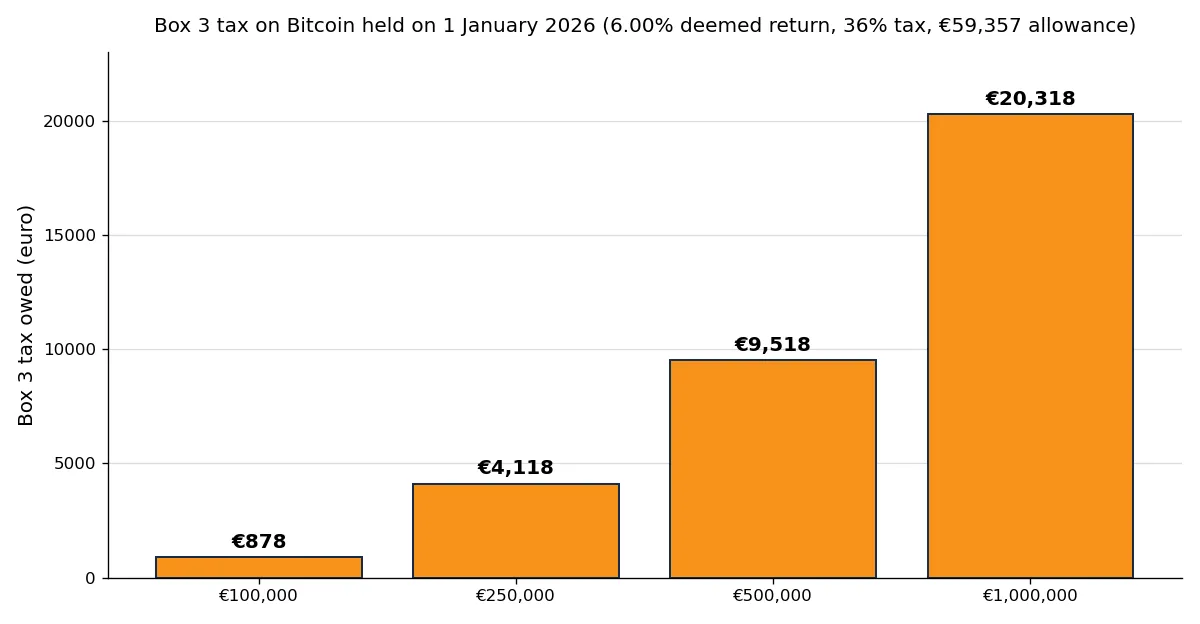
Now scale it up, because the allowance is fixed and the bill grows fast once you pass it. The table below uses the same four steps for larger holdings, and every figure comes from the same 2026 rates.
| Bitcoin on January 1, 2026 | Taxable base | Tax you owe |
|---|---|---|
| 59,357 euro | 0 euro | 0 euro |
| 100,000 euro | 40,643 euro | About 878 euro |
| 250,000 euro | 190,643 euro | About 4,118 euro |
| 500,000 euro | 440,643 euro | About 9,518 euro |
| 1,000,000 euro | 940,643 euro | About 20,318 euro |
Fiscal partners share a combined allowance of 118,714 euro, which cuts the bill roughly in half for a couple with the same holdings. A couple with 100,000 euro of Bitcoin between them pays nothing at all, because their combined wealth sits below the combined allowance.
Our full Bitcoin tax guide puts the Dutch system beside the rest of the world, and the Netherlands sits in the middle: friendlier than countries that tax every sale, harsher than the zero-tax states. The rest of this article explains why the bill works this way, and when you can pay less.
How Box 3 Actually Works
Dutch income tax sorts your money into three boxes. Box 1 covers work and your own home, Box 2 covers a substantial shareholding in a company, and Box 3 covers savings and investments, which is where crypto lives.
Box 3 does not ask what you earned. It looks at what you owned on January 1, sorts it into three groups, assumes a fixed return on each group, and taxes that assumed return at 36%.
The three groups for 2026 are bank savings, investments and other assets, and debts. Savings carry a deemed return of 1.28%, investments and other assets carry 6.00%, and debts carry a 2.70% deduction rate.
Crypto falls in the investments and other assets group, beside shares, bonds, and funds. The Belastingdienst treats a Bitcoin holding the same way it treats a stock portfolio for this purpose, and the 6.00% figure is final for 2026.
Only the 6.00% figure is final. The savings and debt percentages are provisional, and the Belastingdienst sets them definitively early in 2027, so a final bill can shift slightly from the one you estimate today.
The reference date is the part people get wrong most often. The Belastingdienst reads your balance on January 1, not your average across the year and not your year-end total.
Buy Bitcoin on January 2 and it does not count for that tax year at all. Sell everything on January 2 and the full January 1 value still counts, because the snapshot was already taken.
Debts work in your favour, within limits. Only debts above 3,800 euro per person count, and they reduce your Box 3 wealth at the 2.70% rate before the deemed return is calculated.
One more detail matters for 2026. The original plan for this year was a deemed return of 7.78% and an allowance cut to 51,396 euro, but parliament reversed both late in 2025, landing on 6.00% and 59,357 euro.
That reversal saved Anna about 260 euro on her 100,000 euro holding, and most guides written before it still quote the wrong figures.
The Trap: You Owe Tax Even When Bitcoin Falls
Here is the part that feels unfair, and it is the part this guide leads with for a reason. Box 3 taxes a return you may never have made.
Go back to Anna and her 100,000 euro of Bitcoin on January 1, 2026. Suppose Bitcoin falls 30% during the year, and her holding is worth 70,000 euro by December.
Her Box 3 bill stays about 878 euro. The fall changes nothing, because the tax office already fixed the bill on the January 1 value, and the system has no room for what happened after.
She also owes nothing extra if Bitcoin rises. A 30% rise to 130,000 euro leaves the same 878 euro bill, because the deemed return is fixed at 6.00% whatever the market does.
That symmetry is the whole logic of Box 3. The state assumes a steady return and ignores your real one, which helps you in a great year and hurts you in a bad one.
The trap bites hardest for people who buy near the top. Buy 100,000 euro of Bitcoin in December, watch it fall in January, and you still pay tax on the full December 31 value as your January 1 snapshot.
Timing a purchase for January 2 instead of December 31 can defer a whole year of Box 3 tax on that money. It is a legal timing choice, not a loophole, and it is the single most useful planning fact in this guide.
That is crypto tax in the netherlands box 3 explained in one harsh line: the bill is fixed on January 1, and the market does not get a vote.
Our guide to how to buy Bitcoin in the Netherlands covers the practical side of getting started, and the January 1 date should sit on your calendar beside it.
The Escape Hatch: Prove Your Actual Return Was Lower
The trap has an escape hatch, and the Supreme Court built it. If your actual return was lower than the deemed 6.00%, you can pay tax on the real figure instead.
The scheme is called the tegenbewijsregeling, which means the rebuttal scheme. The Senate adopted the law behind it on July 8, 2025, and it applies with retroactive effect to January 1, 2017 under the Legal Redress Act and to January 1, 2023 under the Bridging Act.
Here is how it works in practice. You add up the real return on every Box 3 asset you own, including interest, dividends, and changes in value, both up and down.
If that total sits below the deemed return, you pay tax on the real total instead.
Anna can use it. Her Bitcoin fell 30%, so her real return for the year is negative, and her Box 3 bill drops to zero if she claims the scheme and proves the loss.
But the scheme has a catch of its own, and it is a big one. The 59,357 euro tax-free allowance does not apply to the actual-return calculation at all, because the Supreme Court ruled it out.
That means you compare your total real return across every Box 3 asset against the total deemed figure, not one asset against the 6.00% in isolation, and not with 59,357 euro knocked off first. A loss on Bitcoin can be wiped out by a gain on shares in the same calculation.
For the tax years 2025 and 2026, you make the claim inside the income tax return itself. The separate Opgaaf Werkelijk Rendement form, known as the OWR, only applies to 2024 and earlier, and it has been available since July 10, 2025.
The claim is optional, and it only helps when your real return sits below the deemed one. If your real return was higher, you pay nothing extra, because the deemed figure caps the bill.
Keep records that prove the real return. Exchange statements, wallet histories, and a screenshot of the January 1 value all help, and crypto tax software can pull most of it together for you.
What the Supreme Court Decided
Box 3 has been to the Supreme Court three times, and each ruling changed the rules. The story matters, because it explains why the escape hatch exists at all.
The first ruling came on December 24, 2021, in what the Dutch call the Christmas ruling. The Supreme Court, the Hoge Raad, found that the Box 3 levy as designed since 2017 violated the ban on discrimination and the right to property under the European Convention on Human Rights.
The government answered with legal redress, a new calculation based on a fixed-rate savings option. That fix did not survive either.
On June 6, 2024, the Supreme Court ruled again, and this time it ruled that the redress itself still failed the test. The deemed return on assets other than savings was still discriminatory whenever it sat above the actual return.
The court went further than striking the rule down. It devised its own method for calculating the actual return, including unrealised changes in value, and that method became the basis for the rebuttal scheme described above.
The third ruling, on April 25, 2025, settled the question that matters most to crypto holders. The Hoge Raad confirmed that crypto belongs in the Box 3 base, under case number ECLI:NL:HR:2025:683.
That ruling closed the argument that Bitcoin should sit outside Box 3 altogether. Crypto is a Box 3 asset, it carries the 6.00% deemed return for 2026, and the only way to pay less is the actual-return claim, not a different box.
The legal fight is not over. The Supreme Court has already signalled that the current bridging system has the same flaw, which is why the government is pushing the 2028 reform, and that reform is where this guide turns next.
When Crypto Lands in Box 1 Instead
Not every crypto holder sits in Box 3. Earn crypto through work or run it as a business, and the tax office moves you to Box 1, where the rates are far higher.
Box 1 taxes income from employment and business at progressive rates up to 49.5%. That is the rate that applies to a salary, and it applies to crypto earned as salary too.
The line between Box 3 and Box 1 is decided by facts, not by what you call yourself. The tax office looks at frequency, scale, organisation, and intent, and it decides, not you.
A private holder who buys Bitcoin with savings, holds it, and sells it occasionally stays in Box 3. A person who trades daily with leverage, runs a paid signal group, manages other people’s money, or operates through a company crosses into Box 1.
Mining sits on the same line. A hobby miner with one rig at home usually stays in Box 3, while a mining operation with customers, contracts, and staff is a business, and its income is taxed in Box 1.
Staking rewards follow the same split. A private holder who stakes her own coins reports the rewards as part of her Box 3 wealth, while a validator service with paying customers reports them as business income.
The difference is large enough to plan around. The same 10,000 euro of crypto income costs about 216 euro in Box 3 tax on the wealth behind it, but up to 4,950 euro in Box 1 if the tax office calls it business income.
Keep business crypto and personal crypto in separate wallets and separate records. Mixing them is the fastest way to turn a personal gain into a business one, and the tax office reads the facts, not your labels.
DAC8: The Tax Office Already Knows
The second big change for 2026 has nothing to do with rates. It is about information, and it ends the idea that the Belastingdienst cannot see your crypto.
The European Union’s DAC8 directive requires crypto service providers to collect customer data and report it to tax authorities. Dutch law applies it retroactively from January 1, 2026, and Dutch providers must file their first reports by January 31, 2027.
That means your Dutch exchange will hand the Belastingdienst your identity, your account balances, and your transactions. The tax office can then match that data against your return, and a missing declaration stands out.
The reporting covers exchanges, wallet providers, and other crypto intermediaries, in the Netherlands and across the EU. A foreign exchange that serves Dutch customers reports to its own tax authority, which shares the data with the Netherlands.
Self-custody does not hide you either. The moment coins move from your own wallet to an exchange, or from an exchange to your wallet, the exchange side of the trail is reported.
The practical lesson is simple. Declare what you hold, value it on January 1, and keep the records that prove the number.
The tax office no longer needs to find your crypto, because your exchange will tell it.
This is also why the January 1 valuation matters so much. The Belastingdienst instructs taxpayers to declare the value in economic circulation on January 1, using the rate on that date from the exchange platform they use.
How to Report Your Crypto
Reporting crypto in the Netherlands is a small job once you know the steps. The return is due by May 1 each year, and you file it through Mijn Belastingdienst, the tax office’s online portal.
Follow these steps, and the Box 3 section takes less than an hour for most holders.
Step 1: List every holding on January 1
Write down every coin you held at midnight on January 1, on every exchange and in every wallet. Include staking balances and tokens held on a platform, because they count as assets too.
Step 2: Value each holding at the January 1 rate
Use the rate from the exchange platform you use, on that date. Take a screenshot or export a statement, because the Belastingdienst can ask how you reached the number.
Step 3: Add your other Box 3 assets and debts
Add your savings, shares, and other investments to the crypto total, then subtract debts above 3,800 euro per person. The allowance applies to the whole Box 3 total, not to crypto alone.
Step 4: Subtract the allowance and calculate
Subtract 59,357 euro, or 118,714 euro for fiscal partners, from the total. Apply 6.00% to the investments portion above the allowance, 1.28% to the savings portion, and 36% to the result.
Step 5: Check the actual-return claim
Work out your real return across all Box 3 assets. If it sits below the deemed return, claim the lower figure in the return, and keep the proof.
File by May 1, and keep the records for at least five years. The Belastingdienst can ask for them, and the DAC8 data gives it a reason to check.
What Changes in 2027 and 2028
Box 3 is a system in motion, and the next two years bring the biggest changes since the Christmas ruling. Two of them are already visible, and one is still a proposal.
The first change lands in 2027. A cabinet letter sent to parliament on September 29, 2026 proposed raising the deemed return on other assets, the category crypto sits in, by 1.5 percentage points.
Deloitte puts the 2027 result at 7.87%, up from a projected 6.37%, and the Dutch real estate publication Vastgoedrealist gives the same 7.87% figure. That would lift Anna’s bill on 100,000 euro of Bitcoin from about 878 euro to about 1,151 euro.
But read the letter carefully, because several outlets did not. The letter never mentions crypto, not once in six pages, and the words crypto, cryptoactiva, and bitcoin appear zero times in it.
What the letter does name is the category that moves in 2028: all financial instruments, including shares, bonds, and options. Crypto is not on that list, and the letter never says it belongs there.
The second change is the 2028 reform itself. The Wet werkelijk rendement box 3, the Actual Return in Box 3 Act, would tax real returns instead of deemed ones from January 1, 2028.
The House of Representatives adopted that bill on February 12, 2026. The Senate has not voted on it, and it postponed its vote in June 2026, so the timetable is at risk.
The September 29 letter responds to the criticism by filing a novelle, an amending bill, that moves financial instruments onto a realisation basis from 2028 instead of taxing unrealised gains. That switch covers shares and bonds, and it leaves crypto in the remaining category, still taxed on a deemed or accrual basis.
From 2028 the letter also introduces a heffingsvrij resultaat of 1,000 euro, a tax-free amount of return rather than of capital. That is a different kind of allowance from the 59,357 euro wealth threshold, and it would apply per person.
Every figure in this section comes from a letter proposing legislation, not from legislation. The underlying bill has passed one chamber and stalled in the other, the novelle has not been drafted into statutory text, and the letter itself concedes its own timetable is ambitious.
For the return you are about to file, the system is unchanged. Crypto belongs in Box 3, the 2026 figures are 6.00% and 59,357 euro, and the reform is a reason to watch parliament, not a reason to file differently.
For a sense of how other countries handle the same problem, crypto tax in Brazil still uses progressive rates up to 22.5% with a monthly sales exemption, while crypto tax in South Africa can reach a 45% marginal rate on income. The Dutch wealth tax looks gentle beside both, until the year Bitcoin falls and the bill stays the same.
Common Mistakes
Most Dutch crypto tax mistakes come from treating Box 3 like a capital gains tax. It is not one, and the habits that work elsewhere fail here.
The first mistake is thinking a sale triggers the tax. It does not.
Selling Bitcoin is not a taxable event for a private holder, and the bill is fixed on January 1 whether you sell or hold.
The second mistake is forgetting the January 1 snapshot. Buying on December 31 and selling on January 2 still leaves a full year of Box 3 tax on that money, while buying on January 2 defers it a year.
The third mistake is valuing crypto at the year-end price. The Belastingdienst wants the January 1 value, and a December valuation can overstate or understate the bill by thousands of euro.
The fourth mistake is ignoring the actual-return claim after a bad year. A holder whose portfolio fell 30% can cut the bill to zero with the tegenbewijsregeling, but only if she claims it and proves the loss.
The fifth mistake is assuming the tax office cannot see exchange holdings. DAC8 reporting starts with 2026 data, and the first reports reach the Belastingdienst by January 31, 2027.
The sixth mistake is mixing business and personal crypto in one wallet. The tax office decides Box 1 versus Box 3 on the facts, and mixed records make the business reading easy.
One more comparison helps here. Crypto tax in Germany rewards holders who wait a full year, because gains become tax-free after twelve months, while the Netherlands rewards nobody for waiting and punishes nobody for selling.
The two systems reward opposite behaviour, so do not import German habits into a Dutch return.
That is crypto tax in the netherlands box 3 explained in full: no tax on sales, a 6.00% deemed return on the January 1 value, and an escape hatch when your real return falls short.
Frequently Asked Questions
Six questions come up in almost every conversation about Dutch crypto tax. Here are the short answers.
Do I pay tax when I sell Bitcoin in the Netherlands?
No. A private holder pays no capital gains tax in the Netherlands, and Box 3 taxes the value of your holdings on January 1 instead, so the bill is the same whether you sell during the year or hold.
How much crypto can I hold tax-free in the Netherlands in 2026?
You pay no Box 3 tax on your first 59,357 euro of wealth in 2026, and fiscal partners share a combined allowance of 118,714 euro. The allowance covers your whole Box 3 wealth, including savings and shares, not crypto alone, so a holder with 40,000 euro of Bitcoin and 30,000 euro of savings is already above the line.
What is the Box 3 tax rate on crypto in 2026?
Crypto carries a deemed return of 6.00% for 2026, taxed at 36%, which works out to an effective 2.16% of the value above the allowance. The 6.00% figure is final, while the savings rate of 1.28% and the debt rate of 2.70% are provisional until early 2027.
What if my crypto lost value? Can I pay less tax?
Yes. If your actual return across all Box 3 assets was lower than the deemed return, the tegenbewijsregeling lets you pay tax on the real figure instead, and you claim it inside the income tax return for 2025 and 2026, but the 59,357 euro allowance does not apply to the actual-return calculation.
Does the Belastingdienst know about my crypto?
Yes, in practice. Dutch law applies the EU DAC8 directive retroactively from January 1, 2026, and Dutch crypto providers must file their first reports by January 31, 2027, so declare what you hold and keep the records that prove the January 1 value.
Will Box 3 change in 2028?
A bill to tax actual returns from January 1, 2028 has passed the House of Representatives but still waits for a Senate vote, so it is not yet law. A September 29, 2026 cabinet letter proposes moving financial instruments to a realisation basis and raising the 2027 deemed return on other assets by 1.5 percentage points, but it never mentions crypto, so crypto holders should plan on the current system until parliament decides.